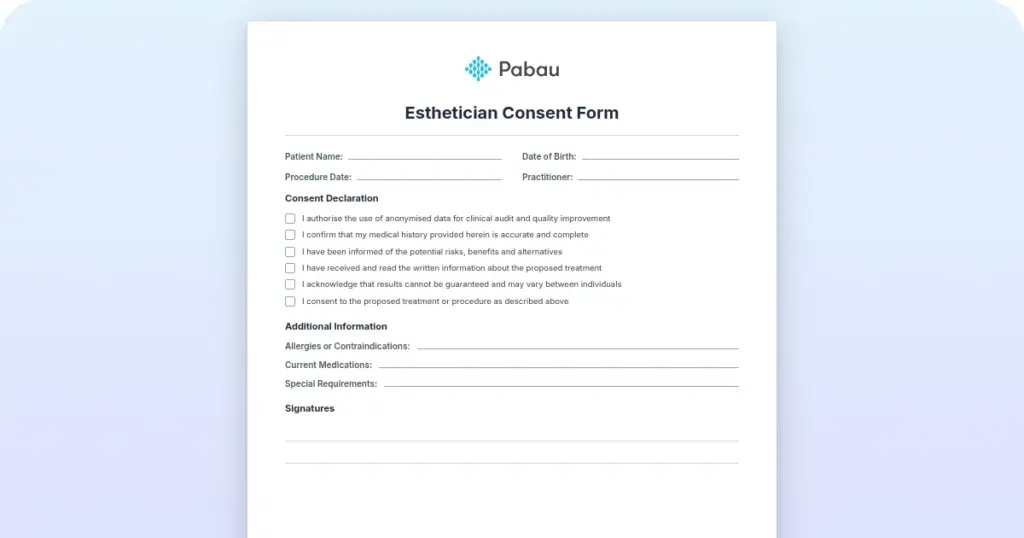
Cytocare consent form
Cytocare is a hyaluronic acid-based mesotherapy skin booster from Revitacare, in...

1
Last Updated: Oct 27, 2026

A nurse practitioner with full practice authority can own a med spa outright in states like Oregon, Colorado, and Washington.
A registered nurse in a corporate practice of medicine state usually needs an MSO structure and a physician medical director.
Your state Board of Nursing is the first call you make, before you form an entity or sign a lease.
Startup costs typically run from $100,000 to $500,000, and a medical director adds $12,000 to $60,000 in year one.
Practice management software like Pabau handles scheduling, consent forms, and client records from your first booking.
Learning how to open a med spa as a nurse starts with a question that is not about injectables at all. What does your state let you own? Your credential answers half of that, and your state’s corporate practice of medicine rules answer the rest.
Get the pairing wrong and you can sink $200,000 into a practice you cannot legally hold. Line it up correctly, and the launch turns into a sequence you can work through in order.
This guide walks that sequence, from your first call to the Board of Nursing through to your first booked client. New or solo med spas have their own pick in our ranking of the best med spa platforms.
Yes. Nurses own med spas in every state. What you can hold in your own name, though, comes down to your credential and your state’s rules.
In full practice authority states, nurse practitioners can own and run a med spa without a physician involved. In restricted or supervised practice states, even an NP needs a collaborating physician.
Registered nurses face the tightest limits. In most states the corporate practice of medicine doctrine, known as CPOM, stops an RN from owning the medical side of a practice outright.
The National Council of State Boards of Nursing (NCSBN) keeps the current map of practice authority by state. Check it before you spend a dollar. Those two questions, taken together, land you in one of four positions.
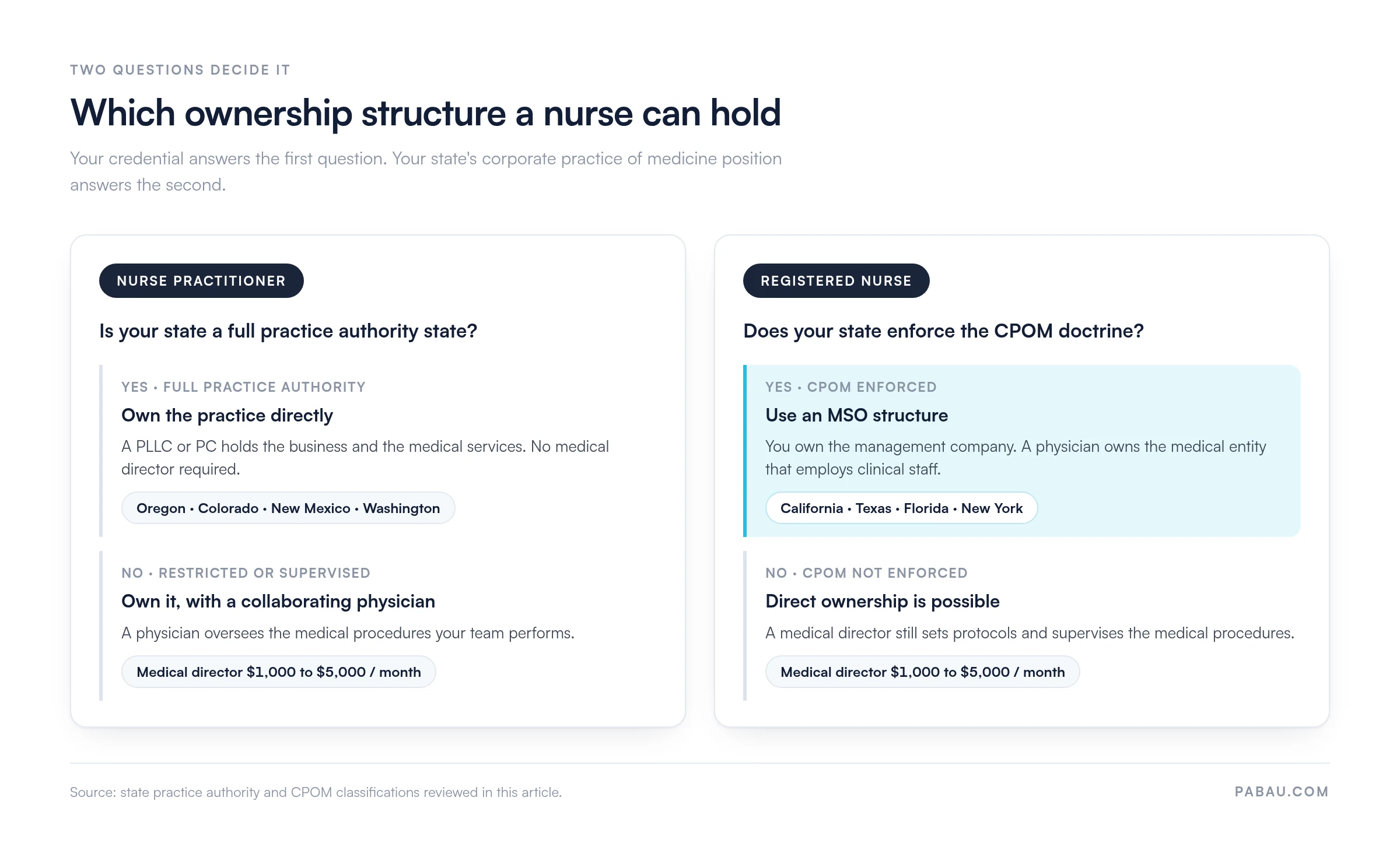
The RN and NP paths diverge early, and they stay apart. The table below shows where they split.
If you are an RN, the management services organization route is the one to understand first. Read how MSOs for med spas are put together before you call a healthcare attorney. The model is legitimate and widely used, and it needs careful setup to hold up.
State law is the biggest single variable in nurse-owned ownership. The American Med Spa Association (AmSpa) tracks these rules and publishes compliance resources. Here is how a sample of states divides.
Worth flagging: these classifications change, and several states have loosened NP rules in recent years. Verify your own state with the Board of Nursing and a healthcare attorney before you form an entity. In Texas, no nursing license lets you own the clinical entity, so our guide to Texas nurse ownership rules covers the MSO route.
In restricted practice states, a licensed physician has to serve as your medical director. The role goes well past a signature. Your medical director sets treatment protocols, reviews complications, and carries meaningful liability for the practice.
Read the guide on how to hire a medical director before you start outreach. The contract terms matter as much as the physician you pick.
Once your legal position is clear, the launch follows a predictable order. Here are the 10 steps, in the sequence that saves the most money.
Contact your state Board of Nursing directly and confirm whether you practice under full, restricted, or supervised authority. Then ask whether the state enforces CPOM. Those two answers set your ownership structure and tell you whether you need a medical director before your first patient.
A nursing license alone does not qualify you to perform aesthetic procedures. You will need hands-on injectables training, laser certification where your state requires it, and a course from a recognized aesthetics program. Credentials matter for your insurance premium, for patient trust, and for whether a physician agrees to supervise you.
In full practice authority states, NPs can usually form a professional limited liability company (PLLC) or professional corporation (PC). That single entity holds both the business and the medical services. In CPOM states, the standard route is the MSO: you own the management company, and a physician owns the medical entity that employs clinical staff. A healthcare attorney is not optional at this stage.
A med spa business plan covers six pieces:
Lenders and investors ask for the document before they talk numbers. Writing it also forces you to price your menu against your product cost per treatment.
Med spa startups are capital-intensive, and the money needs to be committed before the lease is. Common sources include SBA 7(a) loans, equipment financing from device manufacturers, and healthcare-specific lenders.
Personal savings and outside investors round out most launches. The SBA’s loan programs page lists the eligibility rules.
The permits you need depend on your state and your service mix. You may still be weighing whether your license lets you hold the facility.
Our guide to med spa ownership rules covers that eligibility question. Core permits usually include:
Location drives almost every other cost in your model. A 1,200 to 2,000 square foot suite in a professional medical building is a common starting point.
Core equipment covers an injectables workstation, treatment beds, a laser or IPL device if you offer light-based services, and refrigeration for biologics.
Leasing a laser usually makes more sense than buying one in year one. It keeps your capital free while you learn which services sell. Budget separately for fit-out, signage, and a medical waste disposal contract.
A solo nurse-owned med spa usually opens with the owner as the main injector, one esthetician, and a part-time front desk coordinator. Licensed practitioners and support staff come later, once your calendar justifies them.
Every clinical hire needs their own malpractice coverage on top of the practice’s general liability policy. Check each license number on the state board site before that person sees a patient, and diary the renewal date.
This is the step most nurses postpone until the paperwork piles up. Practice management software like Pabau covers the four systems a nurse-owned practice needs immediately:
Purpose-built medical spa software handles that mix in one place. A generic booking tool handles only the calendar.
Still comparing options? Our roundup of med spa EMR software walks through what to check before you commit to a platform.
HIPAA is where new owners often trip up. A practice becomes a HIPAA covered entity when it transmits health information electronically for a covered transaction, such as filing an insurance claim.
A cash-pay med spa that never bills electronically may fall outside that definition. The U.S. Department of Health and Human Services sets out the tests. State privacy law and patient expectations still apply either way, so most owners run HIPAA-grade systems from the start.
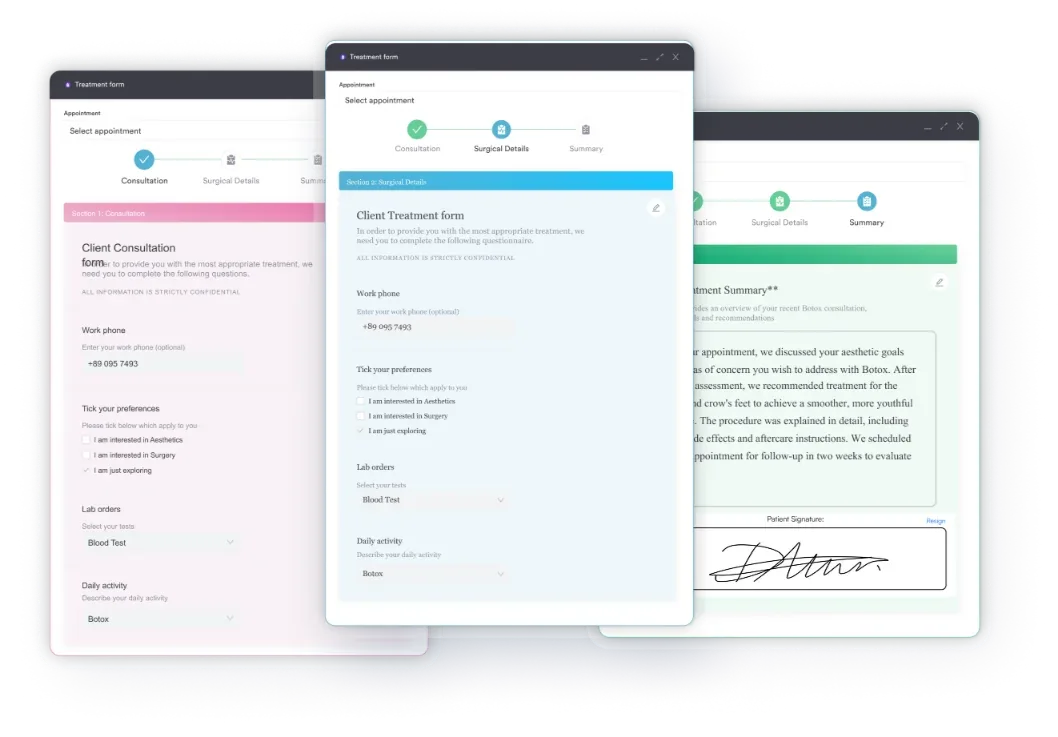
Configure your software before your first client, not after. Setting up consent forms, booking, and client records early saves weeks of retroactive data migration. It also keeps your compliance documentation clean from the very first appointment.
Pre-launch marketing should start 60 to 90 days before you open the doors. Claim and fill out your Google Business Profile first, because local search is where most first-time med spa clients begin.
Build an Instagram presence with educational posts about the services you will offer. Then set up referral relationships with dermatologists, OBGYNs, and plastic surgeons nearby.
Startup costs swing widely with your market, your square footage, and your service mix. The table below shows typical ranges for a small to mid-sized practice.
Most nurse-owned launches land between $100,000 and $500,000, depending on location, service scope, and whether you lease or buy equipment. Present these to a lender as working ranges rather than fixed estimates, and show the assumptions behind each line.
Insurance is where first-time owners underfund most often. Four policies are essential for any nurse-owned med spa.
Ask each carrier, in writing, whether your service menu is covered device by device. A policy that excludes the laser you just leased is worse than no policy, because you will not find out until a claim.
The same problems come up again and again in a first year. Work through this list in the last month before you open.
The costliest mistake here is opening on a verbal understanding with a medical director. Put the scope, the availability, and the liability split in a signed agreement before your first booking.
A new nurse-owned practice generates paperwork faster than most owners expect. Consent forms, pre and aftercare instructions, treatment notes, staff hours, and rebooking all arrive at once.
Handled on paper or across three separate apps, that work quietly eats the evenings you meant to spend on marketing.
Pabau keeps those pieces in one client record. Clients book online and get their reminders automatically. Consent forms go out ahead of the appointment and come back signed, so you are not chasing a signature in the treatment room.
Photos, treatment notes, and injection plotting attach to the same record, and staff hours and commissions run from the same system.
For a solo owner, that means starting the day with a full calendar and finishing it without a stack of forms to file. Every Pabau subscription includes every feature, so your setup does not need rebuilding when you add a second injector.

Pabau handles scheduling, HIPAA-compliant client records, digital consent forms, and staff management, so your opening weeks go on patients instead of paperwork.

The legal side is what decides whether a nurse-owned med spa works, and it gets settled before you treat anyone. Your credential and your state’s CPOM position set the structure. That structure then sets your costs, your medical director bill, and how much of the practice you genuinely own.
So make the calls in order: Board of Nursing, healthcare attorney, entity, lease. Doing it in the other direction forces expensive restructuring in year two. That usually lands right when the practice finally has money worth protecting.
The clinical skill is already yours. The rest is sequence and paperwork, and both get easier with the right system underneath them. Book a demo to see how Pabau runs booking, consent, and client records for a new med spa from opening day.

Working out California’s rules? Can a nurse open a med spa in California covers CPOM enforcement there and what RNs and NPs can each do.
Ready to write the business plan? Medical aesthetics business plan gives you a framework for projections, service menus, and competitive positioning.
Budgeting the launch line by line? How much does it cost to open a med spa breaks the startup budget down in detail.
Unsure where HIPAA applies to you? Do med spas have to be HIPAA compliant explains which practices are covered and what that means day to day.
Opening day getting close? Med spa compliance checklist runs from OSHA requirements through to consent documentation standards.
Plan for six to twelve months from your first Board of Nursing call to opening day. Entity formation and licensing usually take four to eight weeks. A build-out adds several months on top. Order laser or IPL devices early, because lead times are often long.
Yes, and most owners do at first. Check your employment contract for non-compete and outside-practice clauses, especially if your employer runs its own aesthetics service. Tell your malpractice carrier about both roles. Many nurses stay employed until the practice can cover their salary.
A prescriber has to order them. That means a nurse practitioner with prescriptive authority, a physician, or your medical director. An RN cannot order botulinum toxin or dermal fillers independently in most states. Distributors ask for the prescriber’s license details before opening an account.
In reduced and restricted practice states, a nurse practitioner often needs both. The collaborative agreement covers your own clinical scope. The medical director agreement covers the facility and the staff you supervise. They are separate documents, and an inspector may ask to see each one.