Ethical consent form: free template and what to add
An ethical consent form is a written record that a patient or participant agreed...

3
Last Updated: Oct 26, 2026

A good faith exam (GFE) is a formal medical evaluation by a licensed provider, required before prescription aesthetic treatments like injectables.
Three triggers require a GFE: a new patient, a new treatment category, and a significant change in health status.
RNs and estheticians cannot perform GFEs. The exam has to come from a physician, NP, or PA.
A telehealth GFE is valid in most states, provided the provider is licensed where the patient is.
Practice management software like Pabau keeps GFE documentation, consent, and patient history in one audit-ready record.
A good faith exam is the medical evaluation that has to happen before a med spa administers injectables. It is what makes the treatment lawful, and it is the first record a state board asks to see. Without one, the practice is exposed to license action, malpractice claims, and a board investigation. Before choosing where to store exam records, see what our comparison of medical spa systems says about HIPAA compliance and injection charting.
This guide covers what a GFE is, when you need one, who can perform it, and how to keep the documentation audit-ready. The detail maps to what state boards check, whether you are opening a first location or tightening an existing process.
A good faith exam is a formal medical evaluation performed by a licensed healthcare provider before a patient receives a prescription aesthetic treatment. A sales consultation does not count, and neither does a quick intake chat. The provider has to reach a clinical judgment on whether this patient is suitable for the treatment requested.
The American Med Spa Association (AmSpa) defines a GFE as a medical evaluation completed before a patient receives a treatment for the first time. Once that exam is on file, you do not repeat it at every visit. That holds as long as the patient’s health status and treatment category stay the same.
The distinction from a general consultation matters legally. A consultation is advisory. A GFE creates a documented clinical record that a licensed provider assessed the patient and found them eligible for a specific treatment. Without one, administering prescription injectables puts the practice outside the law in most states.
Neurotoxins and dermal fillers are prescription drugs. Administering them without medical oversight creates regulatory exposure for the whole business. Your med spa compliance checklist should treat the GFE as a gatekeeping step rather than an optional add-on.
Three legal rationales drive the requirement:
Penalties range from fines and corrective action plans to license revocation and criminal exposure, depending on the state. Civil liability runs on its own track. A lawsuit can move forward while a medical board investigation is still open.
A GFE does not reset at every appointment. It triggers on three clinical events. Knowing the difference saves your team unnecessary friction and keeps you covered on the visits that matter.
The health status change trigger is where practices get caught out. A returning patient who started a blood thinner since their last visit needs a fresh GFE before their next filler appointment. So does a patient newly diagnosed with a coagulation disorder, even after a dozen identical treatments.
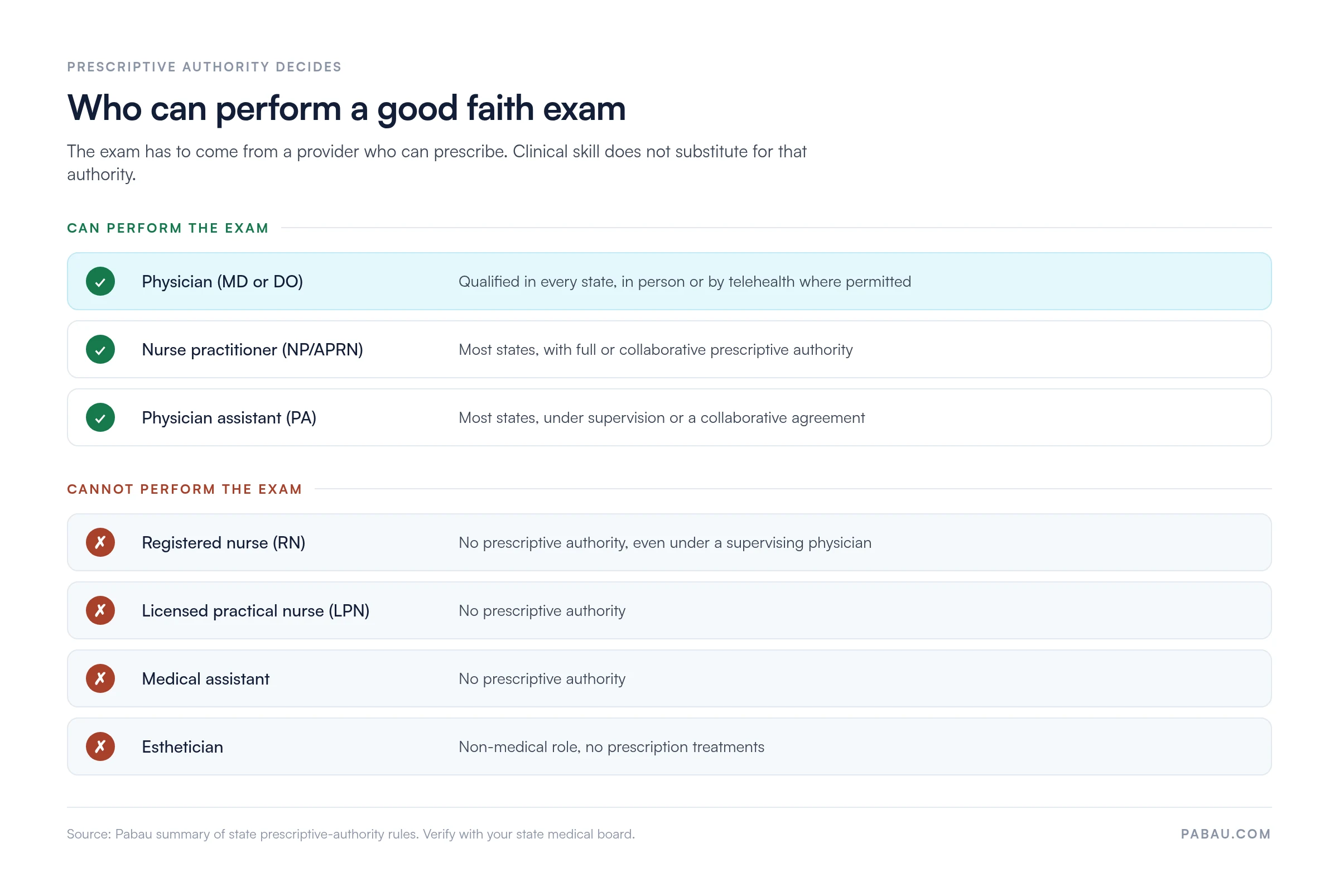
A GFE has to be performed by a provider who holds prescriptive authority. In most states that means a physician, a nurse practitioner, or a physician assistant. That rules out a large share of the staff you might expect to handle it.
Qualified providers in most states include:
Registered nurses, licensed practical nurses, medical assistants, and estheticians cannot perform a GFE. These roles carry no prescriptive authority, however skilled the clinician is. Delegating the exam to them under a supervising physician’s name creates a false record and multiplies your legal exposure.
The split between those two groups is worth pinning to the schedule before anyone books a first-time injectable patient.
For practices without a physician on staff, hiring a medical director is the standard fix. Your medical director can perform GFEs directly, or supervise the NPs and PAs who carry them out, depending on state rules.
A complete GFE for aesthetic treatments covers six clinical areas. Each one produces documentation that goes into the patient record. Leave one out and an attorney or state investigator will find it.
Most GFEs run 7 to 15 minutes once the intake form has done the groundwork. That is a small time cost against the protection the record gives you.
State rules vary considerably, so the table below covers the largest med spa markets. Always verify against your state medical board and current Nurse Practice Act before you make staffing or workflow decisions.
California and Texas have both revised their rules in recent years. Check the current California med spa licensing position before you rely on any general summary.
All state requirements are subject to change. The American Med Spa Association publishes state-specific compliance updates and is the most reliable ongoing resource for regulatory changes.
Most states now permit a virtual good faith exam when specific conditions are met. No state bans them outright, though the conditions vary considerably. That makes telehealth a practical way to run a pre-visit assessment without an in-person appointment.
Pabau supports telehealth consultations that capture GFE data directly in the patient record. The documentation from a virtual assessment then sits in the same system as the treatment record, which keeps the audit trail intact.
Core conditions that make a telehealth GFE valid in most states:
Two shortcuts get practices into trouble. The first is using asynchronous messaging, by text or email, in place of a live evaluation. The second is a provider in one state evaluating a patient in a state where they hold no license. State boards treat both as non-compliance.
Flag telehealth GFEs in the patient record with the provider’s state license number and the platform used. If a state board audits your files, that detail confirms the exam met licensure requirements without a follow-up request.
A GFE that was not documented did not happen. State boards treat a missing record as a compliance failure, whether or not the exam took place. GFE records have to be stored securely and retained for the period your state mandates, typically five to seven years. Some states require longer retention for records involving minors.
Required documentation for every GFE:
Digital intake forms that feed straight into the clinical record remove the transcription errors and filing delays behind most missing documentation. A structured form also stops a provider improvising fields under time pressure. Our med spa consultation form gives you a layout you can adapt.

Med spas that bypass the GFE face more than administrative penalties. The consequences run on several legal tracks at once, and they escalate quickly once a complaint is filed.
Business structure matters here too. In a management service organization (MSO) arrangement, business management sits apart from clinical operations. Both entities can face consequences, so GFE duties have to be assigned and executed on the clinical side.
Tracking which patients need a GFE, chasing paper forms, and keeping a compliant record across a busy schedule adds administrative load. That load scales badly once you are running several providers or more than one location.
Pabau’s medical spa software handles GFE documentation inside the standard patient intake workflow. You do not have to remember to open a second system.
When a new patient books, the intake sequence collects medical history, medications, allergies, and consent before they arrive. The provider reviews and signs that record during the exam itself.
Key workflow advantages for GFE compliance:
Compliance tools built into your practice management system keep GFE documentation attached to the treatment record. There is no export step, no separate folder, and no lag between the exam and the record. That single-system approach is what makes an audit manageable.

Pabau automates new patient intake, captures GFE documentation, stores provider credentials, and creates a timestamped audit trail. Book a demo to see how it works for your med spa.

The exam itself runs 7 to 15 minutes. The record behind it is what protects your license, your medical director’s credentials, and the business when a complaint lands.
If your GFE process lives in a paper folder or a separate app, move it. The change that pays for itself is keeping the exam record in the same place as the treatment record. State rules will keep shifting, and a single system absorbs that better than a filing cabinet.
Pabau’s digital forms and automated intake keep GFE documentation alongside every other patient record, so nothing is missing when an inspector asks. Book a demo to see how that fits your own workflow and state rules.

Need a compliance checklist for the whole operation? Medical spa compliance checklist covers the wider regulatory picture beyond the good faith exam.
Not sure how HIPAA applies to a med spa? Do med spas have to be HIPAA compliant explains which records fall under the rules and how long to keep them.
Working out who owns clinical decisions in an MSO? MSO for med spas sets out how the business and clinical sides divide responsibility.
Operating in Texas? Texas med spa licensing laws covers supervision, delegation, and the state-specific paperwork.
Planning to open a med spa or add a location? How to start a med spa covers licensing, staffing, and compliance setup from day one.
A good faith exam (GFE) is a formal medical evaluation performed by a licensed healthcare provider before a patient receives a prescription aesthetic treatment. It documents the patient’s medical history, current medications, allergies, and clinical eligibility for the requested treatment. It is legally distinct from a general consultation and is required under state medical regulations governing prescription drug administration.
In most states, physicians (MD or DO), nurse practitioners (NP/APRN), and physician assistants (PA) can perform good faith exams. Their prescriptive authority under state law is what decides it. Registered nurses, estheticians, and medical assistants cannot perform GFEs. The exact provider types permitted vary by state, so always verify against your state’s current Nurse Practice Act and medical board guidance.
Required documentation includes the provider’s credentials and license number, plus the patient’s signed medical history and medication list. You also need allergy screening notes, a contraindication assessment, signed informed consent, a treatment plan summary, and the provider’s dated signature. Electronic records with tamper-evident audit trails satisfy documentation requirements in most states.
Skipping a GFE exposes the med spa to a state medical board investigation, license suspension or revocation, and civil malpractice liability. Some states also treat it as criminal unlicensed practice of medicine. Consequences can affect both the business entity and the individual medical director or supervising physician personally.