Facial skin treatment consent form template: Microneedling and phi-ion
A facial skin treatment consent form is the signed proof that a patient was scre...

2
Last Updated: Oct 21, 2026

Your emirate picks your regulator: DHA licenses Dubai, MOHAP the northern emirates, and DoH Abu Dhabi.
Setting up inside Dubai Healthcare City moves you from DHA to DHCR, the zone’s own health regulator.
DHA’s published first-year licensing fees reach AED 12,200 for a specialty clinic with one physician.
Only a trained, privileged licensed physician may administer botulinum toxin or dermal fillers under the DHA standard.
Budget four to six months end to end, because fit-out and staff licensing outlast the license decisions.
How to open an aesthetic clinic in Dubai runs in a fixed order, from picking your regulator to passing a final inspection. The Dubai Health Authority, known as DHA, licenses clinics on the Dubai mainland. Inside Dubai Healthcare City, however, a different regulator does that job. In short, that one fork changes your fees, your premises and your paperwork. With the regulator settled, our list of med spa software can help you compare payment and scheduling tools across eight platforms.
In fact, the published numbers are smaller than most setup articles suggest. DHA’s Sheryan service catalogue puts first-year facility fees for a specialty clinic at AED 9,000. Add one physician’s professional license and you reach AED 12,200. Instead, the premises, the fit-out and the equipment are where the money actually goes, and no authority publishes a rate for those.
Demand is not the constraint. Dubai welcomed 691,478 international health tourists in 2023, and they spent more than AED 1.03 billion on treatment, according to a DHA report. Dermatology, for instance, ranked among the most popular categories. Instead, the hard part is regulatory.
Across the UAE practices we onboard, one detail catches new owners by surprise. Specifically, they budget carefully for the facility license, then discover that every injector needs a separate license before the doors can open.
The regulator follows your emirate, not your business type: DHA licenses Dubai, MOHAP the northern emirates, and DoH Abu Dhabi. As a result, each one runs its own facility-licensing process, its own inspection, and its own professional register.
MOHAP, the Ministry of Health and Prevention, covers Ajman, Umm Al Quwain, Ras Al Khaimah, Fujairah and Sharjah. However, Sharjah is the exception worth knowing about, because the Sharjah Health Authority now issues its own licenses alongside MOHAP.
Licenses do not travel. A physician licensed by MOHAP cannot treat patients in a DHA-licensed practice without applying to DHA, and the same holds in reverse. Therefore, plan the hire and the license together, not one after the other.
Setup guides throw these acronyms around without defining them in one place. Instead, here is the full set, and what each body decides for you.
| Acronym | Full name | What it decides for your clinic |
|---|---|---|
| DHA | Dubai Health Authority | Facility and professional licenses on the Dubai mainland |
| DHCR | Dubai Healthcare City Authority – Regulation | Clinical licensing inside Dubai Healthcare City |
| MOHAP | Ministry of Health and Prevention | Facility and professional licenses in the northern emirates |
| SHA | Sharjah Health Authority | Licensing in Sharjah, including Sharjah Healthcare City |
| DoH | Department of Health – Abu Dhabi | All healthcare services in the emirate of Abu Dhabi |
| DET | Department of Economy and Tourism, Dubai | Your trade name and trade license, and formerly called DED |
| NABIDH | Dubai’s health information exchange | The records connection DHA checks during your application |
A mainland DHA license lets you treat patients anywhere in Dubai, while a Dubai Healthcare City license confines your premises to the zone. In short, that is the trade-off at the heart of clinic setup in Dubai, and it is a property decision as much as a regulatory one.
Ownership used to settle the argument. It no longer does. Federal Decree-Law No. 26 of 2020, consolidated into Federal Decree-Law No. 32 of 2021, removed the majority-Emirati ownership requirement for most mainland activities. As a result, Dubai’s DET positive list runs to more than 1,000 activities and includes healthcare.
So both routes can be fully foreign-owned. What differs is who regulates you, where you may sit, and how much you pay every year. Instead, aesthetic practices in Dubai Healthcare City license with DHCR and follow DHCR’s own standards, which the zone publishes separately from DHA’s.
The DHA licensing manual sets out no conversion route between the two. Moving from the mainland into Dubai Healthcare City, or back out, means a fresh application to the receiving regulator. Therefore, choose deliberately, because switching later is not an amendment.
Cross the three regulators against the two structures and the whole picture fits in one grid. In short, we call it the UAE clinic licensing matrix.

The same matrix, with the ownership and premises columns spelled out, reads like this.
| Emirate | Mainland route | Free-zone route | Foreign ownership | Where your premises may sit |
|---|---|---|---|---|
| Dubai | DET trade license, then a DHA facility license | DHCR commercial license plus a clinical operating permit | Full foreign ownership on both routes | Anywhere in Dubai on the mainland route, inside the zone on the free-zone route |
| Northern emirates | Emirate trade license, then a MOHAP facility license | Sharjah Healthcare City licenses through SHA | Full foreign ownership on the emirate’s positive list | Anywhere in the emirate, or inside the zone you join |
| Abu Dhabi | ADDED trade license, then a DoH facility license | DoH still licenses the facility, whatever the company form | Full foreign ownership on the ADDED positive list | Anywhere in the emirate, subject to DoH layout approval |
Whichever route you pick, the document set is similar. First, you reserve a trade name, sign a lease and register it, prepare a memorandum of association, and file a layout drawing for approval. The health authority wants the premises documents before it will look at the clinical application.
Only a trained and privileged licensed physician may administer botulinum toxin or dermal fillers in Dubai. The DHA Standards for Non-Surgical Cosmetic Procedures settle it. Specifically, version 2.1 took effect on February 18, 2025.
That standard classifies cosmetic botulinum toxin and fillers as prescription-only medicines. It then sets out who may do what, role by role.
Energy devices sit inside the same standard. HIFU, radiofrequency microneedling and PRP are not a lighter category with lighter rules. Instead, build your treatment menu against the supervision requirements, not against your training certificates.
One claim circulating online is wrong. Forum threads and consultancy pages often say DHA demands three years of experience and a case log. In fact, DHA’s new professional license service page states no minimum years of experience. Instead, what it does require is DataFlow primary-source verification, plus a Prometric assessment where the category calls for one.
You also need a medical director on file. Appoint one early, because DHA checks the appointment before it will activate the facility license. Professional licenses filed under an inactive facility license activate with it, so the paperwork can run in parallel.
DHA’s published first-year licensing fees reach AED 12,200 for a specialty clinic staffed by one physician. Notably, every figure in that total comes from DHA’s Sheryan service catalogue, and every large number in a clinic budget sits outside it.
The government’s bill is small, knowable and published. In contrast, the premises, the fit-out and the equipment are neither published nor predictable. That is why quoted totals for a Dubai clinic swing so wildly from one setup article to the next.
| Cost line | Published figure, AED | Who publishes it |
|---|---|---|
| DET trade license, mainland Dubai | Calculated per application | Dubai DET |
| DHA new facility license, initial approval | 1,000 | DHA Sheryan catalogue |
| DHA facility license issue, specialty clinic, one year | 6,000 | DHA Sheryan catalogue |
| DHA final inspection | 2,000 | DHA Sheryan catalogue |
| Physician professional license, one year | 3,000 plus 200 credentialing | DHA Sheryan catalogue |
| First-year DHA licensing, one clinic and one physician | 12,200 | Sum of the four DHA lines above |
| Nurse professional license, one year | 1,000 | DHA Sheryan catalogue |
| DHCC commercial license, instead of the mainland route | 15,000 a year | DHCR price list |
| DHCC single-specialty clinical operating permit | 6,500 a year | DHCR price list |
| Premises, fit-out, equipment and working capital | No published rate | No authority publishes one |
A general clinic license costs AED 5,000 rather than AED 6,000, which brings the same total to AED 11,200. A specialty clinic is the usual classification for an aesthetic practice, so plan on the higher line. The UAE clinic licensing matrix above shows how these lines change inside Dubai Healthcare City.
These fees recur. DHA licenses run for one year, the renewal window opens 90 days before expiry, and a late renewal carries a monthly penalty. Therefore, put the renewal date in the calendar on the day the license activates.
The AED 50,000 question comes up constantly, and the arithmetic answers it cleanly. AED 50,000 covers your DHA licensing four times over. However, it does not cover a lease, a compliant fit-out, a laser platform, or a licensed physician’s salary. Writing a medical aesthetics business plan before you commit to premises is the cheapest hour you will spend.
Seven steps, in order, and roughly four to six months from trade name to opening day. DHA’s own service windows are measured in days, so the calendar goes on premises, fit-out and staff verification instead.
Only two of those seven steps carry a published DHA turnaround, and both are counted in working days. Instead, the rest of the calendar belongs to your landlord, your contractor and your practitioners’ paperwork.

Two stages commonly run long. DataFlow verification depends on how fast your practitioners’ training institutions answer, which is outside anyone’s control. Meanwhile, fit-out approval depends on drawings that meet the facility standard first time.
Our sibling guide to the aesthetic clinic license Dubai route goes deeper on the mainland application itself, stage by stage.
Five obligations sit outside the facility license and can still stop you opening. Notably, none of them appears on a licensing checklist, and all five have lead times.
Most first-time owners hand the submissions to a healthcare consultancy in Dubai or a PRO service. However, a consultancy buys speed rather than certainty. The fee is worth paying if the Arabic paperwork and the DataFlow chasing would otherwise sit on your desk.
Nevertheless, keep the compliance calendar yourself. Renewals, insurance certificates and practitioner license expiries are the items a consultancy stops tracking the moment its engagement ends.
A DHA inspection looks at your records, not just your rooms. Specifically, for injectables that means a signed consent, the product and batch number, before-and-after photos, and the practitioner’s note. On paper those live in four places, and an inspector asks for all four.
Practice management software like Pabau puts them on one client timeline. For example, Pabau’s digital consent forms capture a signature and a timestamp before treatment starts. Injection plotting records what went where, and the batch number sits against the treatment note rather than in a separate stock book.
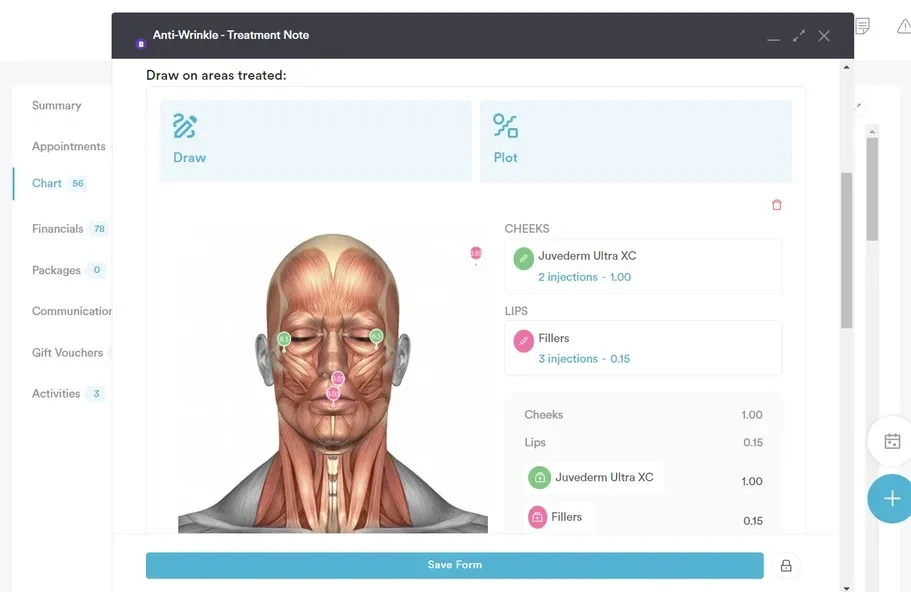
Online booking matters more in Dubai than in most markets, because a large share of aesthetic demand arrives from outside the emirate. Patients book, complete medical questionnaires and sign consents before they land, so the first appointment starts as treatment rather than admin.
Overall, Pabau also scales across locations, which matters if you open on the mainland and later add a site in a free zone. Two locations, two regulators, one client database and one set of reports. Every Pabau subscription includes every feature, so growth changes your user count rather than your plan. If you are still shortlisting, our roundup of the best aesthetic clinic software compares the options side by side.

Pabau puts digital consent, injection plotting, batch numbers and before-and-after photos on one client timeline. Your team stops assembling records for a DHA inspection, because the record was complete when the treatment ended.

Settle the regulator and the structure before you look at a single unit of commercial space. Indeed, that decision sets your fees, your annual renewals, your catchment and your standards, and the DHA manual gives you no cheap way to reverse it.
Then treat the AED 12,200 as the easy part. Licensing is the predictable line in this budget. In contrast, premises, fit-out and the wait on DataFlow verification are what decide whether you open in month four or month nine.
The trade-off worth remembering is scope against reach. Dubai Healthcare City buys you a healthcare-specific environment and a fixed address, and the mainland buys you the whole emirate. Therefore, pick the one that matches the patients you actually want. Book a demo to see how Pabau keeps consent, photos and batch numbers inspection-ready from day one. Our software for med spas also handles a second location when you add one.

What does an aesthetic practice have to document? Med spa compliance sets out the records an inspector expects to find.
Still deciding on your treatment menu? Trending Botox and filler treatments covers what patients are asking for now.
Opening in the US instead? Who can open a medical spa explains the state-by-state ownership rules.
Need patients from day one? Medical aesthetics marketing turns a launch date into a booked calendar.
Comparing records systems? Aesthetic EMR software explains what an aesthetics-specific record needs to hold.
Pick your emirate, which picks your regulator. On the Dubai mainland that is DHA. First, reserve a trade name with DET, file the new facility license application, and take the inactive license to a landlord. Fit out to the facility standard, license your practitioners, appoint a medical director, then pass the final inspection and activate.
DHA’s published licensing fees reach AED 12,200 in year one for a specialty clinic with one physician. The total covers initial approval, license issue, final inspection and the physician’s professional license. However, premises, fit-out, equipment and working capital sit outside it, and no authority publishes a rate for those lines.
A licensed physician with documented training and privileges for the procedure. The DHA Standards for Non-Surgical Cosmetic Procedures restrict cosmetic botulinum toxin and fillers to a trained, privileged physician. In addition, nurses need documented training and supervision by a dermatologist or plastic surgeon. Liposuction is restricted to a plastic surgeon in a hospital or day surgical center.
Not a licensed medical aesthetic clinic. AED 50,000 covers DHA’s published first-year licensing several times over. However, the lease, the fit-out, a laser platform and a physician’s salary all sit outside it. That budget suits a small non-medical service business or a free-zone company formation package instead.
A beauty salon or cosmetology center runs on a DET trade license alone, with no health-authority facility license. A salon may offer facials, waxing and non-medical skincare. A salon may not inject or run medical lasers, because DHA classifies cosmetic botulinum toxin and fillers as prescription-only medicines. Therefore, add treatments like those and you need a DHA facility license.