Nursing narrative note template
A nursing narrative note template is a structured PDF that guides you through re...

2
Last Updated: Oct 21, 2026
A risk for fall nursing care plan records why a patient might fall and what the team is doing about it. It links the NANDA-I diagnosis “Risk for Falls” to a scored assessment, measurable goals, and one intervention for each risk factor found. Each intervention carries a short rationale, so any nurse can see why it’s there.
That link matters more than the paperwork. A score plus a generic checklist doesn’t tell the next shift which hazard to watch, and it won’t hold up in an audit. The sections below cover scoring, goals, interventions and a worked patient example, then hand you a free template.
A printable plan with sections for patient details, a Morse Fall Scale score, goals, interventions, environmental changes, monitoring, and patient and family education. Space for follow-up dates and care team notes closes the form.
Download template
A risk for fall nursing care plan links the NANDA-I diagnosis to a scored assessment, goals, interventions and rationale.
Risk for Falls is a risk diagnosis, so it rests on risk factors and at-risk populations rather than related factors.
Score with one validated tool, such as the Morse Fall Scale, then confirm the result at the bedside.
Write goals the next shift can observe, and give every intervention a reason tied to a finding.
Reassess after any fall, transfer or change in condition, and update the plan the same shift.
A fall risk care plan is the documented plan a nurse builds once a patient is identified as at risk of falling. It connects the NANDA-I diagnosis “Risk for Falls” to the assessment findings, outcomes and interventions that address that risk.
Its main job is handover. A nurse picking up the patient should be able to read the plan and find three answers in under a minute:
A diagnosis recorded on its own tells the next nurse what the risk is. It doesn’t say what has been done about it, or why. Linking each intervention to a stated rationale makes the plan clear at handover and defensible during audit.
The NANDA-I nursing diagnosis “Risk for Falls” describes a patient who is vulnerable to falling. In the current NANDA-I taxonomy, the diagnosis is defined by risk factors and identifies at-risk populations, which the nurse confirms against the patient’s own presentation.
Because it’s a risk diagnosis, it has no defining characteristics. It describes susceptibility to an event that hasn’t happened yet. Recent NANDA-I editions also list an age-specific label, Risk for adult falls (00303), so check which label your organization’s system uses.
If you write plans for several diagnoses, a nursing diagnosis handbook keeps the labels and wording consistent from one plan to the next.
A fall risk assessment starts with a validated tool and is completed with clinical observation. The Morse Fall Scale is the tool most often cited in hospital settings. AHRQ’s Preventing Falls in Hospitals toolkit includes the Morse Fall Scale as an example assessment tool.
The Morse Fall Scale scores six items. Add the points together and record the total in the care plan.
Totals run from 0 to 125. A common banding treats 0 to 24 as no risk, 25 to 50 as low risk, and 51 or more as high risk. Record the band your local policy uses, because thresholds vary between organizations.
The Hendrich II Fall Risk Model is another validated option used in acute care. It includes a Get-Up-and-Go test and weights certain medication classes. Peer-reviewed comparisons suggest performance varies by population. So choose the tool your unit has adopted, and use it consistently for the same patient.
Then look at the patient. A score can’t see a wet floor, worn slippers, or a patient who won’t use the call bell. Note those findings beside the score.
Risk factors fall into two groups. Intrinsic factors come from the patient. Extrinsic factors come from the environment and the care setting.
Orthostatic hypotension deserves a specific check. Measure lying and standing blood pressure where the patient’s condition allows, and record any symptoms on standing.
For polypharmacy, work from the current medication administration record, not the admission list. Sedatives, blood pressure drugs and diuretics started since admission won’t appear on the older list.
Goals should describe what the patient will do, or what will be observed, with a timeframe. Short-term goals usually cover the first shift or first days. Long-term goals cover the admission or episode of care.
Test each goal with one question. Could a nurse on the next shift mark it as met or not met? “Patient will be safe” fails that test. “Patient uses the walker for every trip to the bathroom” passes.
Standard outcome labels help here too. The nursing outcomes classification includes Fall Prevention Behavior, which gives your goals a shared, measurable name.
Interventions should match the risk factors identified in the assessment. A generic list applied to every patient adds paperwork without reducing risk. Select the interventions that address the specific findings, and record why each one was chosen.
Teach the patient to call for help before standing, to report dizziness, and to use safe transfer techniques. Involve family members in discharge planning, particularly where the home carries its own hazards.
Then ask the patient to explain the plan back to you. Teach-back shows whether the message landed, which a signed leaflet can’t.
Here’s how the pieces connect for one illustrative patient. An 82-year-old woman is admitted with pneumonia and has a saline lock in place. She uses a walker, takes six regular medications, and tried to walk to the bathroom alone last night.
Her Morse total is 75. Her secondary diagnosis and walker score 15 each, and the saline lock adds 20. Weak gait adds 10, and forgetting her limitations adds 15. She hasn’t fallen, so history scores 0.
A score of 75 puts her in the high-risk band. Her blood pressure also drops when she stands. Each finding now gets its own intervention and a one-line reason, as the map below shows.
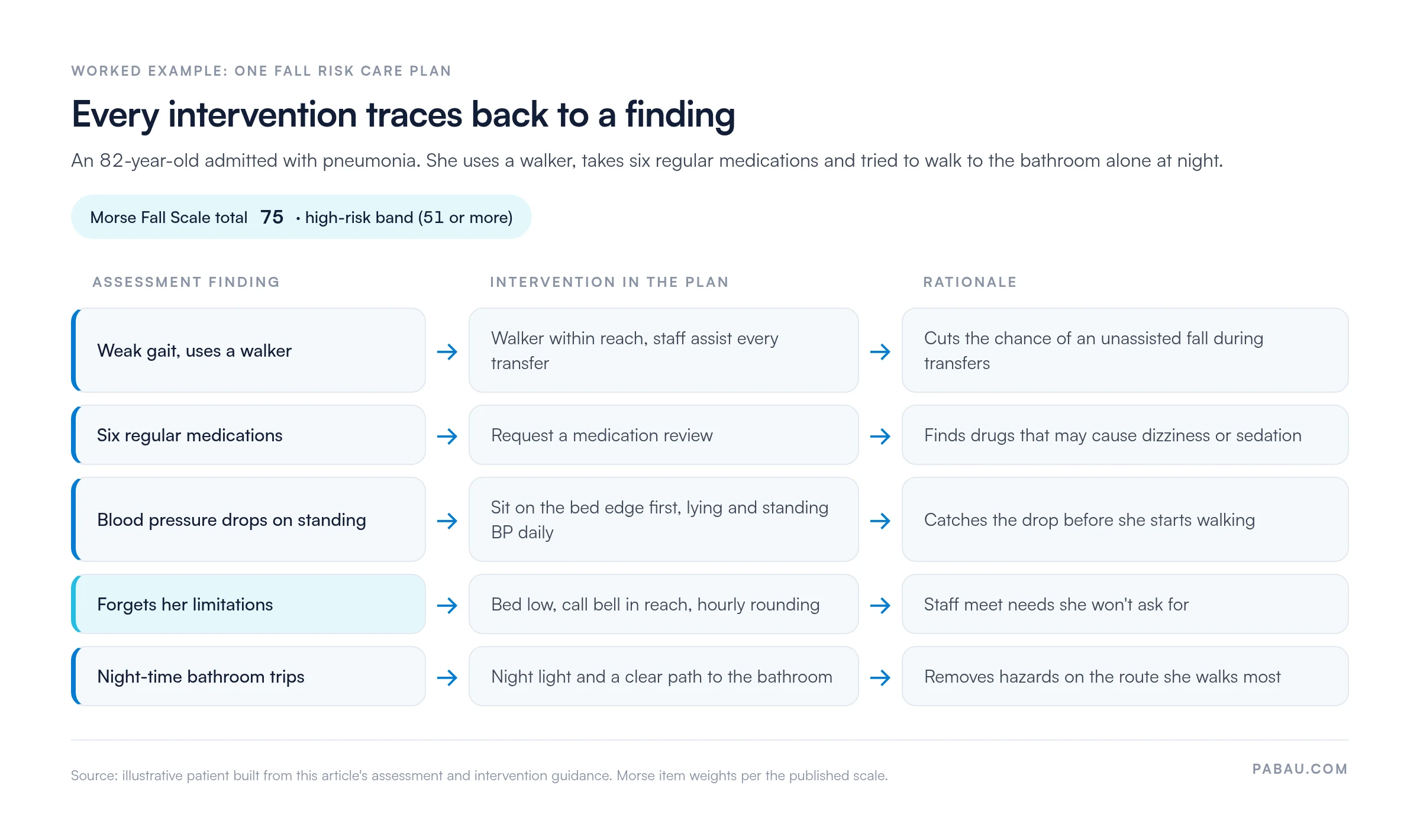
Notice the pattern. Every row starts with something the assessment found. If an intervention can’t point back to a finding, it doesn’t belong in this patient’s plan.
Older adults often carry several risk factors at once. Plan for polypharmacy, cognitive change, sensory impairment and balance disorders together, rather than treating each in isolation.
The factors also feed each other. A sedating drug worsens confusion, and a confused patient forgets the walker. Long-term care residents may need the same assessment with adjusted intervention frequency.
A fall risk plan is a working document. It changes hands several times before discharge:
A structured SBAR handoff keeps the handover step short. It also makes it harder to skip the fall risk line on a busy shift.
What trips plans up is the middle of the stay. The admission plan still reads “walks independently” three days after a sedating drug was added. Tie reassessment to events as well as dates, and the plan stays current.
After a fall, complete an immediate clinical assessment before moving the patient, then document the findings. Notify the responsible clinician and the family according to your policy. Then revise the care plan to reflect the new risk status.
If the fall causes a fracture, a hip fracture care plan runs alongside this one. Keep both open, because a fall adds 25 points to the Morse score.
Most weak plans fail in the same few places. Watch for these before you sign one off:
Work through the template in the order the clinical decisions are made. Each section depends on the one before it, so completing them out of sequence weakens the rationale.
Use the template as a teaching tool, or adapt it for practice once it matches your organization’s policies. Before clinical use, check its scoring section against the Morse item weights above or your unit’s validated version.
Students mapping the full cycle from assessment to evaluation can pair it with a nursing process worksheet.
Before you finish, run this check:
Audit one plan per week against the rationale check. If an intervention has no stated reason tied to a finding, rewrite it before the plan is closed.
Many practices still keep fall risk plans on paper or in a shared drive. The score sits in one place and the interventions in another, so the next clinician has to piece them together.
Pabau, the practice management platform we build, lets you turn this care plan into a digital form. Nurses complete the assessment, goals and interventions on screen, and the finished form saves to the patient’s record.
Our patient intake software collects medical history and current medications before the visit. Risk factors are then visible at the first assessment. Each later review sits beside the last one, so a changed score is easy to spot at handover.

Pabau’s digital forms keep each fall risk assessment, goal and intervention in the patient’s record, so every review builds on the last. Book a demo to see it with your own care plan.

A fall risk care plan earns its place when the next nurse can act on it without asking questions. That depends on one habit. Every intervention traces back to a finding, and every finding gets rescored when the patient changes.
If you fix one part of your current plans, fix the rationale. It shows why each step was chosen, and it turns a checklist into a plan. Book a demo to see how Pabau keeps each fall risk assessment and its interventions in one patient record.

Caring for a patient with swallowing problems? Risk for aspiration nursing care plan applies the same risk-diagnosis structure to aspiration.
Planning for another risk diagnosis? Risk for infection nursing care plan walks through goals and interventions for infection risk.
Worried about skin breakdown in a less mobile patient? Impaired skin integrity nursing care plan covers assessment and wound-focused interventions.
Need another validated risk score? Braden Scale nursing explains how to score pressure injury risk.
Handing the plan to the next shift? Nursing handoff report gives you a structure for passing on each patient’s risks.
Impaired physical mobility is a problem-focused diagnosis, backed by defining characteristics the patient already shows. Risk for falls describes susceptibility to an event that hasn’t happened. A patient can carry both, and mobility interventions often serve both plans.
Reassess on admission, after any fall, on transfer between units, and whenever the patient’s condition or medications change. Many hospitals also set a routine interval, such as every shift or daily, so follow your local policy.
Bed alarms alert staff, but on their own they haven’t been shown to reduce falls. A cluster-randomized trial published in 2012 increased alarm use without lowering fall rates. Treat alarms as one part of a plan built on rounding, toileting and mobility support.
Pediatric units often use the Humpty Dumpty Falls Scale. It scores factors such as age, diagnosis, cognitive impairment and medications. Adult tools like the Morse Fall Scale weren’t built for children, so check which scale your unit has validated.
Restraints aren’t a recommended fall prevention measure. They’re linked to injury, agitation and lost mobility. Federal rules for US hospitals allow them only when less restrictive measures have proved ineffective, so plan alternatives first.