HIPAA compliant texting: What you can send patients & how to communicate securely
HIPAA compliant texting is possible when a text holds no protected health inform...

Last Updated: Oct 16, 2026
An impaired skin integrity nursing care plan is a structured document that records a patient’s skin breakdown, its causes, your goals and your interventions. Each intervention carries a rationale. The document turns bedside skin findings into a plan the whole team can follow, and it shows whether that plan worked.
Students often struggle to connect assessment data to the diagnosis statement. Experienced nurses tend to drop the rationales when a shift gets busy. This guide covers each section in order, from the NANDA-I diagnosis to evaluation, with a worked example and a free PDF template.
A printable care plan with fields for patient details, wound type, location, size and characteristics, and contributing factors. It also covers the nursing diagnosis, goals, interventions, evaluation, patient education and follow-up.
Download template
Impaired skin integrity is a NANDA-I nursing diagnosis for skin that is already damaged, distinct from risk for impaired skin integrity.
A complete plan links assessment findings, defining characteristics and related factors to each diagnosis statement.
Each intervention needs a documented rationale that explains why it is being done.
Goals should be measurable, with a review point and a clear evaluation step.
Every finding should carry through the plan, from assessment to diagnosis, goal, intervention and evaluation.
An impaired skin integrity nursing care plan organizes the assessment, diagnosis, goals, interventions and evaluation for a patient whose skin is already damaged. It gives the care team one shared record of what was found, what was done and whether it worked.
Nursing documentation of this kind supports the standards that regulators and accreditors expect. The National Quality Forum (NQF) classifies stage 3 and 4 hospital-acquired pressure injuries as a “never event.”
CMS’s Hospital-Acquired Conditions program instead withholds additional payment for them, which is one reason facilities scrutinize skin care records closely. The Joint Commission also expects accredited facilities to keep nursing care plans that include skin assessment and intervention records.
Impaired skin integrity is a NANDA-I nursing diagnosis describing damaged or disrupted skin, where the epidermis, the dermis or both are compromised. Confirm the label and its current definition against the NANDA-I taxonomy or a nursing diagnosis handbook before writing it into a plan.
Defining characteristics are the signs and symptoms you observe and document. They commonly include altered skin integrity at the site, tissue damage, and visible changes that match the stage or type of breakdown. Related factors describe what is contributing, such as immobility, altered sensation, moisture, or poor nutrition.
Impaired skin integrity applies when breakdown is already present. Risk for impaired skin integrity applies when no breakdown exists yet but the patient has factors that make it likely.
Complete and document a skin assessment before you plan any intervention. Inspect the skin across all areas, including pressure points such as the sacrum, heels and occiput. A structured skin assessment form keeps those findings consistent from one shift to the next.
Stage pressure injuries using the NPIAP definitions exactly, so the stage you record matches what you see at the bedside.
A nursing diagnosis statement for impaired skin integrity follows a three-part PES format: the problem, the etiology, and the signs and symptoms that support it. Write the related factors in the “related to” clause and the defining characteristics in the “as evidenced by” clause.
Goals should be measurable and time-bound, so the team can tell whether the plan is working. Set short-term goals for the first review and longer-term goals for healing or prevention. Standard outcome labels from the Nursing Outcomes Classification, such as wound healing, keep goal wording consistent across the team.
Each intervention should carry a rationale that explains why you are doing it. The table below pairs common interventions with the reason behind them.
Regular repositioning on an individualized schedule is the core pressure relief intervention. Build the schedule from the patient’s mobility and skin status rather than a fixed interval, and document the schedule you chose and why.
Cleanse the wound, select a dressing category that suits the wound type and stage, and record how often it is changed. Dressing choice belongs to the wound plan agreed with the prescriber or wound specialist.
Moisture from incontinence or wound exudate can damage surrounding skin. Apply a barrier product to periwound skin and change absorbent products promptly.
Protein, fluid and micronutrient intake all influence wound healing. Where intake is poor, refer to a registered dietitian rather than setting a target yourself, since requirements vary by patient condition.
Document the teaching you deliver, including signs of infection, when to seek care, how to inspect the skin at home, and how to position safely. An open wound also raises infection risk, so many patients carry a risk for infection plan alongside this one.
Evaluation checks each goal against the findings recorded at review. Compare the current skin assessment with the baseline, and note whether each goal was met, partly met or not met.
Write the rationale in the same sentence as the intervention, for example: reposition on the documented schedule to limit sustained pressure on the sacrum. A rationale written this way is easier to audit and easier for a colleague to follow on the next shift.
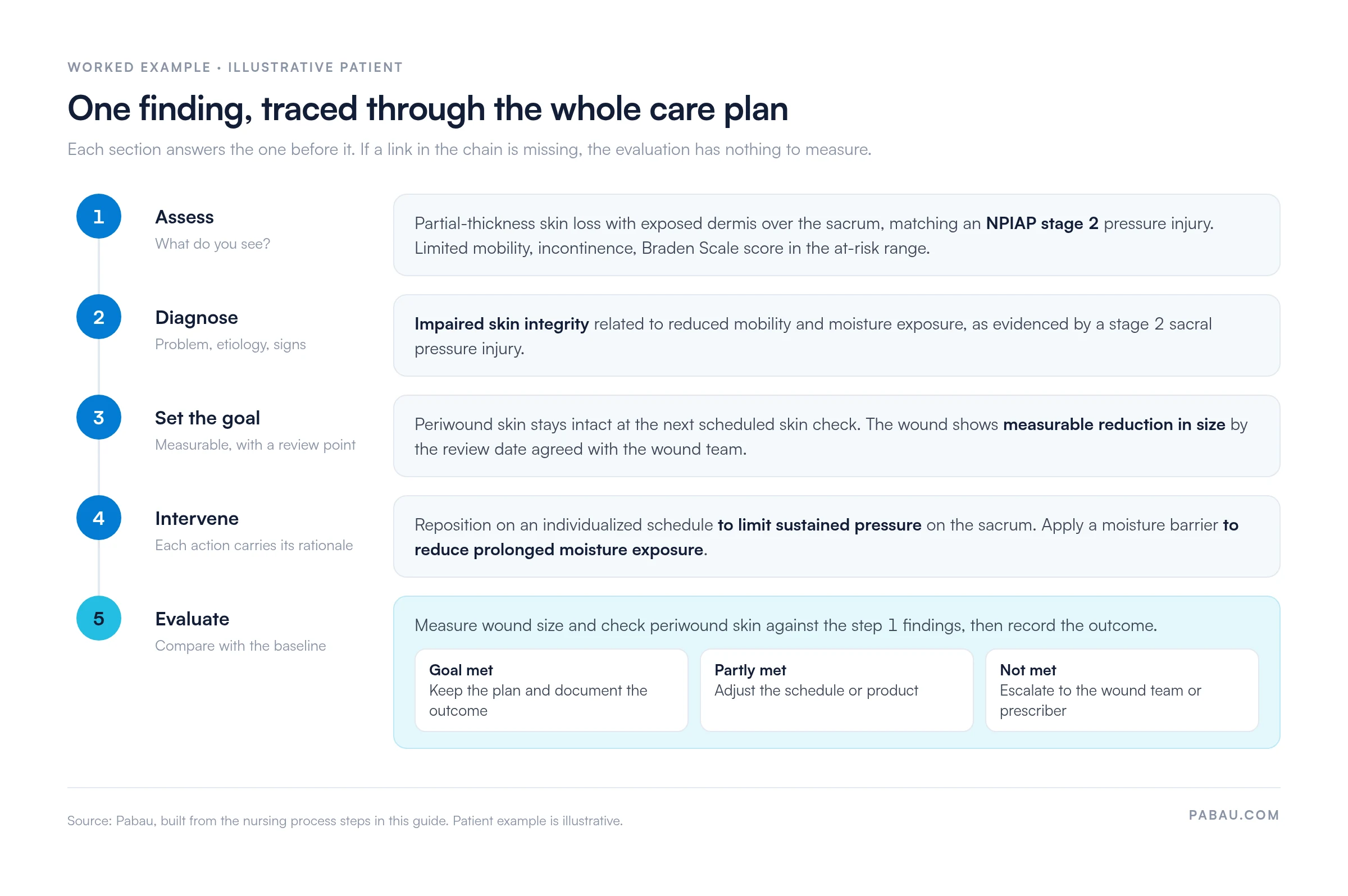
The patient below is illustrative, but the structure matches the template. Follow one finding through each section of the plan, and notice that every step answers the one before it.
Most errors come from mixing up the diagnosis type, writing vague goals, or leaving out rationales. Check your draft against the list below before you submit it.
Many practices that treat wounds and skin conditions still run this plan on paper. The assessment sits in one folder, wound photos sit on a phone, and the evaluation lives in a separate note. Whoever reviews the plan has to piece it together before they can judge progress.
Pabau, the practice management platform we build, lets you turn this care plan into a digital form that saves straight to the patient’s file. The same patient intake software that collects medical history before the first visit holds the skin assessment, so the baseline is already on record.
Wound photos are captured and tied to the record, so each evaluation compares the wound with its baseline image. Treatment notes, care plan entries and photos share one timeline, so the next nurse can see what changed and why.

Pabau’s digital forms, photos and treatment notes keep each skin assessment, care plan entry and wound photo in one patient timeline. Reviews start from the baseline instead of a search through folders.

A care plan is only as useful as the thread that runs through it. If an assessment finding never reaches a goal, or an intervention has no rationale, the plan cannot show whether care worked.
Settle the diagnosis type first, because choosing impaired skin integrity over risk for impaired skin integrity changes every section that follows. Then write each goal so the next nurse can mark it met, partly met or not met without asking you.
A complete plan takes longer to write on the first shift. It pays that time back at every review, because nobody has to reconstruct what happened. Book a demo to see how Pabau keeps skin assessments, wound photos and care plan entries in one patient record.

Not sure how to state the diagnosis? Nursing process worksheet walks through each ADPIE step so assessment, diagnosis and evaluation line up.
Want to map related factors visually? Nursing concept map template shows how to connect assessment data, diagnoses and interventions on one page.
Writing a care plan for a respiratory patient? Impaired gas exchange nursing care plan applies the same structure to oxygenation problems, with a worked example.
Caring for a patient with cognitive changes? Nursing care plan for impaired memory covers goals and interventions for patients who need support to recall and follow care.
Impaired skin integrity is a NANDA-I nursing diagnosis describing disrupted or damaged skin. Confirm the current definition against the NANDA-I taxonomy before using it in a plan.
Impaired skin integrity applies when breakdown is present. Risk for impaired skin integrity applies when the skin is intact but related factors make breakdown likely.
Yes, use the download button above to get the printable care plan PDF. Adapt the fields to your clinical setting and local policy.