Normal vital signs chart
A normal vital signs chart lists the expected resting ranges for blood pressure,...

1
Last Updated: Oct 19, 2026
A hip fracture nursing care plan is a structured document setting out the assessments, NANDA diagnoses, interventions and expected outcomes after a broken hip. Hip fractures are most common in older adults. The first 72 hours after surgery and the first weeks of mobilization carry the highest risk of complications.
This guide walks through the assessment, diagnoses and interventions a nurse needs, with a shift-by-shift checkpoint schedule and a fully worked care plan entry. It links to a free downloadable template you can adapt for each patient.
A ready-to-use care plan covering patient assessment, NANDA nursing diagnoses, perioperative and postoperative interventions, expected outcomes, and discharge planning for hip fracture patients.
Download template
A hip fracture nursing care plan links each assessment finding to a NANDA-I diagnosis, a measurable goal, an intervention and a review point.
Acute pain, impaired physical mobility, risk for falls and risk for infection anchor most plans, with acute confusion and constipation close behind.
Neurovascular checks, venous thromboembolism (VTE) prophylaxis, delirium screening and getting the patient up the day after surgery are the priority postoperative interventions.
Hip precautions depend on the surgical approach, so the plan should copy the surgeon’s own orders rather than a generic list.
Digital forms in practice software such as Pabau keep the plan in one record that each shift updates and the next shift can trust.
A hip fracture nursing care plan is a written framework that connects what the nurse observes with what the nurse does about it. Each entry names a nursing diagnosis from NANDA International (NANDA-I) and the related factors that support it. It then sets out the interventions chosen and the outcomes the team expects to see.
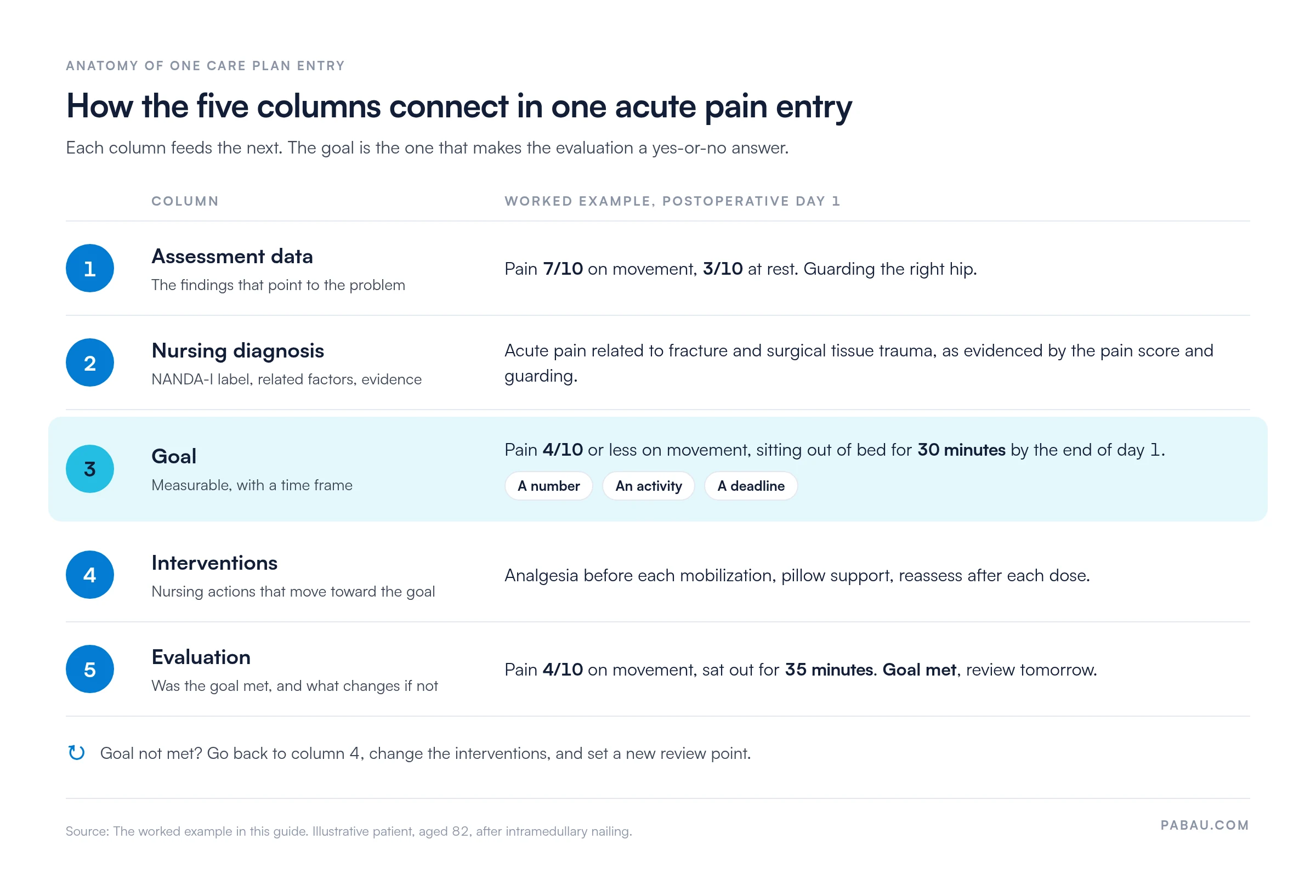
Most plans follow the same five columns:
The diagram below follows one acute pain entry from the worked example through all five columns.
Multidisciplinary teams use the plan to coordinate orthopedic surgeons, physical therapists, pharmacists and discharge coordinators. Regulators such as The Joint Commission expect care planning to be consistent and traceable. A shared plan supports both patient safety and audit readiness.
Hip fractures are usually classed by location: Femoral neck, intertrochanteric and subtrochanteric. The fracture type decides the operation, and the operation decides much of the nursing plan.
Timing matters as much as technique. The NICE hip fracture guideline (CG124) recommends surgery on the day of admission or the day after. The American Academy of Orthopaedic Surgeons (AAOS) guideline supports surgery within 24 to 48 hours.
Elderly patients make up most cases, and they often carry comorbidities that raise the risk of delirium, pulmonary complications and falls. Planning starts at admission and continues through rehabilitation.
Begin with a baseline the team can compare against later. Record pain, neurovascular status, skin integrity, nutrition, cognition and fall risk at admission.
A full nursing skin assessment at admission gives you a reference point for every pressure area check that follows. The same applies to the cognitive baseline. Without it, new confusion after surgery is hard to tell apart from a long-standing memory problem.
NANDA-I diagnoses give the care plan a common language. The four below appear most often in hip fracture plans, and each should be linked to measurable goals.
Acute pain is usually the first diagnosis to address, because it limits the movement that every other goal depends on. Impaired mobility follows closely, and the two should be reviewed together at each shift. For wound checks and dressing goals, the risk for infection plan goes into more detail.
Immobility and age both raise pressure injury risk. Plans should set a repositioning schedule and specify any pressure-relieving equipment. Record the screening score as one input among several clinical observations.
Delirium is common after hip fracture surgery and often starts within the first few days. Pain, infection, dehydration, urinary retention and new medicines can all trigger it. Screen at set intervals, and treat a sudden change in attention as urgent.
Opioids, bed rest and reduced fluid intake slow the bowel. Retention is also common once a catheter comes out. Record each void and each bowel movement, because both problems can drive pain and delirium. The constipation nursing care plan sets out bowel goals and interventions in full.
Not every patient needs the same plan. Add these diagnoses when the assessment supports them:
Each of these has its own detailed plan. The DVT nursing care plan and the imbalanced nutrition care plan show how to write the goals and interventions in full.
Interventions change across the surgical pathway. Preoperative work focuses on pain control, fasting status and baseline observations. Postoperative work focuses on circulation, breathing, clot prevention and early mobilization.
Dosages, anticoagulant choices and weight-bearing status are set by the surgical and medical team for each patient. The care plan should reference those orders rather than restate them as universal rules.
Hip precautions protect a replaced hip from dislocating while the soft tissues heal. They depend on the surgical approach, and many surgeons now relax or skip them. Copy the surgeon’s orders into the plan word for word.
Getting the patient up early is one of the most effective interventions in the plan. NICE recommends a physical therapy assessment and mobilization on the day after surgery, unless there is a medical or surgical reason to wait. After that, the patient should mobilize at least once a day.
Give prescribed analgesia ahead of each session so pain does not cut it short. Record what the patient managed, such as sitting out, standing or steps with a frame. That record lets the next shift build on it.
Each phase of the first 72 hours has its own priorities. The schedule below maps them to the admission, surgery and early recovery phases, alongside what to write down. Frequencies still follow your ward protocol.
The “what to document” column is what makes handover work. When the plan records the time and result of each check, the next nurse can compare readings and spot a trend.
Here is one completed entry for acute pain, for an illustrative patient. She is 82 and had an intertrochanteric fracture fixed with an intramedullary nail. Use it as a model for the other diagnoses.
Notice that the goal names a number, an activity and a deadline. With all three in place, the evaluation becomes a yes-or-no answer.
Older patients are at higher risk of postoperative delirium. Screening with the Confusion Assessment Method (CAM) is widely used in clinical practice. Teams should confirm which tool their local policy requires before stating it as mandatory.
Record the time of each neurovascular check next to the limb assessment. Consistent timing makes a slow change in circulation easier to spot than a single set of notes.
Discharge planning starts on admission. The care plan should record the home environment, mobility aids, medication changes, follow-up appointments and physical therapy arrangements. Capture them before the patient leaves the ward.
Patient teaching belongs in the plan with its own goals and evaluation. Before discharge, confirm the patient or caregiver can explain the following:
A discharge planning worksheet helps you check equipment, follow-up and caregiver arrangements in one pass.
The downloadable template is a practical starting point rather than a finished record. Adapt each section to the patient in front of you and keep the clinical orders in your own record.
Ward nurses, orthopedic and geriatric teams, rehabilitation staff and nursing students all use hip fracture care plans. Students benefit from seeing how a diagnosis links to an intervention and an outcome. Post-acute and home care teams use the same plan to pick up where the hospital left off.
A shared template makes handover faster and reduces the chance that a risk, such as falls or pressure injury, is missed between shifts. It also gives auditors a clear trail of assessment and response.
A paper care plan goes stale between updates. When it sits in a folder at the bedside, the night shift’s neurovascular check may never reach the day team’s handover. Findings get rewritten from memory, and a slow change is easy to miss.
Pabau, the practice management platform we build for private practices, rebuilds the template’s headings as digital forms for nursing teams. Staff complete each assessment on a tablet at the bedside, and the entry saves straight to the patient’s Client record with a time stamp. The next nurse opens one record and sees the trend.
Orthopedic, rehabilitation and post-acute practices can keep assessments, care plans and discharge notes together. That means less time chasing paperwork and more time with the patient. Every Pabau subscription includes the full feature set.
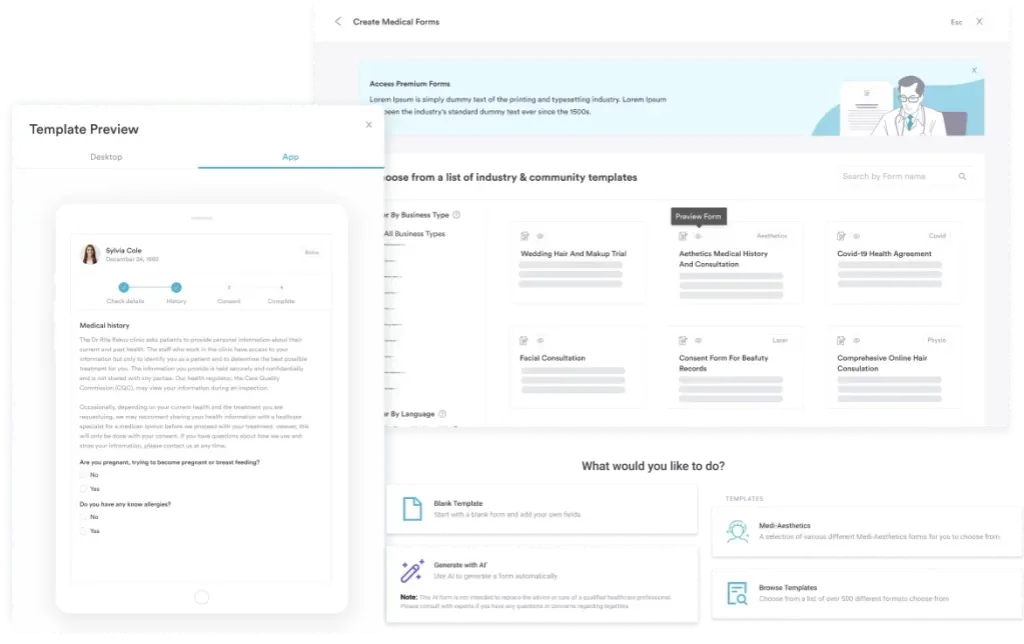

Pabau’s digital forms and Client records keep assessments, care plans and discharge notes in one place. Each update is time-stamped, so the next nurse sees what changed.

A hip fracture care plan earns its keep in the first 72 hours. That is when delirium, clots, pressure injuries and failed mobilization are most likely to start, and when a timed record catches them early. Write every goal with a number, an activity and a deadline.
The template gives you the structure, but the patient sets the content. Copy the surgeon’s orders for weight-bearing and precautions, and drop any diagnosis the assessment does not support. A shorter plan that the team reviews each shift beats a long one nobody updates.
If your team still carries care plans on paper, moving them into one shared record is the change that pays back fastest. Book a demo to see how Pabau keeps assessments, care plans and handover notes in one place for your team.

Caring for a patient on anticoagulant prophylaxis? DVT nursing care plan sets out the clot-prevention checks, leg assessments and teaching that run alongside hip fracture recovery.
Worried about pressure injuries during bed rest? Nursing skin assessment gives you a head-to-toe template for recording pressure areas, wounds and changes between shifts.
Is a fixation site showing signs of deep infection? Osteomyelitis nursing care plan covers the diagnoses and interventions for bone infection after orthopedic surgery.
Is poor appetite slowing your patient’s recovery? Imbalanced nutrition nursing care plan shows how to set intake goals and track weight, meals and dietitian input.
Getting ready to send the patient home? Discharge planning worksheet helps you confirm equipment, follow-up appointments and caregiver teaching before the patient leaves.
A hip fracture nursing care plan is a structured document linking assessment findings, NANDA nursing diagnoses, interventions and expected outcomes after a broken hip. The team reviews it each shift and updates it as the patient recovers.
Acute pain, impaired physical mobility, risk for falls and risk for infection are the diagnoses most often included. Risk for acute confusion, constipation and risk for impaired skin integrity are common additions for older patients.
Nurses record pain, neurovascular status, skin integrity, nutrition, cognition and fall risk at admission. They repeat the checks on the ward protocol schedule and compare each result with that baseline.
Yes, and it suits elderly patients well because it prompts checks for delirium, nutrition and falls. Adjust the screening tools to those your local policy requires.
Most guidelines recommend surgery within one to two days of admission. NICE advises operating on the day of admission or the day after. The AAOS guideline supports surgery within 24 to 48 hours.
Hip precautions are movement limits that protect a replaced hip from dislocating. After a posterior approach they usually rule out bending past 90 degrees, crossing the legs and turning the leg inward. The surgeon sets the exact limits for each patient.
Most patients should get up on the day after surgery unless there is a medical or surgical reason to wait. NICE recommends a physical therapy assessment and mobilization on that day, then mobilization at least once a day.
Watch for delirium, venous thromboembolism, chest infection, pressure injuries and surgical site infection. Urinary retention and constipation are also common, especially in patients taking opioids. Escalate new confusion, fever, calf pain or falling urine output promptly.
Review the plan at least once every shift, and again whenever the patient’s condition changes. A fall, new confusion or a change in weight-bearing orders should trigger an immediate update.