Anja Dodevska

MELD score: MELD 3.0 formula, ranges and free worksheet
Download your free MELD 3.0 score worksheet A two-page MELD 3.0 worksheet that o...

1
Last Updated: Nov 4, 2026
Free PDF 3 pages, print-ready Clinician-reviewed
A pain medication chart is a clinician reference that groups analgesics by drug class, strength tier, and DEA schedule. It lets a prescriber compare options at a glance and start at the lowest-risk step that fits the pain type. The tiers follow the WHO analgesic ladder, moving from non-opioids to opioids, with adjuvants added where pain is neuropathic. This chart covers OTC pain relievers, nerve pain agents, muscle relaxants, and opioid cautions, plus a formulary worksheet your practice fills in. Dosing reflects typical FDA labeling and must be individualized under each product's prescribing information.
A three-page reference that groups analgesics by drug class, strength tier, and controlled-substance status. It adds OTC cautions, a decision checklist, and a formulary worksheet for onset, duration, and DEA schedule.
Start from scratch, or upload this PDF or any form you already use, and Pabau's AI Form rebuilds it with tick boxes, text fields and a signature. Attach it to the treatment once, and every patient gets it on time.
AI Form rebuilds the consent, history and aftercare forms you already use. You review each one, then publish.
Patients complete forms on their phone before they arrive, so the front desk stops retyping paper.
Every signed form is versioned and attached to the treatment record, ready when you need it.
Set how long a consent stays valid. Returning patients skip forms they have already signed.
Supports HIPAA and GDPR compliance AES-256 encryption 4.8 on G2 4.7 on Capterra Trusted by 4,000+ practices worldwide

A pain medication chart groups analgesics by drug class, strength tier and DEA schedule, so the lowest-risk option is easy to find.
The chart climbs in three tiers, from OTC non-opioids to prescription adjuvants to opioids, and each step adds a prescribing control.
Acetaminophen and NSAIDs carry hepatic, renal, GI and cardiovascular risks that need screening before use.
Since 2018, the FDA Opioid Analgesic REMS has covered immediate-release as well as extended-release and long-acting outpatient opioids.
Pabau, the practice software we build, keeps e-prescriptions and the reasoning behind them in the patient record.
A pain medication chart is a clinician-facing reference that lists analgesics by drug class, strength, onset, duration, and controlled-substance status. It supports consistent prescribing conversations and documentation across a team.
Clinicians use the chart to place a patient on the WHO analgesic ladder, which moves from non-opioids to opioids. It also shows the next step if first-line therapy fails, and the scheduling rules to confirm before writing a prescription. The chart does not replace the prescribing information for any product.
Pain medications fall into a small number of classes, each with a different mechanism and risk profile. The summary below is the first layer of the chart.
Ordering a pain medication chart by strength helps clinicians move from the least to the most potent option in a predictable sequence. Potency ranking is a relative guide, not a dosing instruction.
Each step up the chart brings a new prescribing control, from labeled OTC limits to federal scheduling. Adjuvants for neuropathic pain can join at any step.
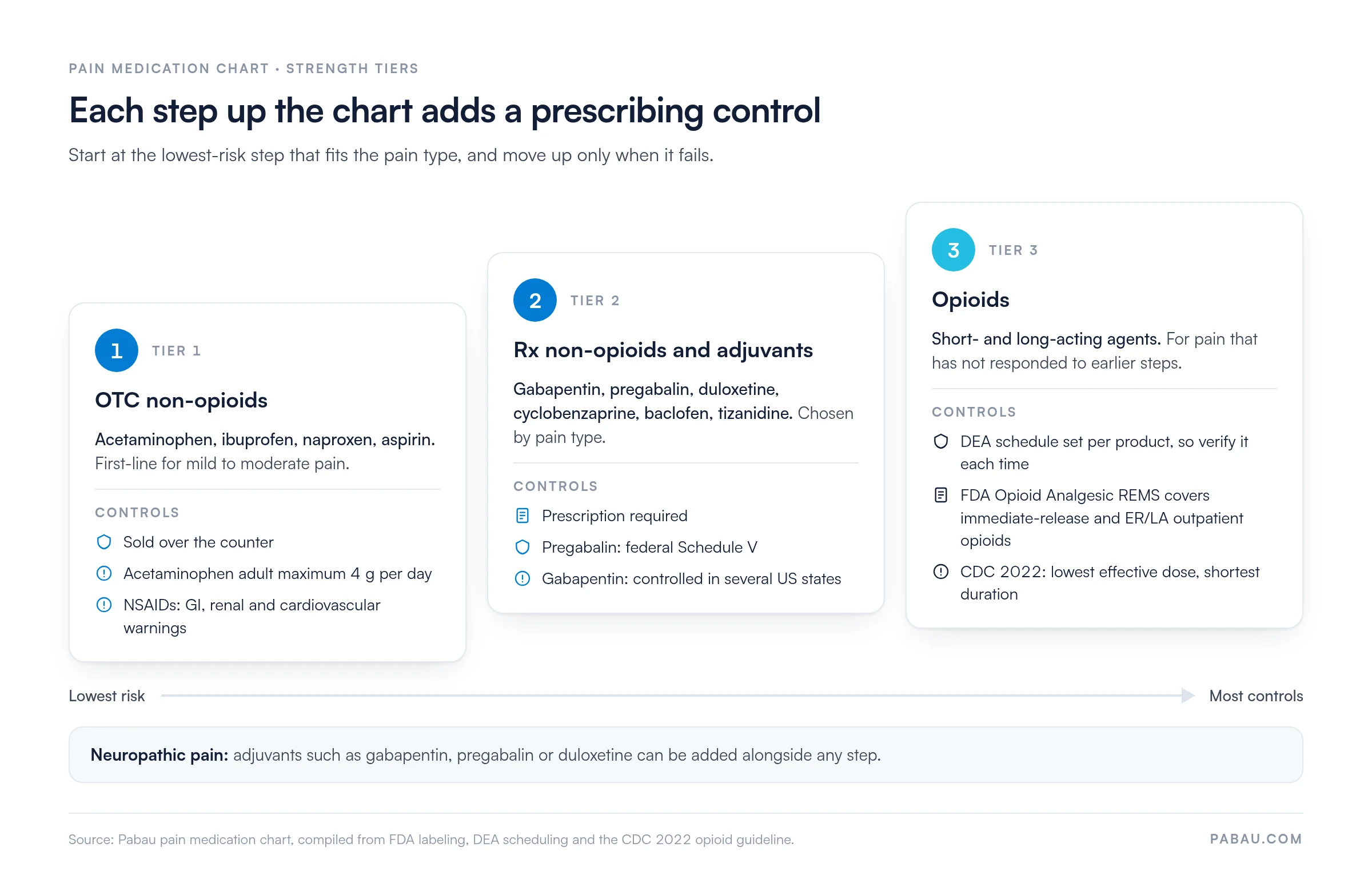
OTC pain relievers are the most common first step. The table compares the main options and the cautions that matter most in practice.
Aspirin and NSAIDs raise bleeding risk in patients on anticoagulants. Check the medication history against a blood thinning medication list before recommending either one.
Opioids sit at the top of the strength chart and carry the most stringent controls. Scheduling depends on the specific product. Some agents, including tramadol, have been placed in different DEA schedules over time, so verify the current classification before documenting.
Long-acting opioids carry higher overdose risk than immediate-release formulations. Since its 2018 expansion, the FDA Opioid Analgesic REMS covers both immediate-release and extended-release or long-acting opioids for outpatient use.
The label suffix is the quickest way to tell the formulations apart, and a list of medication suffixes decodes ER, XR and the rest. Equianalgesic conversions between opioids are high risk, so make them only with current labeling and clinical judgment.
Non-narcotic pain medication options include prescription NSAIDs, neuropathic agents, muscle relaxants, and topical analgesics. Many patients who need more than an OTC product can be managed here before an opioid is considered.
Neuropathic agents such as gabapentin and pregabalin are often used for nerve pain. Gabapentin is not federally scheduled but is controlled in several US states, and pregabalin is Schedule V federally, so check jurisdiction-specific status.
Nerve pain medications work on different pathways from standard analgesics, so they belong on their own row of the chart. Dosing should follow the prescribing information for each agent. Our nerve medication list sorts these agents into treatment tiers with dosing ranges.
Muscle relaxer medication is commonly prescribed for short courses in acute muscle spasm. Sedation is the main limiting effect, and combining these agents with other sedating drugs increases the risk.
Pain medications are chosen by step and by pain type, not by strength alone. Start with the lowest-risk effective option, then escalate only when the clinical picture supports it.
Step 2 goes faster when the patient has already listed current medications, allergies and liver or kidney history. With paperless patient intake, those answers arrive before the consultation starts.
Every class on the chart carries a specific risk. Acetaminophen carries hepatotoxicity risk, particularly at high doses or with alcohol use. NSAIDs carry GI, renal, and cardiovascular warnings, which the FDA reflects in boxed labeling.
Medication overuse headache is a recognized concern when analgesics are used frequently for headache. Not all frequent analgesic use causes it, so assess pattern and duration before attributing symptoms to overuse. Document the screening you performed.
A printed chart often hangs on a wall or sits on a shared drive, while the prescription goes out through a separate system. The note explaining why tier 2 came before tier 3 ends up somewhere else again.
Pabau brings those pieces into one record. Its e-prescribing software writes the script from the patient file and checks for drug interactions as you go. Controlled prescriptions carry a full audit trail.
The intake answers, the treatment note and the prescription sit side by side. So when a patient comes back asking for something stronger, the clinician can see what was tried, at what step, and why.

Pabau’s e-prescribing sits inside the patient record, with drug interaction checks and a full audit trail. Every pain medication decision stays on file with the notes behind it.

A chart earns its place when the whole team reads it the same way. Fill in the formulary worksheet with the products your practice stocks, and have a licensed clinician sign it off.
Then put a review date on it. Scheduling moves, as tramadol’s history shows, and the opioid REMS widened in 2018. A chart nobody revisits drifts out of step with the label.
The trade-off is time. A short review each quarter costs far less than a prescription written from a stale schedule. Book a demo to see how Pabau keeps each pain prescription and its reasoning in one patient record.

Need the mechanism behind each drug class? Nursing pharmacology cheat sheet covers 20 common drugs by class in one printable PDF.
Recording doses after the prescription? The medication log template tracks daily, weekly and as-needed doses for each patient.
Charting medicines on a ward? The national inpatient medication chart walks through each section of the standard inpatient form.
Screening before you prescribe? The medical history questionnaire adds a red-flag checklist to the standard history questions.
A pain medication chart is a reference that organizes analgesics by class, strength, onset, duration, and DEA schedule. It supports consistent prescribing and documentation across a clinical team.
No OTC product is strongest for every patient. Among OTC options, NSAIDs such as ibuprofen and naproxen are often considered more potent for inflammatory pain than acetaminophen, but both carry labeled risks.
Opioids act on mu-opioid receptors and carry dependence and overdose risk, while non-opioids work through other mechanisms. Non-opioid options are usually considered first under the WHO analgesic ladder.
NSAIDs are typically tried first for inflammatory musculoskeletal pain. Opioids are reserved for moderate to severe pain that has not responded to other steps. The CDC 2022 guideline recommends the lowest effective dose for the shortest duration.
Gabapentin is not federally scheduled in the US but is controlled in several states. Check the status in your jurisdiction before prescribing.