Anja Dodevska

House rehab checklist
What a house rehab checklist covers and who completes it A house rehab checklist...

4
Last Updated: Oct 27, 2026
Free PDF 2 pages, print-ready Clinician-reviewed
A fluid and electrolyte cheat sheet is a quick clinical reference for normal values, IV fluid tonicity, imbalance signs and nursing interventions. This two-page PDF lists adult serum ranges for sodium, potassium, calcium, magnesium and phosphate. It shows what isotonic, hypotonic and hypertonic fluids do to cells, with the signs and first actions for each imbalance. It closes with refeeding syndrome monitoring steps and a bedside notes panel. Nurses use it at the bedside and students use it for NCLEX review, alongside facility protocols and prescriber orders.
A two-page reference with adult ranges for five electrolytes, IV fluid tonicity, imbalance signs and interventions, and refeeding syndrome monitoring steps. A bedside notes panel records results, the current IV order and escalation actions.
Start from scratch, or upload this PDF or any form you already use, and Pabau's AI Form rebuilds it with tick boxes, text fields and a signature. Attach it to the treatment once, and every patient gets it on time.
AI Form rebuilds the consent, history and aftercare forms you already use. You review each one, then publish.
Patients complete forms on their phone before they arrive, so the front desk stops retyping paper.
Every signed form is versioned and attached to the treatment record, ready when you need it.
Set how long a consent stays valid. Returning patients skip forms they have already signed.
Supports HIPAA and GDPR compliance AES-256 encryption 4.8 on G2 4.7 on Capterra Trusted by 4,000+ practices worldwide

A fluid and electrolyte cheat sheet is a quick-reference PDF for bedside assessment and exam review.
Normal serum sodium is 135-145 mEq/L and potassium is 3.5-5.0 mEq/L, per standard clinical references.
Isotonic, hypotonic and hypertonic IV fluids shift water differently, so check tonicity before hanging.
Hyperkalemia above 6.5 mEq/L is an emergency, and a drop in phosphate is the hallmark of refeeding syndrome.
Pabau, the practice software we build, turns electrolyte checklists into digital forms saved to the patient record.
A fluid and electrolyte cheat sheet condenses the core facts nurses need to assess fluid status. It covers electrolyte normal ranges, IV solution classes, imbalance signs and first-line nursing actions. This one adds refeeding syndrome monitoring and a bedside notes panel. Four groups use it most:
Electrolytes are minerals that carry electrical charge in serum and cells. Sodium governs extracellular water, while potassium drives intracellular function and cardiac conduction.
Water moves between compartments in response to osmotic gradients. That is why intracellular fluid, extracellular fluid and interstitial fluid behave differently when sodium or glucose changes.
Reference ranges vary by laboratory and analyzer, so always confirm against your facility’s lab report. The values below are adult serum ranges from standard clinical references.
Ionized calcium reads differently from total calcium, so note which one your lab reports. Critical values are set by each institution, so confirm your panic thresholds before acting on any result.
Tonicity describes how a solution affects cell volume. Isotonic solutions keep cells stable, hypotonic solutions move water into cells, and hypertonic solutions pull water out of them.
Fluid selection is a prescriber decision based on the patient’s clinical picture. Use this table to check what a fluid does, then confirm the order and rate against your protocol.
Imbalances usually reflect a shift in intake, output, or the hormones that control them. Matching the cause to the sign helps you prioritize what to assess first. The chart below puts each electrolyte’s normal range between the signs of a low and a high level.
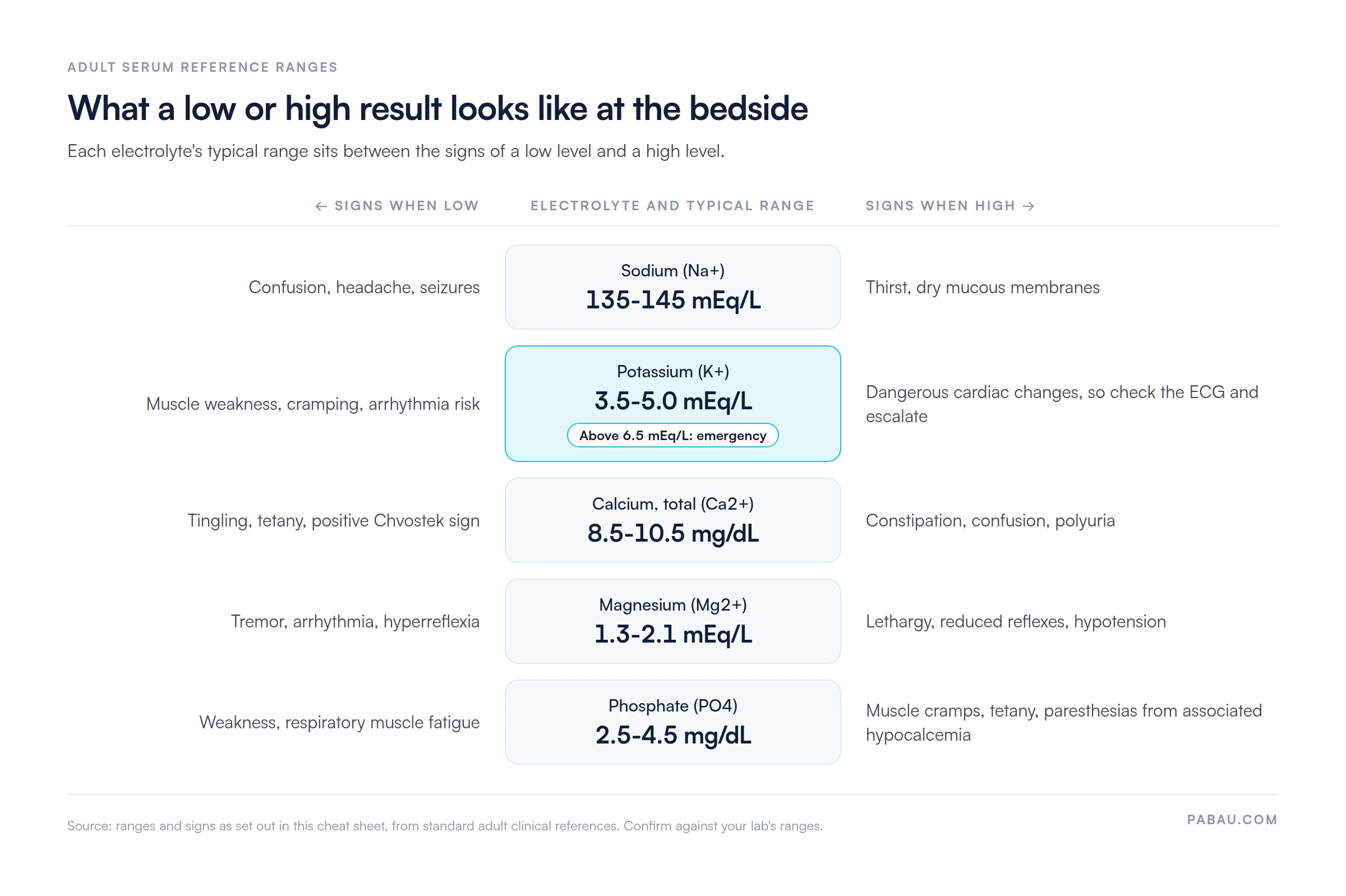
When an imbalance needs a documented plan of care, the electrolyte imbalance care plan adds NANDA diagnoses and assessment prompts.
Hyponatremia can follow excess free water intake or the syndrome of inappropriate antidiuretic hormone (SIADH), which dilutes sodium. Watch for confusion, headache and seizures, and review fluid restriction and neurological status. Hypernatremia usually follows free water loss and shows as thirst and dry mucous membranes.
Hyperkalemia above 6.5 mEq/L can cause dangerous cardiac changes, so treat it as an emergency and escalate immediately. Check the electrocardiogram (ECG), review renal function and medications, and follow institutional protocol.
Hypokalemia often presents with muscle weakness, cramping and arrhythmia risk. Review diuretic use, GI losses and magnesium status before planning replacement.
Magnesium and phosphate both depend on the kidneys for clearance, so check renal function before replacing either. For patients with chronic kidney disease, the CKD nursing care plan covers assessment, interventions and patient teaching at each stage.
Refeeding syndrome is a serious shift in phosphate, potassium and magnesium that can follow the restart of nutrition in malnourished patients. The drop in phosphate is the hallmark, and it can cause cardiac and respiratory complications.
Keep the cheat sheet at the nurses’ station or saved to a shared drive, and use it as a prompt rather than a script. It sits well next to a nursing brain sheet, which tracks the shift’s labs and tasks. Work through these five checks:
On many units the electrolyte check still lives on paper or a printed sheet. Results, the fluid running and what was escalated end up in different places, and trends are hard to see across a shift.
Pabau lets you rebuild this cheat sheet’s bedside check as one of its digital forms. Staff complete it on a tablet or desktop, and each entry saves to the patient’s record with the date and time.
That gives the next nurse the latest values, the current IV order and the actions taken in one place. It also supports the habits of good nursing documentation, because every check is timed and attributed.

Pabau’s digital forms turn your bedside electrolyte check into a structured record. Results, the IV order and escalation notes save to the patient’s file, ready for handoff.

A cheat sheet earns its place when it changes what you check first. Start with potassium and the ECG, check tonicity before any bag is hung, and run the refeeding steps before feeding restarts.
The trade-off is that these are general adult ranges. Your lab’s ranges and your institution’s critical thresholds always win, so write them on the sheet before you rely on it.
Book a demo to see how Pabau turns bedside electrolyte checks into timed records your whole team can review at handoff.

Need the rest of your charting on one page? Nurse charting cheat sheet collects charting formats, assessment order and approved abbreviations for a shift.
Is confusion pointing to a neurological cause? Neuro exam cheat sheet gives you a fill-in form for mental status, cranial nerve and motor findings.
Starting with a first look at the patient? General survey nursing template covers appearance, consciousness, skin and breathing before a focused assessment.
Assessing a patient in the emergency department? Emergency nursing assessment template walks through vital signs, the ABCDE primary survey and SAMPLE history.
Worried about sepsis alongside fluid shifts? Sepsis nursing care plan sets out the assessments, nursing diagnoses and interventions to record.
A fluid and electrolyte cheat sheet is a condensed clinical reference covering normal values, IV fluid types, imbalance signs and nursing interventions. It supports quick checks at the bedside and exam review, but it does not replace facility protocols.
Electrolytes control fluid distribution, nerve signaling, muscle contraction and heart rhythm. Small shifts can cause serious symptoms, which is why nurses track them closely.
Electrolytes carry electrical charge and move across cell membranes to create gradients. Water follows those gradients, so electrolyte changes shift fluid between compartments.
Isotonic fluids keep cell volume stable, hypotonic fluids move water into cells, and hypertonic fluids draw water out of them. Fluid choice is a prescriber decision, so check the order and your protocol.