Monika Lazarevska
Head to toe assessment cheat sheet: Printable nursing guide
A head to toe assessment cheat sheet gives you one fixed order at the bedside, s...

5
Last Updated: Oct 23, 2026
Free PDF 4 pages, print-ready Clinician-reviewed
A medication administration record in nursing is a legal clinical document. It tracks every medication given to a patient, by whom, when, and at what dose. It sits in the permanent medical record, and both a court and a state inspector can call for it.
Ten fields make that record defensible, and an auditor writes up the one you left blank. The template below prints all ten on a four-page form, alongside the code key for a refused or held dose.
A four-page printable record for nursing teams, covering patient and prescriber details, an allergies and precautions alert, and an eight-code omission and refusal key. Inside you also get scheduled and PRN administration grids, each with its own route, dose and initials columns. A signature legend and a Schedule II-V controlled substance log with witness and shift-count lines complete the set.
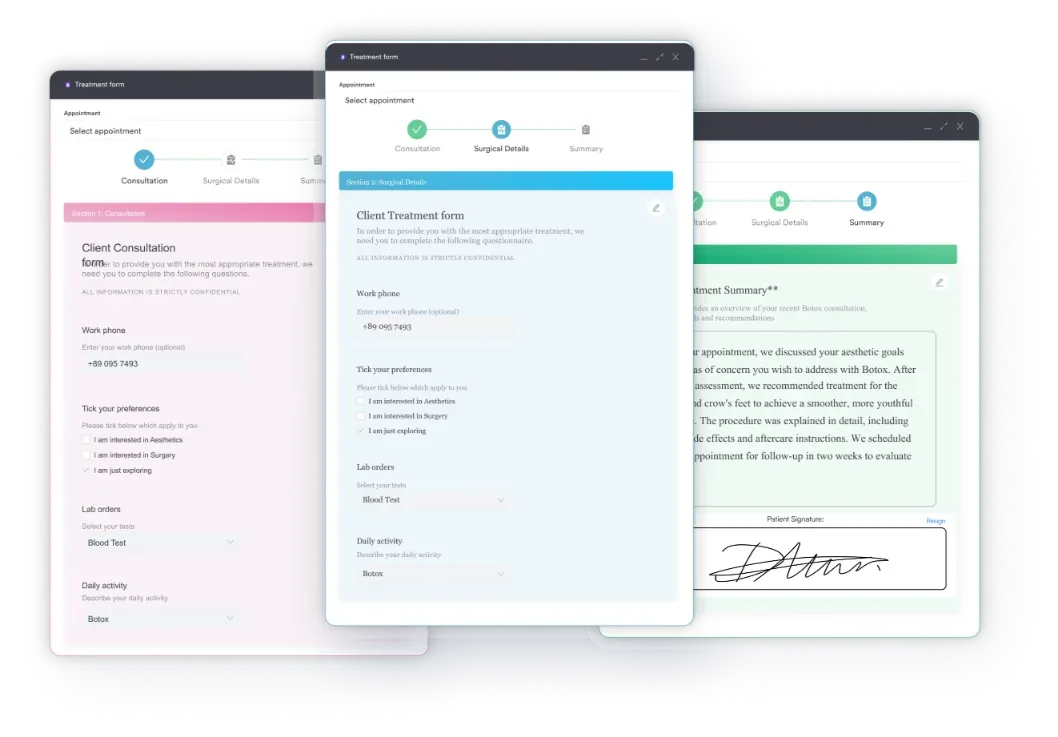
Upload this PDF, or any form you already use, and Pabau's AI Form rebuilds it with tick boxes, text fields and a signature. Attach it to the treatment once, and every patient gets it on time.
AI Form rebuilds the consent, history and aftercare forms you already use. You review each one, then publish.
Patients complete forms on their phone before they arrive, so the front desk stops retyping paper.
Every signed form is versioned and attached to the treatment record, ready when you need it.
Set how long a consent stays valid. Returning patients skip forms they have already signed.
Supports HIPAA and GDPR compliance AES-256 encryption 4.8 on G2 4.7 on Capterra Trusted by 4,000+ practices worldwide

A MAR records the name, dose, route, time, and signature for every medication given, which is what separates it from a medication order.
Required fields include patient name, medication name and strength, dose, route, time administered, and nurse signature or initials.
The five to 12 rights of medication administration (right patient, drug, dose, route, time) are verified before charting on the MAR.
A dose that was not given still needs an entry, using a code such as R for refused or H for held.
Practice management software like Pabau captures medication details on digital forms that file straight into the client record.
A medication administration record (MAR) documents every medication given to a patient. Hospitals, practices, long-term care facilities, and home health services all rely on it as a legal document. A court or a state inspector can call for it years after the dose was given.
The MAR does three jobs at once. It provides a chronological record of what was given and when, and it prevents duplicate administration or missed doses. It also creates accountability, because a nurse or clinician signs off on every dose.
According to Joint Commission medication management standards, accurate MAR documentation is a patient safety requirement. A late or missing entry is treated as a care failure, not a clerical one.
Four pages cover the whole record: patient details, the scheduled and PRN grids, the refusal codes and signature legend, and a controlled substance log. It is built for point-of-care charting. Print it, clip it into a paper chart, and fill it in by hand at the bedside.
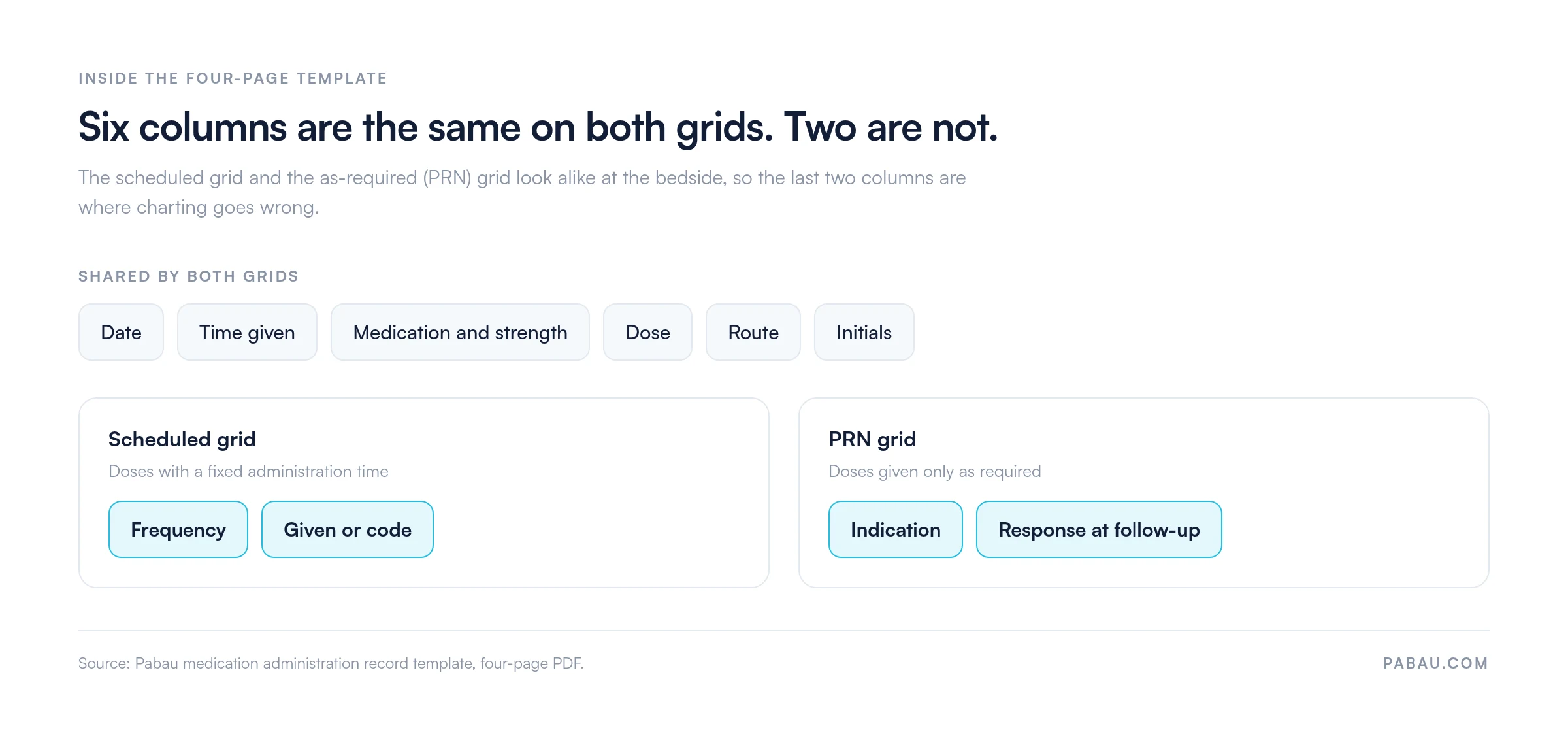
Six columns appear on both grids. They are date, time given, medication and strength, dose, route, and initials. The scheduled grid adds frequency and a given-or-code box. The PRN grid drops those two and asks instead for the clinical indication and the patient’s response at follow-up.
Practices that only need to log doses at home or in an outpatient setting can use the lighter medication log instead. The full MAR is built for a unit where several people chart against the same patient.
Every MAR carries the same core fields, whoever prints it. Missing or illegible information can lead to audit findings, legal liability, and medication errors. Each field below has a dedicated column or box on the template above.
Naming the exact drug and strength matters most on specialty therapy. A patient on pulmonary hypertension medications may be taking two agents from different pathways, and riociguat is never combined with a PDE-5 inhibitor.
Practices that collect medication details on patient-completed intake forms start from a typed list instead of a handwritten one. The allergies and the current medications are already in the record before the first dose is due.
Before charting on a MAR, nurses verify the “rights of medication administration.” That safety framework has grown from five rights to as many as 12, depending on the healthcare setting and training program. The original five remain the foundation of safe practice.
Some settings add a sixth right: right documentation, meaning the MAR is signed immediately after administration. Extended frameworks may include right reason, right assessment, right response, and the right to refuse. Always verify the standard used in your facility.
Seven steps take you from the order to the signature, and all of them happen at the bedside. Never chart before you give the dose, and never save it for the end of the shift. Delay is how a detail gets forgotten or written down wrong.
Step 1 rests on an order someone else authorized. In schools and care facilities, that approval is recorded on a signed medication authorization form before the first dose.
A practice that keeps structured patient records can build the same field list into a digital form. A required field stops the entry from being saved until the timestamp, the patient ID, and the signature are all there. Practices already working from digital medical forms can make several of these steps mandatory in the same way.
A patient may refuse a dose, or a medication may not be safe to give. Vomiting and an inability to swallow are two common reasons. The MAR is still completed with an omission code, never left blank.
The template’s code key carries eight entries. Pick the one that matches what happened, then add a short note if the reason needs explaining.
Some facilities use numeric codes or their own abbreviations. Follow your own policy wherever it differs from the key printed on the template.
After documenting the refusal or omission, notify the provider if the medication is critical, such as antibiotics or pain management. Do the same if the patient’s condition changes. Refusals must be signed by the nurse, not left as a blank entry.
Controlled substances require additional documentation beyond standard MAR entries. That covers Schedule II-V drugs: opioids, benzodiazepines, stimulants, and low-dose codeine combination products.
Federal DEA regulations and state pharmacy boards mandate separate controlled substance logs that run parallel to the MAR.
Each controlled substance administration must include the patient name, the drug name and strength, the dose, the time given, and the route. Record the lot or serial number, the expiration date, and the reason for use alongside it.
Some settings also require two-witness signatures for intravenous or other high-risk routes. The count of controlled substances in the cabinet or dispensary must reconcile at shift change. Any discrepancy, whether a missing dose, a count mismatch, or unexplained waste, triggers a formal incident report.
Whiteout and deletion are not options on a controlled substance log. Errors follow the correction protocol below.
Never erase, white out, or use correction fluid on a paper MAR. An obscured entry raises questions about what the record originally said. Corrections must be transparent and traceable, which means four steps.
An electronic MAR handles this differently. The system keeps the original entry and logs the change against a timestamp and a user ID, so both versions stay readable.
Charting the wrong medication, the wrong dose, or the wrong time counts as a medication error in its own right. Report it to the provider and document it in a compliance tracking incident report, separate from the MAR. Correcting the MAR alone does not satisfy error-reporting requirements.
The most common MAR-related errors happen when nurses rush, when the medication environment is noisy, or when staffing is stretched. These are all preventable with deliberate practice.
Research puts the reduction in transcription and administration errors at 30-50% for electronic MARs compared with paper. They achieve it by automating dose verification, flagging allergies, and requiring real-time documentation.
Electronic records win on legibility, error alerts, and audit trails. Paper wins on cost, and it still works when the network is down. The choice affects workflow, error rates, and how much work an audit creates.
Many long-term care and hospital settings now require an eMAR. Some states have gone further and legislated in favor of electronic records for controlled substance documentation.
A paper MAR lives in a binder at the nurses’ station. When a patient’s allergy list changes, someone writes it onto the sheet again. The rest of that patient’s history sits in a different file entirely.
Practice management software like Pabau keeps the client record and the forms in the same place. Digital forms capture the medication list, the allergies, and the doses a patient reports at intake. Those answers file straight into the client record, so the next clinician reads them without hunting for paper.
Structured documentation then replaces the loose sheets a practice keeps alongside its main chart. Every entry carries a timestamp and the name of the person who made it. When someone asks who recorded a detail and when, the answer is in the record rather than in a colleague’s memory.
Ready to stop rewriting the same allergy list? Book a demo to see how Pabau keeps patient forms, treatment notes, and client records in one place.

Pabau’s digital forms capture a patient’s medication list and allergies, and file the answers into the client record. Treatment notes sit in the same place, so the medication list never gets copied across from a paper sheet.

The MAR is one of the few nursing documents a court will read line by line. Print the template, agree the code key with your team, and chart against it from the next shift.
Paper holds up as long as one person is holding the chart. Once several people chart against the same patient, the binder starts costing more than it saves. The same is true the first time an inspector asks for six months of entries.
Whichever route you take, the record has to say who gave what, when, and at what dose. Book a demo to see how Pabau keeps medication details, consent forms, and treatment notes in one client record.

Need the wider picture on nursing records? Nursing documentation covers the notes, charts, and handover records a MAR sits alongside.
Charting doses outside a hospital unit? Medication log template is the lighter record for home and outpatient use.
Building a print pack for a nursing team? Emergency nursing assessment template gives you a structured first-contact form to keep alongside the MAR.
Deciding what to move off paper first? Clinical documentation software explains what to look for before you commit to a system.
Writing notes as well as charting doses? Clinical notes software covers how treatment notes are structured and stored.
A medication administration record documents every medication given to a patient, including drug name, dose, route, time, and administrator signature. It prevents duplicate doses, tracks therapeutic compliance, and serves as a legal record if a medication error or adverse event occurs.
The five rights are right patient (verified with two identifiers), right drug (matches the order), and right dose (calculated correctly). The last two are right route (correct method of delivery) and right time (per schedule). Some settings add a sixth right: right documentation, meaning the MAR is signed immediately after.
Yes. A MAR is part of the patient’s permanent medical record. It is admissible in court as evidence of what medications were given, by whom, and when. Accurate, legible, and timely documentation strengthens your legal position in case of a lawsuit or licensing investigation.
The healthcare professional who administers the medication is responsible for completing the MAR immediately after giving the dose. In most settings this is a registered nurse (RN), licensed practical nurse (LPN), or nurse aide under RN supervision. State licensure laws and facility policy decide which.
Document the refusal on the MAR using your facility’s standard code, usually “R” for refused. Briefly note why if appropriate. Notify the provider of the refusal, especially if the medication is critical. Never leave a blank on the MAR.
In nursing homes and long-term care facilities, the MAR is the primary compliance document reviewed during CMS inspections. Electronic MARs are increasingly required because they reduce errors, provide automatic audit trails, and meet regulatory standards for controlled substance documentation.
Medication administration training covers the rights of medication administration, how to read MAR orders, and dose verification and calculation. It also covers routes of administration, side effects and contraindications, patient education, and documentation standards. Error reporting and controlled substance handling are taught to your setting’s own policy and state regulations.