Monika Lazarevska

Reflection questions: 14 examples and a free template
Reflection questions are open-ended prompts that guide a person through structur...

17
Last Updated: Oct 16, 2026
Free PDF 3 pages, print-ready Clinician-reviewed
A life goals worksheet is a printable form that takes you from what you value to goals you can act on. Goals set one at a time tend to pull against each other, so this one starts wide. You note your values, write a goal for each of six life areas, then pick the one that matters most right now.
That priority becomes up to three SMART goals, an action plan and a short reflection. You finish with one clear goal and the first steps toward it.
A three-page PDF that moves from your values to a goal in each of six life areas, then to one top priority. It gives you space for three SMART goals, an action plan, a short reflection and practitioner notes.
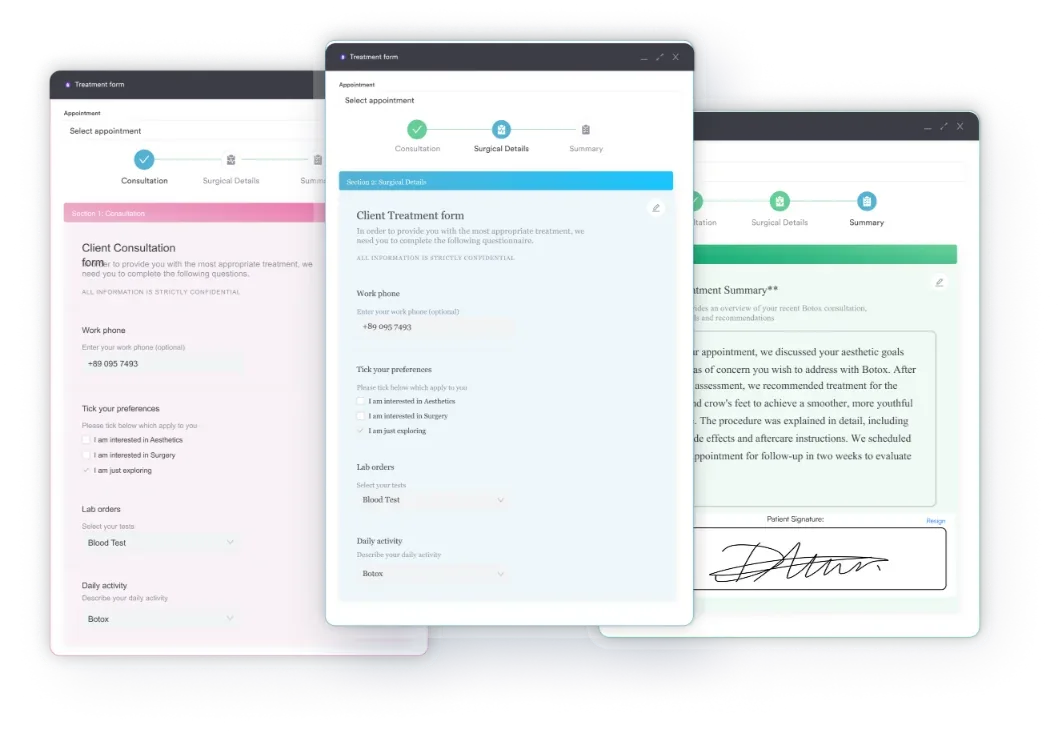
Start from scratch, or upload this PDF or any form you already use, and Pabau's AI Form rebuilds it with tick boxes, text fields and a signature. Attach it to the treatment once, and every patient gets it on time.
AI Form rebuilds the consent, history and aftercare forms you already use. You review each one, then publish.
Patients complete forms on their phone before they arrive, so the front desk stops retyping paper.
Every signed form is versioned and attached to the treatment record, ready when you need it.
Set how long a consent stays valid. Returning patients skip forms they have already signed.
Supports HIPAA and GDPR compliance AES-256 encryption 4.8 on G2 4.7 on Capterra Trusted by 4,000+ practices worldwide

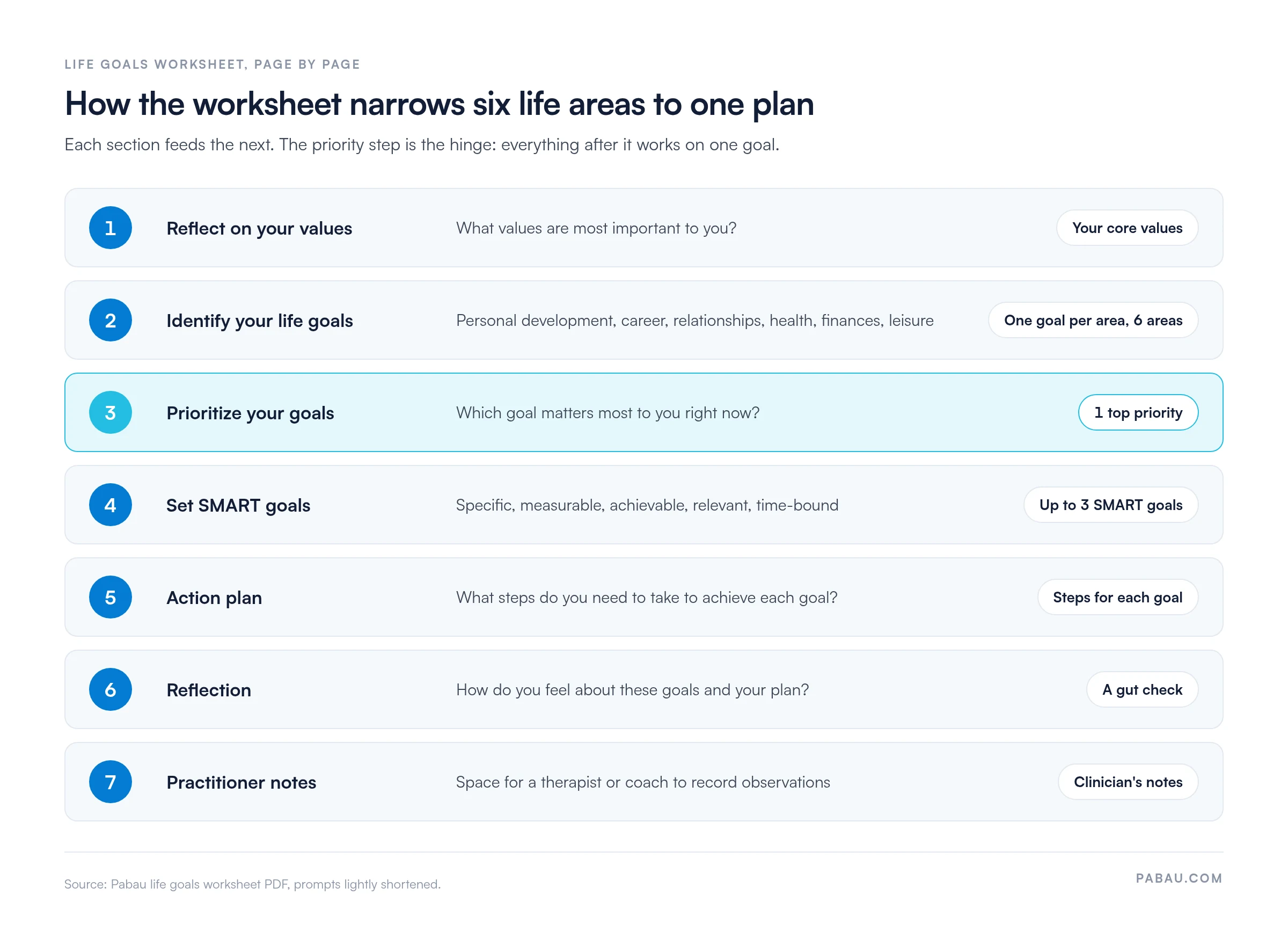
The worksheet starts with your values, then asks for a goal in each of six life areas.
Choosing one priority before you write SMART goals keeps the plan small enough to act on.
A goal without a number to measure and a date to finish by is still a wish.
Write a review date in the Next session date field, or beside your reflection, because priorities shift as circumstances change.
Therapists and coaches can send it once treatment goals are agreed, so patients arrive at the next session with reflections already started.
A life goals worksheet is a printable tool that asks you to reflect on what matters before you choose specific goals. Instead of starting from a blank page, you answer a sequence of prompts that connect your values to the actions you want to take.
That order matters more than it looks. Goals written without a values check often belong to someone else, like a parent, a manager or the people you follow online. If you can’t name your values yet, a values worksheet is a good warm-up.
Starting from values is also central to Acceptance and Commitment Therapy (ACT), where clarifying what matters to you comes before committed action toward it.
A little preparation makes the first pass quicker and the answers more honest. Have these ready:
The worksheet runs in a fixed order, and each section feeds the next. The flow below shows how six life areas narrow down to one plan.
Not sure how satisfied you are in each area to begin with? A quick wheel of life assessment gives you a baseline before step two.
SMART goals give each entry a test it has to pass before it goes on your list. The acronym is usually credited to George Doran, who wrote about it in 1981, and it remains a common framework in coaching and management.
The letters have shifted over time. Doran’s version used assignable and realistic, where most worksheets now say achievable and relevant.
Research backs the format. Locke and Latham’s goal-setting theory, built on decades of studies, found that specific, challenging goals beat vague aims like “do your best.”
Here’s how it works on a health goal written as “get fitter.” Run it through the five letters, and a vague hope becomes something you can start on Monday.
The finished line reads: walk for 30 minutes before work, three mornings a week, and review progress in 12 weeks. That’s one sentence you can check off, where “get fitter” gave you nothing to check. For more practice with the format on its own, try our SMART goals worksheet.
A worksheet rarely stalls on the day you fill it in. It stalls a few weeks later, for reasons you can spot while you’re still writing.
1. Six big goals at once. Ambitious goals in every area compete for the same hours.
Mark one or two areas as “keep steady” instead.
2. Skipping the values prompt. Without it, you have nothing to settle a tie when two goals pull in different directions.
Answer the values prompt first, then use it to decide between goals that clash.
3. Hiding the trade-offs. A career goal that needs long hours may leave no room for a health goal.
Write the conflict down and decide which one gives way.
4. Steps you can’t start. “Get promoted” is an outcome.
“Ask my manager what the next role requires” is a step.
5. No review date. A worksheet nobody reopens stops reflecting your life within a few months.
Use the Next session date field as your review date, or write one beside your reflection.
The worksheet suits adults planning their own direction, therapists and counselors who want a structured reflection tool, and coaches running goal-setting sessions. Each group uses it for a different purpose, so the same template can serve several roles.
In therapy and counseling settings, clinicians usually treat the worksheet as a supplement to their own assessment and treatment plan. It is a planning tool, and it does not replace professional therapy or counseling.
Coaches can pair it with the competency framework of the International Coaching Federation, which covers goal setting within its client growth competencies. If you run a coaching business, coaching client management software keeps each client’s sessions, notes and goals together.
The main benefit of a life goals worksheet is that all your goals sit in one place, so you can see how they connect. Goals spread across separate notes are easy to forget, while goals on one page are easy to compare.
That single page also makes reviews quick. A short monthly check, plus a full rewrite after a big change like a new job or a move, keeps it current.
Wellbeing planning fits naturally into this process. The NHS Every Mind Matters campaign offers public guidance on looking after your mental health, which can sit alongside any personal goal work.
Keep two copies of the worksheet. Use the first for rough drafts, then transfer your final goals to a clean copy with the date written on it. A dated version lets you compare your priorities at each review, which is far easier than trying to remember what you once wrote. Store the dated copy where you can find it, such as a shared folder or a notebook you keep beside your planner.
Plenty of therapists still hand the worksheet over on paper, then scan it or retype the answers later. Pages go missing, and the goals rarely make it back into the next session.
Once you and the patient have agreed treatment goals, Pabau, the practice management platform we build, sends the worksheet as one of your digital forms. Patients arrive at the next session with their reflections already started, and the answers sit in their patient record beside your session notes.
That keeps goal reviews part of ordinary care instead of a separate paper chase. For therapy practices, it all runs inside the same therapy practice management system that handles booking, reminders and payments.
Want to see how goal planning fits into patient intake at your practice? Book a demo and we’ll walk you through it.

See how Pabau’s digital forms deliver the worksheet once treatment goals are set and keep each patient’s goals next to their session notes.

Treat the worksheet as a draft you’ll come back to, not a one-off exercise. Fill it in once, choose one priority, and write a review date in the Next session date field before you close the file.
The trade-off is focus. Choosing one priority means the other five areas wait, and that can feel uncomfortable. It’s also why the plan has a fair chance of surviving its first busy week.
If you use the worksheet with patients, the payoff comes from keeping their goals visible between sessions. Book a demo to see how Pabau sends goal worksheets ahead of a session and keeps each answer on the patient record.

Need a step-by-step plan for one goal? Action plan template gives a single goal its own page of steps and deadlines.
Tracking goals across therapy sessions? Client goals template shows how to frame goals inside a 5 Ps case formulation.
Starting work with a new coaching client? Life coach intake form collects background and goals before the first session.
Want to explore purpose as well as goals? Meaning in life questionnaire measures how much meaning a person feels, with a scoring guide.
Planning a full coaching program? Coaching plan template maps sessions, milestones and outcomes for a coaching engagement.
Start with your values and a goal for each main area of life. Then add a single top priority, SMART versions of that goal and an action plan. A reflection prompt helps, and the Next session date field doubles as your review date.
There is no single standard model, but one common version lists career, finances, health, family, social life, personal growth and spirituality. This worksheet uses six areas, folding family and social life into relationships and swapping spirituality for leisure.
A quick monthly check works for most people, with a full rewrite every three to six months. Revisit it sooner after a big change, such as a new job, a move or a diagnosis.
No. A life goal is the long-term direction, such as “be financially secure.” A SMART goal is a measurable step toward it with a deadline, such as saving a set amount each month for a year.
Yes, with some adjustment. Swap career and finances for school, skills and saving, and have a parent, counselor or coach talk through the priority step with them.