Printable values cards: What they are and how to use them in therapy
Printable values cards are a reflection tool that helps a patient work out which...

15
Last Updated: Sep 30, 2026
An all about me worksheet for adults is a guided self-reflection form that maps your background, values, strengths, goals, interests, and relationships in one document. This free PDF has eight sections and takes 45 to 60 minutes to complete. It suits therapy intake, coaching, adult education, and personal development work.
Therapists and coaches often hand it out before a first session, so the conversation starts from the person’s own account of their life. Download it below, then follow the steps to complete it, review it, and come back to it a few months later.
An eight-section PDF with prompts on personal details, life history, values, strengths, areas for growth, goals, hobbies, and relationships. Print it for pen and paper, or fill it in on screen before a therapy or coaching session.
Download template
An all about me worksheet for adults is a guided self-reflection tool covering personal background, values, strengths, goals, and interests.
The PDF’s eight sections run from life history and relationships to beliefs, skills, and future plans. Laid out together, the answers make patterns easier to spot.
Clinicians use these worksheets in therapy intake, coaching, occupational therapy, and group work to gather personal context before treatment planning.
Completing the worksheet again after three to six months gives a baseline to compare against, which shows how values and goals have shifted.
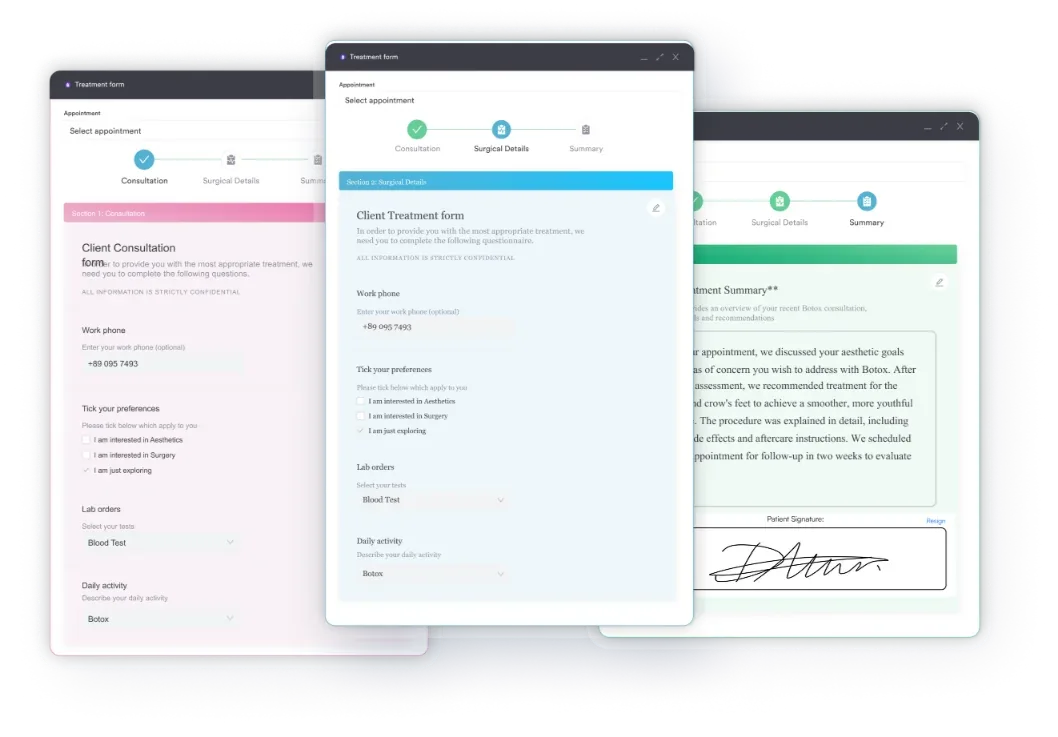
In Pabau’s practice management software, the worksheet can go out as a digital form and save to the patient record next to progress notes.
An all about me worksheet for adults is a structured questionnaire that guides self-reflection across the main areas of a person’s life. It mixes open-ended prompts with targeted questions, which helps uncover patterns in thinking, values, and goals.
Adult versions differ from child-focused ones in tone and depth. They assume life experience, responsibility for decisions, and the capacity for introspection. So they cover work challenges, relationship dynamics, financial stress, and bigger questions about meaning that a children’s exercise would skip.
The prompts usually fall into six areas:
If identity is the main question a patient is working through, a narrower who am I worksheet goes deeper on that one theme.
The PDF has eight sections, each with prompts that build a snapshot of your background, values, and plans.
Some patients stall on the values and beliefs section. A scored values test can give them words for what matters before they write their own answers.
The worksheet works in six settings, and each one uses it for a slightly different job.
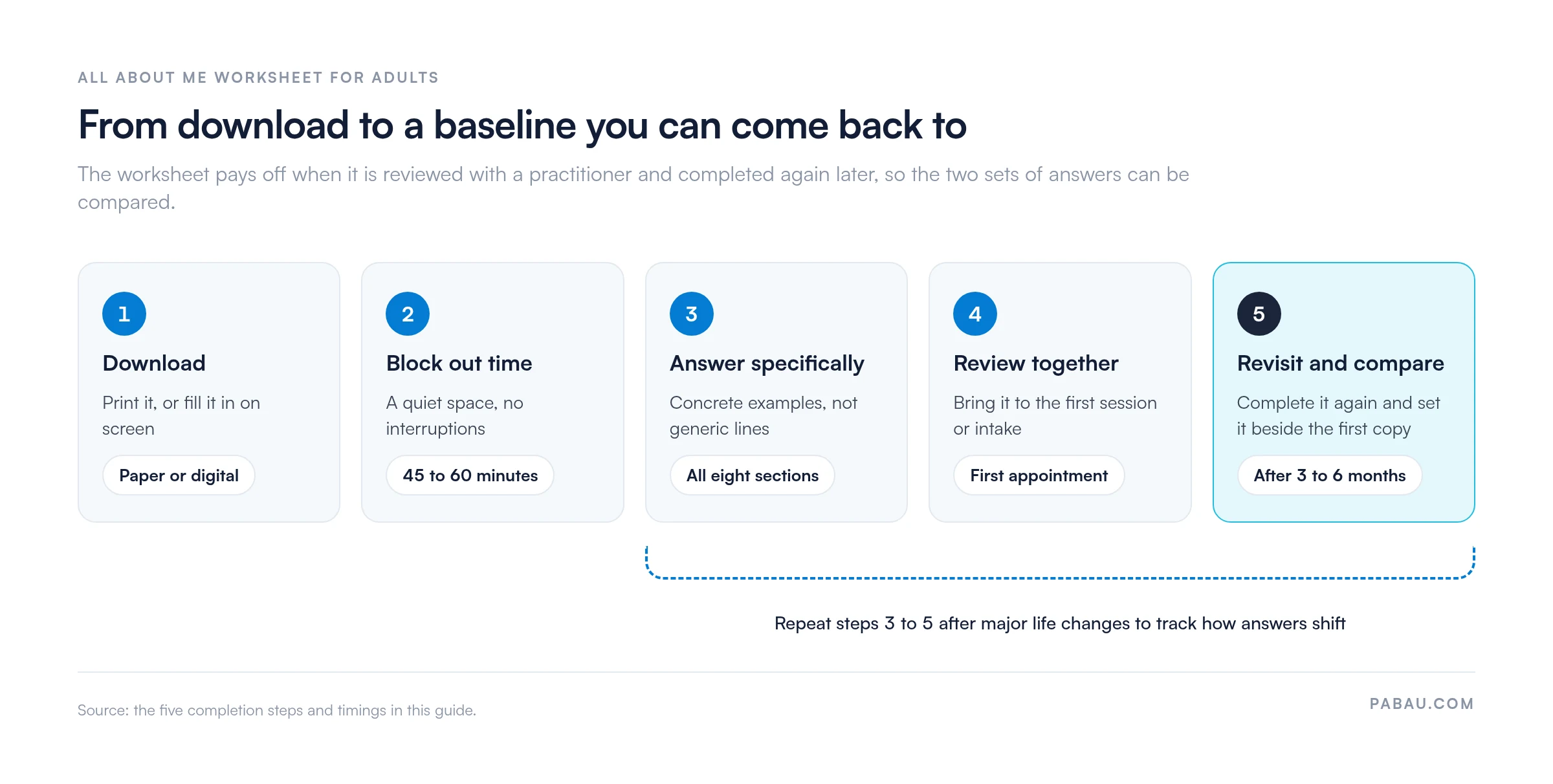
Five steps take the worksheet from download to a useful document for therapy or coaching, and the last step loops back to the third.
For practitioners, sending the worksheet as one of your digital intake forms means the answers arrive before the session. They then stay in the patient’s clinical record, next to treatment notes, progress tracking, and follow-up assessments.
Self-reflection gets easier with practice, and a few habits make the first attempt more useful. If the strengths section stays blank, a self-esteem worksheet for adults can be a gentler place to start.
Mental health practitioners, occupational therapists, and coaches fold the worksheet into assessment and treatment planning. The structured answers help build rapport faster, target interventions, and set clearer treatment goals.
In therapy intake: Therapists review completed worksheets before or during the first session to understand patient history, current stressors, and values. That context leads to deeper follow-up questions and surfaces themes that might otherwise take several sessions. Pair it with an adult counseling intake form for the clinical history.
In group work: Facilitators use adapted versions as icebreakers and as a structure for discussion. Participants complete the worksheet alone, then share selected sections with the group.
In coaching: Coaches use the worksheet to record how a client sees themselves at the start. They then build accountability around the goals and values the client listed. Revisiting it six months later shows the client how far they’ve moved.
Clinical documentation: Stored through medical records management software, worksheet answers stay available throughout treatment. Clinicians can link presenting concerns back to the life history and values the patient described at intake.
A dated, completed worksheet also documents that the patient took part in their own assessment, which helps when notes are reviewed or audited.
Many practices still print the PDF, hand it over in the waiting room, and scan it into a folder afterward. The answers arrive late, and by the three-month review nobody can find the first copy.
Pabau, the software built for therapists and other practitioners, sends the worksheet as a digital form before the first appointment. Completed answers save straight to the patient record, so you can read them before the session and keep them open beside your notes.
When it’s time to revisit, you send the same form again and compare both versions in one place. Patients spend the session talking, and you skip the scanning and searching.

Pabau sends intake worksheets as digital forms before the appointment and saves every answer to the patient record, ready for treatment planning.

The worksheet earns its 45 to 60 minutes only when somebody reads it. Filed away, it stays a journaling exercise. Reviewed in the first session and completed again at three to six months, it becomes a baseline you can measure change against.
If you run a therapy or coaching practice, decide now where completed worksheets will live. Then they are on hand when a patient’s goals come up again. Book a demo to see how Pabau collects intake worksheets before the first session and keeps them with the patient’s notes.

Want a shorter reflection exercise? Self reflection worksheet gives patients a quicker set of prompts between sessions.
Need a lighter way to keep reflection going? Fun journal prompts for adults turns the themes from the worksheet into regular journaling.
Running a full mental health intake? Mental health intake covers the clinical history that sits alongside the worksheet.
Want to check in between appointments? Mental health check-in worksheet tracks mood and coping from one session to the next.
An all about me worksheet for adults is a structured self-reflection tool covering personal background, values, strengths, goals, hobbies, and relationships. Therapists and coaches use it to understand a person’s context before treatment planning, and adults use it to build self-awareness.
Yes. You can add your practice logo, adjust questions to match your clinical focus, and remove sections that don’t apply to your patients. A medical practice might stress health history, while a coach might add questions on financial stress. Most practitioners add two or three practice-specific questions and keep the core sections.
Most adults finish the worksheet in 45 to 60 minutes. The time depends on writing speed, the depth of reflection, and whether someone writes beyond the space provided. Encourage patients not to rush, because hurried answers are less useful for treatment planning.
Yes. Group facilitators adapt the worksheet as an icebreaker and a structure for discussion. Participants complete it alone, then share selected sections with the group. Group versions often focus on aspirations, strengths, and interests rather than sensitive personal history.
Store completed worksheets in the patient’s clinical record within your practice management system, not in separate files or emails. Encrypted storage with access controls supports data protection compliance and keeps worksheets easy to find at follow-up appointments. Scan paper copies into the record, then store or destroy the originals securely.