Antipsychotic medication list
An antipsychotic medication list is a structured reference that organizes psychi...

2
Last Updated: Oct 13, 2026

Motivational interviewing (MI) is a way of talking with patients that draws out their own reasons for change, rather than pushing yours.
The four OARS skills are open-ended questions, affirmations, reflective listening, and summaries. They carry most of an MI conversation.
A script gives you the exact wording for the conversations you have most: medication adherence, weight, substance use, and lifestyle change.
Write the patient’s own change talk into their record, in their words. That is what the next appointment picks up from.
Practice management software like Pabau keeps the note, the forms, and the agreed follow-up in one patient file.
A structured guide with annotated sample dialogues and an OARS question bank you can read straight from. It includes role play scripts for staff training and question sets for medication adherence, weight management, and lifestyle change.
Download templateA motivational interviewing script is a worked example of the conversation. It shows what you ask, how the patient answers, and which skill you just used. Instead of handing out advice, you draw out the patient’s own reasons for change. This template gives your team dialogues to adapt for consultations or for in-house training.
Below you’ll find an annotated sample dialogue, the OARS question bank behind it, and the habits that quietly undo an MI session. It also covers what to write in the patient’s record afterward, so the next appointment can pick up the same thread.
A motivational interviewing script is a structured example dialogue between a clinician and a patient that models the collaborative spirit of MI.
Psychologists William Miller and Stephen Rollnick developed the method in the 1980s. It is now a standard communication approach in mental health, addiction treatment, adherence coaching, and chronic disease care, and is maintained today by the Motivational Interviewing Network of Trainers, the international body that trains and certifies MI practitioners.
The spirit of MI rests on four principles:
A good script models that spirit turn by turn, with each clinician line tagged by the skill it uses. What separates it from a generic conversation guide is the evidence underneath.
Certain question types, affirmations, and reflections increase change talk, meaning the patient’s own statements in favor of change. They also reduce sustain talk, which is the case for staying as things are.
A patient holding both positions at once needs a way to weigh them. A values ranking worksheet asks them to write down what matters and rate each one, which surfaces the conflict before you ask about change.
Written up in organized patient records, those conversations also leave a clinical audit trail that supports HIPAA and GDPR requirements.
Here is a short adherence conversation with a patient who keeps missing doses of a blood pressure tablet. The right-hand column names the skill behind each clinician turn.
| Speaker | What is said | Skill used |
|---|---|---|
| Clinician | “What worries you most about taking the tablets every day?” | Open-ended question |
| Patient | “I forget half the time. And the cost adds up.” | Barriers named |
| Clinician | “You’re managing this on a tight budget and still getting most doses in.” | Affirmation |
| Patient | “I try. I don’t want to end up on insulin like my dad did.” | Change talk |
| Clinician | “So the cost stings, and staying off insulin matters more than the cost.” | Reflective listening |
| Clinician | “Where does that leave you for the next month?” | Evocative question |
| Patient | “I could try a pill box and see how a month goes.” | Commitment talk |
| Clinician | “Cost is the obstacle, your dad is the reason, and a pill box is your next step.” | Summary |
Notice that the clinician never argues and never prescribes a plan. Every turn either invites the patient to say more or repeats their own words back to them. The pill box was the patient’s idea, which is why they are likely to try it.
The note afterward should quote the last two patient lines almost verbatim. “Doesn’t want to end up on insulin like my dad” is worth far more at the next appointment than “counseled on adherence”.
The script works best once you have adapted it to your own patients. Five steps get you there:
Scripts are teaching tools, not permanent crutches. After a few months your clinicians will run the conversation without one, and the template becomes something you hand new staff in week one.
Running this form inside a GP practice system keeps clinical documentation in one place.
MI scripts earn their place across a wide range of clinical and coaching roles:
Inside the practice. The same applies to therapy practice workflows, where several clinicians often share a caseload.
New clinicians get there faster. An annotated dialogue shows the phrasing, the timing, and the tone of competent MI. A textbook chapter describes them.
Less drift under pressure. When clinics get busy, clinicians slide back toward advice-giving and persuasion. A script pulls the team back to the technique.
Documentation that matches. When everyone follows the same clinical note standards after an MI session, the audit trail holds up. That supports HIPAA in the US and GDPR in the UK and EU.
Confidence in the hard moments. A script gives you wording for the objection you dread. Clinicians who have rehearsed it in role play tend to stay in MI mode when a patient pushes back.
Something you can measure. Teams working from a script record change talk and sustain talk more consistently. That gives you a way to track patient engagement alongside clinical outcomes, instead of guessing whether the training landed.
Track your MI ‘hit rate’ by noting in each patient record whether the session produced at least one change talk statement from the patient. Reviewing that note monthly tells you whether the technique is landing, long before any outcome data arrives.
A script in hand does not stop the old habits. These are the ones that surface most often:
MI is not a treatment on its own. It is the communication layer that makes other interventions stick, and it earns its keep in these situations:
MI conversations also need room in the diary. Your patient scheduling software can flag the appointment types that deserve a longer slot, such as a new diabetes diagnosis or a first addiction visit.
The MI session usually goes well. What fails is the handover. The change talk lives in one clinician’s memory. The barriers get summarized as “counseled on lifestyle”. Three months later nobody knows what the patient agreed to. So the next appointment starts from scratch and the patient repeats themselves.
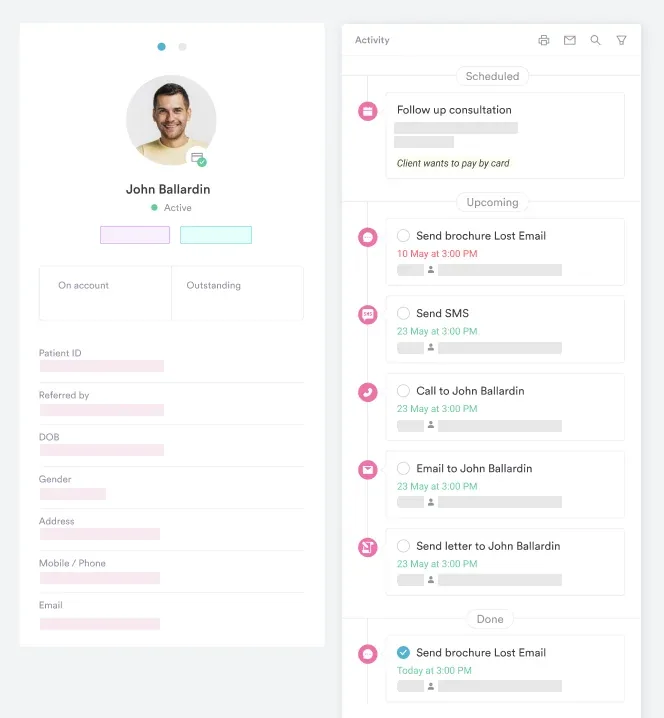
Pabau is an all-in-one practice management system, and it puts that detail somewhere it survives. Digital forms collect the patient’s stated reasons and barriers before they sit down. Pabau Scribe, our AI scribe, drafts the treatment note from the session. The patient’s own wording lands in the record, not a summary of it.
The follow-up sits in the same file. Reminders, messages, and the next appointment all attach to the patient record, so whoever sees them next opens one screen and knows what was agreed. Every subscription includes all of it, and the records stay compliant with HIPAA and GDPR as they build up.

Pabau’s digital forms and treatment notes capture what the patient said and what they agreed to. Your team opens the file at the next visit and picks up the same thread.

Download the script, then run one role play session with your team before anyone uses it on a patient. Reading a dialogue and saying it out loud are different skills, and the second one is what shows up in the consultation room.
The trade-off worth remembering is that MI takes longer up front. You spend 10 minutes drawing out motivation that you could have spent issuing instructions. What you buy is a patient who states the plan in their own words, which is the version they tend to follow.
Then protect the part that usually gets lost. Write the change talk down in the patient’s words, and keep it where the next clinician will find it. Book a demo to see how Pabau captures MI conversations and the follow-up they lead to.

Screening for psychopathic traits in a case? Psychopath spectrum test template offers an evidence-informed framework for evaluating psychopathic traits across a continuum.
Looking for a values exercise to open the conversation? The wellness wheel worksheet gives patients a way to name which part of their life they want to work on first.
Working with patients who carry trauma? Somatic experiencing exercises cover body-based techniques that pair well with MI when talking alone raises a patient’s distress.
Need structure for a high-risk conversation? The suicide prevention worksheet sets out a safety planning format for the sessions where MI on its own is not enough.
Looking for a spectrum screening tool instead? The RAADS-R test provides structured data across sensory, social, and interest-based domains for diagnostic evaluation.
An example script is a turn-by-turn dialogue between clinician and patient, tagged with the skill used in each turn. Here is a short one. Clinician: “What worries you about taking your blood pressure medication?” Patient: “I worry about the side effects.” Clinician: “You’re concerned the medication could cause problems worse than the blood pressure itself.” That last turn is a reflection rather than advice, and it invites the patient to say more.
OARS stands for open-ended questions, affirmations, reflective listening, and summaries. These four skills carry most of an MI conversation. Open questions invite detail instead of a yes or no. Affirmations name something the patient has already managed. Reflections show you understood them. Summaries collect what the patient said and point the conversation forward.
Start by handing the patient the floor. Open with “What brings you in today?” or “How have things been going since we last spoke?” Let them finish without interrupting, then ask one open follow-up about whatever they raised. Those first two turns set the collaborative tone and tell you how ready the patient is to change.
Yes, and it is used across most of them. Family physicians, mental health clinicians, addiction specialists, diabetes educators, nurses, and health coaches all work with MI. The evidence supports brief MI inside routine appointments, where it improves medication adherence, lifestyle change, and engagement with substance use treatment.
Change talk is anything the patient says in favor of change, such as “I want to lose weight because I would feel better.” Sustain talk argues for the status quo, such as “I don’t think I can stick to a diet.” In MI you explore change talk further and meet sustain talk with a reflection instead of an argument.
Record the patient’s change talk in their own words, the barriers they named, and the one next step they agreed to. If your team is still learning, note which OARS skills you used. Keep all of it in the patient record rather than a separate training file, so the next clinician can pick the thread back up.