Co-parenting agreement
A co-parenting agreement is a written plan that separated or divorced parents us...

Last Updated: Oct 15, 2026
A sense of belonging scale is a validated psychological assessment tool that measures how connected, accepted and included a person feels within their social environment. Clinicians use it to understand social integration and to spot patients who may benefit from interventions that build community connection.
The free PDF on this page reproduces the 16-item Sense of Belonging Scale (SBS), scored on a 5-point Likert scale. Below, you’ll find how to introduce and score it, and which named versions suit which populations.
A six-page PDF of the 16-item Sense of Belonging Scale, with 1–5 response options under each statement and the reverse-scored items starred. It closes with boxes for SBS-8 and SBS-16 scores and space for notes.
Download template
A sense of belonging scale measures perceived connection and inclusion, not a clinical diagnosis.
Named versions differ in population and item set, so confirm which one you are using.
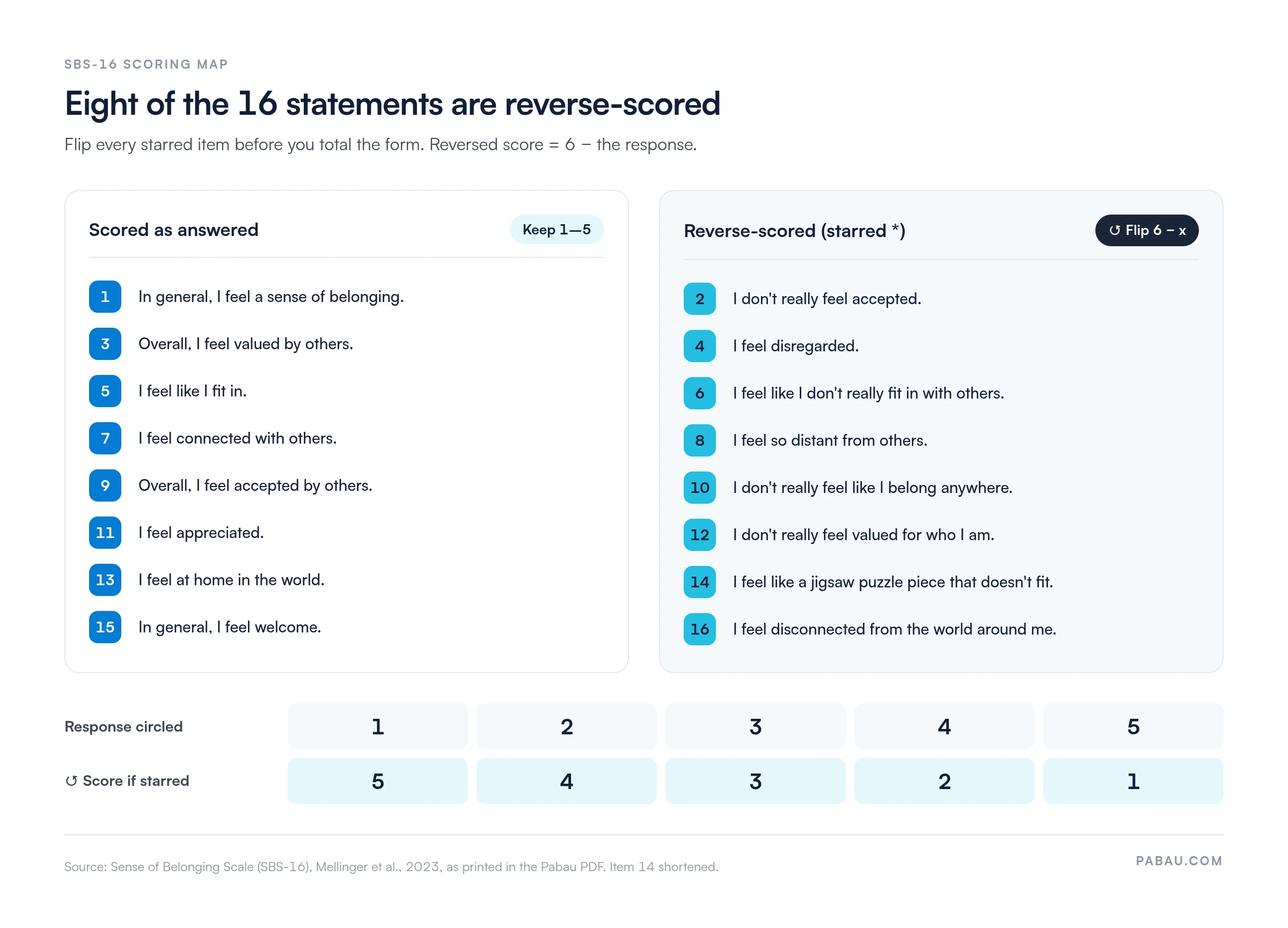
Half of the 16 statements on the SBS are reverse-scored, so flip them before you total the form.
Interpret scores against the original validation study rather than unsourced cutoffs.
Pabau, the practice management platform we build, lets you attach the scale to a patient record and track responses over time.
A sense of belonging scale is a self-report questionnaire about social connection. It asks people to rate how strongly they feel connected to, accepted by and part of the groups around them. Respondents answer a set of statements, usually on a Likert-type rating scale. The responses are combined into a score that reflects perceived belonging.
It is a measurement instrument, not a diagnostic tool. The result gives a clinician a structured starting point for a conversation about social connection, but it does not label a condition.
Researchers use these scales with student populations, workplaces and community groups. In clinical practice, a result can prompt a useful discussion when a patient presents with low mood, loneliness or social anxiety. It pairs well with the UCLA loneliness scale, which measures subjective loneliness and social isolation.
Several named versions exist, and they are not interchangeable. The versions table later in this article summarizes the four you are most likely to encounter.
Introduce the scale as a short, optional questionnaire, and give the patient a quiet setting to complete it. Then review the responses together rather than scoring them in isolation. Most clinicians follow a simple sequence:
Use the PDF as the working copy. Print it for in-person sessions, or keep the completed form with the rest of the patient file. If you already collect patient information online, you can send the questionnaire before the session through digital intake forms.
If you document sessions with AI-assisted clinical documentation, record the discussion of scores alongside the scale so the reasoning stays with the result. In Pabau Scribe, our AI scribe, that discussion becomes a drafted note in the patient record.
The sense of belonging scale is used most often by mental health professionals, psychologists, counselors and researchers. It suits any setting where social connection is part of the clinical picture.
Psychologists and psychiatric practices typically use it as one input alongside a full clinical interview. Counselors and therapists may use it at intake or to revisit belonging later in treatment.
A structured scale gives you a consistent way to raise belonging, which otherwise tends to surface only in passing. Keeping to the same version and administration method also makes responses easier to compare over time.
For practice managers, a digital version cuts paperwork. Responses stored in the patient record are easier to find at review, audit or handover.
Record the version name, date and setting every time you administer the scale. Without those details, a shift in score could come from a different instrument or setting, and you would have no way to tell.
Four versions come up most often in published work and in practice. Check the item set and intended population for each before you choose one. Related instruments such as the social connectedness scale cover overlapping ground, so name the instrument in your notes to avoid mixing results.
Sense of belonging is related to, but distinct from, constructs such as self-efficacy and self-compassion. Published evidence on those cross-scale relationships is limited, so avoid claiming that one scale predicts another. If coping confidence is the clinical question, the coping self-efficacy scale measures it directly.
Review the original validation papers on PubMed before you cite reliability or validity figures. The American Psychological Association also publishes ethical guidance on using psychological assessments responsibly.
Score the scale using the method in the version you have chosen. Do not apply cutoff scores that you cannot trace to a published validation study, because scoring direction and reverse-coded items differ between versions.
On the 16-item SBS in the PDF above, eight statements are negatively worded and marked with an asterisk. “I feel disregarded” is one of them, and each one is reversed before you total the form. On a 1–5 scale, the reversed score is 6 minus the response, so a 2 becomes a 4. The map below shows which items flip.
Treat a total score as one piece of evidence about perceived belonging. A low score may point to thin social connection, but it can also reflect current mood, recent events or how the patient read the wording.
Track scores over time, but discuss change with the patient rather than reporting a single number. A sustained shift is usually more informative than one reading.
On paper, the scale gets printed, scored by hand and filed. Comparing a second administration months later means finding the first sheet and repeating the reverse-scoring by hand.
In Pabau, the questionnaire goes out as a digital form before the session, and completed responses land in the patient record next to your notes. Practices that run Pabau as their software for therapy practices keep intake, notes and assessments in the same place.
Each completed scale is dated and attached to the patient, so you can compare results across sessions without retyping a score. That leaves the review time for the conversation with the patient.

Book a demo to see how assessment scales, digital forms and patient records fit into your practice workflow.

The sense of belonging scale is most useful as a structured opening to a conversation about connection. It does not settle a clinical question by itself.
Pick one version that matches your patients, record which one you used, and keep reverse-scoring consistent every time. Do that, and a change in score across sessions becomes something you can discuss with confidence.
The trade-off is depth for speed. A 16-item form takes minutes, so pair it with a clinical interview before you act on a low result. Book a demo to see how Pabau keeps every completed scale in the patient record, ready for the next session.

Measuring the support side of connection? Social support scale rates how much support a patient feels from the people around them.
Screening for loneliness as well? Chronic loneliness test gives you a short screen to run alongside the belonging scale.
Mapping a patient’s relationships? Social network index counts the social roles and contacts a patient maintains.
Building a fuller intake picture? Psychosocial assessment places belonging inside a structured review of social and psychological history.
Setting up a psychology practice? Psychology practice software explores how practices handle assessments and records.
Belonging and belongingness refer to the same underlying construct in most research literature, so the terms are often used interchangeably. Some authors use belongingness for the broader human need for social connection and belonging for the felt sense of connection in a given setting.
Yes. The PDF on this page reproduces the 16-item Sense of Belonging Scale as a printable template, with boxes for SBS-8 and SBS-16 scores. Check the version details against the original publication before using it in a formal assessment.
No. It is a self-report measurement tool that describes perceived belonging, so it should inform clinical judgment rather than replace a diagnostic assessment.
Choose the version whose population and setting match your patient group. For university students, belonging items or indices drawn from the NSSE survey may fit better. Confirm the item set and scoring rules in the original source before use.