Social work treatment plan
A social work treatment plan is a written document that sets out a client’...

1
Last Updated: Oct 20, 2026
My Life Story Journal is a free, printable template that guides you through recording your personal history, memories, and values for your family. Unlike a diary, which captures daily events, it organizes a whole life into themed chapters with gentle prompts in each one. Seniors use it to leave a legacy, adult children use it to interview aging parents, and therapists use it for reminiscence work.
Download the PDF below, print it or fill it in on screen, and work through the chapters at your own pace. Most people finish in two to three months.
A printable journal with guided prompts for childhood memories, family history, career milestones, relationships, personal values, and legacy reflections. Print it and write by hand, or fill it in digitally at your own pace.
Download template
A life story journal uses guided prompts to help you record your history, memories, and values as a keepsake for your family.
The template splits a life into themed chapters, so you never face a blank page and can start with whichever one feels easiest.
Save the values and life lessons chapter for last, once the story itself is on paper.
Working through one or two sections a week, most people finish in two to three months.
Therapists and counselors can use the same prompts for reminiscence and life review work with aging patients.
A life story journal is a guided template for documenting your personal history so it can be passed down. A diary records daily events, and an autobiography is usually a polished narrative. A life story journal sits between the two, using prompts to capture the people, experiences, and values that shaped you.
It typically covers childhood, family, education and career, marriage and parenthood, beliefs, challenges overcome, and lessons learned. Each prompt is a gentle question meant to spark a memory, so you don’t need to be a confident writer. Your children and grandchildren end up with a record of where they come from.
The process has psychological value too. Life review and reminiscence work are techniques recognized by the American Psychological Association. For older adults, guided life review is linked to better emotional wellbeing, cognitive engagement, and sense of purpose.
Work through the template at your own pace and in any order, on paper or on screen.
The template is organized into four life chapters, each with prompts that help you capture that period in detail. Here’s how they fit together, and the order that tends to work best.
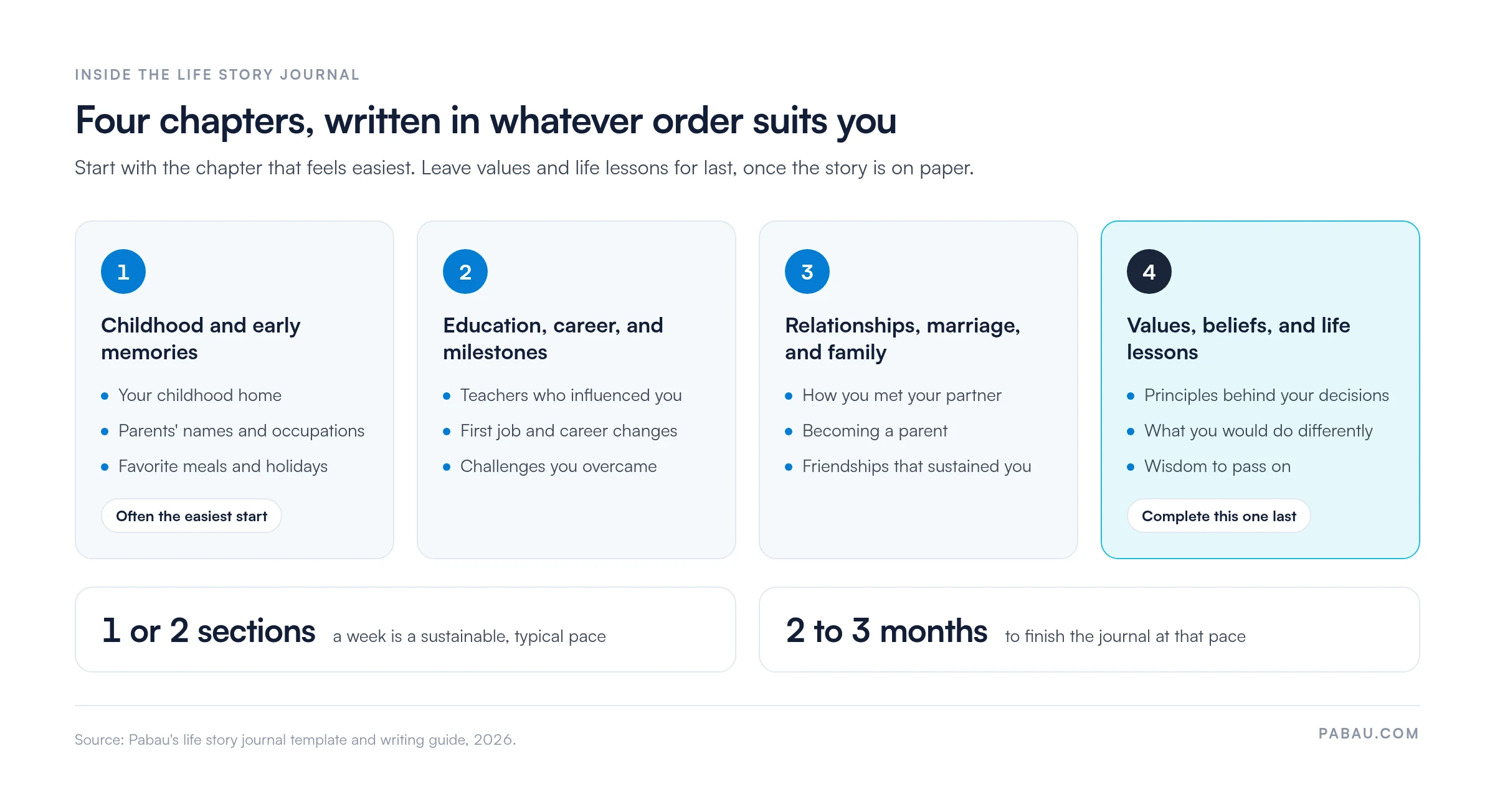
Begin with your earliest memories: where you grew up, your parents and siblings, family traditions, and the games you loved. The prompts ask about your childhood home, your parents’ names and jobs, favorite meals, and memorable holidays. They also ask what your parents taught you about right and wrong.
This chapter is often the easiest to complete, because childhood memories tend to be vivid. Take your time, and include the small details that made your childhood yours.
This chapter covers your schooling, your working life, and the milestones that shaped your adult identity. Describe the schools you attended, favorite subjects, teachers who influenced you, and your first job. Then move on to career changes, accomplishments you’re proud of, and challenges you overcame.
Finish with how your work shaped your sense of purpose. If you spent your career in healthcare or therapy, this is a chance to reflect on the patients and colleagues you influenced.
Share the story of your most important relationships. Describe how you met your spouse or partner, meaningful moments together, becoming a parent, and your bond with your children. Include the siblings you were close to, friendships that sustained you, and people who changed your life unexpectedly.
The final chapter shifts from events to reflection. What do you believe in, and which principles guided your decisions? What would you do differently, and what wisdom do you want to leave your grandchildren? This chapter turns the journal from a record of events into a statement of who you are.
If your values are hard to put into words, rank them first with a life values inventory. Then write about the top few.
A blank page can feel daunting, so a steady routine matters more than inspiration. These four habits keep the journal moving.
If your memories feel jumbled, sketch a life events timeline before you start. It gives each story a place in the sequence, so the chapters fill in faster.
A life story journal is especially valuable for older adults, whether they complete it alone or with an adult child’s help. Keep these points in mind.
Research from the National Institute on Aging supports life review and reminiscence in later life. Both are linked to cognitive engagement, emotional processing, and a stronger sense of purpose.
Once complete, the journal becomes a family keepsake. Here are a few ways to share it.
A finished journal lets relatives you’ll never meet learn what you valued and where they come from.
Each format has distinct advantages. The right choice depends on your comfort with technology, whether you prefer handwriting, and how you plan to share the journal.
Many people start with the printed template and scan it once it’s finished. That pairs the feel of handwriting with a copy that can’t be lost.
For therapists, counselors, and mental health practitioners, the journal doubles as a clinical tool. Many practitioners use life story frameworks to help patients process identity, meaning, and family patterns.
The prompts suit aging patients, patients working through grief or a major transition, and anyone trying to strengthen family relationships. Assign one chapter between sessions, then use the answers to open the next conversation.
When the family chapters surface unresolved hurt, a radical forgiveness worksheet gives the patient a structured way to address it. For a patient who needs daily structure rather than chapter work, add a year of daily prompts between appointments.
If the chapters feel too heavy, lighter journal prompts give the patient an easier way back to the page between sessions. That set comes with a log for triggers and intensity, so the next appointment starts from what the patient recorded.
Once the journal is part of treatment, the answers belong in the patient’s clinical record. Keeping them in a mental health EMR puts each reflection next to the session notes it informed.
In many therapy practices, life story work still runs on paper. The therapist prints the PDF, the patient brings pages back, and someone scans them into the file.
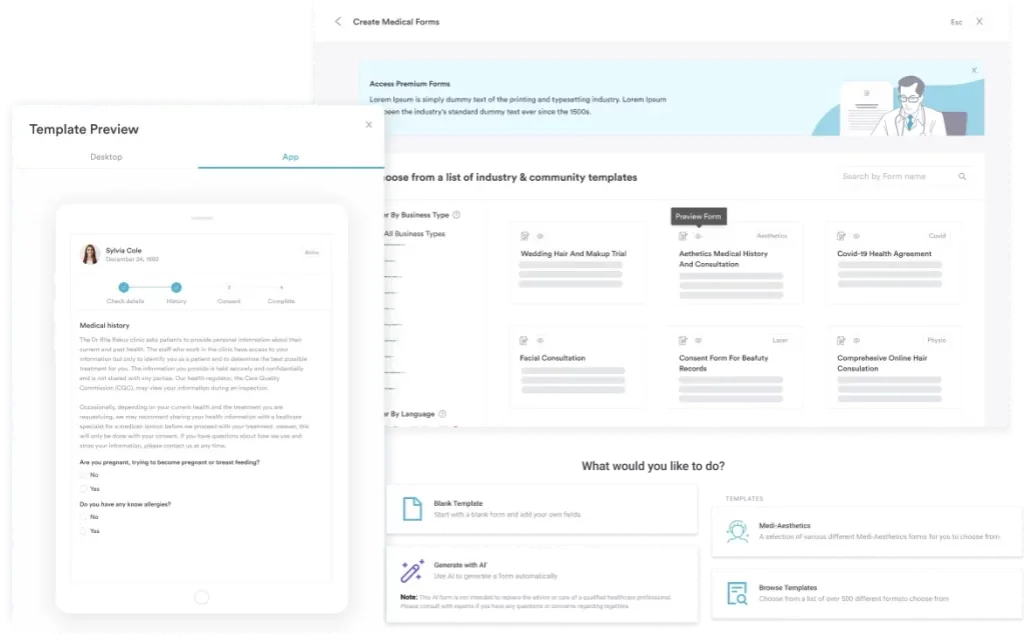
Practice management software like Pabau takes the paper out of that loop, bringing forms, notes, and scheduling together for easier therapy practice management. You can rebuild the journal’s prompts as a digital form, or start from Pabau’s form template library. Patients complete a chapter at home before their appointment, and the answers land on their record.
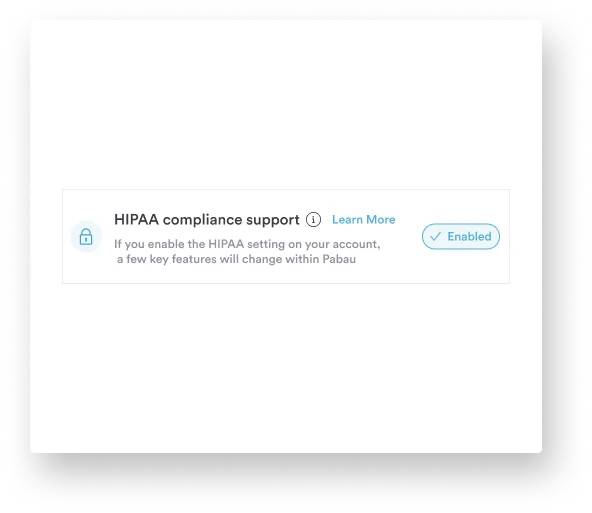
US practices can switch on Pabau’s HIPAA compliance support, which changes how several features handle patient data. That matters once personal memories and family details sit in a clinical record.
The result is session time spent on the reflection itself, instead of on chasing and filing paper pages.

Pabau’s digital forms let patients complete journal chapters before their session, with every answer saved to their record. Each session can start from what the patient wrote.

A life story journal only works if it gets finished, so structure matters more than eloquence. Pick the easiest chapter, book a regular writing slot, and leave values for last.
If you’re helping a parent, sit with them instead of handing the template over. The conversations are often worth as much as the pages.
For therapists, the same prompts can turn a few sessions of reminiscence into a lasting record for the patient’s family. Book a demo to see how Pabau lets patients complete each chapter as a digital form before their session.

Want a daily writing habit alongside the journal? Self-reflection journal offers short prompts for noticing patterns in your thoughts and choices.
Supporting a parent whose memory is fading? Dementia worksheets give caregivers and clinicians structured activities for memory and cognition.
Exploring what gives a life its purpose? Meaning in life questionnaire measures how strongly someone feels their life has meaning.
Writing through a recent loss? 7 stages of grief template helps patients map where they are in the grieving process.
Looking for a gentler emotional outlet? Healing journal uses guided prompts to help process difficult experiences.
A life story journal is a guided template for documenting your personal history, memories, relationships, and values for your family. It uses prompts and themed sections to capture the experiences and lessons that define your life.
An autobiography is usually a polished, chronological narrative, often written for publication. A life story journal is more personal and built around prompts, so memory and reflection matter more than literary polish. It’s organized by theme, such as childhood, relationships, and values.
Download the PDF, then print it or fill it in on screen. Start with whichever section feels easiest, since you don’t have to begin with childhood. Read each prompt, write freely, and include sensory details and emotion.
Yes, especially when you offer to work through it together or to read the finished sections. Giving it with the message “I want to know your story” shows that their life matters to the family.
Most people finish in two to three months, working through one or two sections a week. There’s no set length. Some journals run 20 to 30 pages and others 50 to 100, and depth matters more than volume.
Yes. The My Life Story Journal template on this page is free to download, print, and share with family, with no subscription or fees.
That’s normal. Write what you remember, note what you’re unsure of, and ask relatives to fill in details. Family members often recall shared events differently, and those conversations can become the most meaningful part of the process.