Fair fighting rules worksheet
A fair fighting rules worksheet is a therapy handout that sets out ground rules ...

3
Last Updated: Oct 21, 2026
Personification worksheets help a patient turn a difficult emotion, thought, or behavior into a character they can observe from a distance.
Anxiety might become a jittery figure pacing by the door. Inner criticism might become a sharp-voiced coach on the sidelines. Once the experience has a face and a voice, the patient can talk to it rather than be carried along by it.
The free worksheet below takes the patient through five sections. They name the experience, build the character, work out its role, hold a conversation with it, and choose one way to respond this week.
A printable two-page worksheet that guides a patient through personifying anxiety, low mood, inner criticism, or another difficult experience. Its five sections cover the experience, the character, its role, a conversation with it, and one approach to try this week.
Download template
A personification worksheet helps a patient give a difficult emotion or thought pattern a human form, so they can step back and observe it.
Its five sections move from naming the experience to describing the character, understanding its role, talking to it, and choosing a response.
The technique draws on externalization from narrative therapy, which treats the problem as separate from the person who has it.
The worksheet offers four approaches to try in the week ahead: acknowledgment, dialogue, boundary setting, and collaboration.
Digital forms keep each completed worksheet in the patient record, so you can see how the character changes across sessions.
A personification worksheet is a guided self-reflection exercise. The patient picks one challenging experience, such as anxiety, low mood, or a harsh inner voice, and describes it as if it were a person.
The worksheet asks what that person looks like, how they sound, and when they tend to show up. It then asks what they might be trying to do for the patient, and what the patient would like to say back.
The page tells the patient there are no right or wrong answers, and it produces no score. Their own description becomes the material you work with in session.
Personifying an experience puts some distance between the patient and the feeling. “I am anxious” sounds like an identity. “My anxiety is shouting again” sounds like a visitor, and a visitor can be noticed, questioned, or asked to wait.
The idea has roots in narrative therapy. Michael White and David Epston called this externalizing. Their approach is often summed up as “the person is not the problem, the problem is the problem.”
It also sits close to methods you may already use. Internal Family Systems treats an inner critic as a part with a protective intent. In ACT, cognitive defusion uses naming to loosen a thought’s grip.
The worksheet’s third section leans on that protective idea. Many difficult experiences began as an attempt to help, and seeing the intent makes a kinder response possible.
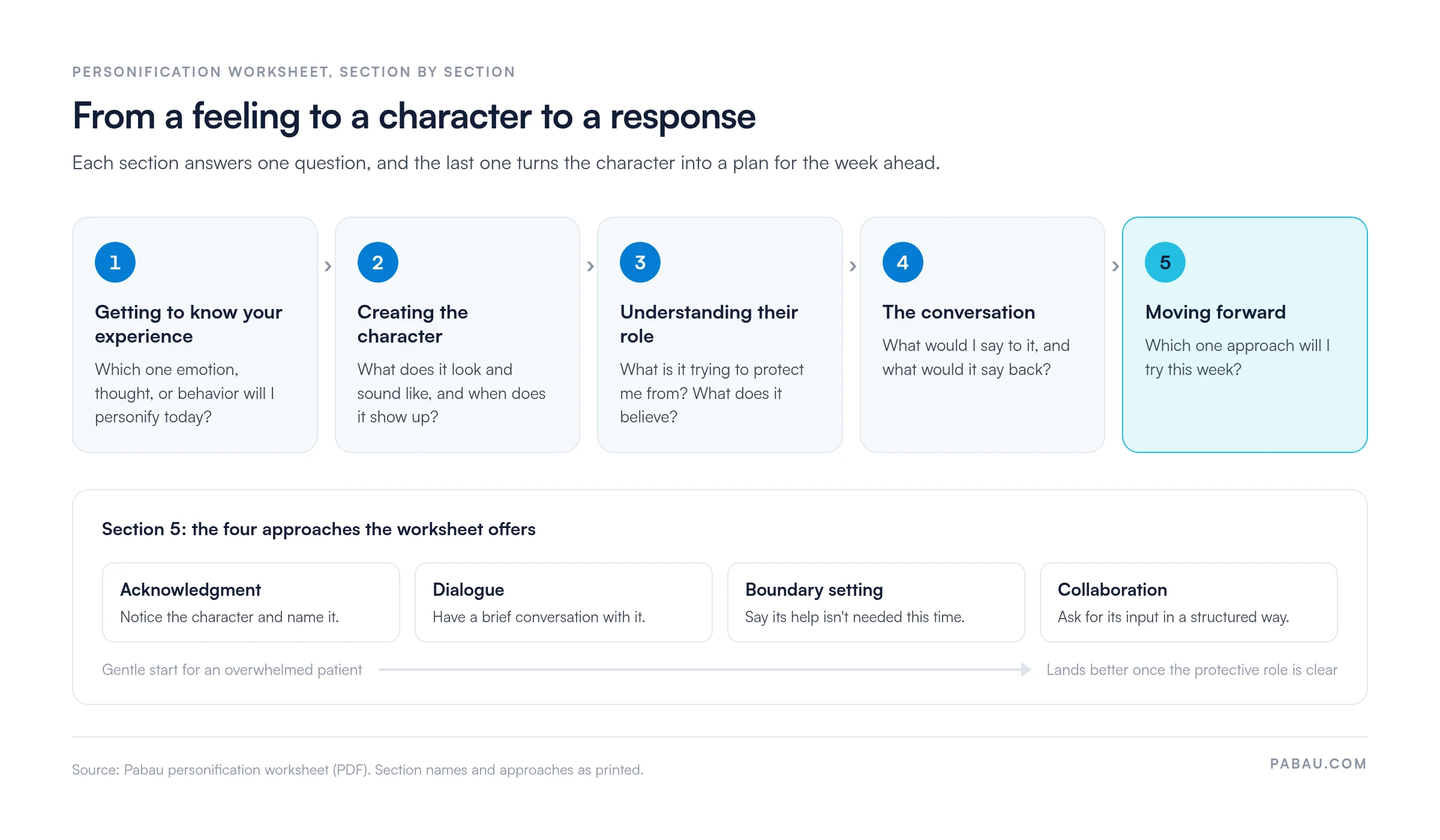
The worksheet runs in five sections, and each one builds on the last. The map below shows the question each section asks, and the list after it explains how to work through them.
The name and date fields at the top earn their place too. Dated copies let you and the patient compare the same character from one month to the next.
The last section gives the patient four ways to respond when the character appears. Each one suits a different stage in their relationship with the experience.
Acknowledgment is a gentle starting point for a patient who feels overwhelmed. Boundary setting and collaboration usually land better once the patient understands what the character is trying to protect.
An “other approach” line leaves room for the patient’s own strategy. Encourage them to use it if none of the four fits.
Here is how a patient working on self-criticism about their job might complete the worksheet.
The example shows why the role section matters. Once the patient sees the critic as a protector with an outdated method, they can keep the concern and turn down the tone.
His belief that relaxing leads to failure is a prediction rather than a fact. A DBT checking the facts worksheet tests whether the emotion fits the situation that set it off.
Introduce the worksheet when a patient keeps describing an experience as part of who they are. “I’m just an anxious person” is a useful cue. A patient who cannot picture a character can start with a mental health color chart and name the feeling by color first.
Complete the first two sections together in session. Let the patient choose the character’s details, and ask follow-up questions rather than suggesting answers.
Take your time over the conversation section. Some patients find it easier to say their lines out loud first, then write them down.
Set the chosen approach as homework for the week. At the next session, ask when the character appeared, which approach they tried, and how it responded. A set of themed writing prompts can sit alongside that homework, giving the patient a gentler task between sessions.
The closing note reminds the patient that personification is a practice they can return to. Its stated goal is a more conscious, compassionate relationship with difficult experiences.
Some presentations call for more than a reflection exercise. If a patient reports thoughts of self-harm or is in crisis, follow your practice’s risk assessment protocol first.
Most therapy practices hand reflection worksheets out on paper. The completed copy comes back folded in a bag, if it comes back at all, and it rarely reaches the clinical note.
Practice management software like Pabau lets you build the personification worksheet once as a digital form. Send it to the patient between sessions, and the completed version files itself against their record.
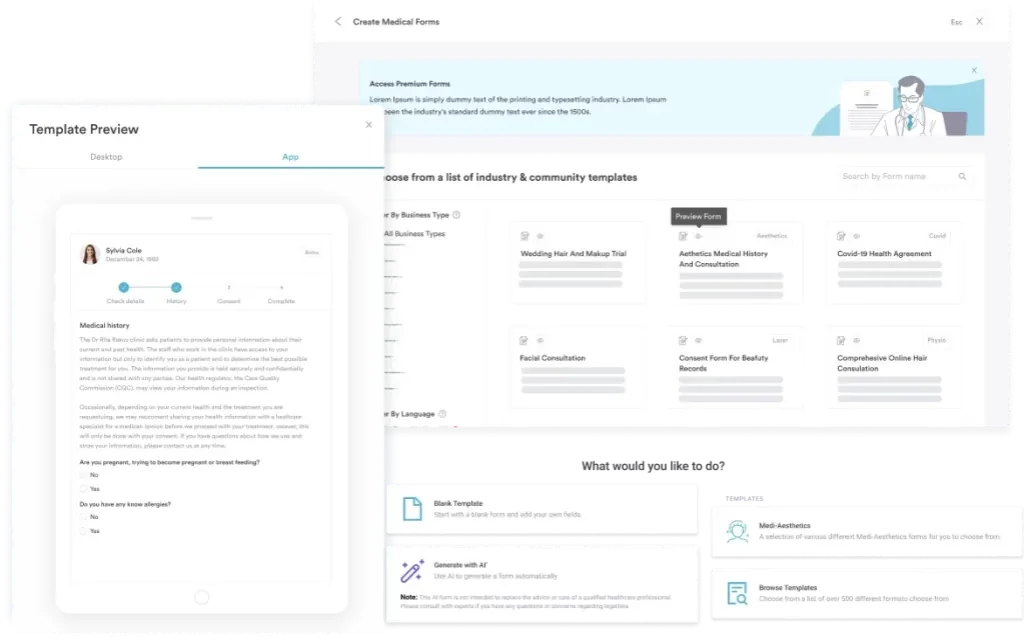
You then have a dated series of worksheets in one place. Patient records software shows whether the character is shrinking, which approaches the patient keeps choosing, and how their conversation with it has changed.
The worksheets then sit alongside the rest of your therapy practice management, from session notes to appointment reminders.
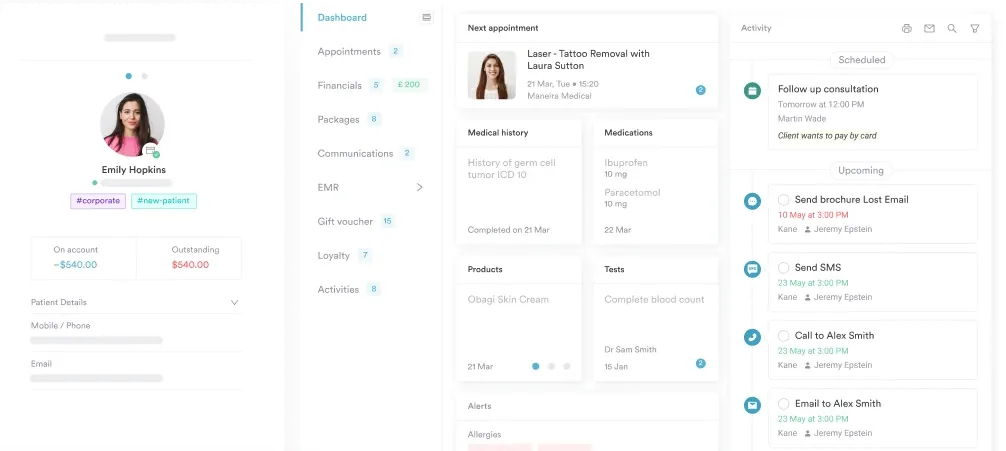

Pabau’s digital forms send the personification worksheet to your patient and file the completed copy against their chart. You see how each character changes across sessions without chasing paper.

A personification worksheet gives a patient a way to meet a difficult experience instead of being defined by it. The five sections move them from naming the feeling to choosing how to answer it.
Use it in session first, then as homework. Across several copies the character on the page often changes, and that change is worth talking through.
Store each copy where the rest of the note lives, so the pattern stays visible. Book a demo to see how Pabau sends therapy worksheets out and files completed copies against the patient record.

Want to map when the character shows up? Anxiety triggers worksheet helps a patient log the situations that bring their anxiety on.
Is the character an inner critic? Self-compassion journal gives the patient a daily place to answer that voice more kindly.
Need skills for the moment a feeling peaks? Emotional regulation worksheet builds the in-the-moment skills that sit alongside personification work.
Helping the patient write their own strategy? Coping skills worksheet collects the strategies that already work for them.
Does the character predict disaster? Catastrophizing worksheet walks the patient from a worst-case prediction to a balanced thought.
A personification worksheet is a therapy exercise that helps a patient describe a difficult emotion, thought, or behavior as a character. Giving it a face, a voice, and a role creates distance, so the patient can observe the experience and choose how to respond.
Personification in therapy means giving an internal experience human qualities, such as a name, an appearance, or a voice. It is closely linked to externalizing in narrative therapy, which separates the problem from the person.
The worksheet works with any emotion, thought pattern, behavior, or internal experience the patient finds challenging. Common choices include anxiety, depression, inner criticism, anger, and worry.
Therapists, counselors, and coaches can use it in session or set it as homework. Adults can also work through it on their own. It is a reflection exercise and does not diagnose or treat a condition by itself.
No. The worksheet tells the patient there are no right or wrong answers. Their own description of the character is what matters, and it can change each time they return to the page.
Yes. The worksheet is a free PDF you can download, print, and use with patients. You can also rebuild it as a digital form in your practice software, so completed copies file to the patient record.