Dental vacuum form: Free template for appliance records
A dental vacuum form is a production record for each vacuum-formed appliance you...

Last Updated: Oct 6, 2026
Fun journal prompts for adults are short, open-ended questions that make sitting down with a blank page feel enjoyable rather than like homework. Research covered by the American Psychological Association suggests that regular expressive writing can reduce stress, improve mood, and build self-awareness over time.
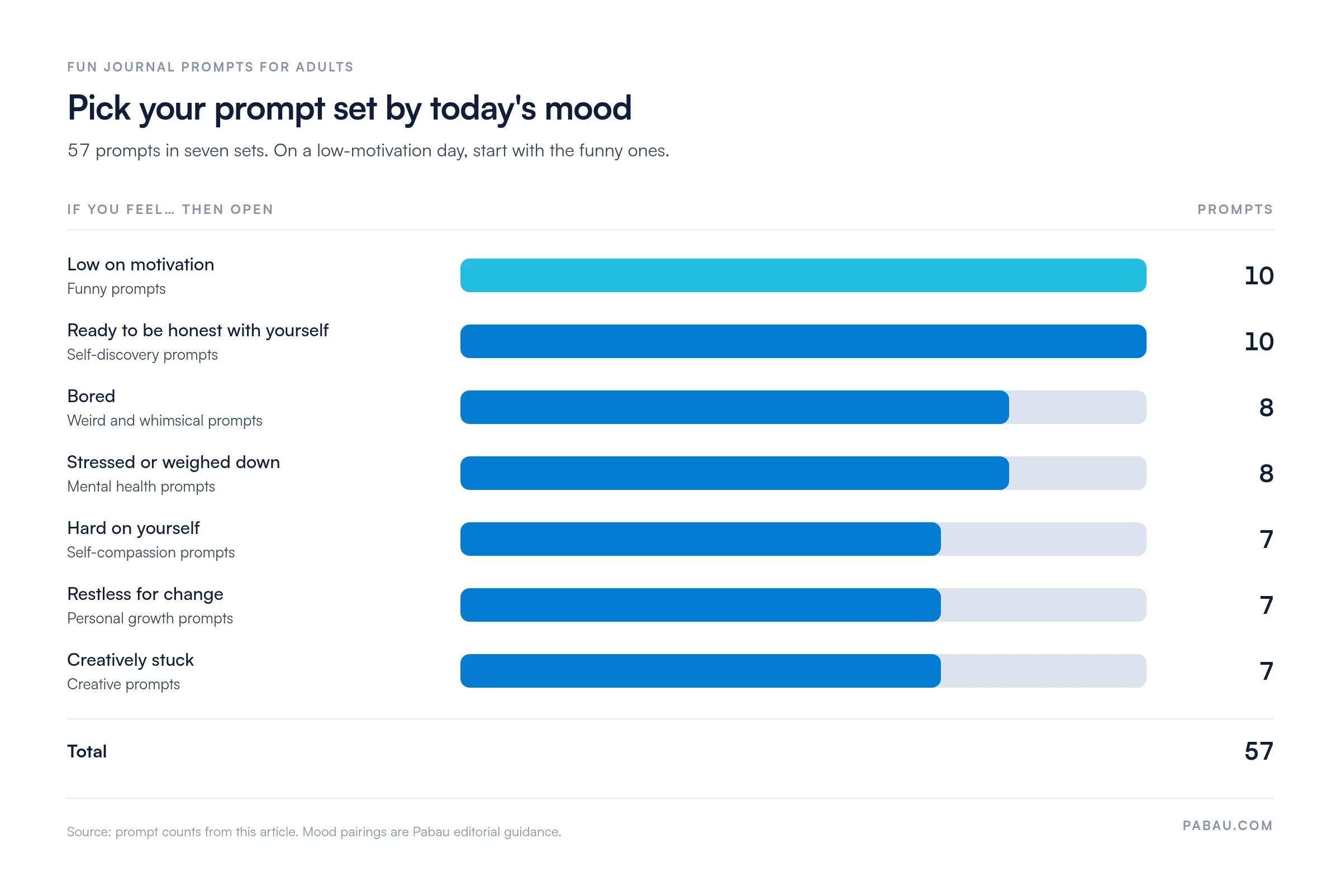
Below are 57 prompts in seven sets, from laugh-out-loud funny to quietly reflective, so you can pick by mood. You’ll also find a four-week plan for turning prompts into a habit. The free printable log helps you track each session and the patterns it reveals.
A three-page printable log with a table for each entry’s date, time, trigger, intensity from 0 to 10, and notes. It closes with space for the patterns you noticed and questions for your next appointment.
Download template
Fun journal prompts for adults are question-based writing cues that make starting a daily writing habit easier.
Research suggests expressive writing can reduce stress and build self-awareness, and approachable prompts make it easier to keep going.
Picking prompts by mood, from funny to reflective, gives you a fitting starting point on any day.
Start with five-minute sessions in week one and build toward 15 minutes once the habit holds.
Pabau, the practice software we build, lets therapy practices send journaling logs as digital forms and store every entry in the patient record.
A blank journal page is surprisingly intimidating. A common sticking point is sitting down, staring at the paper, and leaving it empty because you do not know where to start.
Prompts solve this. They give the brain a specific direction without prescribing the answer. According to Mental Health America, journaling can help people deal with stress, process difficult emotions, and spot mood patterns.
Because the benefits build with consistency, the prompts that make you want to return matter more than the ones that look most meaningful on paper.
Funny and whimsical prompts lower the entry threshold. They signal that this is not a task you can fail. Once the habit is established, deeper reflection tends to follow naturally. If you see a therapist, entries written between sessions give you concrete material to bring along. Practices using mental health EMR software can collect those entries before the appointment.
Pick one prompt per session, not several. Writing deeply about one question beats skimming five. Five to 15 minutes is enough for most adults to feel the benefit without it becoming a chore.
The seven prompt sets below suit different moods, and the chart shows which one to open first and how many prompts each holds.
These prompts are designed to make you laugh first and reflect second. Humor is a legitimate gateway to self-awareness.
When boredom sets in, strange questions unlock creative thinking faster than sensible ones. These prompts work best when you commit fully to the absurdity.
Self-discovery through journaling means asking questions you would normally dodge. These prompts are approachable enough to answer honestly. Therapists using psychology practice software can assign them as between-session homework. For a longer guided exercise, try the self-reflection journal template.
These prompts support emotional processing and stress relief. Use them gently. They help with personal development and don’t replace professional mental health care.
Psychologist James Pennebaker at the University of Texas found that writing about emotionally significant experiences can produce measurable improvements in mood and immune function. Sessions of as little as 15 minutes over four days were enough. One proposed explanation is that turning raw experience into a narrative gives the brain a sense of structure and control.
Self-compassion improves with practice, like any skill. These prompts practice it in small, specific ways rather than asking for grand declarations.
Growth prompts work best when they stay specific. Vague aspirations stay vague on the page. These questions push toward concrete answers.
Creative journaling works best when you let yourself be illogical. These prompts give you that permission explicitly.
A list of prompts gets you through one session. The four-week plan below gets you through a month, starting light and adding depth once the routine sticks.
Anchor the habit to something you already do. Write immediately after your morning coffee, before bed, or during a lunch break. The trigger matters more than the time of day.
Keep your journal and a printed copy of the log in the same place, physically or digitally. Each extra step between you and the page is another reason to skip a session, so remove as many as you can.
A therapist who suggests journaling usually hands over a printout and hears about it only if the patient remembers to bring it back. The entries stay in a notebook, and patterns surface late, if at all.
Pabau, the therapy practice management software we build, lets you rebuild a log like this one as a digital form. You send it to patients between appointments, they fill it in on their phone, and each entry is saved to their patient record.
So you open the session with the patient’s triggers, intensity scores, and questions already in front of you. Less time goes on reconstructing the week from memory, and more goes on the work itself.

Pabau lets therapy and wellness practices send journaling logs and questionnaires as digital forms. Every entry lands in the patient record before the next appointment.

Start smaller than feels useful. One funny prompt and five minutes tonight will do more for the habit than an ambitious hour you never repeat.
Once the routine holds, move toward the self-discovery and mental health sets, and use the log to see what keeps coming up. If you work with a therapist, those patterns and questions give your next session a head start.
For practices, the same log works as structured homework that arrives before the patient does. Book a demo to see how Pabau sends journaling logs to patients and files every entry in their record.

Want to dig deeper than a fun prompt? Shadow work journal prompts take self-discovery further, into the parts of yourself you tend to avoid.
Short on time? 5-minute gratitude journal fits a daily gratitude practice into a few minutes.
Prefer a calmer routine? Mindfulness journal pairs daily writing with present-moment awareness.
Stuck on a recurring worry? Thought journal gives you a structured page for recording a worrying thought and looking at it again.
Fun journal prompts for adults are open-ended questions or scenarios that give adult writers a clear, low-stakes starting point for a journaling session. They cover themes from humor and creativity to self-discovery and personal growth. They work by removing the blank-page paralysis that stops many people from journaling consistently.
Start with one prompt, a pen, and five minutes. Pick a funny or whimsical prompt from this list, set a timer, and write without editing. The goal in week one is to build the habit, not to produce meaningful writing. Depth follows naturally once the routine is established.
Research suggests it can support mental health, though it is not a treatment for clinical conditions. Studies by psychologist James Pennebaker and others show that expressive writing can reduce stress, improve mood, and help people process difficult emotions. Journaling works best as a complement to professional care, not a replacement for it.
Yes. The download button near the top of this page gives you a free three-page journaling log. It has a table for each entry’s date, time, trigger, intensity from 0 to 10, and notes. It also has space for patterns you noticed and questions for your next appointment. The prompts themselves are on this page.
One prompt per session is the most effective approach. Writing deeply about one question for ten to fifteen minutes produces more insight than answering five prompts superficially. If one prompt does not resonate, swap it for another from the same category rather than adding more to the session.