Sense of belonging scale
A sense of belonging scale is a validated psychological assessment tool that mea...

2
Last Updated: Oct 15, 2026
A miracle question worksheet is a solution-focused tool that asks patients to imagine their problems solved overnight and name the first signs of change. Solution-focused brief therapy (SFBT) uses it to shift a session from the problem to a clear picture of what the patient wants.
Clinicians use the worksheet to capture those answers in a consistent format, so the preferred future is documented alongside goals and next steps. Download the free PDF below, then use the guide to run it in five steps within SFBT and related approaches.
A ready-to-print worksheet with prompts for the preferred future, the first signs of change, existing strengths, support network, and action steps.
Download template
The miracle question worksheet turns an overnight-change question into a written, reviewable record.
It is a core SFBT technique, developed by Steve de Shazer and Insoo Kim Berg.
Capture the patient’s own words for the signs the problem has gone.
Pair the worksheet with scaling questions and one concrete next step.
Store completed worksheets in the patient record, not on loose paper.
The miracle question is a solution-focused prompt that asks a patient to imagine waking up after a miracle has resolved the problem overnight. Steve de Shazer and Insoo Kim Berg developed the technique as part of solution-focused brief therapy.
The question shifts attention from what went wrong to what the patient wants instead. Because the patient describes the day in concrete detail, the therapist gets a working picture of the preferred future without a full problem analysis first.
That future-first stance is what sets SFBT apart from problem-focused models. A counseling theories chart shows where it sits next to CBT, person-centered therapy, and other approaches.
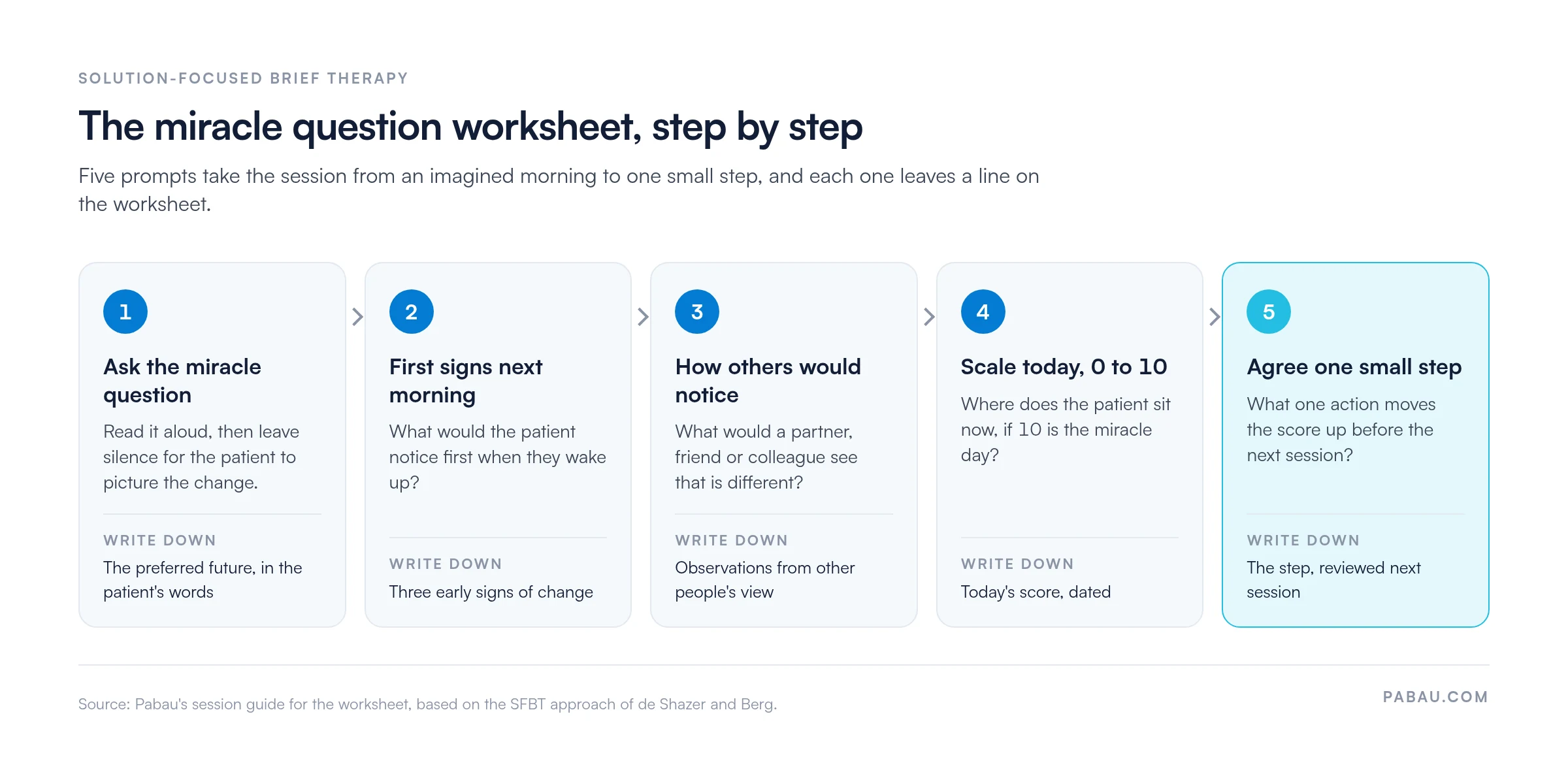
A miracle question worksheet can be completed in the session or sent home as preparation. Work through the prompts in order, using the patient’s own language.
Each step leaves its own line on the worksheet, and the flow below shows what gets written down at each one.
“I don’t know” is the most common first answer, and it usually means the patient needs more time. Stay quiet for a few seconds longer than feels comfortable before you prompt again.
If the silence doesn’t help, ask what they might say if they did know. Many patients answer this version easily because it lowers the pressure to be right.
Some patients describe other people changing instead, such as a manager who is kinder. Note it on the worksheet, then ask what the patient would do differently in response. That keeps the action steps within the patient’s control.
Solution-focused practitioners use the worksheet most directly, but it also suits other settings where people need a clear goal. Mental health counselors, psychologists, coaches, and social workers all work with people who struggle to describe what they want.
It is also useful in group work and in early sessions, when the therapist needs a fast way to move from complaint to goal.
A written worksheet makes the patient’s preferred future easy to revisit. Patients can see their own words at the next session, which often sharpens the goals.
For clinicians, a standard format gives consistent documentation across caseloads. It also supports the goal-setting step that many clinical records need.
Date every completed worksheet and write the scaling score at the top. Laying two or three sheets side by side shows progress faster than rereading the narrative answers.
Clinicians often adapt the wording to suit the patient. The core structure stays the same: an overnight change, then the signs that show it happened.
Within SFBT, the worksheet works best alongside scaling questions and exception-finding. Use it to clarify the goal, then use scaling to measure progress toward it.
Once the preferred future is clear, a SMART goals worksheet can turn it into measurable targets. Close each session by reviewing the worksheet with the patient and agreeing the next action step.
The miracle question can support CBT goal setting when a patient needs a concrete target behavior. Cognitive behavioral therapists sometimes use the same worksheet to define the change before working on thoughts and behaviors.
Coaches and group facilitators also use the prompt. Adjust the wording to the setting, and keep the focus on observable change. Positive psychology uses a similar future-focused exercise, set out in the best possible self worksheet.
Write the session up while the answers are fresh. A counseling SOAP note gives the worksheet its clinical context in the record.
Many therapists still print the worksheet, fill it in by hand, and file the sheet in a folder. By the next session, finding it means digging through paper, and the scaling scores never sit side by side.
Pabau, the practice software we build for therapists and other clinicians, turns the worksheet into a digital form. Patients can complete it before the session or on a tablet in the room. The answers save to their patient record, next to your session notes.
You open the last worksheet in one click at the start of the next session, so the patient’s own words frame the conversation. It is part of a wider setup built for smoother therapy practice management, with scheduling, notes, and billing in one place.

Pabau sends the miracle question worksheet as a digital form and files the answers in the patient record, beside each session note.

The miracle question earns its place when the answers are written down and revisited. A worksheet that sits in a drawer after one session has done half its job.
Start by using it in a first session, scaling the result, and bringing the same sheet back next time. If patients struggle to answer, slow down rather than rephrasing too quickly. The trade-off is time, since a well-run miracle question can take most of a session.
Book a demo to see how Pabau keeps every completed worksheet with the session notes, ready for the next appointment.

Want to measure progress toward the preferred future? Goal attainment scale gives you a scored way to track each goal across sessions.
Building on what already works for the patient? Strengths list helps patients name the resources they can use toward change.
Meeting ambivalence about change? Motivational interviewing script offers wording for patients who are not yet ready to act.
Writing up the session afterwards? Therapy progress notes cheat sheet covers what to record so each note supports the treatment plan.
Turning answers into agreed goals? Client goals template structures the goals a patient sets with you into one document.
The miracle question is a solution-focused prompt that asks patients to imagine their problem resolved overnight and describe the first signs of change. It was developed by Steve de Shazer and Insoo Kim Berg.
Yes. Practitioners in CBT, coaching, and group work adapt the prompt to define observable goals. The adaptation should keep the focus on the person’s own description of change.
No. The worksheet supports goal setting and documentation but does not replace assessment or clinical decision-making.