Therapeutic interventions list
A therapeutic interventions list is a reference of evidence-based treatment tech...

Last Updated: Oct 13, 2026

SOAP notes document a counseling session in four parts: what the client reports, what you observe, what you conclude, and what happens next.
The section a line belongs in matters more than its wording, and interpretation slipping into the Objective section is the most common error.
Consistent SOAP notes support insurance billing, continuity between sessions, and any later audit, without adding much time to your day.
HIPAA governs how you store and share the note, not the format you write it in.
Practice management software like Pabau opens the SOAP template inside the appointment, so the note is done before the next client arrives.
A ready-to-use template with all four SOAP sections laid out, plus space for treatment goals, homework assignments, and follow-up notes. Each section carries a short prompt, so you are not staring at a blank box after a session.
Download templateA SOAP note turns a 50-minute session into a record someone else could follow. Therapists have to produce that quickly, defensibly, and often between back-to-back clients. The SOAP format handles all three by splitting the session into four sections.
This guide covers what belongs in each section, with two worked examples you can copy. It also has a sorting test that keeps your notes audit-ready.
A SOAP note for counseling is a structured clinical record of a therapy session, written in the same four sections every time. SOAP stands for Subjective, Objective, Assessment, and Plan. Each section holds a different layer of what happened in the room.
SOAP notes started in medical settings in the 1960s. Mental health, therapy, and rehabilitation professions adopted the format because it separates the client’s experience from your reading of it.
That separation is what makes a note hold up later. For therapists in private practice, community mental health, or a larger organization, SOAP is the expected standard.
SOAP notes do three jobs in a counseling practice.
The structure also improves the clinical work. Writing an assessment section forces you to say whether the treatment plan is working, and to commit to a reason. That question is easy to skip when notes are free-form.
Each section has its own conventions. Knowing which one holds a given line is what makes notes fast to write and hard to challenge.
One line causes most of the confusion. Homework goes in Subjective when the client tells you how it went, and in Objective when your own record shows what was completed.
In couples work, the Subjective section carries two accounts of the same week. Asking the same couples session questions each time keeps those entries comparable from one note to the next.
Describing mood and affect precisely is half the work in the Objective section. A list of mood words for documentation saves you reaching for the same three adjectives every week.
Writing one of these by hand takes most therapists 10 to 15 minutes once the session ends. The five steps run in order.
A referral you name in the Plan section still needs paperwork behind it. A structured referral form records the receiving specialist, the reason, and a 0 to 10 urgency rating.
Client: Alex, 34-year-old presenting with anxiety and relationship distress. Second session of treatment.
Subjective: Alex reports increased anxiety this week, especially around an upcoming presentation at work. States “I know it’s irrational but I’m convinced I’ll mess it up and everyone will think I’m incompetent.” Mentioned feeling distant from partner, saying “we barely talk anymore.” Completed grounding exercises from homework, but only 3 out of 5 days. Denies suicidal or self-harm ideation.
Objective: Client presented on time, well-groomed. Mood anxious throughout session, affect congruent. Engaged actively, made consistent eye contact, asked clarifying questions about anxiety management strategies. No psychomotor agitation or retardation.
Assessment: Generalized Anxiety Disorder with specific activation around performance situations. Progress on cognitive awareness is solid. Client identifies catastrophic thinking patterns reliably. Relationship strain appears secondary to anxiety, with the client withdrawing when anxious. Treatment is on track. Recommend more frequent grounding practice, plus communication skills work for the relationship.
Plan: (1) Continue cognitive-behavioral work on anxiety, and introduce thought records for tracking triggers and responses. (2) Assign grounding exercises daily, 5 to 10 minutes, with phone reminders if helpful. (3) Begin the couples communication module next session if the client agrees. (4) Schedule follow-up in 1 week. No referrals indicated at this time.
A group note documents one client inside a group setting. The four sections stay the same, but the Objective and Assessment sections carry participation and group dynamics.
Subjective: Jamie participated in today’s group DBT skills session on emotion regulation. Shared an experience of using the opposite action skill after conflict with a family member. Reported feeling “heard” by the group. No new crisis or safety concerns.
Objective: Jamie attended on time, seated between two group members, engaged in peer feedback. Spoke twice during the session, and offered one piece of support to another group member. Eye contact good, voice modulated appropriately. No behavioral concerns.
Assessment: Demonstrating increased social participation and willingness to use peer support. Emotion regulation skills are being applied outside the room, in a family interaction this week. Group cohesion is benefiting Jamie’s engagement.
Plan: Continue in group. Encourage Jamie to practice the opposite action skill at least twice before next session. Connect Jamie with one peer buddy for a between-session check-in if interested.
Naming the four sections is easy. Sorting a line into the right one is where notes go wrong, and one error accounts for most of it. A conclusion gets written into the Objective section as though it were an observation.
Written that way, the note reads as though you measured something you inferred. A reviewer who disagrees with the inference has no observable fact to check it against. The six lines below come from the two notes above, sorted into the section that should hold them.
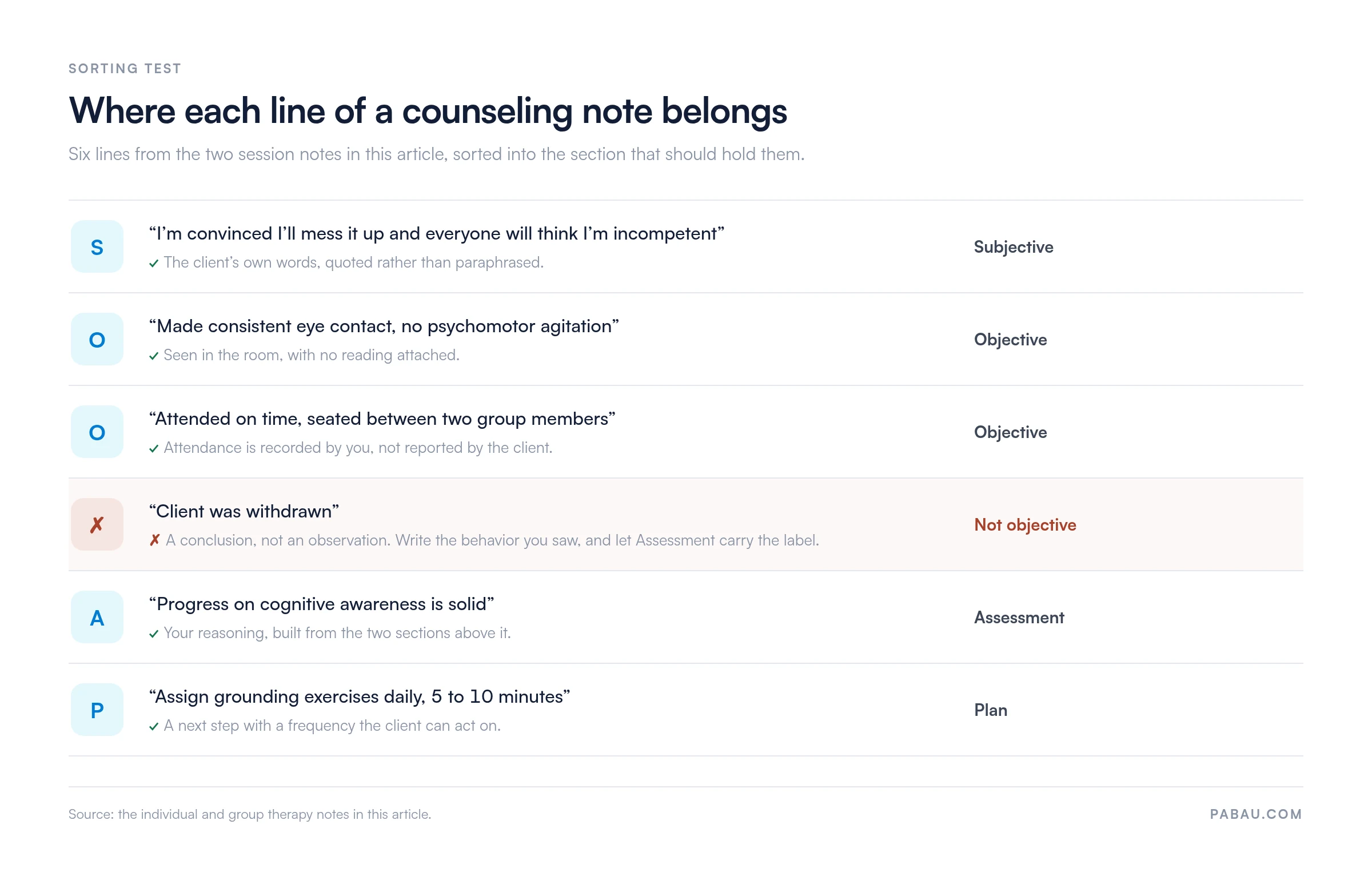
The fix is mechanical. Write the behavior in Objective, then carry the label into Assessment, where your reasoning belongs.
Some organizations and settings prefer a different structure. A DAP note template merges the first two sections into one. Here is how the three most common formats compare.
Most therapists in private practice or community mental health use SOAP, because insurers recognize it. Behavior-focused services often use a BIRP note instead. If you are unsure which format your employer or licensing body requires, ask your supervisor.
The US Health Insurance Portability and Accountability Act, known as HIPAA, sets privacy and security rules for protected health information. It governs how you store and share a note, not how you write one. Accuracy and timeliness are your licensing board’s requirement, and your payer’s.
SOAP notes do not make a practice HIPAA compliant on their own. They do support it.
HIPAA does not require a specific note format. It requires that records are kept securely and made available on request. SOAP is standard practice because it satisfies that, plus what insurers and licensing boards expect.
Experienced therapists tend to share the same handful of habits.
Writing notes in a word processor means leaving the system that holds the appointment. You finish the session, switch programs, find the template, type the note, then save it somewhere you hope to find again. The switching is where notes get delayed.
Practice management software like Pabau opens the SOAP template inside the appointment you just finished. The note saves into the client’s chart on its own, and the session code on the invoice already matches it. Pabau Scribe, our AI scribe, can draft the note for you to review and edit.
That takes writing a note from 10 to 15 minutes down to 5 to 7. It also removes the window in which a note goes missing. Good therapy practice management software covers the compliance side too, so every note is timestamped, access is logged, and backups run on their own.
A mental health EHR built for therapy keeps intake forms, session notes, and insurance billing on the same client record. You never copy the same detail from one system into another.

Pabau opens the SOAP template inside the appointment and saves it to the client record, so notes are finished before the next session starts.

Download the template, then use it the same day you see the client. The structure will do most of the work. What it cannot do is decide whether a line is an observation or an inference, and that decision is what a reviewer will test.
Get the Objective section right and the rest of the note tends to follow. Get it wrong and every section after it inherits the problem. That is the habit worth building first, ahead of any shortcut in wording.
Book a demo to see how Pabau opens the SOAP template inside the appointment and files the finished note in the client’s record.

Need a wider view of note formats? Progress notes for psychotherapy shows how session notes sit alongside treatment plans.
Writing notes between back-to-back clients? Therapy progress notes cheat sheet gives you phrasing to reach for when time is short.
Starting with a new client? Adult counseling intake form collects the history your first Subjective section depends on.
Running a group program? 8-week group counseling plan maps session themes, so your group notes track against a plan.
Comparing systems to hold your notes? Top 7 mental health software reviews the platforms therapy practices use in the US.
A SOAP note is a structured clinical documentation format used by therapists and counselors to record therapy sessions. SOAP stands for Subjective (the client’s self-reported experience), Objective (your observations), Assessment (clinical impressions and diagnosis), and Plan (next treatment steps). It is the standard format in mental health, medical, and allied health professions.
A note for a standard 50-minute therapy session usually runs 250 to 500 words. Subjective is normally the longest section, followed by Objective, Assessment, and Plan. Quality matters more than length. A concise note that captures the clinically relevant detail beats a verbose one.
SOAP notes are one structured format for documenting a single session. Progress notes are the broader category, and they include SOAP, DAP, BIRP, and other formats. Progress notes track a client over time, while SOAP organizes each individual session. Many practices use SOAP notes as their progress note format.
No. HIPAA sets privacy and security rules for client information, and it does not mandate any particular note format. Your licensing board and your payers are what expect accurate, timely records. SOAP notes help because they leave an organized, timestamped trail of treatment decisions, which is what a reviewer asks for.
Yes. For a group session you document one client inside the group context. Subjective covers that client’s participation and self-report, Objective notes their behavior and engagement, Assessment addresses individual progress, and Plan outlines their next steps. Shared group interventions, such as a DBT skill taught to every member, belong in the Plan section.
The Assessment section documents your clinical impressions. That means the current diagnosis or working hypothesis, plus progress toward each treatment goal. Add how this session connects to the treatment plan, and any change in risk or formulation. Tie it back to the subjective and objective data, so the reasoning behind your conclusion is visible.
DAP (Data, Assessment, Plan) folds the Subjective and Objective sections of SOAP into a single Data section. It is used more in substance abuse counseling and in some community mental health agencies. SOAP keeps the client’s report separate from your observation, which many therapists find clearer. Both are acceptable, and your employer or licensing body usually specifies which one to use.