Sample treatment plan
A sample treatment plan is a structured clinical document that sets out a patien...

3
Last Updated: Oct 12, 2026
A feelings thermometer turns “How do you feel?” into a number a patient can point to. It’s a 0-10 scale, where 0 means a feeling is absent and 10 means it’s at its strongest.
That one number matters because many patients, especially children, can’t name what they feel but can rate it. Tracked across sessions, the ratings show whether coping skills are working. They also flag when a patient needs a safety plan.
Keep in mind that it’s a self-rating and communication aid with no validated cut-offs. Below, you’ll find the free assessment form, a zone guide, coping ideas for each level and the mistakes that skew ratings.
A four-part assessment form with identifying details, a 0-10 rating line for seven emotions, assessor notes and next steps. The emotions are happiness, sadness, anger, anxiety, fear, excitement and neutral. The zone and coping tables on this page are guidance to use alongside it, not part of the PDF.
Download template
A feelings thermometer rates emotional intensity from 0 to 10, so patients who struggle to name a feeling can still report it.
The free PDF is a four-part assessment form that rates seven emotions separately, with space for assessor notes and next steps.
The zones on this page (0-2, 3-5, 6-8 and 9-10) are a common convention, not a validated clinical standard.
Ratings are most useful as a trend, compared with the same patient’s earlier scores rather than with other people’s.
Practice software such as Pabau lets patients complete forms digitally and saves each one to their patient record.
A feelings thermometer measures how strong an emotion feels right now. Instead of asking “How do you feel?”, you ask “Where are you on the thermometer?” That gives patients, and children in particular, a fixed point of reference.
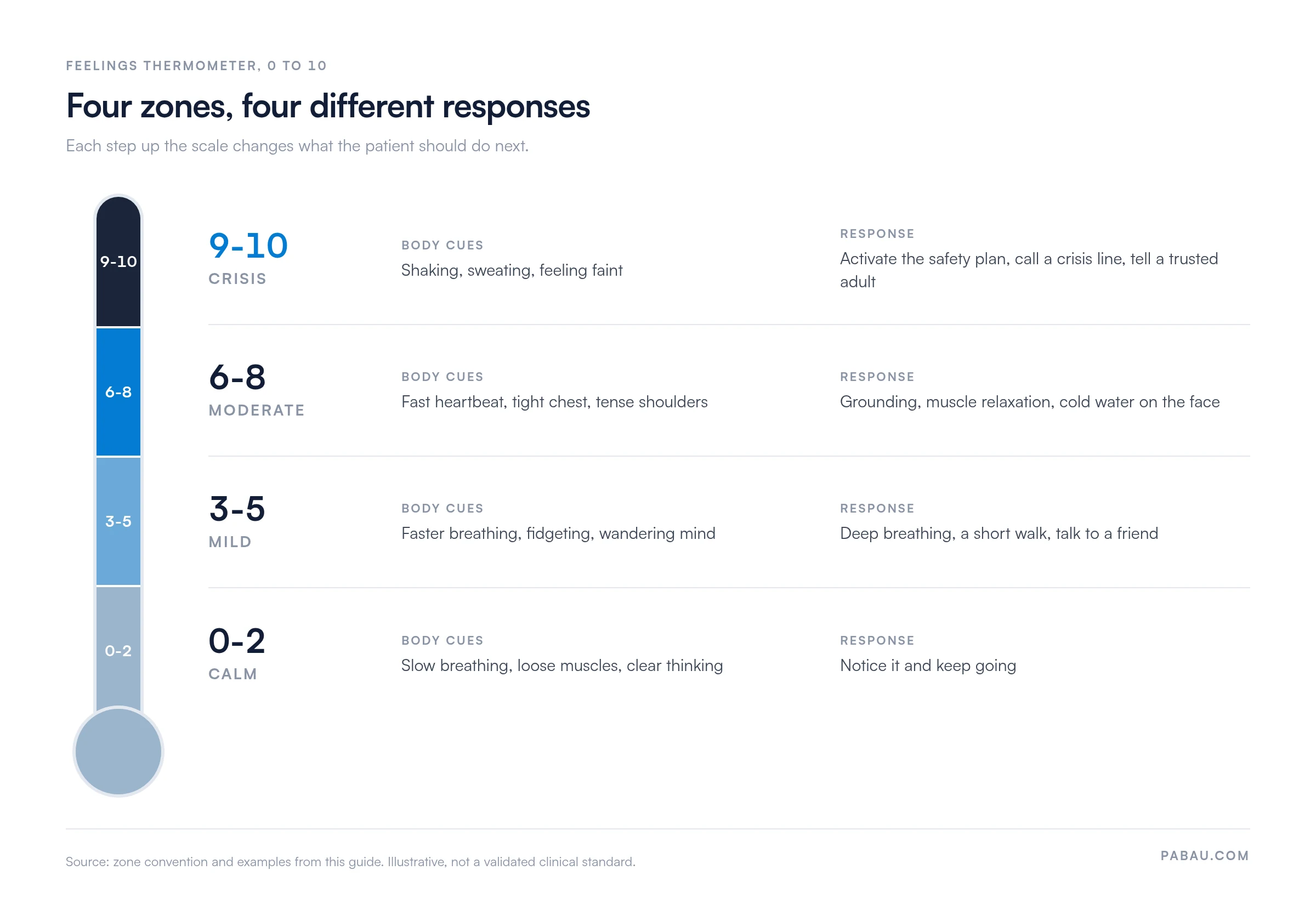
A common way to use it is to split the scale into four zones: calm (0-2), mild (3-5), moderate (6-8) and crisis (9-10). Each zone pairs emotion words with body cues, from slow breathing at the bottom to a racing heart near the top. The diagram below shows how the response changes as the number climbs.
The free form takes a slightly different approach. It rates seven emotions on their own 0-10 lines, so you can see that anxiety sits at 8 while anger sits at 2.
Whichever layout you use, the tool can’t diagnose a condition. It has no validated cut-off scores, and the zone boundaries are a convention rather than a tested standard. Treat each rating as a prompt for conversation.
The steps below work for children and adults. With children, keep the language simple and add faces or colors. With adults, the same steps support self-monitoring between sessions.
Adults often respond better to terms like “emotional activation” or “arousal” alongside the thermometer. In CBT, therapists can use the ratings to follow mood between sessions. DBT therapists may pair zone 9-10 with the TIPP skill.
TIPP stands for temperature, intense exercise, paced breathing and paired muscle relaxation. It’s a distress tolerance skill for moments of very high arousal. Our guide to DBT distress tolerance skills covers TIPP and its companion skills.
In schools, teachers can fold the thermometer into social-emotional learning (SEL). A morning check-in asks each student for a number. Students at 6 or above can then get a breathing exercise or quiet-corner time before the lesson starts.
The tool works across ages, settings and conditions because it solves one common problem. It puts a number on a feeling.
For children too young to use numbers, a feelings face chart swaps the scale for illustrated faces.
It makes feelings easier to share. Many people, including children, autistic people and trauma survivors, find emotions hard to put into words. “I’m at a 7” is quicker and clearer than “I feel bad.”
It shows when to act. Regular ratings reveal patterns. If a patient’s numbers climb from 4 to 7 before a meltdown, that climb marks the moment to use a coping skill.
It gives coping skills a trigger. When each zone has a practiced skill, such as breathing, grounding or distraction, a patient at 6 or above already knows what to do. DBT, for example, teaches specific skills for these high-distress moments.
It takes the judgment out. On a neutral scale, a high rating isn’t “bad.” It’s information about how the patient feels now, and a prompt to act.
It costs next to nothing. A printed sheet fits in a pocket and needs no app. Clinicians can adapt it in minutes, and patients can use it on their own.
Use the table below as guidance when you build a patient’s own thermometer. It isn’t part of the PDF form. Personalize it, because two patients can place the same emotion in different zones.
At 0-2, the only job is to notice the calm. At 3-5, early coping stops the feeling from building. Most therapy work happens at 6-8, where coping needs more support.
At 9-10, the patient needs professional help, not self-help alone. Our guide to crisis intervention strategies covers the clinician’s side of that response.
A few minutes of setup makes every later rating easier to read. Check these points first.
An anger thermometer measures anger and aggression only, rather than emotion in general. Schools use it in behavior plans. It also appears in anger management programs and in de-escalation training for staff.
It keeps the 0-10 scale but swaps in anger words: calm (0-2), irritated (3-5), angry (6-8) and explosive (9-10). Body cues include a flushed face, clenched fists and a raised voice. Coping steps focus on calming down, such as time-out, physical activity and assertive communication.
The narrower focus helps patients who struggle to tell anger apart from other feelings, or who have a history of aggression. Our anger meter worksheet gives you a ready-made version.
A coping-skills version puts the rating and the response on one sheet. The patient finds their number and reads what to do next, without hunting through a workbook. The free PDF doesn’t include this layout, so you’ll build it from the table above.
A common format puts the thermometer on one side and coping cards on the back. Zone 0-2 might say “Notice what’s going well.” Zone 6-8 might say “Stop. Breathe in for four and out for six. Name five things you can see.”
Zone 9-10 lists the crisis plan, with a phone number, a trusted person and a safe place to go. Write the strategies with the patient in session, then laminate the card so it survives daily use.
To dig into what pushed a rating up, our emotional regulation worksheet records the triggers, thoughts and coping responses behind it.
Paper thermometers work, but they scatter. Ratings sit in folders, home sheets go missing, and spotting a trend means leafing through weeks of paper.
Pabau, the therapy practice management software we build, lets you set up an assessment like this as a digital form. Patients complete it online, and each completed form is saved to their patient record.
The rating, your notes and the agreed next steps then sit alongside appointments and treatment notes. You see the history at the next session instead of searching for it. Our digital intake forms page shows how forms are set up.

Pabau’s digital forms let patients complete assessments like the feelings thermometer online. Each completed form is saved to their patient record, ready for the next session.

The thermometer earns its place when you use it the same way every time. Agree on the anchors, personalize the zones and compare each rating with the patient’s own history. Done that way, a single number becomes a trend you can act on.
Keep its limits in view, too. It’s a conversation aid with no validated cut-offs, so a high score is a cue to ask more. Any rating at 9-10 needs a written crisis plan before the patient goes home.
Download the free form above and run your first check-in this week. Book a demo to see how Pabau saves completed assessment forms to each patient’s record, ready for your next session.

Looking for a fuller assessment than an emotion rating? Psychiatric evaluation template gives you a structured framework for initial psychiatric consultations.
Want a broader check-in than one number? Mental health check-in worksheet pairs a 0-10 mood check-in with reflection prompts and goal setting.
Need a skill for the moment a rating spikes? DBT STOP skill explains a short pause patients can use before strong emotions turn into action.
Working with younger patients? Therapy worksheet for kids collects structured activities that help children work through feelings in session.
Yes. The PDF on this page is a four-part assessment form. It rates seven emotions from 0 to 10 and includes assessor notes and next steps. It has no color zones or coping section, so use this page’s tables for those.
In survey and political science research, a feeling thermometer measures how warmly someone feels toward a group, person or issue. It usually runs from 0 to 100, cold to warm. The clinical version borrows the name but rates emotional intensity instead.
The Zones of Regulation is a school-based framework that sorts states into four colored zones: blue, green, yellow and red. It describes the kind of state a child is in. A feelings thermometer rates how intense an emotion feels, using numbers.
No. The PHQ-9 and GAD-7 are validated questionnaires with set scoring and severity cut-offs for depression and anxiety. A feelings thermometer has neither. Use it for quick check-ins between those formal screens, not instead of them.