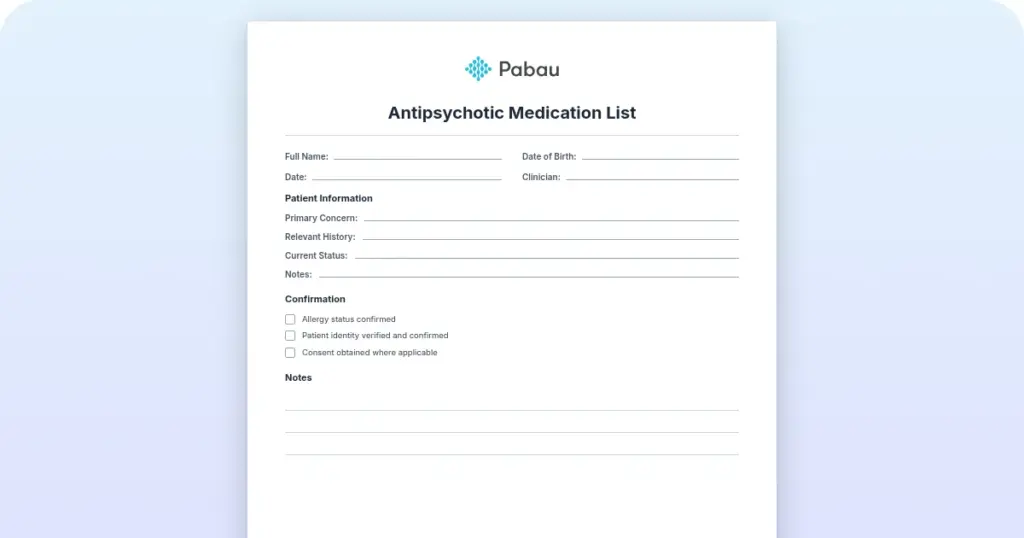
Antipsychotic medication list
An antipsychotic medication list is a structured reference that organizes psychi...

2
Last Updated: Oct 13, 2026

A client goals template is a case-formulation form that connects what the client wants to achieve with the clinical picture behind it, starting from the presenting problem.
The 5 Ps model (predisposing, precipitating, perpetuating, and protective factors, framed around the presenting problem) turns scattered client history into a coherent case formulation.
A completed formulation feeds directly into a problem list, treatment goals, a written case formulation, and a documented treatment mode or set of interventions.
Practice management software like Pabau lets you capture, document, and review the full case formulation in one client record, without paper-based admin.
A ready-to-use case-formulation form built on the 5 Ps model: presenting problem, predisposing, precipitating, perpetuating, and protective factors, plus a problem list, treatment goals, and case formulation. Works for therapy, mental health, and wellness practices.
Download templateVague goals are why treatment stalls.
A client says they want to feel better. However, without asking why the problem started and what’s keeping it going, goals are just guesses.
A client goals template fixes that by walking you through a structured case formulation before you set a single objective. As a result, goals grow out of a clear clinical picture instead of a vague wish. Practice management software like Pabau can store and track that formulation for you. However, the template works just as well on paper.
In practice, this template works across therapy, mental health, and wellness practices. It’s built on the 5 Ps model: presenting problem, predisposing, precipitating, perpetuating, and protective factors. Specifically, this feeds into a problem list, treatment goals, and a documented case formulation.
Below you’ll find how to use it and client goal examples by discipline. In addition, we cover a review cadence that stops the formulation from quietly going stale after intake.
Without clearly defined client goals, treatment drifts. In turn, sessions feel unfocused and clients lose motivation. As a result, practitioner time gets wasted on interventions that don’t serve the person sitting across from you. In practice, plenty still rely on handwritten notes or memory to track what they agreed to work on.
Client goals do three things at once:
When a client sees documented progress toward their own objectives, they’re far more likely to complete treatment. As a result, they often refer others and become a long-term partner in their own care.
This is where structured patient record systems change practice. Instead of recreating goal documentation from scratch for each client, a template standardizes the process. As a result, this saves time at intake and ensures nothing gets missed.
In fact, a client goals template is a structured case-formulation form. Specifically, it helps practitioners connect what a client wants to achieve with the clinical picture behind it.
The 5 Ps model covers presenting problem, predisposing factors, precipitating factors, perpetuating factors, and protective factors. As a result, they sit at the heart of your treatment plan. They record not just the goal itself, but why the problem exists and what’s keeping it in place.
Unlike generic progress notes, a dedicated case-formulation template creates a single source of truth. Every time you sit down with a client, you reference the same documented formulation. Specifically, that means the problem, the factors behind it, and the goals that follow. As a result, there’s no ambiguity about what you’re working toward or why.
For regulatory compliance, whether you’re managing CQC standards, GDPR client data, or HIPAA records, a formalized case-formulation document helps. Specifically, it reduces the risk of disputes and strengthens your clinical defensibility.
The best client goals templates combine two elements. First, a section for capturing the client’s own goals and presenting problem in their words. Second, a structured 5 Ps analysis that maps the predisposing, precipitating, perpetuating, and protective factors driving that problem.
From there, the template guides you through a problem list and treatment goals. In addition, it covers a written case formulation and your planned treatment mode or interventions. As a result, the client’s voice and your clinical reasoning sit side by side.
The key is consistency: same template, same review rhythm, same documentation location. As a result, this creates a clear audit trail and ensures client expectations stay aligned with your clinical direction.
The 5 Ps model is a widely used approach to case formulation across psychology, therapy, and mental health practice. Each P forces clarity on a different part of the clinical picture. Work through all five. As a result, a vague presenting problem turns into a formulation you can act on.
When a formulation feels thin, go back and ask: What made this client vulnerable before the problem started? What changed recently? What’s reinforcing the problem today? What’s already working in their favor? In turn, the answers fill out the 5 Ps and point directly to a workable problem list and treatment goals.
The client goals examples below are grouped by discipline. Each one is a measurable treatment goal you might document once your case formulation is complete. As a result, you can adapt these therapy goals examples and physical health targets to your own clients.
For a specific modality, pair this template with a dedicated one. For example. Then layer your 5 Ps formulation on top.
These mental health goals examples show how a broad therapy aim turns into a measurable treatment goal. Specifically, once you run the aim through a case formulation, it becomes concrete and trackable.
The relationship skills example above works better with a documented starting point. The Relationship Scales Questionnaire measures adult attachment anxiety and avoidance, giving you a baseline to revisit at each review.
In addition, everyone involved needs to agree on them. In practice, your template should support shared access if the client consents.
Documentation is where intent becomes record. In fact, a poorly documented goal is almost as useless as no goal at all. You can’t track what you haven’t written down. In addition, you can’t defend clinical decisions if there’s no evidence the goal was agreed.
Store the full case formulation in one place. In practice, that’s your practice management system’s client record or a dedicated section in the paper file. At minimum, the record should include:
Each time you review, add a note about progress against the treatment goals and any adjustments to the formulation. Documented this way, your client goals template doubles as a case-formulation record you can reference and adapt across similar cases.
In practice, the template itself becomes the documentation standard: same fields, same process, every client. This uniformity also makes it easier to audit your practice. Specifically, it helps show regulators (CQC, professional bodies) you’re using a structured, evidence-informed approach to case formulation and goal-setting.
In practice, goals are only useful if you measure them. At each appointment, ask the client directly: How are you tracking against goal 1? What’s changed since we last met? Where are you now on a scale of 0-10? A structured therapy progress notes cheat sheet keeps that session-by-session tracking consistent across your caseload.
Even small wins, such as moving from 8/10 anxiety to 7/10, are worth celebrating. As a result, they build momentum and reinforce that treatment is working.
Use automated goal review reminders to keep goals visible between sessions. Set a reminder to check in on a specific goal. Or, send the client a weekly text asking them to rate one metric. This keeps both of you accountable and creates a rhythm of progress-checking that feels collaborative rather than clinical.
Any practitioner who works one-to-one with clients and wants treatment to be purposeful and measurable will get value from it. That includes:
Managing multiple treatment courses per client, running group sessions, or supervising junior staff all make a standardized goals template valuable. Specifically, it becomes your quality benchmark: it ensures every practitioner in your team documents goals the same way. As a result, it’s easier to review cases together and onboard new staff. It also helps maintain consistency across patient portal access to records and client-facing communication.
Clarity and accountability: Written goals eliminate the “I thought we were working on X” miscommunication. As a result, both you and the client know exactly what you agreed to, in what timeframe.
Measurable progress: Without metrics, “improvement” is subjective. A clear problem list and treatment goals, grounded in the case formulation, give you objective evidence that treatment is working. In turn, this is essential for client confidence and your own clinical validation.
Faster treatment planning. Using a template saves time at intake. Instead of writing free-form notes, you fill in structured fields. As a result, this speeds up documentation and ensures you don’t miss key details.
Regulatory and compliance strength. Demonstrating that you set clear, documented, client-agreed treatment goals is a gold standard in CQC inspections and professional body audits. In addition, it matters in insurance claims disputes. As a result, a template shows you follow best practice.
Stronger therapeutic alliance: Clients who see their goals written down and reviewed regularly feel heard and respected.
Reduced liability. A documented goal-setting process is your defense if a client later disputes what they agreed to. In addition, it helps if they claim treatment wasn’t addressing their needs. The record speaks for itself.
Customize the template to your client type before using it with your first client. If you work mainly with anxiety, add specific anxiety metrics (GAD-7 scale). If you’re a nutritionist, include a food diary section. The more aligned the template is to your practice, the faster practitioners will adopt it.
A template only works if it’s integrated into your practice workflow. In practice, store it somewhere every practitioner accesses regularly. That could be electronic health records for private practice. Alternatively, use a shared folder or a printed copy filed with the client’s paper record.
Set a reminder at intake to complete it, and another at each review milestone. Train every team member on why goals matter and how to discuss them with clients in a collaborative way.
In practice, a template gives your practice shared direction, not more paperwork. When client goals are visible, memorable, and regularly reviewed, treatment becomes purposeful instead of drifting. As a result, clients feel more engaged, you can demonstrate clinical impact, and your practice becomes more defensible.

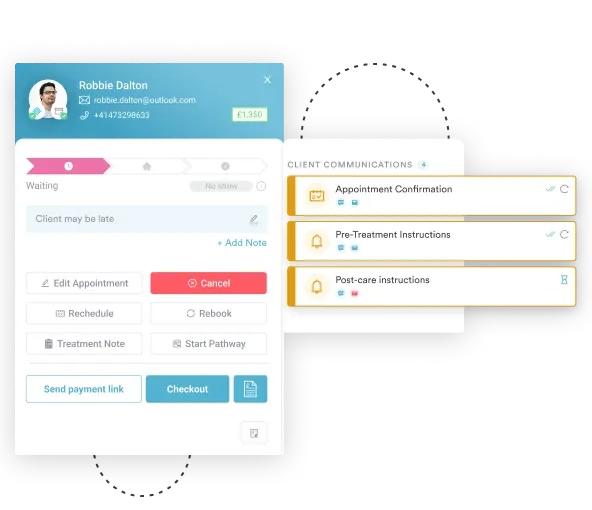
Pabau’s digital intake forms and client records let you capture goals at intake, track progress in real-time, and run automated reviews, all from one practice management platform. Book a demo to see how to centralize goal documentation for your whole team.

Setting goals FOR the client instead of WITH them. If you decide what the client should work on without asking them what matters, the goal won’t stick. Always start with open questions: “What brought you in today?” “What would you like to be different?”
Making goals too vague: For instance, “Get better” is not a goal. “Reduce lower back pain from 8/10 to 3/10” is. Specificity and measurability are non-negotiable.
Setting too many goals at once: In practice, more than 3-4 goals overwhelms the client. Prioritize together. Focus on what matters most.
Forgetting to review: If you don’t revisit goals, they become invisible and clients lose motivation.
Client goals transform treatment from vague intention into purposeful action. Specifically, that action is grounded in a clear case formulation of the client’s presenting problem. A structured template ensures every client leaves your first session knowing what you’re working toward and how you’ll measure success. It also tells them when you’ll review together. As a result, the template becomes your clinical standard, your audit trail, and your evidence of care quality.
Download the template above, adapt it to your practice, and start using it at your next client intake. You’ll see the difference immediately: clearer conversations, faster progress, stronger client retention, and a practice that looks professional and evidence-informed.
If you’d like to centralize goal documentation across your whole team, book a demo with Pabau. That way, you can see how digital forms and client records streamline the entire workflow.

Want a visual way to review client goals? Wellness wheel worksheet rates eight life dimensions from 1 to 10 and plans around the two lowest scores.
Managing behavioral health documentation at scale? Behavioral health EHR guide covers what to look for in an EHR built for mental health practices, so case formulations and notes stay in one place.
Tracking ADHD symptoms alongside client goals? ADHD symptom tracker tracks DSM-5 ADHD symptoms plus medication and mood, for adults and children.
A client goal is what the client wants to achieve, stated in their own words and priorities. A treatment objective is how you, as the practitioner, will help them get there. Both matter: goals ensure treatment stays client-centered, objectives ensure your clinical approach is evidence-informed and structured.
Review goals briefly at every session (ask the client “How are you tracking?”) and conduct a formal review every 4 weeks or at the goal’s target date. A comprehensive goal reset happens every 8-12 weeks or when treatment moves into a new phase.
That’s healthy. If their priorities shift or a goal no longer feels relevant, revise it. Document the change and the reason why. This shows you’re flexible and client-centered, not rigidly attached to an outdated plan.
Yes, though how much weight you give each factor varies by modality. CBT and other structured, present-focused approaches tend to lean on precipitating and perpetuating factors, while psychodynamic and trauma-informed approaches often spend more time on predisposing factors and history. Whatever the modality, mapping all five Ps first keeps your problem list and treatment goals grounded in the client’s clinical picture rather than assumptions.
Some clients resist because past experiences taught them goal-setting feels controlling. Reframe it: “This is about what YOU want, not what I think you should do. I’m just here to help you get there.” Start with one small goal and build from there. Respect their pace.
Start with the presenting problem, then work through the predisposing, precipitating, perpetuating, and protective factors that explain it. Once those are mapped, distill them into a short problem list, convert each problem into a treatment goal the client can recognize and work toward, and note the treatment mode or interventions you’ll use. That sequence turns a vague wish like feeling less anxious into a documented goal, such as reducing panic attacks from three per week to one within eight weeks, that you can track together, session by session.