Mental health self-care checklist
A mental health self-care checklist is a structured daily tool for tracking the ...

6
Last Updated: Oct 20, 2026

A strengths list is a prompt sheet that helps clients name abilities they already have, across emotional, cognitive, social, and professional domains.
Therapists use it to build self-esteem, steady clients through setbacks, and move the session from what is wrong to what is possible.
The VIA framework sorts 24 character strengths under six virtues, which gives you validated vocabulary when a client cannot find their own words.
Introduce the list in the first or second session, complete it together, then tie each strength to a treatment goal in writing.
Pabau’s digital forms let you reuse the strengths list across your caseload, and completed forms feed into the client record.
A one-page reflection form with client and health information fields, then blank columns for strengths and qualities, examples, and the feelings each one brings up. Open reflection questions close the page, so you can pair it with any framework you use in session.
Download templateA strengths list gives a client the vocabulary to name what they already do well. Most of a therapy hour goes to what hurts, so clients often freeze when you ask what they are good at.
A prompt sheet removes that blank-page problem in a single session. Timing matters more than the wording of the list. Introduce it early and you can point back to it months later, when a client stalls.
The sections below cover the 24 VIA character strengths, the four domains worth asking about, and where the form sits across a course of treatment.
A strengths list is a one-page prompt sheet of positive attributes, abilities, and character traits a client can recognize in themselves. It is the mirror image of the intake paperwork, which asks what is wrong. This one asks what works.
Clinicians use it in individual psychotherapy, group counseling, family work, career coaching, and school settings. It does two jobs at once. As an assessment, it tells you what the client can draw on. As an intervention, the act of naming a strength out loud often produces the insight.
Strengths work raises engagement, because it gives the client something to do besides describe their problems.
Clients who recognize their strengths tend to show better treatment adherence and higher self-reported wellbeing. The American Psychological Association publishes much of that research in its clinical journals.
In practice, the list earns its place in five ways:
Self-esteem is the most common reason therapists reach for this tool. Where a client needs more structure than a list of words, a self-esteem worksheet walks them through the same territory with guided questions.
The VIA (Values in Action) model sorts 24 character strengths under six universal virtues. The VIA Institute on Character developed it, and researchers have validated it across cultures and populations. That makes it a defensible answer when a client asks where the words came from.
Reach for it when a client draws a blank. Reading the six virtues aloud gives them options instead of an empty page.
The table works as a reference rather than a score. A character strengths assessment ranks all 24 for the client and hands you a top five to work from.
The VIA list covers character. Day-to-day capability is broader than that, so most clinicians sweep four domains as well. Each one catches strengths the others miss.
This domain covers resilience, self-awareness, emotional regulation, empathy, and stress tolerance. Ask for evidence rather than adjectives. Useful client phrasings sound like “I can name what I am feeling and ask for help,” or “I recover from a disappointment inside a week.”
Problem-solving, critical thinking, creativity, learning speed, and curiosity all sit here. Clients in demanding jobs or study usually find these easiest to name. Watch the client who lists only cognitive strengths, though, because that is often avoidance of the emotional ones.
Communication, listening, repairing conflict, and keeping relationships going belong in this group. For interpersonal work, naming one existing social strength stops the session collapsing into shame. “I know how to apologize properly” is a better starting point than a catalog of failures.
Reliability, attention to detail, time management, leadership, and collaboration make up the fourth domain. These travel with the client between roles, which matters after a job loss or a career change. Career counseling clients often start here, then work backward into the emotional domain.
Every strength has a cost when it runs unchecked. Pairing each one with its shadow keeps the exercise honest, and it stops the session tipping into cheerleading. Common pairings:
Then ask which pairing the client recognizes. That single question usually produces more material than the strengths list itself.
Introduce the list early, complete it with the client instead of sending it home, then keep coming back to it. The five stages below run across a course of treatment, not a single hour.
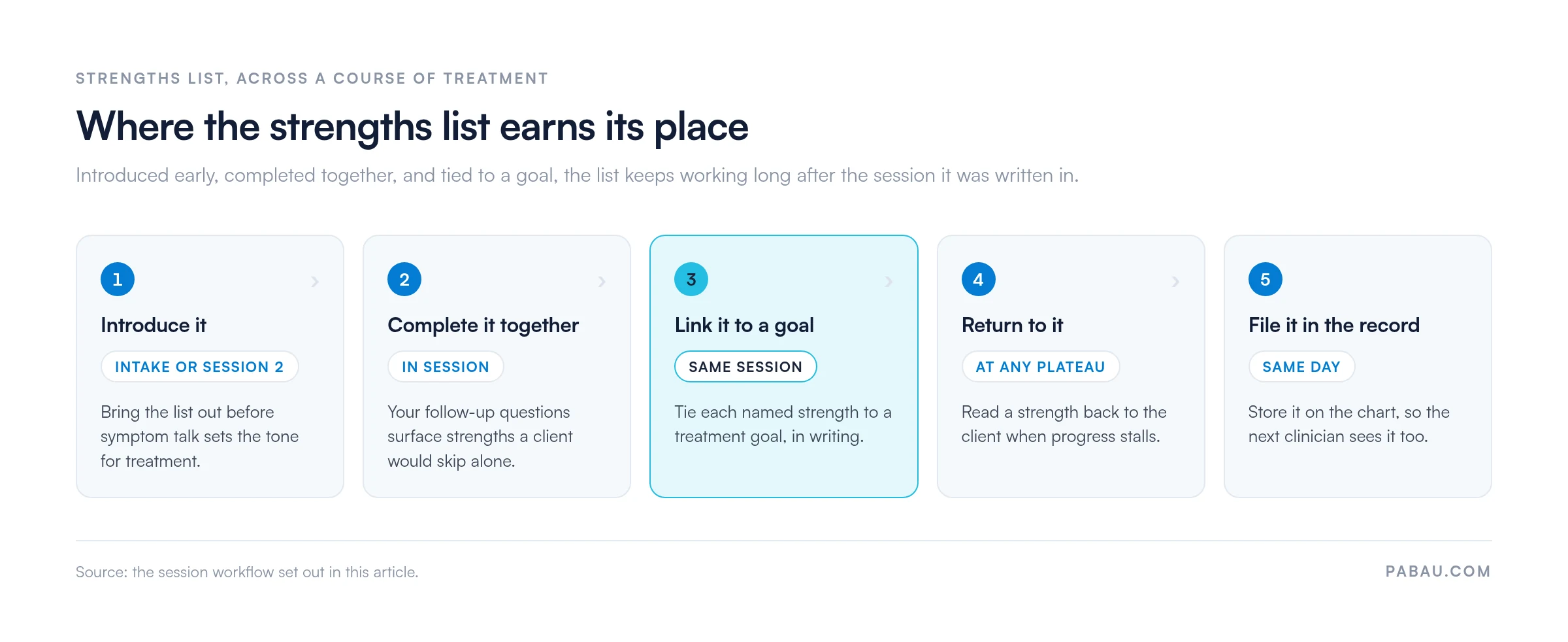
Stage three carries most of the therapeutic value. Some clients struggle to turn a strength into a concrete target. Pair the list with goal setting worksheets, then write the goal in their own words.
Five decisions, all quicker to make now than mid-session:
Four failure modes come up again and again:
Most practices keep the completed form as a scan or a paper page in a folder. It ends up filed away from the treatment notes. Six months later, when the client stalls and you want to quote them back to themselves, nobody can find the page.
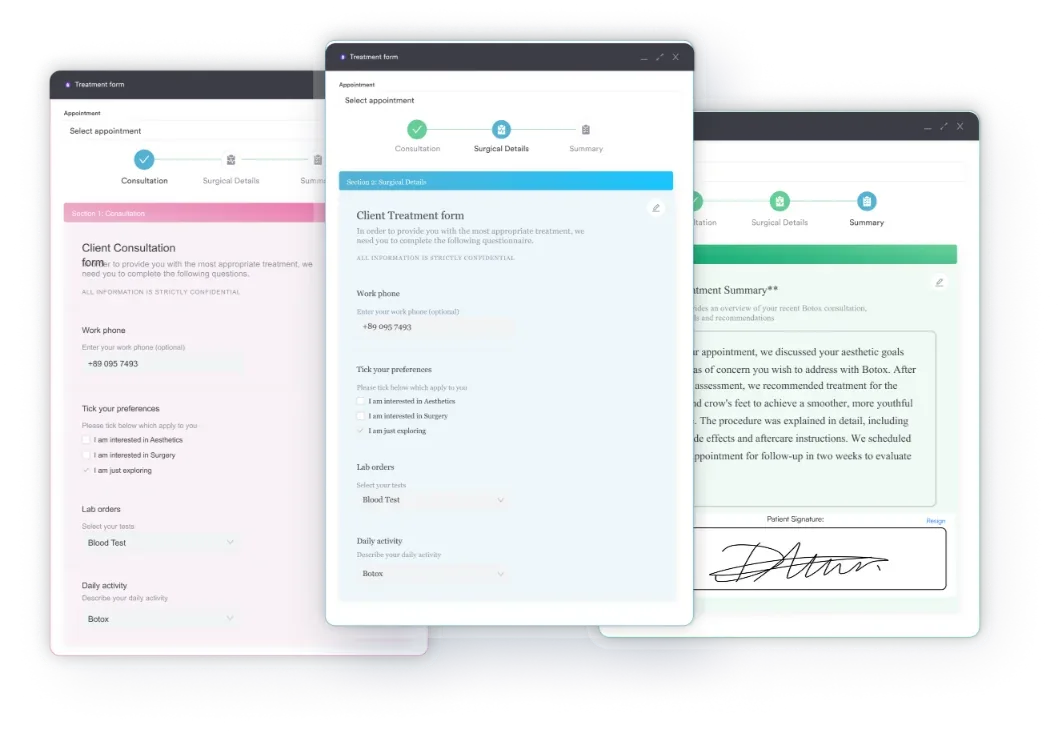
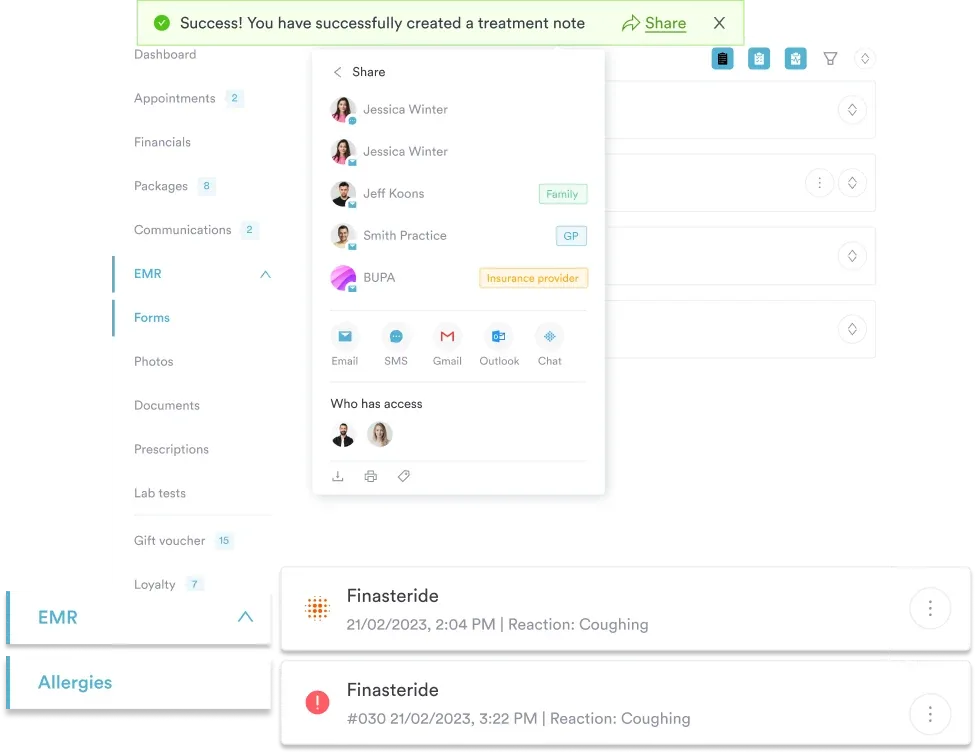
Practice management software like Pabau closes that loop. Our digital intake forms let you build the strengths list once and reuse it across your whole caseload. Completed forms feed into the client record, so the form sits with the notes and the treatment plan instead of in a separate system.
Pabau Scribe, our AI scribe, drafts the session note while you talk. That keeps you in the conversation during the part that matters, which is the client saying out loud what they are good at.

Pabau’s digital forms let you reuse the strengths list across your caseload. Completed forms feed into the client record, so the form sits with your notes and treatment plan.

A strengths list is cheap to introduce and easy to abandon. What separates those two outcomes is whether you go back to it. Read once in week two, it makes for a pleasant session. Quoted in week 20, it changes how a client sees themselves.
So pick one framework, decide where the completed form will live, and leave yourself a note to reference it at the next plateau.
Book a demo to see how Pabau keeps forms like this one attached to the client record, where you can find them again.

Need a structured follow-up once strengths are named? Resilience worksheet turns a client’s coping strengths into something they can practice between sessions.
Working with a client who cannot say what matters to them? Core values exercise sits underneath strengths work and often unblocks it.
Looking for a lighter between-session task? Positive affirmation worksheet gives clients a short daily exercise built on the words they chose in session.
Ready to write the strengths into a formal plan? Psychology treatment plan template gives you the structure for goals, interventions, and review dates.
Carrying a heavy caseload of strengths-based work? Therapist burnout: signs, causes, and prevention covers what keeps clinicians steady enough to do it well.
Yes. The VIA Institute offers its character strengths survey free online, and it returns a ranked list of all 24 strengths. Paid reports add deeper interpretation. Many therapists ask clients to take it between sessions, then bring the ranking in to discuss.
Three to five is a workable number. A client who names 15 strengths rarely remembers any of them a week later. Ask for the handful they recognize most clearly, then explore each one with a specific example.
Yes, with the wording adjusted. Younger clients respond to concrete prompts rather than abstract nouns like prudence. Ask what they are good at in school, at home, and with friends, then translate their answers into strength language together.
It can, once it sits in the client record and your notes reference it. On its own, a loose worksheet is not documentation. Tie it to a treatment goal and cite it when you review progress.
A list is a prompt sheet. It gives clients the vocabulary to recognize what they already do. An assessment, such as the VIA Survey or CliftonStrengths, scores responses and ranks the results. Many therapists use the list first, then the assessment.