Despina Petrushevska

Anxiety tracker template: free printable PDF for clinicians
What is an anxiety tracker and how is it different from journaling? An anxiety t...

3
Last Updated: Oct 27, 2026
Free PDF 3 pages, print-ready Clinician-reviewed
A human body quiz is a short set of questions that tests how well a learner knows the body's structures, systems and common conditions. Educators, clinical trainers and wellness practitioners use one to check understanding before moving on to harder material.
This free printable quiz has 20 short-answer questions across four sections: general anatomy, systems of the human body, diseases and disorders, and miscellaneous facts. The PDF has no answer key, so we've listed the answers to all 20 questions further down this page.
A three-page PDF with 20 short-answer questions in four sections: general anatomy, systems of the human body, diseases and disorders, and miscellaneous. Learners write each answer in the space below the question.
Start from scratch, or upload this PDF or any form you already use, and Pabau's AI Form rebuilds it with tick boxes, text fields and a signature. Attach it to the treatment once, and every patient gets it on time.
AI Form rebuilds the consent, history and aftercare forms you already use. You review each one, then publish.
Patients complete forms on their phone before they arrive, so the front desk stops retyping paper.
Every signed form is versioned and attached to the treatment record, ready when you need it.
Set how long a consent stays valid. Returning patients skip forms they have already signed.
Supports HIPAA and GDPR compliance AES-256 encryption 4.8 on G2 4.7 on Capterra Trusted by 4,000+ practices worldwide

The free PDF has 20 short-answer questions in four sections: general anatomy, body systems, diseases and disorders, and miscellaneous.
The PDF carries no answer key, so the answers to all 20 questions are listed on this page.
Learners write each answer in the space under the question, which tests recall rather than recognition.
Bone, muscle and directional-term questions aren’t in the PDF, but this page suggests prompts you can add.
Use the quiz for classroom teaching, staff training or patient education sessions.
The quiz has four sections of five questions each. Run the whole set, or pick the sections that match your learners. Every question is a short-answer prompt. Learners write their answers in the space provided rather than choosing from options.
The diagram below shows how the questions move from structure to function and then to disease.
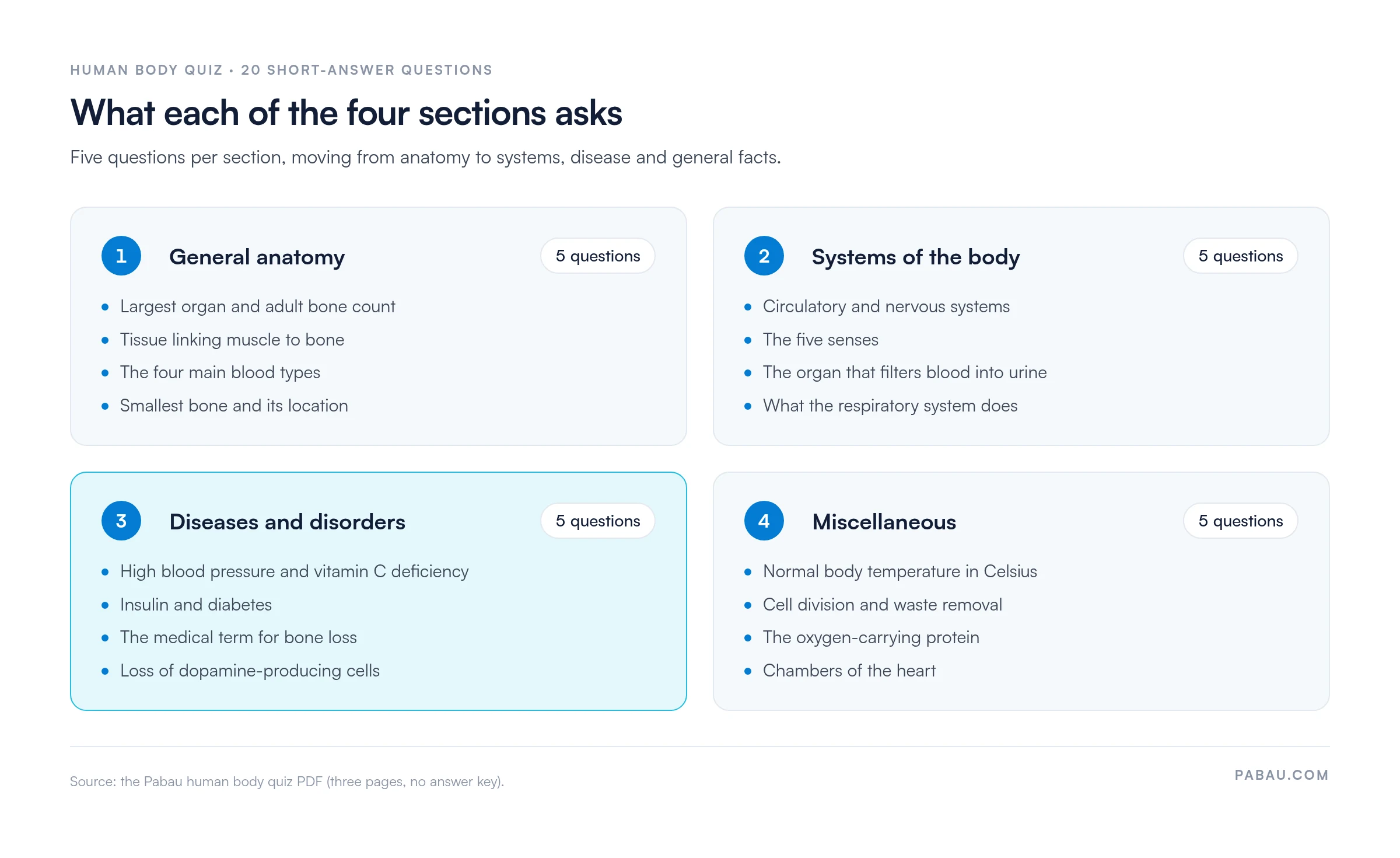
The systems and disease sections work best once learners can name the major organs. If your group needs that grounding first, start with a human body organs diagram before you hand out the quiz.
The PDF ships without an answer key. Use this table to mark completed quizzes. Questions 1 to 5 cover anatomy, 6 to 10 body systems, 11 to 15 diseases, and 16 to 20 miscellany.
| # | Question | Answer |
|---|---|---|
| 1 | What is the largest organ of the human body? | The skin |
| 2 | How many bones are in the adult human body? | 206 |
| 3 | What type of tissue connects muscles to bones? | Tendons |
| 4 | Name the four main blood types. | A, B, AB and O |
| 5 | What is the smallest bone, and where is it? | The stapes, in the middle ear |
| 6 | Which system transports blood around the body? | The circulatory (cardiovascular) system |
| 7 | Name the five senses. | Sight, hearing, smell, taste and touch |
| 8 | Which organ filters waste from the blood to make urine? | The kidneys |
| 9 | Which system controls voluntary and involuntary actions? | The nervous system |
| 10 | What is the main function of the respiratory system? | Taking in oxygen and removing carbon dioxide |
| 11 | What is the term for high blood pressure? | Hypertension |
| 12 | Name a condition caused by a lack of vitamin C. | Scurvy |
| 13 | Which disease involves not producing or responding to insulin? | Diabetes (diabetes mellitus) |
| 14 | What is the medical term for bone loss? | Osteoporosis |
| 15 | Which disease follows the loss of dopamine-producing brain cells? | Parkinson’s disease |
| 16 | What is the average normal body temperature in Celsius? | About 37°C (98.6°F) |
| 17 | Name the process by which cells divide to reproduce themselves. | Mitosis |
| 18 | Which protein carries oxygen in the blood? | Hemoglobin |
| 19 | How many chambers does the human heart have? | Four |
| 20 | What is the term for removing waste products from the body? | Excretion |
Accept 37°C or 98.6°F for question 16, and either diabetes type for question 13. For more on hormones, try an endocrine system assessment next.
Running the quiz takes little preparation. The steps below work for classrooms, staff inductions and group patient education.
Treat the scores as a teaching tool rather than a grade. They tell you where to spend the next lesson.
The PDF doesn’t cover body regions, directional terms or muscles, and it asks only two bone questions. If your learners need those topics, add a short page of your own using example prompts like the ones below.
| Question type | Example prompt |
|---|---|
| Regions | Which region sits between the chest and the pelvis? |
| Direction | Which term describes a structure closer to the midline? |
| Location | Which organ sits in the upper right quadrant of the abdomen? |
Direction and region questions carry over into clinical notes and patient handouts. A learner who can describe a location precisely will document it more clearly.
For bones, the PDF asks how many bones an adult has (206) and which is the smallest (the stapes, in the middle ear). Infants are born with more bones, and some fuse as the body matures. Extra prompts that build on those two include:
Muscle questions suit physical therapy and sports medicine groups. Standard anatomy references describe well over 600 skeletal muscles, and the exact count depends on how muscles are classified. The table below gives three starting points.
Ask learners to name the muscle group first, then describe its location and function. This two-step prompt catches learners who memorize names without understanding what the muscle does.
A printed quiz works well in a classroom. In a practice, patient education usually means a paper handout, a quick verbal check at the appointment and no record of what the patient understood.
Pabau, the practice management platform we build, includes digital forms that patients complete before a visit. The same patient intake software that collects medical history can carry a few short questions on the treatment or condition ahead.
Completed forms land in the patient’s record next to their treatment notes and consent forms. You walk into the appointment knowing which points to explain again, and the record shows what was covered.

Pabau’s digital forms let patients answer questions before their appointment, with every response saved to their record. You start each visit knowing what to explain.

Hand out the quiz as it is when you need a quick, printable check on core anatomy and common conditions. Keep the answer table from this page next to it, because the PDF won’t give learners or markers the answers.
If your group needs muscles, regions or more bones, add your own page rather than stretching the quiz to cover them. A few minutes of writing buys you a test that matches what you taught.
Book a demo to see how Pabau sends education questionnaires before appointments and saves every answer to the patient record.

Teaching where the organs sit? Human body organs diagram maps the major organs by region, with a free organ notes template.
Moving on to the nervous system? Cranial nerves test walks through how to test all 12 cranial nerves, step by step.
Covering hormones and diabetes in more depth? Endocrine system assessment explains how nurses assess the endocrine system in practice.
Want learners to track their own health? Health worksheet templates give printable sheets for logging symptoms, medications and appointments.
Moving patient paperwork online? Digital patient intake forms explains how to get forms completed before the visit.
A human body quiz is a set of questions that tests knowledge of anatomy, body systems and common conditions. This version is a printable PDF with 20 short-answer questions in four sections.
No. This PDF contains the questions only, so prepare your own answers or use the reference facts on this page.
It suits healthcare students, clinical trainers, wellness teams and general learners. The miscellaneous section works well for mixed groups, while the diseases and disorders section suits learners with some clinical background.
The adult human body has 206 bones. Infants have more, because some bones fuse during growth.