Visual scanning worksheets
Visual scanning worksheets are structured printable tasks that train a patient t...

1
Last Updated: Oct 19, 2026
A general survey in nursing is the first, head-to-toe observation a nurse makes of a patient before any focused assessment begins. It covers appearance, level of consciousness, behavior, skin, breathing, gait, and vital signs. A structured general survey nursing template makes sure each observation is recorded in the same format, every time.
Nurses learn the general survey in training, but on a busy ward or outpatient unit it often gets charted from memory. A consistent template turns that first look into a record colleagues can read, compare over time, and act on.
A ready-to-use form for recording general appearance, level of consciousness, affect and behavior, skin, breathing, gait, body measurements, and vital signs. Each section leaves space for observations and baseline measurements.
Download template
A general survey is the opening, head-to-toe observation that starts every nursing assessment.
It covers appearance, consciousness, behavior, skin, breathing, gait, and vital signs.
Record objective findings with measurable detail, and keep subjective reports in the patient’s words.
A standard template keeps findings consistent across shifts and handovers.
Pabau, the practice management platform we build, can hold the same fields as a digital form in each patient’s record.
A general survey nursing assessment is the opening phase of the wider physical assessment. It gives you a quick picture of the patient’s overall state before you move into system-by-system checks. It also shapes which focused assessments come next. A drowsy or confused patient, for example, may need neuro checks before anything else.
The survey is observational first. You look, listen, and note what you see before you touch the patient. That’s why the template leads with appearance and behavior.
Most general survey frameworks cover the same core domains. The template follows this order so that each section prompts a specific observation.
Those seven domains fall into four stages. The hands-off observations come first, before any check that could change how the patient presents.
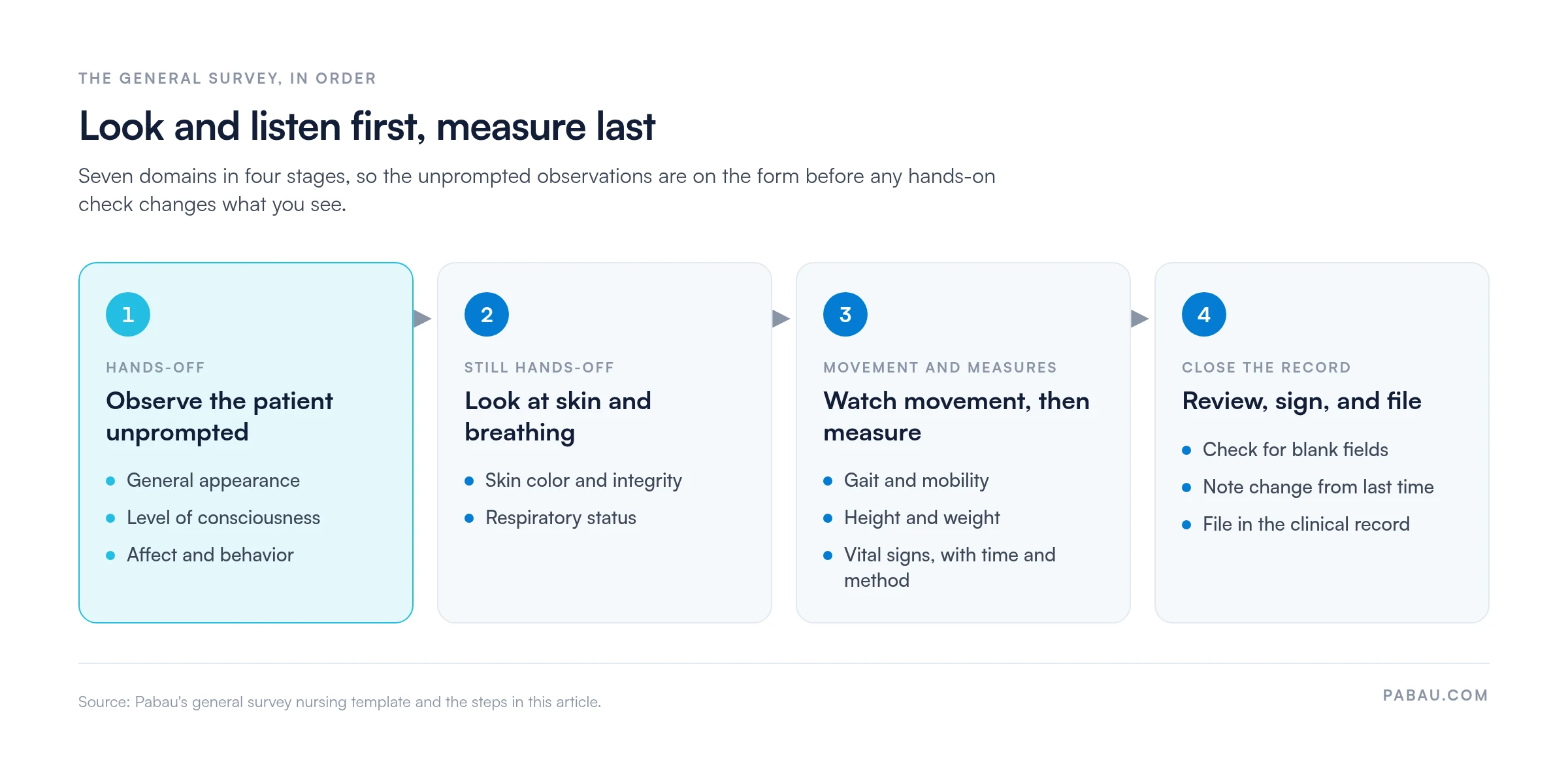
Work through the sections in the order they appear, and complete each one before moving on.
Ward nurses, outpatient nurses, and nursing students all use the general survey. Practical and vocational nurses carry out the same observations in many settings, and the template works across those roles.
Private practices, mental health services, and wellness practices also use the general survey as a baseline record before ongoing care.
A template makes the general survey repeatable. Two nurses assessing the same patient record findings in the same structure, so changes are easier to spot between shifts. Those findings also slot straight into an SBAR handoff at shift change.
It also supports documentation standards. The Joint Commission expects clinical records to be accurate, timely, and complete, and a structured form helps teams meet that expectation.
General survey findings are objective data. They feed the assessment step of the nursing process, which then informs the diagnosis, planning, implementation, and evaluation stages.
Record what you observe in measurable terms, then pair it with the patient’s reported symptoms. Together, they let a nurse move from an observation to a considered nursing diagnosis. A nursing diagnosis handbook helps you match those findings to the right diagnostic label.
Good documentation separates what you saw from what the patient told you. Keep both on the form, labeled clearly.
Put together, a completed survey reads as a short run of objective statements. For example: Adult patient sitting upright, in no acute distress. Alert and oriented to person, place, and time. Skin warm, dry, and pink. Respirations even and unlabored. Gait steady without an assistive device.
When a patient needs repeated observations, a separate vital signs record keeps the trend on one page. The general survey then stays the baseline it was meant to be.
In the United States, patient information falls under the Health Insurance Portability and Accountability Act (HIPAA). Store completed forms only in systems with appropriate access controls.
On paper, a general survey lives in a folder, and the next nurse has to find it before comparing anything. Handwriting, skipped fields, and loose pages slow that comparison down.
Pabau’s digital forms let your team build the same fields into one form. Nurses then complete it on a tablet at the bedside or in the exam room. Each completed form saves to the patient’s record automatically.
Pabau’s medical records keep observations, measurements, and notes together under each patient. The nurse on the next shift can open the earlier survey and compare it line by line.

Pabau’s digital forms capture general survey findings at the bedside and save them to the patient record. Your team compares assessments across shifts without hunting for paper.

A general survey only pays off when the next clinician can read it and compare it. Use the template in the same order every time, chart in objective terms, and note what has changed since the last assessment.
The cost is a minute or two of structure at the start of each assessment. In return, changes are easier to catch between shifts, and handovers start from recorded findings instead of memory.
Book a demo to see how Pabau stores general survey findings so every shift works from the same patient record.

Assessing a patient in an emergency? Emergency nursing assessment gives you a structured form for rapid triage findings.
Need to chart a neurological exam? Neuro assessment documentation covers what to record when consciousness or orientation changes.
Handing over at the end of a shift? Nursing handoff report helps you pass findings to the next nurse in a consistent format.
Caring for patients after birth? Nursing postpartum assessment walks through the BUBBLE-HE checks that follow delivery.
Juggling several patients on one shift? Nursing brain sheet keeps each patient’s key details on one page.
A general survey is a head-to-toe observation that a nurse performs at the start of an assessment. It covers appearance, consciousness, behavior, skin, breathing, gait, and vital signs.
The general survey is observational and broad. A focused physical examination goes deeper into specific body systems once the survey has pointed to where to look.
Objective findings from the survey, combined with the patient’s reported symptoms, form the evidence base for the nursing diagnosis step of the nursing process.
Yes, students can use the template to practice structured observation. Educators should confirm local requirements before using any form in supervised clinical placements.