
Pabau Engage inbox

Pabau Engage is here: every patient conversation in one inbox.

Learn more
HCPCS Code

HCPCS code T1003 – LPN/LVN skilled nursing services


Code Definition

T1003 is the HCPCS Level II code for LPN/LVN services, up to 15 minutes. It covers skilled nursing that a licensed practical or vocational nurse delivers under a physician-ordered plan of care, billed to state Medicaid programs.

T1003 sits between T1002 for registered nurse services and T1004 for qualified nursing aide services. The license of the person who made the visit decides the code. Each claim needs the plan of care, the nurse's license, and clock times in and out for every visit.

Level
Level II
Category
T — State Medicaid agency codes
Status
Active, effective July 1, 2001
Billable
No
Code also known as
LPN Medicaid billing, home health nursing code, LVN Medicaid code
Save time. Improve accuracy. Get paid faster.
Automate coding with Pabau

Let Pabau's smart automation suggest the right codes, reduce claim denials, and keep your practice compliant—effortlessly.

  • AI-powered code suggestions
  • Real-time compliance checks
  • Faster claims, fewer denials
Why practices choose Pabau
Save hours every week

Automate repetitive tasks and focus on what matters most—your patients.

Improve accuracy

Reduce coding errors and ensure compliance with the latest regulations.

Get paid faster

Clean claims, fewer denials, and faster reimbursements.

Grow with confidence

Powerful insights and reporting to help your practice thrive.

HIPAA compliant SOC 2 certified GDPR-compliant Trusted by 4,000+ clinics worldwide

Key takeaways

Key takeaways

HCPCS code T1003 covers LPN/LVN skilled nursing only, billed in units of up to 15 minutes. RN services bill under T1002 instead.

T1003 is a Medicaid code. Medicare does not recognize T-codes, and most commercial payers don’t either.

Daily unit limits and prior authorization rules vary by state Medicaid program, so never assume a universal cap.

Missing or incomplete documentation is a leading cause of T1003 denials, and every visit needs clock times in and out.

Pabau keeps visit notes, forms and claims in one system, so incomplete documentation is caught before a claim goes out.

HCPCS code T1003: Definition and quick-reference data

HCPCS code T1003 is defined by the Centers for Medicare and Medicaid Services (CMS) as LPN/LVN services, up to 15 minutes. It covers skilled nursing that a licensed practical or vocational nurse delivers under a physician-ordered plan of care.

The code sits in the T-code range of HCPCS Level II, which state Medicaid agencies use for services CPT codes don’t describe. The table below sums up the data points a biller needs before submitting a T1003 claim.

FieldValue
HCPCS CodeT1003
Official DescriptorLPN/LVN services, up to 15 minutes
Code CategoryHCPCS Level II (T-codes) – Medicaid state plan services
Primary PayerMedicaid (state programs only; not covered by Medicare)
Unit Definition1 unit = up to 15 minutes of LPN/LVN skilled nursing service
Eligible Provider TypesLicensed Practical Nurse (LPN), Licensed Vocational Nurse (LVN)
Common SettingsPatient home (POS 12), assisted living, private duty nursing settings
Prior AuthorizationCommonly required; varies by state Medicaid program

What T1003 covers

T1003 covers skilled nursing performed by an LPN or LVN under a physician-ordered plan of care, billed in units of up to 15 minutes.

Use it when the service needs nursing judgment and technical skill beyond what a nursing aide or home health aide provides. The other condition is that an LPN or LVN delivers it, not a registered nurse (RN).

Services within T1003 scope include wound care and dressing changes, medication administration, blood glucose monitoring, catheter care, tube feeding management, and vital signs assessment. Each service must fall within the LPN/LVN’s scope of practice under state licensure law.

According to the AAPC HCPCS code set, CMS maintains T-codes like T1003 for Medicaid programs. They let a state tell provider levels apart within the same service.

State programs pay less for LPN/LVN services than for RN services billed under T1002. Submitting T1002 when an LPN delivered care is upcoding, which carries compliance risk well beyond a denied claim.

What T1003 does not cover: Exclusions and limitations

T1003 is limited to LPN/LVN skilled nursing and excludes several adjacent service types that coders sometimes incorrectly bill under this code.

  • RN services: Services performed by a registered nurse must bill under T1002, not T1003, regardless of the setting or service type.
  • Personal care and custodial services: Assistance with bathing, dressing, grooming, or ambulation that does not require nursing judgment bills under T1004 (qualified nursing aide services).
  • Home health aide services: Paraprofessional home health aide tasks generally fall under T1004 or state-specific home health codes, not T1003.
  • Medicare beneficiaries: T-codes are not recognized by Medicare. Do not submit T1003 on a Medicare claim or a Medicare Advantage plan that follows Medicare billing rules.
  • Commercial insurance payers: Most commercial health plans do not cover T-codes, because coverage is specific to state Medicaid programs. Always verify the beneficiary’s payer before submitting.
  • Non-Medicaid state programs: Some states fund home-based nursing through block grants or separate waivers that use different code sets. T1003 may not apply in those programs.

How T1003 compares to neighboring T-codes: T1000, T1002, and T1004

The T1000-T1004 code series covers a spectrum of Medicaid home-based nursing and personal care services, differentiated primarily by provider type and service level. Picking the wrong code in this series is a common cause of wrong-code denials in home health and private duty nursing billing.

CodeProvider TypeService TypeUnit DefinitionKey Differentiator
T1000Licensed private duty or independent nurse (RN or LPN/LVN, state-specified)Private duty / independent nursing servicesUp to 15 minutesSome states use T1000 for all private duty nursing, whatever the license level
T1002Registered Nurse (RN)RN skilled nursing servicesUp to 15 minutesRN-level scope; higher Medicaid reimbursement rate than T1003
T1003Licensed Practical Nurse (LPN) / Licensed Vocational Nurse (LVN)LPN/LVN skilled nursing servicesUp to 15 minutesLPN/LVN scope only; lower reimbursement than T1002
T1004Qualified nursing aideQualified nursing aide servicesUp to 15 minutesNon-skilled personal care that does not require a nursing license

Some state Medicaid programs use T1000 as an umbrella code for all private duty nursing, whatever the nurse’s license level. In those states, T1002 and T1003 may not be used at all. The decision flow below runs the three checks in the order a biller should make them.
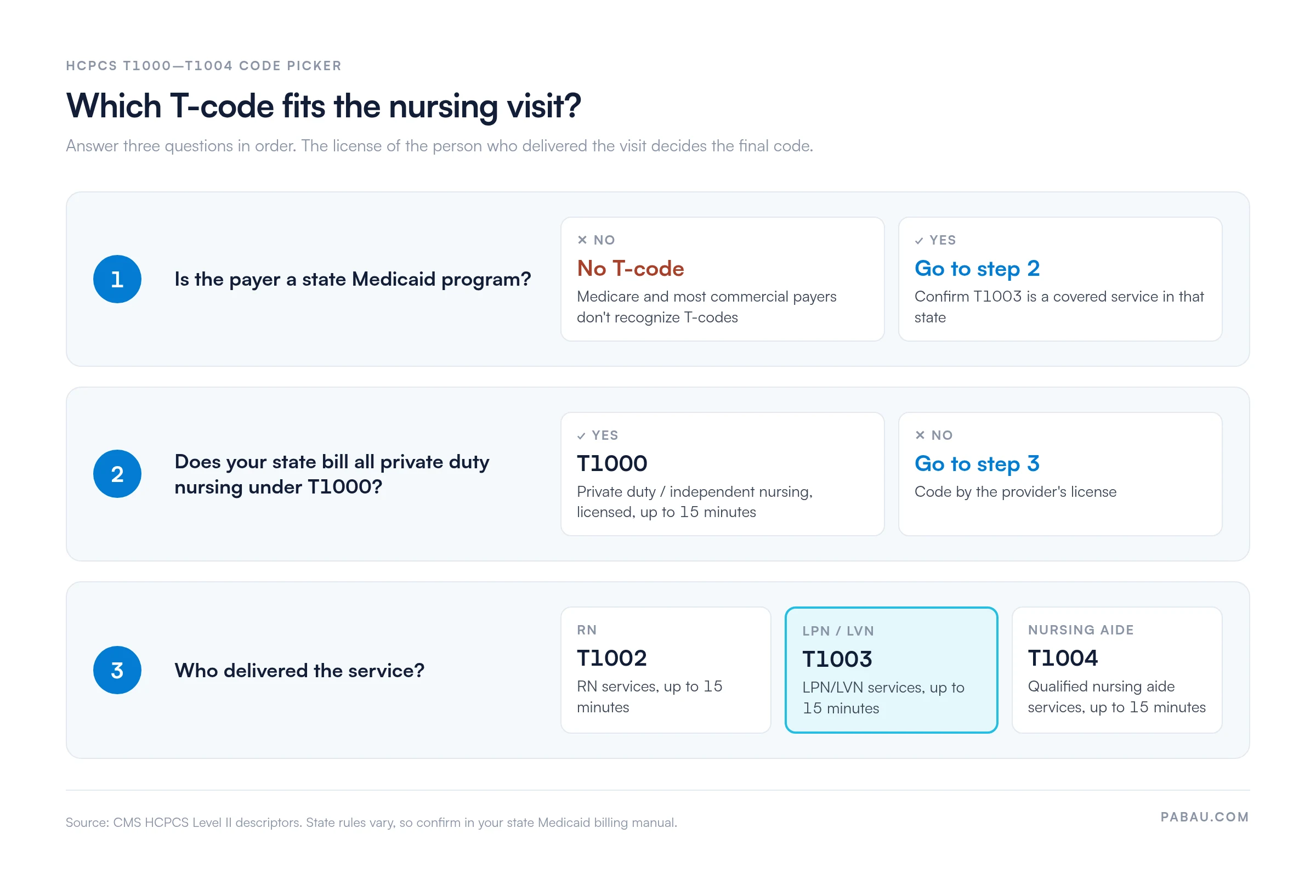
Decision flow for HCPCS T-codes.
The payer and the state’s T1000 policy come first, and only then does the nurse’s license pick the code. Descriptors are from the CMS HCPCS Level II code set.

Who can bill T1003: Eligible providers and settings

T1003 can be billed by Medicaid-enrolled home health agencies and private duty nursing agencies. Some states also let individual LPN/LVN practitioners bill it once they meet Medicaid provider enrollment requirements.

  • Home health agencies: Must be enrolled as a Medicaid home health provider in the state where services are rendered. The billing agency is the enrolled provider, even when an individual LPN/LVN delivers the service.
  • Private duty nursing agencies: Must hold appropriate licensure under state home health or private duty nursing regulations. Provider number must match the enrolled agency type.
  • Individual LPN/LVN practitioners: Permitted in states that allow individual provider enrollment for Medicaid home-based services. Requires active state licensure and Medicaid provider number.
  • Valid place-of-service codes: POS 12 (patient’s home) is the most common. Some states also accept POS 04 (homeless shelter), POS 33 (custodial care facility), and other residential settings covered for home-based nursing. POS 11 (office) is generally not appropriate for T1003 services.

Agencies hiring licensed practical nurses for home-based work should confirm each LPN/LVN holds an active, unrestricted license in the state of service. Check it before submitting any T1003 claim for their visits. A lapsed or restricted license is a documentation defect that can trigger denials retroactively.

Unit structure and how to count units for T1003

One unit of T1003 covers up to 15 minutes of LPN/LVN skilled nursing. Many state Medicaid programs round time with a midpoint rule like the CMS 8-minute rule shown below, but the exact rounding rule varies by state.

Actual Time SpentUnits to Bill (8-minute rule)Notes
0-7 minutes0 unitsBelow the 8-minute threshold; not billable
8-22 minutes1 unitMeets the 8-minute threshold for the first unit
23-37 minutes2 unitsSecond full 15-minute interval reached
38-52 minutes3 unitsApproximately one hour of service
53-67 minutes4 unitsVerify state daily unit cap before billing 4+ units

Daily unit maximums vary by state Medicaid policy. Some states cap T1003 at a set number of units per day or per visit. Others set limits through prior authorization rather than a hard billing rule. Never apply a unit cap from one state’s manual to a beneficiary enrolled in a different state’s Medicaid program.

Documentation must support every unit billed. The visit note must record the clock time the nurse arrived at the patient’s home and the time the nurse left, not just the duration. A note that says “45-minute visit” without explicit time in/out is insufficient for most state Medicaid audits.

Pro Tip

Bill T1003 units based on documented clock times, not estimated duration. If the LPN’s visit note shows arrival at 10:05 and departure at 10:48, that is 43 minutes. Under the 8-minute rule, that rounds to 3 units. Round before submitting, and keep the raw times in the visit record for any audit request.

Medicaid payer requirements and state-by-state variations for T1003

T1003 is a Medicaid state plan code. Medicare does not pay for T-codes, and neither do Medicare Advantage plans that follow traditional Medicare billing rules. Before submitting a T1003 claim, confirm the beneficiary is actively enrolled in Medicaid. Then confirm the state’s Medicaid program lists T1003 as a covered service.

State programs differ on three points:

  • Coverage settings: Some states cover T1003 only in the beneficiary’s primary home (POS 12). Others extend coverage to assisted living facilities or community-based residential settings. Check the state’s Medicaid billing manual for the approved place-of-service list.
  • Daily and annual unit limits: States set their own unit caps, either as a daily maximum, a visit maximum, or an annual hour limit. These limits usually sit in the prior authorization approval rather than in the fee schedule.
  • Rate-setting: State Medicaid programs set their own reimbursement rates for T1003 independently. The rate in one state can differ sharply from a neighboring state’s, even for the same LPN service.

The CMS HCPCS Level II coding system provides the national code framework. Each state Medicaid agency writes its own coverage and payment rules within it. When in doubt, the state’s provider billing manual is the controlling document, not a third-party code lookup tool.

Prior authorization requirements for T1003 claims

Prior authorization (PA) is commonly required for T1003 services, though the specific threshold, process, and documentation requirements differ by state. Most state Medicaid programs require PA before LPN/LVN private duty nursing starts. Some allow a short initial period of services before PA must be in place.

Running insurance eligibility verification before the first visit prevents most PA-related denials. The PA process for T1003 usually follows these steps:

  1. Physician order: Get a signed physician order for LPN/LVN skilled nursing. It should state the frequency and duration of services and the primary diagnosis behind medical necessity.
  2. Plan of care: Write a nursing care plan that matches the physician order and names the skilled tasks the LPN/LVN will perform. It also records the expected outcomes and timeframe.
  3. PA request submission: Send the PA request to the state Medicaid managed care organization (MCO) or fee-for-service (FFS) program. Include the physician order, care plan, and supporting ICD-10 diagnosis codes.
  4. PA approval and tracking: Record the PA approval number, authorized unit limit, and expiration date in the billing system. Services rendered after the PA expiration date are not covered, even if the underlying medical need continues.
  5. Renewal before expiration: Start the PA renewal at least 30 days before the current authorization expires. Visits delivered after the old PA lapses but before the renewal is approved are a common source of denials.

Some states require PA for each new plan of care period, commonly 60 or 90 days. Others require it only when the number of authorized hours changes. Verify the renewal cycle in the applicable state’s Medicaid billing manual.

Documentation requirements to support a T1003 claim

Inadequate documentation is a leading cause of T1003 claim denials and the main weak point in Medicaid audits. Every T1003 claim needs a complete record that proves medical necessity, provider eligibility, and accurate unit billing.

  • Physician-ordered plan of care: Signed by the ordering physician and dated within the certification period. It specifies the frequency and duration of LPN/LVN services by diagnosis.
  • LPN/LVN licensure verification: A copy of the current, unrestricted state license for each nurse providing services. Some state programs require the license number to appear on every claim line.
  • Visit note with time in/out: The nursing note must record the clock times the nurse arrived and left. It also lists the skilled services performed and the patient’s clinical status. Duration alone is not sufficient.
  • ICD-10-CM supporting diagnosis: The primary diagnosis code must establish medical necessity for skilled nursing services. The diagnosis must link directly to the skilled tasks performed during the visit.
  • Prior authorization number: Must appear on the claim if PA was required. A claim submitted without a required PA number is denied on the front end before clinical review.
  • Superbill or billing record: The internal superbill documentation should capture all of the above plus the unit count per visit. That way the claim can be rebuilt if an audit starts.

ICD-10 diagnosis codes commonly paired with HCPCS code T1003

The ICD-10-CM diagnosis code on a T1003 claim establishes medical necessity for skilled nursing services. The diagnosis must call for the nursing assessment or intervention an LPN/LVN performs. A custodial or maintenance-only diagnosis won’t support T1003 billing.

ICD-10-CM CodeDescriptionCommon T1003 Use Case
L89.xxxPressure ulcer (stage-specific)Wound care, dressing changes, wound assessment
Z87.39Personal history of other musculoskeletal disordersMedication management following orthopedic events
E11.xxxType 2 diabetes mellitus (complication-specific)Blood glucose monitoring, insulin administration, foot care
N31.9Neuromuscular dysfunction of bladder, unspecifiedCatheter care and urinary management
K94.20Gastrostomy complication, unspecifiedTube feeding management and site care
I50.9Heart failure, unspecifiedVital signs monitoring, fluid status assessment, medication compliance
J44.1COPD with acute exacerbationRespiratory assessment, oxygen monitoring, nebulizer administration

Verify that each ICD-10-CM code paired with T1003 is current for the date of service. Some codes in this clinical area have been updated or retired in recent ICD-10-CM annual revisions. Use the NLM Clinical Table Search or the CDC ICD-10-CM tool to confirm code validity for the applicable fiscal year.

Top reasons T1003 claims are denied and how to fix them

T1003 claim denials follow predictable patterns, and pre-submission checks prevent most of them. The denial management process for T1003 starts by finding which denial category drives the most volume in your practice. Then build the fix into the documentation or authorization step, so the same denial doesn’t recur.

Denial ReasonRoot CauseCorrective Action
Wrong provider typeRN delivered the service but T1003 was billed instead of T1002Match code to the actual provider’s licensure; add a pre-submission provider-type check
Missing prior authorizationPA number not on claim, or services rendered after PA expirationTrack PA expiration dates; begin renewal at least 30 days before lapse
Incorrect place of servicePOS code does not match the setting where services were deliveredVerify the state’s approved POS list for T1003 and apply the correct POS per visit location
Unit count mismatchBilled units exceed what documented time supportsCalculate units from time in/out before billing; retain raw time data for audit support
Unsupported ICD-10 diagnosisDiagnosis does not establish medical necessity for skilled nursingReview diagnosis-to-service linkage before submitting; use a diagnosis code that reflects the skilled need
Timely filing exceededClaim submitted after the state’s filing deadline (commonly 90-365 days from DOS)Establish a claim submission cycle with internal deadlines well inside the state’s limit
Incomplete documentationVisit note missing time in/out, physician order, or licensure verificationUse a standardized visit note template that captures all required fields before the note is finalized

Can T1002 and T1003 be billed together on the same date of service?

T1002 and T1003 can be billed on the same date of service for the same beneficiary. Both the RN and the LPN/LVN must each have provided distinct, separately documented skilled nursing. This scenario is subject to NCCI bundling edits and state payer policies, which vary widely.

Key considerations before billing both codes on the same DOS:

  • Distinct services required: Each provider must have delivered a separate, documented service. Simply having two nurses present for a single visit does not support two separate code lines.
  • State NCCI edit check: CMS applies National Correct Coding Initiative (NCCI) edits to Medicaid claims in participating states. Some states have NCCI procedure-to-procedure (PTP) edits that bundle T1002 and T1003 when billed together. Verify the current edit status against the applicable state’s NCCI tables before submitting.
  • Modifier requirement: Some states allow same-day billing of T1002 and T1003 with a modifier. There, document each service separately and apply the modifier as the state instructs. Common modifiers used in this context include 59 (distinct procedural service) or the state’s equivalent.
  • Authorization coverage: The prior authorization must cover services from both a licensed RN and an LPN/LVN for same-day billing to be valid. If the PA was issued only for LPN/LVN services, billing T1002 on the same date may create an unauthorized service denial.

Because state policies on same-day T1002 and T1003 billing vary, check every same-day claim by hand against the state billing manual before you submit it.

Pro Tip

Before billing T1002 and T1003 on the same date, pull your state’s current NCCI Medicaid edit table and check the T1002-T1003 pair. If an edit exists, determine whether a modifier is permitted to bypass it or whether separate billing is prohibited. Document your verification in the billing record.

How claims management software prevents T1003 denials

Manual T1003 workflows break in three predictable places: miscounted units, missed PA renewals, and incomplete documentation that surfaces only at denial. Pabau, the all-in-one practice management system we build, includes claims management software that keeps the visit note and the claim in one place.
Automate claims and billing with Pabau
Pabau’s claims and billing tools build each T1003 claim from the signed visit note, so units and authorization details match what the nurse recorded.
  • Unit calculation from clock times: When the visit note captures start and end times, the unit count follows the state’s rounding rule without manual arithmetic.
  • PA expiration tracking: Recording each authorization’s expiry date against the patient lets the team renew it before visits roll past the covered period.
  • Documentation completeness checks: Required fields catch a missing PA number or an incomplete time record before the claim reaches the payer.
  • Denial pattern reporting: Tracking denials by code, provider, and payer shows repeat problems that single claim reviews miss. One example is an LPN/LVN whose notes keep leaving out the time out.

Pabau’s clean claim submission workflow and structured note templates help home health and private duty nursing teams send complete T1003 claims. Time in/out and licensure details are captured at the point of care, not pieced together from memory at billing time.

Stop T1003 denials before they start

Pabau keeps visit notes, authorization details and claims in one system, so incomplete T1003 documentation is caught before submission. See how it works for home health and private duty nursing billing.

Pabau claims management dashboard

Conclusion

T1003 takes one line to define and plenty of care to bill. Your state’s Medicaid manual sets the unit cap, the authorization cycle and the approved settings, and it may route the visit to T1000 instead.

So code from the license of the person who delivered the visit, and make that check part of every submission. Pair it with clock-time visit notes and PA expiry tracking, and most T1003 denials never happen.

Book a demo to see how Pabau helps home health and private duty nursing teams get T1003 claims paid the first time.

Continue your research

Continue your research

Want to understand the full denial lifecycle? Denial codes in medical billing explains common CARC denial codes and how to respond to each one systematically.

Billing the nurse’s assessment visit? HCPCS code T1001 covers nursing assessment and evaluation, the visit that often comes before ongoing T1003 care.

Looking to understand Medicaid billing compliance requirements? Medical billing compliance covers the audit risk areas and documentation standards that apply to Medicaid home health providers.

Frequently asked questions

What does HCPCS code T1003 cover?

HCPCS code T1003 covers skilled nursing by a licensed practical nurse (LPN) or licensed vocational nurse (LVN). It is billed to Medicaid in units of up to 15 minutes. Covered tasks include wound care, medication administration, blood glucose monitoring, catheter care, tube feeding management, and vital signs assessment. Each task must fall within the LPN/LVN’s state-defined scope of practice.

Is T1003 a Medicaid-only code?

Yes. T1003 is a HCPCS Level II T-code for state Medicaid programs. Medicare does not recognize T-codes, so traditional Medicare and most Medicare Advantage plans won’t pay T1003 claims. Most commercial payers don’t cover T-codes either.

What is the difference between T1002 and T1003?

T1002 covers registered nurse (RN) skilled nursing, and T1003 covers LPN/LVN skilled nursing. Both are billed to Medicaid in units of up to 15 minutes. State programs pay T1002 at a higher rate, reflecting the higher license level. Billing T1002 when an LPN delivered the service is upcoding.

How many units of T1003 can be billed per day?

Each state Medicaid program sets its own daily unit limits for T1003, and CMS sets no federal cap. Most states build the authorized daily or weekly hours into the prior authorization approval. Check the state billing manual and the beneficiary’s PA before billing multiple units on one date of service.

Why would a T1003 claim be denied?

The most common reasons are the wrong provider type, such as billing T1003 for an RN visit, and missing or expired prior authorization. Claims also fail on the wrong place-of-service code or on units the documented time doesn’t support. A diagnosis that doesn’t show a skilled need, or a late filing, triggers denials too. Missing time in/out records are the most frequent audit finding.

What ICD-10 diagnosis codes are commonly paired with T1003?

Common pairings include pressure ulcer codes (L89.xxx) for wound care and type 2 diabetes codes (E11.xxx) for glucose monitoring and insulin administration. Heart failure (I50.9) supports vital signs monitoring, and COPD with exacerbation (J44.1) supports respiratory assessment. N31.9 supports catheter care. The diagnosis must support the skilled task performed at the visit, not just the patient’s overall condition.


Avatar photo
Anja Dodevska
Content Writer

Anja Dodevska writes about healthcare, dermatology, and the day-to-day realities of running a medical practice for Pabau. She enjoys breaking down complex topics into clear, accessible content and has a soft spot for the often-overlooked aspects of clinic life. When she's not writing, she's exploring cafes, walking her dog, or spending time with friends and family.
×

