HCPCS Code Q4185: Cellesta flowable amnion billing guide
HCPCS Code Q4185: definition and official descriptor HCPCS Code Q4185 is the Lev...

Last Updated: Nov 20, 2026
T1031 is the HCPCS Level II code for nursing care, in the home, by licensed practical nurse, per diem. State Medicaid programs use it to pay for private duty nursing when a licensed practical nurse (LPN) works the shift.
Its companion code, T1030, covers the same skilled home nursing by a registered nurse (RN). So the nurse's license decides the code: an RN shift goes on T1030, and an LPN shift goes on T1031. Medicare pays neither code, and the state manual decides whether a unit means a day, an hour or a shift.
Let Pabau's smart automation suggest the right codes, reduce claim denials, and keep your practice compliant—effortlessly.
Automate repetitive tasks and focus on what matters most—your patients.
Reduce coding errors and ensure compliance with the latest regulations.
Clean claims, fewer denials, and faster reimbursements.
Powerful insights and reporting to help your practice thrive.
HIPAA compliant SOC 2 certified GDPR-compliant Trusted by 4,000+ clinics worldwide

HCPCS code T1031 is nursing care, in the home, by a licensed practical nurse (LPN), billed per diem.
The nurse’s license picks the code: RN shifts go on T1030 and LPN shifts go on T1031.
The descriptor says per diem, but many payers bill it by the hour or by the shift, so follow the state manual.
Medicare does not pay T-codes, so T1031 claims go to Medicaid, Medicaid managed care plans and other non-Medicare payers.
Prior authorization, a physician order, a plan of care and a signed nursing note for every shift keep T1031 claims payable.
HCPCS code T1031 is the Level II code for skilled nursing care given in the patient’s home by a licensed practical nurse (LPN). Its official descriptor reads “Nursing care, in the home, by licensed practical nurse, per diem.” State Medicaid programs use it as the LPN code for private duty nursing (PDN).
T1031 sits in the “Additional Nursing Services” range (T1030-T1031), next to its RN companion, HCPCS code T1030. The two codes describe the same home nursing. The license of the nurse who worked the shift is the one difference between them. CMS maintains both codes as part of the T-code range for non-Medicare payers.
T1031 covers skilled nursing that an LPN, or a licensed vocational nurse (LVN) in some states, delivers in the home. The tasks must fall within the LPN scope of practice set by the state nurse practice act. In most states, an LPN works under the direction of an RN or a physician.
Typical T1031 tasks include:
These services sit outside T1031:
Scope of practice differs from state to state. Before an LPN takes on a task such as IV therapy, check the state board of nursing rules. The plan of care must order the task too.
Both codes describe skilled nursing in the home, billed per diem. Neither one is a personal care code. So the question to ask is simple: who held the license for that shift?
Billing an LPN shift under T1030 claims a higher credential than the one on file. That mismatch can lead to denials and recoupment. Billing an RN shift under T1031 underpays the agency for the care given.
Because the unit is set by the payer, the same shift can look different on two claims. The U.S. Department of Labor’s Energy Employees Occupational Illness Compensation Program, for example, still bills T1030 and T1031 per 8-hour unit. Its home health billing brochure keeps that unit only for authorizations approved before December 17, 2022. Newer authorizations use the hourly codes S9123 and S9124. A Medicaid program may instead pay per hour or per day.
Where a state pays LPN nursing in 15-minute increments, the shift bills under T1003 rather than T1031. Some commercial plans use the hourly LPN code S9124 instead.
Put together, two questions settle the code for any home nursing shift: who held the license, and how the payer counts the unit.
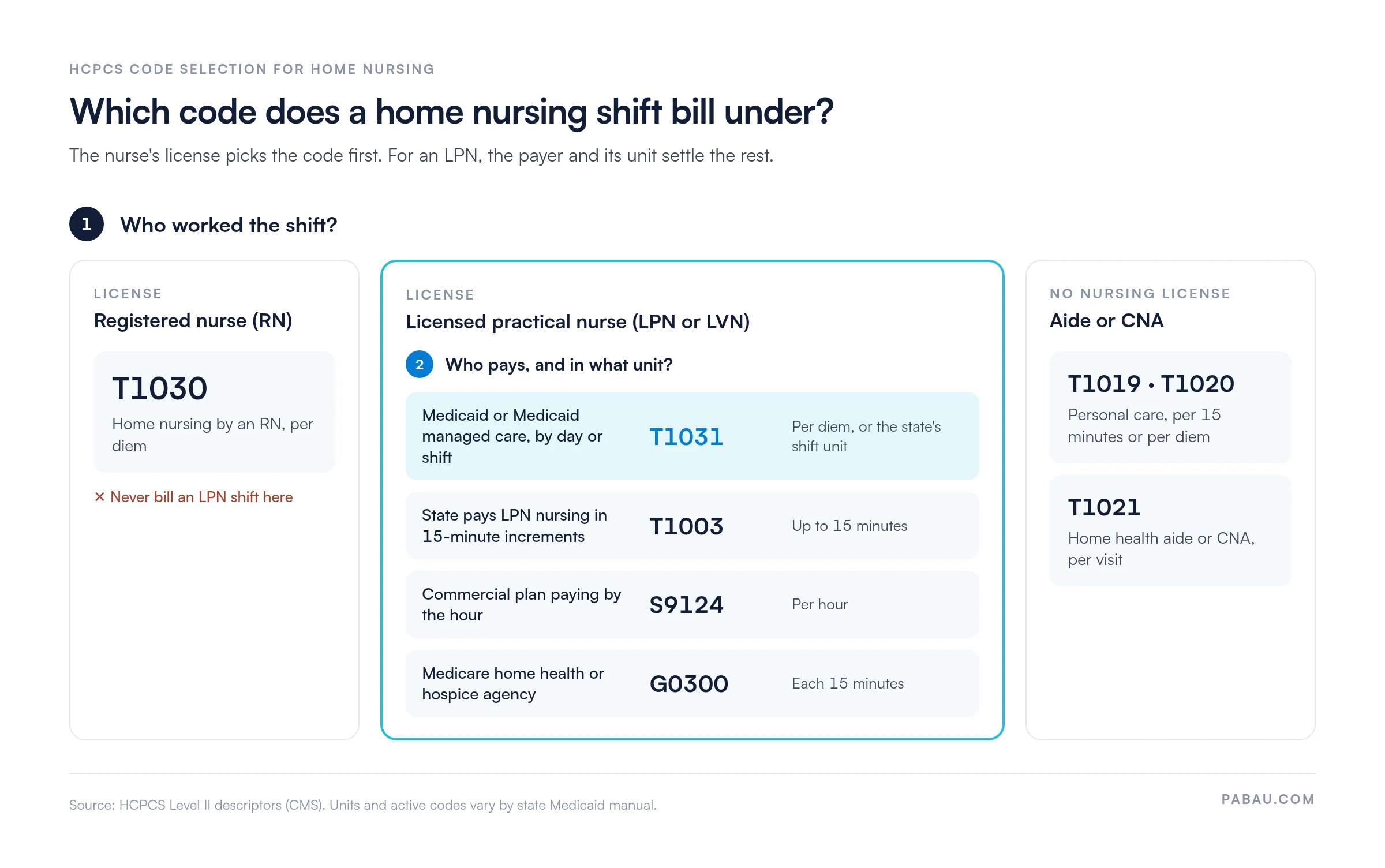
The T10xx codes sit close together, and several describe home care by different workers. This table separates the nursing codes from the personal care and aide codes.
T1032 and T1033 are doula birth worker codes, not residential or nursing codes. Your state Medicaid billing manual decides which of these codes are active in your program, so check it before you submit.
Start with the payer’s unit definition. The descriptor says per diem, but your state manual may say hourly or per shift. Use one unit definition per claim line, and keep billed units inside the authorized hours.
Place of service: 12 (Home) for most programs. Confirm any state-specific rule before you submit.
Modifier use for T1031 is state-defined. The table lists the national HCPCS modifiers that home nursing programs most often reference. Apply one only when your state manual requires it.
Applying a modifier that your state program does not recognize is a common source of technical denials.
Before you add any U-series modifier to T1031, check its definition in your state Medicaid billing manual. The same U modifier can mean different things in two states. A wrong modifier can make a correct claim look like an upcoded one.
Most Medicaid programs and managed care plans want prior authorization before LPN private duty nursing starts. Rules differ by payer. Care delivered without authorization is often denied, and appeal options vary by state.
A typical authorization request runs in five steps:
The approved nurse type matters. If the plan authorized RN hours only, LPN shifts may need their own approval under T1031.
A payer can ask for the records behind any shift billed. Good billing compliance means those records exist before the claim goes out.
Section 12006 of the 21st Century Cures Act requires electronic visit verification (EVV) for Medicaid personal care services and home health care services. CMS guidance on EVV applies the rule to services that need an in-home visit. The Medicaid home health benefit includes nursing services.
Whether a T1031 shift needs EVV depends on how your state classifies private duty nursing. Ohio and Colorado, for example, list private duty nursing as an EVV service. Other states apply EVV only to the home health benefit.
Where EVV applies, the system records the service type, the patient, the nurse, the date, the location and the start and end times. Reconcile those records with the nursing notes before each claim batch goes out.
There is no national rate for T1031. Each state Medicaid program sets its own rate and unit, and managed care plans pay contracted rates. Rates can also differ by program, waiver or patient acuity.
Check the current state fee schedule, or the plan contract, before you bill. Tracking paid amounts against expected rates is part of managing the revenue cycle.
T1031 denials tend to come from the same few causes. A steady denial management routine catches them before they repeat.
Reading the denial codes on your remittances shows which of these causes keeps coming back.
Run a weekly report of every T1031 authorization ending in the next 30 days. Start renewals from that list. One lapsed authorization can deny a whole month of LPN shifts.
Many private duty nursing agencies keep shift notes in one place and claims in another. When a payer asks for records, staff chase paper and spreadsheets.
Pabau, the practice management and billing platform we build, keeps the patient record and the claim side by side. Its claims management software helps your team build, submit and track claims. So the plan of care, the nursing notes and the claim are easy to find when a payer asks.
When a T1031 claim comes back denied, your team opens the patient record and finds the shift note behind it. Records requests get answered without a search through paper files.

Pabau keeps nursing records and claims in one place, so your team spends less time chasing denials and more time on care.

Start every T1031 claim with one question: was the nurse an LPN? Get that right, and the rest becomes routine. Then match the payer’s unit, stay inside the authorized hours, and keep a signed note for each shift.
The trade-off is a little more checking before each billing run. That time costs less than reworking denied claims weeks later. Want claims and nursing records in one place? Book a demo to see how Pabau keeps the paperwork beside each claim.

Billing the RN side of the same patient? HCPCS code T1030 covers home nursing by a registered nurse, billed per diem.
Need a foundation for understanding HCPCS billing? Medical billing fundamentals explains how HCPCS claims flow from service delivery to payment.
Struggling with claim rejections across your practice? Denial management in healthcare covers root-cause analysis and appeal workflows for common payer denials.
Does your state pay LPN nursing in 15-minute units? HCPCS code T1003 covers LPN or LVN services billed per 15 minutes.
Billing LPN visits for a Medicare home health agency? HCPCS code G0300 explains the Medicare code for LPN skilled nursing in home health and hospice.
T1031 means nursing care, in the home, by a licensed practical nurse, billed per diem. State Medicaid programs use it for LPN private duty nursing shifts. The payer’s manual decides whether a unit is a day, an hour or a shift.
Both codes cover skilled nursing in the home, billed per diem. T1030 is for a registered nurse and T1031 is for a licensed practical nurse. The license of the nurse who worked the shift decides the code.
No. T1031 is a nursing code that requires an LPN. Personal care aide services use codes such as T1019 or T1020, and home health aide visits use T1021.
Under the per diem descriptor, one unit covers one day. Many payers convert T1031 to hourly or shift units instead. Either way, billed units must stay inside the authorized hours.
No. Medicare does not pay T-codes. Medicare home health agencies and hospices report LPN skilled nursing as G0300, in 15-minute units, on their own claims.
Most Medicaid programs and managed care plans require it before LPN shifts start. The request usually needs a physician order, a plan of care and the approved nurse type. Check your state manual for the exact rules.