

CCSD code XR940: Foreign body retrieval billing guide
CCSD code XR940 is the UK private healthcare code for retrieval of a foreign bod...

Last Updated: Nov 26, 2026
T1004 is the HCPCS Level II code for services of a qualified nursing aide, up to 15 minutes. It covers personal care such as bathing, dressing, transfers and meal help, delivered under a physician-ordered plan of care.
T1004 is a T code, so state Medicaid programs, Medicaid MCOs and HCBS waivers pay it, while Medicare does not. Most programs require prior authorization, and each state sets its own rate and daily unit limits.
Let Pabau's smart automation suggest the right codes, reduce claim denials, and keep your practice compliant—effortlessly.
Automate repetitive tasks and focus on what matters most—your patients.
Reduce coding errors and ensure compliance with the latest regulations.
Clean claims, fewer denials, and faster reimbursements.
Powerful insights and reporting to help your practice thrive.
HIPAA compliant SOC 2 certified GDPR-compliant Trusted by 4,000+ clinics worldwide

HCPCS Code T1004 covers qualified nursing aide services in 15-minute units, and only Medicaid pays it, never Medicare Part A or B.
Bill one unit per 15 minutes of direct aide service, and keep time-stamped notes that support every unit on the claim.
Most Medicaid programs and MCOs require prior authorization before services start, so a missing authorization is the leading denial trigger.
T1004 sits in the T1000 to T1005 nursing services range, and the code changes with the credential of whoever delivered the care.
In Pabau, practices record the authorization code, dates and sessions on the case and see a warning when an authorization is missing.
HCPCS Code T1004 is the Level II code for services of a qualified nursing aide, billed in units of up to 15 minutes. CMS’s HCPCS Level II coding procedures describe T codes as codes for Medicaid state agencies that Medicare does not pay. T1004 sits in the T1000 to T1005 nursing services range of that section.
T codes cover Medicaid services that no CPT or permanent Level II code describes. Each state decides whether and how it pays them, so check local coverage before you submit. The table below sums up the code at a glance.
Each unit of T1004 represents up to 15 minutes of direct, face-to-face aide service. To count units for a date of service, divide the documented minutes by 15 and round under your state program’s policy.
Many states follow the 8-minute rule, so confirm your state’s policy. Under it, a final partial block counts as a unit only once it reaches 8 minutes. The ladder below shows how a visit’s minutes convert.
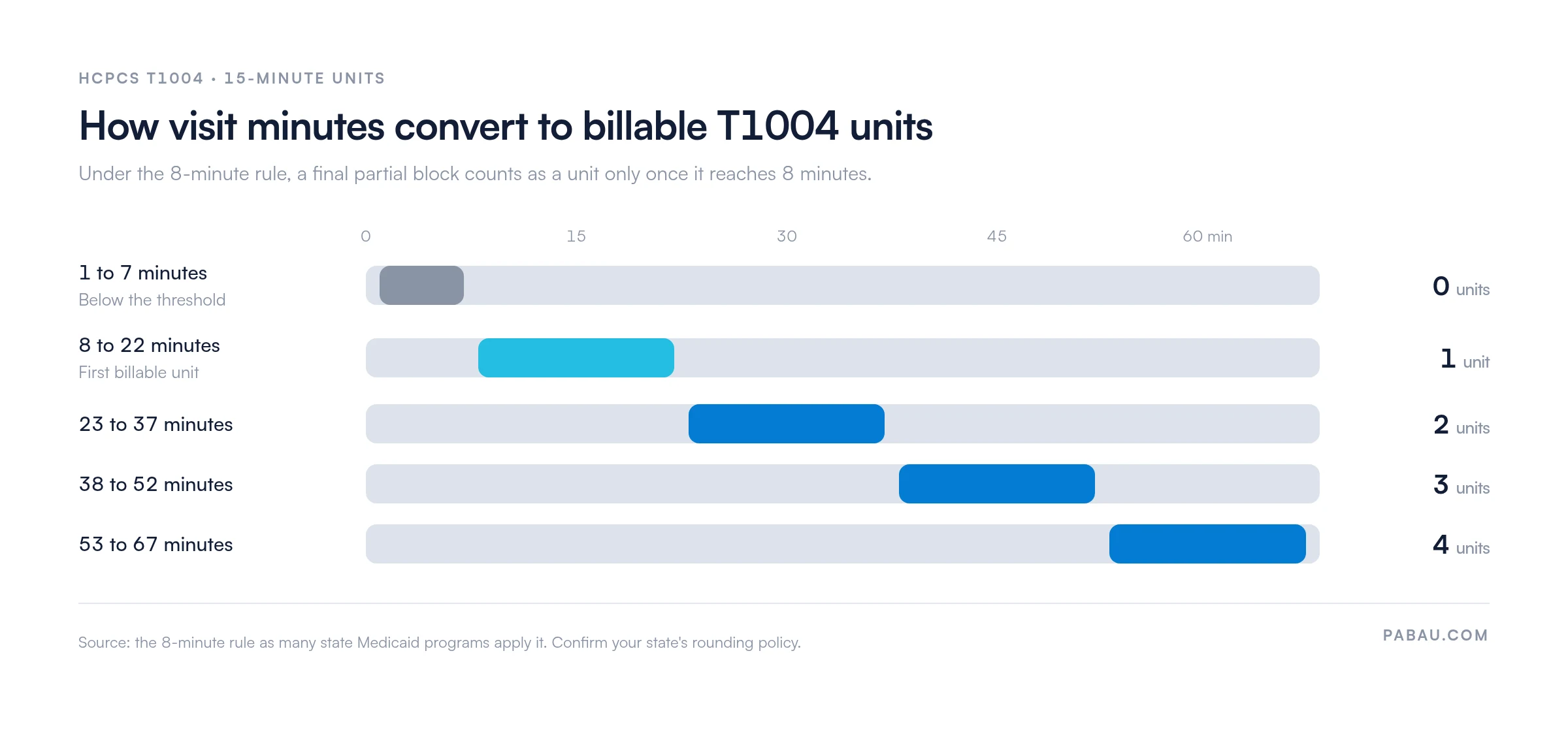
Time-unit documentation is the most audited element of a T1004 claim. Every unit billed must trace to a time-stamped service note with a start time, an end time and the tasks performed.
Breaks between visits on the same date need an explanation in the record. Billing more units than the documented minutes support invites a records request or a recoupment.
Check your state Medicaid billing manual for the daily unit maximum. Some HCBS waiver programs authorize a fixed number of aide hours per week, so the authorization also caps the units you can bill.
T1004 covers personal care and basic support that a qualified nursing aide delivers under an authorized plan of care. The work falls into two groups: help with activities of daily living (ADLs), and basic health maintenance that needs no licensed nurse.
Coverage requires an approved setting, usually the patient’s home or a qualifying HCBS waiver community setting. The aide must also work under a current, physician-ordered plan of care.
What counts as “qualified” varies by state. Some states require a CNA training program and a state registry listing, while others set their own competency standards. Confirm the aide’s qualification against your state Medicaid billing manual before you submit.
T1004 is one of six codes in the T1000 to T1005 nursing services range. Picking the wrong one is a frequent audit finding, because the codes split on provider type and service level.
The most common mix-up is billing T1004 when a licensed nurse delivered the service. If the aide hands a task to an RN during the visit, the RN’s time goes under T1002. An LPN’s time goes under T1003.
Mixing provider credentials on one claim is a documentation integrity problem, and payers flag it on audit.
T1004 is a Medicaid code, and Medicare Part A and Part B do not pay T codes. Every T1004 claim goes to a state Medicaid program, a Medicaid managed care organization (MCO) or an HCBS waiver program.
Coverage within Medicaid varies a great deal by state. States running HCBS 1915(c) waivers are the most common T1004 payers, because those waivers fund in-home personal care and aide services. Some states cover T1004 through the state plan personal care benefit instead.
MCOs that manage Medicaid long-term services and supports usually recognize T codes. They may still add their own prior authorization steps and daily unit limits on top of the state rules.
Commercial plans rarely recognize T codes. When a patient has both Medicaid and a commercial plan, coordination of benefits rules apply. Medicaid is normally the payer of last resort, so confirm the order with the MCO before you bill.
Each state sets its Medicaid rate for T1004 and updates it every year, and no national fee schedule exists for T codes. A 15-minute unit might pay between $4 and $12. The figure depends on the state, the waiver program and whether the provider is agency-based or self-directed.
For your current rate, open your state Medicaid agency’s fee schedule and filter by T1004. The CMS Physician Fee Schedule search tool covers Medicare-payable codes only, so it returns no T1004 rate. Your state Medicaid billing manual is the authoritative source.
Pull the rate from your state Medicaid portal before enrolling a new aide under T1004, rather than reusing last year’s contracted rate. Several states changed personal care aide rates in FY 2025 and FY 2026 after minimum wage increases. A stale rate leads to underbilling or a mismatch with the MCO contract.
Most Medicaid programs and MCOs require prior authorization before T1004 services begin. A missing or expired authorization is the most common reason these claims are denied outright. Some programs also run a concurrent review, often every 90 to 180 days, to keep the authorization active.
A complete authorization request for T1004 usually includes these five items.
Requirements vary by state and by MCO contract. An authorization from one Medicaid MCO does not carry over when a patient switches plans mid-year. Request a new one whenever the payer changes, the plan of care changes, or the authorized period lapses.
T1004 documentation must support each unit billed on the date of service. Auditors look for a clear chain from the authorized plan of care, through each service note, to the units on the claim. A unit that breaks that chain is treated as unsupported.
The required documentation elements are listed below.
A superbill that captures the authorization number and the unit count before submission lets billing staff catch mismatches early. Keep aide service records under the same HIPAA safeguards as the rest of the patient chart.
T1004 claims are denied for a predictable set of reasons. The table below maps each trigger to its claim adjustment reason code (CARC) and the action that prevents it. Our guide to medical billing denial codes explains each CARC in more depth.
Run a monthly T1004 denial report sorted by CARC. If CARC 15 or CARC 185 shows up more than twice in a month, the problem sits in intake, not claim submission. Fix the intake checklist first, and the denial rate follows.
T1004 modifiers are set by each state and MCO, and no single modifier is required across every Medicaid program. The table lists modifiers that appear on T1004 claims in several state billing manuals. Verify the requirements with your own state agency before submission.
Most Medicaid systems treat a missing required modifier as an incomplete claim and deny it without medical review. Build the modifier rules into your claim scrubbing, so the error is caught before submission.
A clean T1004 claim depends on a process that starts before the aide’s first visit. Complete the seven steps below in order, because a skipped step surfaces as a denial weeks later.
Manual T1004 billing lets errors compound. An authorization lapses without anyone noticing, and service notes pile up before anyone checks the units against them.
In Pabau, a practice management platform with US insurance billing, practices record insurance policies, authorization codes, dates and sessions against the case. Pabau warns when an authorization is missing, so staff see the problem before the claim goes out.
Pabau’s claims management tools submit CMS-1500 claims through Claim.MD and track each one to remittance. Billing staff can then see which T1004 claims were paid and which came back with a CARC to work.
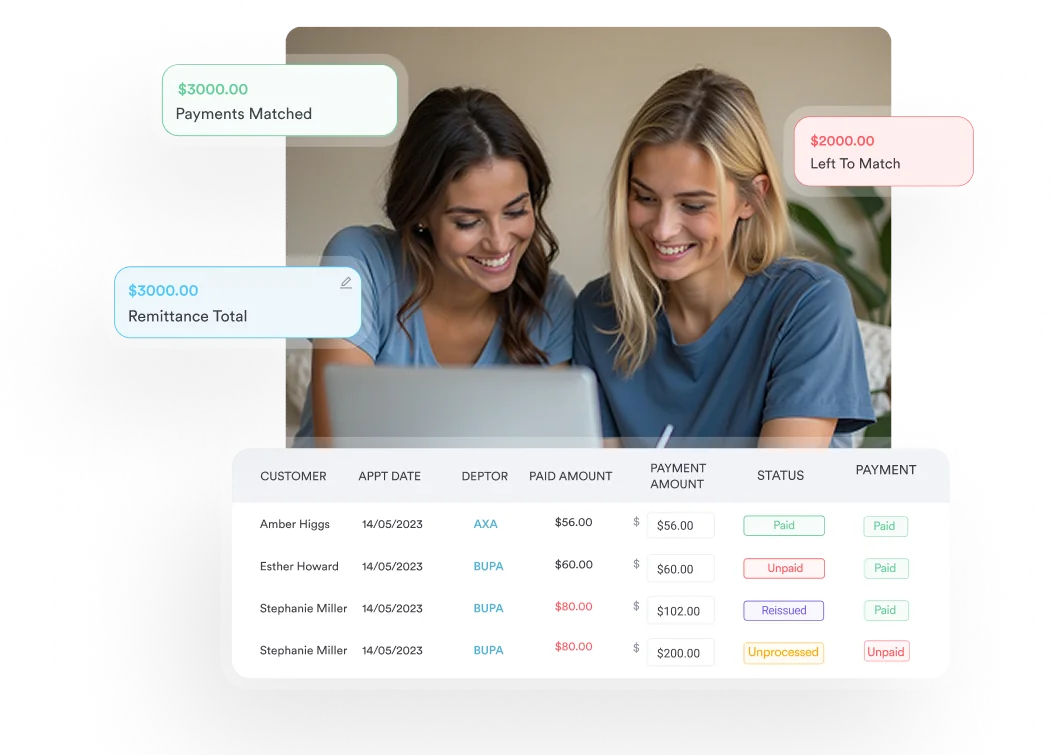

Pabau records authorization codes, dates and sessions on the case and warns when one is missing. Claims go out through Claim.MD and are tracked to remittance, so denials surface early.

Most T1004 denials trace back to work done before the claim exists. The authorization, the aide’s credentials and the time notes decide the outcome long before submission.
Put those three checks at intake and re-run them when a plan, payer or aide changes. Claims that pass them have a far better chance of becoming a clean claim on the first pass. The trade-off is a slower start for each new patient, which costs less than reworking a month of denied units.
Book a demo to see how Pabau keeps Medicaid authorizations and claims in one place for your aide services.

Comparing T1004 with the licensed private duty code? HCPCS code T1000 covers licensed private duty nursing billed in 15-minute units.
Billing the nursing assessment visit? HCPCS code T1001 explains how the nursing assessment and evaluation code works.
Unclear on how clearinghouses process Medicaid claims? Medical claims clearinghouse guide walks through how claims are validated, scrubbed and routed before reaching the payer.
Looking to improve documentation standards across your team? Medical billing compliance covers the documentation and audit-readiness standards that support clean claim submission.
Need a framework for reducing billing rejections? Denial codes in medical billing explains the most common CARC and RARC codes and how to build an appeal workflow around them.
HCPCS Code T1004 covers services of a qualified nursing aide, billed in units of up to 15 minutes. It includes bathing, dressing, walking assistance, meal preparation and basic health maintenance. The aide works under a physician-ordered plan of care in the home or an HCBS waiver setting.
Only Medicaid covers T1004, because Medicare Part A and Part B do not pay T codes. A claim sent to a Medicare MAC will be rejected. Send it to the state Medicaid program, the Medicaid MCO or the HCBS waiver payer instead.
Each state Medicaid program sets the daily limit, and the patient’s authorization can cap it further. Many standard personal care programs allow 4 to 8 units, or 1 to 2 hours, per day. HCBS waiver authorizations can allow more, so check your state manual and the authorization itself.
Yes, most Medicaid programs and MCOs require prior authorization before you bill T1004. The request needs the plan of care, medical necessity documentation and proof of aide qualification. Billing without an active authorization is the most common reason these claims are denied outright.
T1002 covers RN services and T1003 covers LPN/LVN services, both in 15-minute units and both requiring a nursing license. T1004 is for qualified nursing aides doing non-skilled personal care. Billing T1004 for a licensed nurse’s work is a documentation integrity error that surfaces on audit.
The usual causes are a missing or expired authorization (CARC 15 or 197) and an aide below the payer’s qualification threshold (CARC 185). Units above the authorized amount (CARC 119) and missing time documentation (CARC 252) follow. A pre-billing check of credentials, authorization and notes prevents each one.



