CCSD code XR320: Nasolacrimal duct stenting billing guide
CCSD code XR320 is the UK private insurance code for dilatation or stenting of t...

Last Updated: Nov 24, 2026
V1730 is the CCSD code for extra-oral fixation of the mandible, billed to UK private medical insurers. It covers stabilising a fractured lower jaw with pins placed through the skin and joined by an external frame.
Open reduction with internal plates is coded V0820, and closed reduction with intermaxillary fixation is V0830. V1730 sits at Intermediate complexity in section 6.1 Face and jaws.
Let Pabau's smart automation suggest the right codes, reduce claim denials, and keep your practice compliant—effortlessly.
Automate repetitive tasks and focus on what matters most—your patients.
Reduce coding errors and ensure compliance with the latest regulations.
Clean claims, fewer denials, and faster reimbursements.
Powerful insights and reporting to help your practice thrive.
HIPAA compliant SOC 2 certified GDPR-compliant Trusted by 4,000+ clinics worldwide

CCSD code V1730 covers extra-oral fixation of the mandible, using pins and an external frame placed through the skin.
V1730 sits in chapter 6 of the CCSD Schedule, section 6.1 Face and jaws, at Intermediate complexity.
UK private medical insurers such as Bupa, AXA Health, Vitality and Aviva set their own fees. National Friendly pays £348.
Pair V1730 with a WHO ICD-10 mandible fracture code from S02.6, as specific as the imaging allows.
Pabau’s claims software sends CCSD-coded claims to UK insurers through Healthcode, with the operative note on the same patient record.
CCSD code V1730 is the UK private medical insurance code for extra-oral fixation of the mandible. It is set by the Clinical Coding and Schedule Development group (CCSD), which publishes the procedure codes UK insurers use. National Friendly’s schedule of fees lists V1730 under that descriptor.
The code covers stabilising a fractured lower jaw with hardware anchored outside the mouth. Pins or screws pass through the skin into the bone, and an external bar or frame joins them. Open reduction with internal plates and closed reduction with intermaxillary fixation have codes of their own.
CCSD sets the codes and their descriptors, but it does not set fees. Each insurer publishes its own fee schedule against the CCSD codes. The amount paid for V1730 therefore depends on the patient’s insurer and policy. Our CCSD code library lists the other codes in the schedule.
Extra-oral mandibular fixation stabilises the lower jaw with hardware anchored through the skin rather than through the mouth. The surgeon passes percutaneous pins or Schanz screws through the skin and into the bone on each side of the fracture. An external frame or carbon-fibre bar then joins the pins and holds the fragments in alignment while the bone heals.
Pin sites are planned from pre-operative imaging to avoid tooth roots and the inferior alveolar nerve. Under general anaesthesia, the pins go in bicortically into stable bone either side of the fracture. The connecting bar is locked with the jaw held in correct occlusion. The frame usually stays for four to eight weeks, depending on the fracture and how the patient heals.
Because the hardware sits outside the mouth, extra-oral fixation avoids contamination from oral bacteria. That matters most in infected or heavily comminuted fractures, where intraoral approaches carry a higher infection risk.
Not every mandible fracture warrants an extra-oral approach. Surgeons choose it where other fixation methods are contraindicated or would not hold.
Coders most often confuse V1730 with the jaw fracture codes in the same section of the CCSD Schedule. The difference is where the fixation sits and how the fracture is reduced. Cheekbone fractures have codes of their own in the same section, such as V0980 for open reduction of the zygomatic complex. The Bupa CCSD codes guide covers the wider schedule.
Fees above are from the National Friendly schedule of fees. The descriptors decide the code, not the injury. An operative note that says only “mandible fracture fixed” leaves the insurer to guess between V0820, V0830 and V1730. The chart below maps each fixation method to its code.
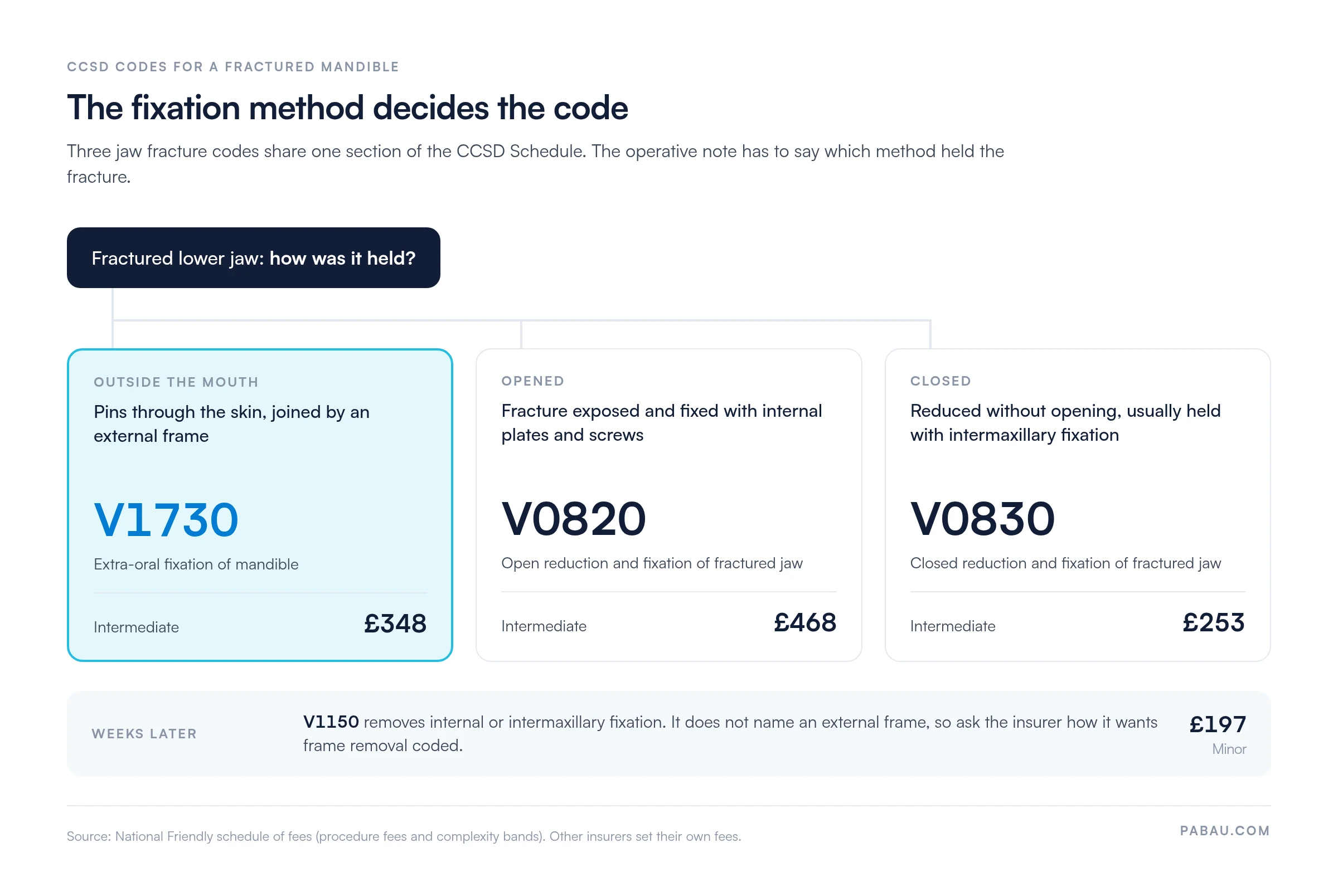
Removing the frame weeks later is a separate episode with its own date of treatment. The V1150 descriptor names internal and intermaxillary fixation only, so ask the insurer how it wants frame removal coded. Check descriptors against the current CCSD Schedule at the date of treatment.
Before you invoice V1730, check the operative note for arch bars or intermaxillary wiring placed at the same sitting. If it mentions them, check the CCSD unacceptable combinations and the insurer’s rules before adding a second code. Two codes for one fixation episode is a common reason for a query.
UK insurers code diagnoses with WHO ICD-10, not the US ICD-10-CM. Every V1730 claim needs a diagnosis that supports extra-oral fixation. For a fractured mandible, that means a code from S02.6.
Use the most specific code the imaging and operative note support. Where several fracture sites are documented, put the site that drove the decision to fix externally first. Add a secondary code for infection or non-union only when the notes record it.
Each insurer sets its own fee against V1730. The National Friendly schedule of fees lists V1730 at Intermediate complexity with a £348 procedure fee. Open reduction and fixation of a fractured jaw, V0820, pays £468 in the same schedule.
Bupa, AXA Health, Aviva, Vitality, WPA and other UK insurers publish their own schedules in pounds sterling. Check the patient’s insurer before quoting a fee, and check again each year. A surgeon who charges more than the insurer pays leaves the patient with a shortfall. Explain that in writing before surgery.
UK private medical insurers expect the policyholder to call for authorisation before planned treatment. The insurer issues an authorisation number for the planned procedure code. That number is not a promise of payment, because the invoice still has to match the code, the notes and the policy.
The clinical letter for a V1730 request should include:
UK private medical insurance does not usually cover emergency admission, so most acute jaw fractures are treated first in the NHS. A private V1730 claim is therefore most often planned, for example for an infected fracture or failed internal fixation. If the plan changes in theatre, ask the insurer to update the authorisation before you invoice.
Insurers judge a queried V1730 claim on the clinical record. After a missing or mismatched authorisation, an operative note that leaves out the device or the approach is a common reason for a query. Structured clinical records capture each element at the point of care.
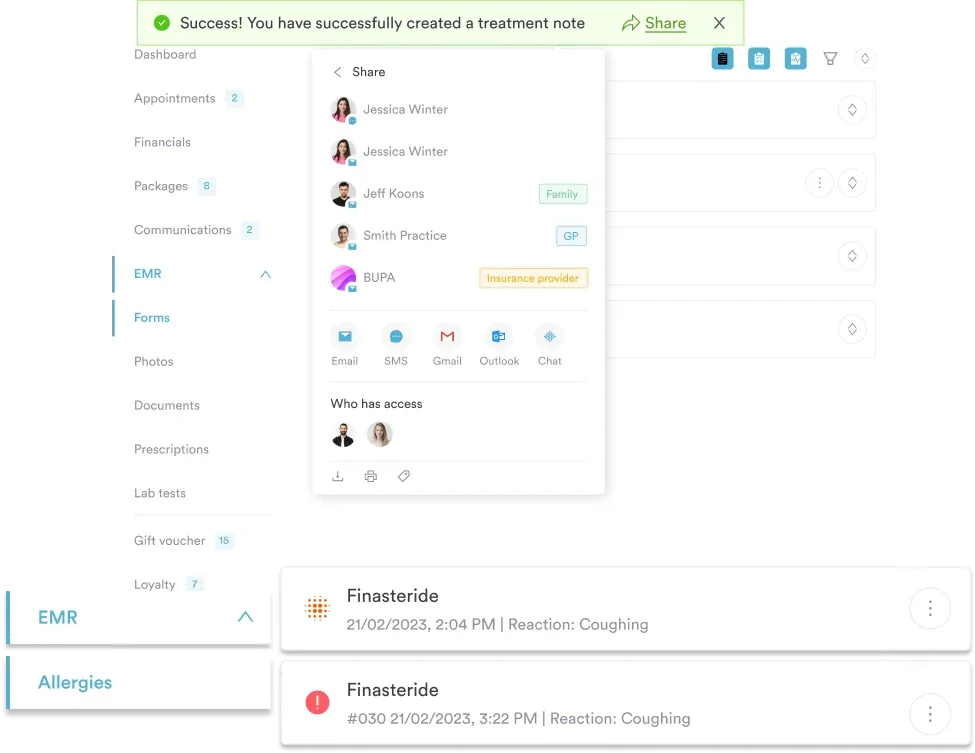
Keeping these documents in digital intake forms linked to the encounter means none goes missing at invoice time. It also makes the evidence pack quick to send when an insurer asks for a clinical letter.
The anaesthetist invoices the insurer separately, using the same CCSD procedure code, V1730. The insurer pays the anaesthetist under its own fee schedule. CCSD codes carry no modifiers, so the invoice needs only the code, the date and the authorisation number.
The hospital bills theatre, ward and consumables on its own account. Insurers treat an assistant surgeon in different ways, and some pay no separate assistant fee. Ask before surgery, and include any assistant in the authorisation.
Pin insertion and frame assembly are part of V1730, not extra lines. Billing them separately is unbundling, and insurers query it.
V1730 is billed by the consultant who performs the fixation, usually an oral and maxillofacial surgeon. In the UK, OMFS consultants hold both medical and dental qualifications. They are on the GMC Specialist Register for oral and maxillofacial surgery.
Each insurer also runs its own recognition process for consultants. A claim from a surgeon the insurer has not recognised is likely to be rejected. Confirm recognition with each insurer, and keep the provider number on file, before the first claim.
Check the consultant’s GMC number and insurer provider number on every V1730 invoice. A single wrong digit can send the claim back, and the fix takes weeks. Add a credentials check to your billing workflow before submission.
Most V1730 rejections trace back to a short list of causes. Ask the insurer for the reason in writing, then answer that reason directly.
If the insurer still declines, use its complaints process with a clinical letter from the surgeon. The CCSD technical guide (October 2025) sets out the schedule’s coding rules. It helps when a query turns on bundling.
Accurate V1730 billing depends on three things: the right code, a complete operative note and an authorisation that matches both. Each one breaks down when the note, the authorisation and the invoice sit in different systems.
Pabau keeps all three on one patient record. Its claims management software sends CCSD-coded claims to UK insurers through Healthcode and Bupa. The authorisation number and treatment dates sit on the patient’s case, next to the operative note.

Pabau keeps operative notes, authorisations and CCSD-coded claims on one patient record, and sends claims to UK insurers through Healthcode.

V1730 is a narrow code. It pays for one fixation method: pins and a frame outside the mouth. Most queried V1730 claims turn on that boundary with V0820 and V0830, not on the surgery itself.
So the claim rests on an operative note that names the extra-oral approach and the device used. Match the authorisation to that note, and check the insurer’s own fee before you quote. Book a demo to see how Pabau sends CCSD claims through Healthcode with the note beside each one.

Need a broader CCSD billing reference? Bupa CCSD procedure codes covers how CCSD codes are structured, submitted and paid by UK private medical insurers.
Billing surgery that removes part of the jaw? CCSD code V1423 covers extensive excision of the mandible with disarticulation, a Major Plus procedure.
Managing claims across multiple specialists? Claims management software from Pabau tracks submission status, flags missing documentation, and supports appeal workflows for complex procedure codes like V1730.
CCSD code V1730 covers extra-oral fixation of the mandible. Pins are placed through the skin into the fractured lower jaw and joined by an external frame. It does not include intraoral wiring, internal plates or later removal of the frame, which are coded separately.
UK insurers use WHO ICD-10, and the S02.6 codes for fracture of mandible are the primary pairing. Use the most specific code the imaging supports: S02.61 (condylar), S02.62 (subcondylar), S02.64 (ramus), S02.65 (angle) or S02.69 (other). Use S02.60 only when the notes and imaging do not name the site.
Yes. UK private medical insurers such as Bupa, AXA Health, Vitality and Aviva expect authorisation before planned treatment. The insurer issues an authorisation number for V1730, which goes on the invoice. Emergency admission is not usually covered, so most acute jaw fractures are treated first in the NHS.
V1730 covers fixation applied outside the mouth with pins and a frame. V0820 covers open reduction with internal plates, and V0830 covers closed reduction, usually held with intermaxillary fixation. If both methods are used at one sitting, check the CCSD unacceptable combinations and the insurer’s rules before billing two codes.
V1730 is billed by the consultant who performs the fixation, usually an oral and maxillofacial surgeon. OMFS consultants in the UK hold medical and dental qualifications and sit on the GMC Specialist Register. Each insurer must also recognise the consultant before it pays the claim.
Each UK insurer sets its own fee in pounds sterling. National Friendly’s schedule of fees lists V1730 at Intermediate complexity with a £348 procedure fee. Check the patient’s insurer’s current schedule before quoting a fee.
The most frequent reasons are a missing or mismatched authorisation, a non-specific ICD-10 code and an unrecognised consultant. Unbundled component steps and duplicate invoices follow. Ask the insurer for the reason in writing, then answer it with the clinical letter, imaging and operative note.