Pabau Engage inbox

Pabau Engage is here: every patient conversation in one inbox.

Learn more
Book a demo Book a demo
☰
CPT Code

CPT code 27091 – Complicated removal of hip prosthesis


Code Definition

CPT code 27091 reports complicated removal of a hip prosthesis, including a total hip prosthesis and its bone cement, with or without a spacer. Surgeons often use it for the first stage of a two-stage revision after a hip implant infection.

Complexity, not the spacer, separates 27091 from 27090. The operative report has to show why the removal was hard, such as cement extraction or extensive dissection. That matters because 27091 carries about twice the work RVUs of 27090, so payers check the note closely. The sections below cover the criteria, a worked claim and a pre-submission checklist.

Section
10004-69990 Surgery
Subsection
20100-29999 Musculoskeletal system
Code range
27000-27299 Pelvis and hip joint
Billable
No
Code also known as
hip prosthesis explantation, complicated hip implant removal
Save time. Improve accuracy. Get paid faster.
Automate coding with Pabau

Let Pabau's smart automation suggest the right codes, reduce claim denials, and keep your practice compliant—effortlessly.

  • AI-powered code suggestions
  • Real-time compliance checks
  • Faster claims, fewer denials
Why practices choose Pabau
Save hours every week

Automate repetitive tasks and focus on what matters most—your patients.

Improve accuracy

Reduce coding errors and ensure compliance with the latest regulations.

Get paid faster

Clean claims, fewer denials, and faster reimbursements.

Grow with confidence

Powerful insights and reporting to help your practice thrive.

HIPAA compliant SOC 2 certified GDPR-compliant Trusted by 4,000+ clinics worldwide

Key takeaways

Key takeaways

CPT code 27091 reports complicated removal of a hip prosthesis, including a total hip prosthesis and bone cement, with or without a spacer.

Complexity separates 27091 from 27090, so a spacer never moves a case up and a missing spacer never forces 27090.

Both codes carry a 090-day global, and 27091 holds about twice the 2026 work RVUs of 27090.

Pair 27091 with the hip-specific T84 complication code for the correct side, because right and left hip codes differ.

Never report 27090 and 27091 together for the same hip on the same date of service.

CPT code 27091 covers complicated hip prosthesis removal

CPT code 27091 reports “Removal of hip prosthesis; complicated, including total hip prosthesis, methylmethacrylate with or without insertion of spacer.”

AAPC’s summary of CPT 27091 describes the surgeon breaking up the methylmethacrylate bone cement to remove the total hip prosthesis. It also notes that a spacer may or may not go in. So the spacer is optional. The complicated removal is what the code pays for.

The code is maintained by the American Medical Association and sits in the Musculoskeletal System section, under Pelvis and Hip Joint (27000-27299). Within that range, it belongs to the Introduction or Removal subheading, which runs from 27086 to 27091.

FieldDetail
CPT code27091
Official descriptorRemoval of hip prosthesis; complicated, including total hip prosthesis, methylmethacrylate with or without insertion of spacer
Code rangeMusculoskeletal System, Pelvis and Hip Joint (27000-27299), Introduction or Removal (27086-27091)
Sister code27090, Removal of hip prosthesis; (separate procedure)
Global period090 days (major surgery)
LateralityReport the side with modifier RT or LT where the payer expects it

What makes a hip removal complicated enough for 27091

The descriptor gives you the clues. It names a total hip prosthesis and methylmethacrylate, the bone cement that fixes many implants. Those are the features that tend to make a removal long and difficult.

In practice, the operative report supports 27091 when it shows work like this:

  • Total hip prosthesis removal. Both sides of the joint are involved, rather than a simple single-component extraction.
  • Cement removal. The surgeon describes breaking up and clearing methylmethacrylate from the femoral canal or acetabulum.
  • Extensive dissection. Dense scar tissue, prior surgeries or infected soft tissue add time and effort.
  • Difficult extraction. Well-fixed components, osteotomy to free the stem or bone loss make removal harder.

A spacer often goes in during the first stage of a two-stage revision for periprosthetic joint infection (PJI). It holds the joint space and can deliver local antibiotics. Still, treat the spacer as supporting detail. It doesn’t decide the code.

27091 vs 27090: Complexity decides the code

CPT 27090 and CPT 27091 both report removal of a hip prosthesis. 27090 is the standard removal, flagged as a separate procedure. 27091 adds the word complicated and names a total hip prosthesis and cement.

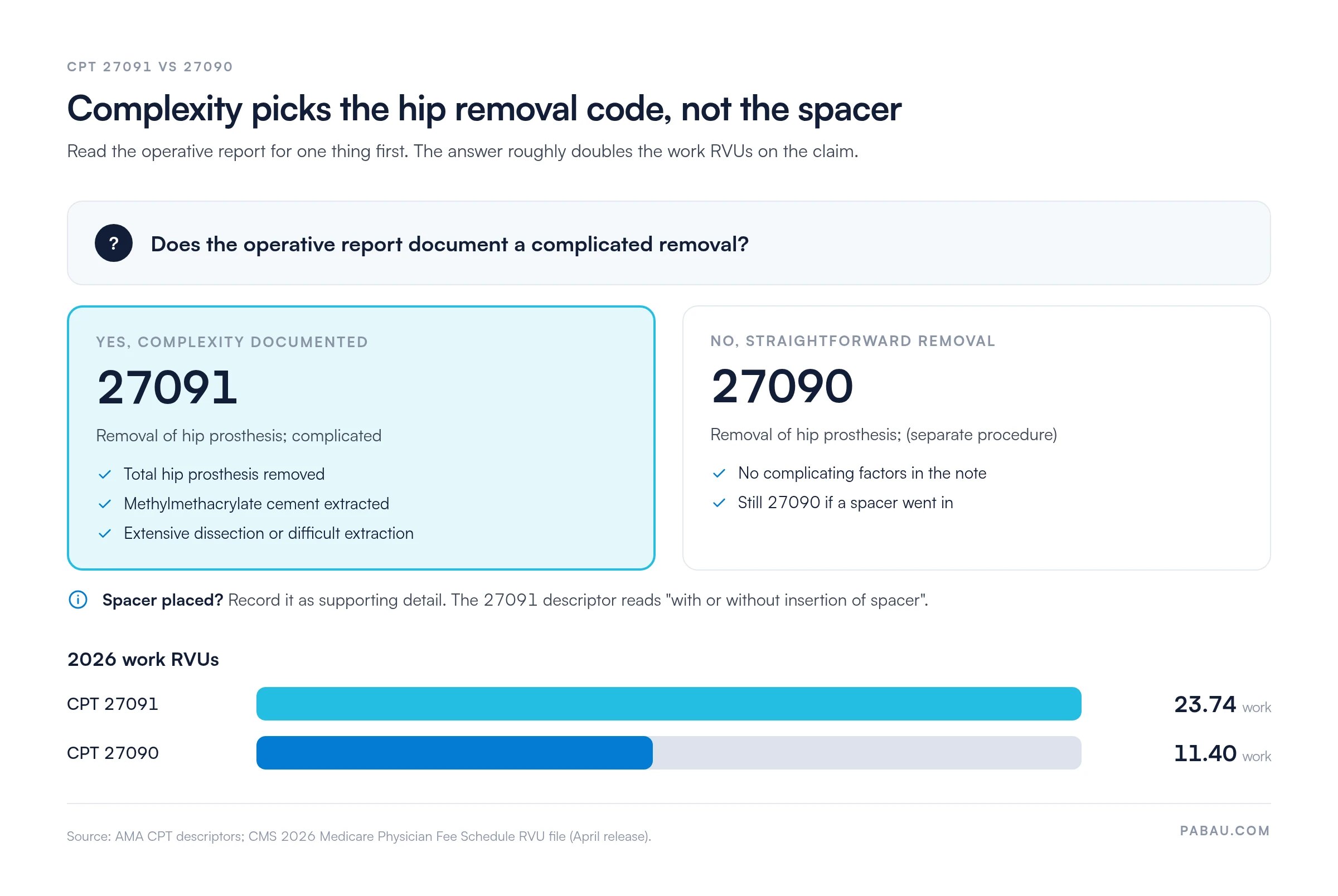
So ask one question first. Does the operative report describe a complicated removal? If it does, 27091 fits, whether or not a spacer went in. If the removal was straightforward, 27090 fits, even if a spacer was placed.
Decision diagram for CPT 27091 vs 27090
The spacer sits outside the decision, yet the code you pick roughly doubles or halves the work RVUs. Descriptors come from the AMA and RVUs from the CMS 2026 fee schedule file.
What to checkCPT 27090CPT 27091
DescriptorRemoval of hip prosthesis; (separate procedure)Removal of hip prosthesis; complicated, including total hip prosthesis, methylmethacrylate with or without insertion of spacer
What decides itA removal without documented complicating factorsDocumented complexity, such as total hip removal, cement extraction or extensive dissection
SpacerNot the deciding factorOptional; supports the record but doesn’t decide the code
2026 work RVU11.4023.74
Global period090 days090 days

Pro Tip

Read the operative report for complexity before you look for a spacer. If the surgeon describes cement extraction, extensive dissection or a difficult total hip removal, 27091 is supported. If the note is thin, query the surgeon rather than guessing up or down.

A worked example: Coding the first stage of an infected right hip

Here’s an illustrative case. A patient has a cemented total hip on the right side with a confirmed periprosthetic infection.

  1. Read the indication. The pre-op note records infection, with aspiration culture results. That points to T84.51XA, right hip.
  2. Read the removal. The surgeon removes the femoral stem and acetabular cup and clears cement from the canal. The note describes dense scar tissue.
  3. Pick the code. The removal is complicated, so 27091 fits. A static antibiotic spacer was also placed, which the note records.
  4. Add the side. Append RT where the payer expects a laterality modifier.
  5. Plan for stage two. Reimplantation later uses 27134. Within the 90-day global, add the right modifier (see below).

Now change one detail. Say the surgeon removed a loose, uncemented component in a short case with no complicating findings. That reads as 27090, even with a spacer in place.

Knowing the neighbors helps you avoid two errors. One is reporting removal when a full revision happened. The other is reporting a revision when only removal happened.

CPT codeShort descriptorWhen it applies
27090Removal of hip prosthesis (separate procedure)Removal without documented complicating factors
27091Removal of hip prosthesis, complicatedComplicated removal, with or without a spacer
27130Total hip arthroplastyPrimary implantation of femoral and acetabular components
27132Conversion of previous hip surgery to total hip arthroplastyConversion from prior hip surgery to a total hip
27134Revision of total hip arthroplasty, both componentsFull revision, including second-stage reimplantation
27137Revision of total hip arthroplasty, acetabular component onlyCup revision with the femoral stem kept
27138Revision of total hip arthroplasty, femoral component onlyStem revision with the acetabular cup kept

ICD-10-CM codes that commonly support 27091

Every 27091 claim needs a diagnosis that shows why the implant came out. Hip prosthesis complication codes split by side, so match the code to the operative side.

ICD-10-CM codeDescriptionUse when
T84.51XAInfection and inflammatory reaction due to internal right hip prosthesis, initial encounterPJI of the right hip
T84.52XAInfection and inflammatory reaction due to internal left hip prosthesis, initial encounterPJI of the left hip
T84.010ABroken internal right hip prosthesis, initial encounterImplant breakage, right hip
T84.011ABroken internal left hip prosthesis, initial encounterImplant breakage, left hip
T84.020ADislocation of internal right hip prosthesis, initial encounterRecurrent dislocation driving removal, right hip
T84.021ADislocation of internal left hip prosthesis, initial encounterRecurrent dislocation driving removal, left hip
T84.030AMechanical loosening of internal right hip prosthetic joint, initial encounterAseptic loosening, right hip
T84.031AMechanical loosening of internal left hip prosthetic joint, initial encounterAseptic loosening, left hip
T84.050APeriprosthetic osteolysis of internal prosthetic right hip joint, initial encounterOsteolysis, right hip
T84.051APeriprosthetic osteolysis of internal prosthetic left hip joint, initial encounterOsteolysis, left hip

Z96.641 (presence of right artificial hip joint) and Z96.642 (left) are status codes. On their own, they don’t explain why the implant was removed. Check every code against the current fiscal-year tabular list, since CMS updates ICD-10-CM each October 1.

2026 RVU components for CPT 27091

CMS sets relative value units (RVUs) for 27091 in the annual Medicare Physician Fee Schedule (MPFS). The figures below are RVU components from the 2026 MPFS RVU file (April release), not payment rates.

Payment depends on the conversion factor and your locality, so confirm current values in the CMS Physician Fee Schedule lookup.

RVU componentCPT 27091CPT 27090
Work RVU23.7411.40
Practice expense RVU14.269.36
Malpractice RVU5.032.39
Total RVU43.0323.15
Global period090 days090 days

27091 carries about twice the work RVUs of 27090. That difference is why payers look closely at the complexity documentation. For revenue cycle management, pull the current year’s file rather than trusting last year’s billing system defaults.

Documentation that holds up a 27091 claim

Most 27091 denials trace back to the chart. Make sure the record shows these points:

  • Indication. The pre-op note names the reason, such as infection, loosening, breakage or dislocation, with labs or imaging.
  • Components removed. The operative note says which components came out and how.
  • Complicating factors. Cement extraction, scar tissue, osteotomy, bone loss or extra time are described in plain terms.
  • Spacer, if used. Type and antibiotic load are recorded as supporting detail.
  • Cultures and pathology. Specimens sent are listed when infection is suspected.
  • Side. The operative side matches the diagnosis code and any RT or LT modifier.

Many commercial plans require prior authorization for planned hip surgery, so check each plan before the date of service. A clean claim for 27091 carries the diagnosis, the procedure code, the side and any authorization number together.

Modifiers you may need with 27091

Each modifier needs record language to back it. Use them only when the chart supports them.

  • RT or LT. Identifies the operative side where the payer expects it.
  • Modifier 22 (increased procedural services). For a case substantially harder than a typical 27091. The note must describe the extra work and time, and payer review decides whether more is paid.
  • Modifier 62 (two surgeons). Applies only where the MPFS co-surgeon indicator for 27091 allows it. Check the indicator before both surgeons bill.
  • Modifier 58 (staged procedure). Used when a planned second-stage reimplantation falls within the global period of the 27091.
  • Modifier 78 (unplanned return to the OR). Used for a related, unplanned return, such as spacer dislocation, if the return to the OR falls within the global period.

Reimplantation can be staged beyond the 90-day global. In that case, 27134 is reported without a global-period modifier.

Common mistakes that trip up 27091 claims

MistakeWhy it causes troubleFix
Coding by spacerA spacer is optional in the descriptor, so it can’t justify 27091 or rule it outCode from the documented complexity of the removal
Thin operative noteA note without complicating factors invites a downcode on reviewQuery the surgeon to document cement removal, dissection or extraction difficulty
Wrong side in the diagnosisRight and left hip codes differ, and a mismatch with RT or LT stalls the claimMatch the T84 code to the operative side
Status code aloneZ96.641 or Z96.642 shows an implant exists, not why it came outLead with the T84 complication code
27090 and 27091 togetherBoth describe the same removal for the same hipReport one code per hip per date
Missing global modifierA stage-two claim inside the global period can bundleAdd 58 for a planned stage or 78 for an unplanned related return

Track each denial back to its cause. Denial codes in medical billing helps you map a CARC code to the documentation gap behind it.

Before you submit: A quick 27091 checklist

  • The operative note describes why the removal was complicated.
  • You haven’t coded from the spacer alone.
  • The T84 diagnosis matches the operative side.
  • RT or LT is appended where the payer expects it.
  • Prior authorization is on file where the plan requires it.
  • 27090 isn’t billed for the same hip on the same date.
  • Any modifier 22, 58, 62 or 78 has record language behind it.

How Pabau helps you track 27091 claims after submission

Orthopedic billing teams often lose time after a high-value claim goes out. They chase status by phone, re-key remittances and spot denials late.

Pabau, a practice management platform, takes that follow-up off your team. It works through a Claim.MD integration, which tracks claim status, denials and ERA remittances for US practices. Your coders still own the code choice and the documentation review.

The result is a shorter path from denial to resubmission. See how it works in Pabau’s claims management software.

Follow every hip surgery claim to payment

Pabau tracks claim status, denials and ERA remittances through Claim.MD, so your billing team sees where each 27091 claim stands.

Pabau claims management dashboard

Conclusion

27091 rewards a careful read of the operative report. If the removal was complicated, the code fits, with or without a spacer. If it wasn’t, 27090 is the honest choice.

Check complexity first, and query the surgeon when the note is thin. That one habit protects a code worth about twice the work RVUs of its sister code.

Book a demo to see how Pabau tracks your hip surgery claims, denials and remittances through to payment.

Continue your research

Continue your research

Planning the second stage? CPT code 27134 covers revision of both hip components, the usual reimplantation code.

Only the cup needs revising? CPT code 27137 explains acetabular-only revision when the femoral stem stays.

Converting earlier hip surgery? CPT code 27132 sets out conversion of previous hip surgery to a total hip.

Reading remittances on hip claims? Electronic remittance advice explains how to read ERA 835 files and match CARC codes to claim errors.

Cutting repeat denials? Denial management in healthcare covers root-cause tracking for recurring denial patterns.

Frequently asked questions

What does methylmethacrylate mean in the 27091 descriptor?

Methylmethacrylate is the acrylic bone cement used to fix many hip implants. Removing it from the femoral canal or acetabulum takes extra time and care. That’s one reason a cemented total hip removal often supports 27091.

Is a knee prosthesis removal coded with 27091?

No. 27091 is for the hip only. Knee prosthesis removal, including a total knee and cement, with or without a spacer, is reported with CPT 27488.

How is a Girdlestone procedure coded?

On a native hip, femoral head resection (Girdlestone procedure) is CPT 27122. When a hip prosthesis is removed and left out, report 27090 or 27091 based on the complexity of the removal.

Can 27091 be added to a same-day revision?

Generally no. A one-stage revision, such as 27134, already includes removing the old components. Report 27091 when the implant comes out and reimplantation happens at a later, separate session.

Is the hip spacer billed separately from 27091?

No. The 27091 descriptor already includes spacer insertion, so the surgeon doesn’t report it with a separate CPT code. Record the spacer type and antibiotic load in the operative note.


Avatar photo
Monika Lazarevska
Content Writer

Monika Lazarevska writes content for owners and healthcare professionals who want clear, no-fluff content that actually helps them run their practice better. With a background in storytelling and SEO, she knows how to make even the driest topics worth reading. Off the clock, you'll find her in a café somewhere in Europe, probably with a good book and an even better coffee.
×