

CCSD code G5100: Bypass of duodenum billing guide
CCSD code G5100 bills a bypass that leaves the duodenum in place CCSD code G5100...

Last Updated: Oct 16, 2026
Q4159 is the HCPCS Level II code for Affinity, a human amniotic membrane allograft billed per square centimeter of graft applied.
From January 1, 2026, Medicare pays Q4159 as an incident-to supply at a flat national rate of $127.14 per square centimeter, adjusted by locality. Most denials trace to three causes. The units don't match the graft size, the patient's MAC doesn't accept the diagnosis code, or the chart lacks proof of failed conservative care.
Let Pabau's smart automation suggest the right codes, reduce claim denials, and keep your practice compliant—effortlessly.
Automate repetitive tasks and focus on what matters most—your patients.
Reduce coding errors and ensure compliance with the latest regulations.
Clean claims, fewer denials, and faster reimbursements.
Powerful insights and reporting to help your practice thrive.
HIPAA compliant SOC 2 certified GDPR-compliant Trusted by 4,000+ clinics worldwide

HCPCS Code Q4159 describes Affinity (Organogenesis), a human amniotic membrane allograft billed per square centimeter of graft applied to a chronic wound.
Since January 1, 2026, Medicare pays Q4159 as an incident-to supply at a flat national rate of $127.14 per square centimeter. The rate is fixed for the whole year and adjusted by locality.
The old lesser-of-invoice pricing is gone, and Palmetto GBA’s current invoice code list no longer includes Q4159.
Coverage depends on your MAC. Novitas, First Coast, and CGS keep older skin substitute LCDs, while Palmetto GBA and other MACs review each claim for medical necessity.
Practice management software like Pabau keeps wound measurements, graft details, and claim status in one patient record, so each Q4159 claim goes out complete.
HCPCS Code Q4159 is assigned to Affinity, a human amniotic membrane allograft produced by Organogenesis, and it is billed per square centimeter. The code sits in the Q-code range of HCPCS Level II, which CMS uses for temporary product-specific codes. Because each Q-code maps to one product, Q4159 cannot be used for any other skin substitute, even one with a similar composition.
Q4159 is an add-on code, so it never stands alone on a claim. It is reported with the application procedure, such as CPT 15271 for the first 25 sq cm on the trunk, arms, or legs.
The table below captures the reference data a coder needs before touching the claim form.
Medicare covers Q4159 for chronic wounds that have not healed with standard care, and the exact rules depend on the patient’s MAC. CMS withdrew the new skin substitute LCDs on December 24, 2025, days before they were due to take effect. Novitas, First Coast, and CGS kept their older skin substitute LCDs in force. Palmetto GBA, NGS, WPS, and Noridian have no skin substitute LCD, so each claim is judged on whether the graft was reasonable and necessary. The diagram below shows how that split plays out on a claim.
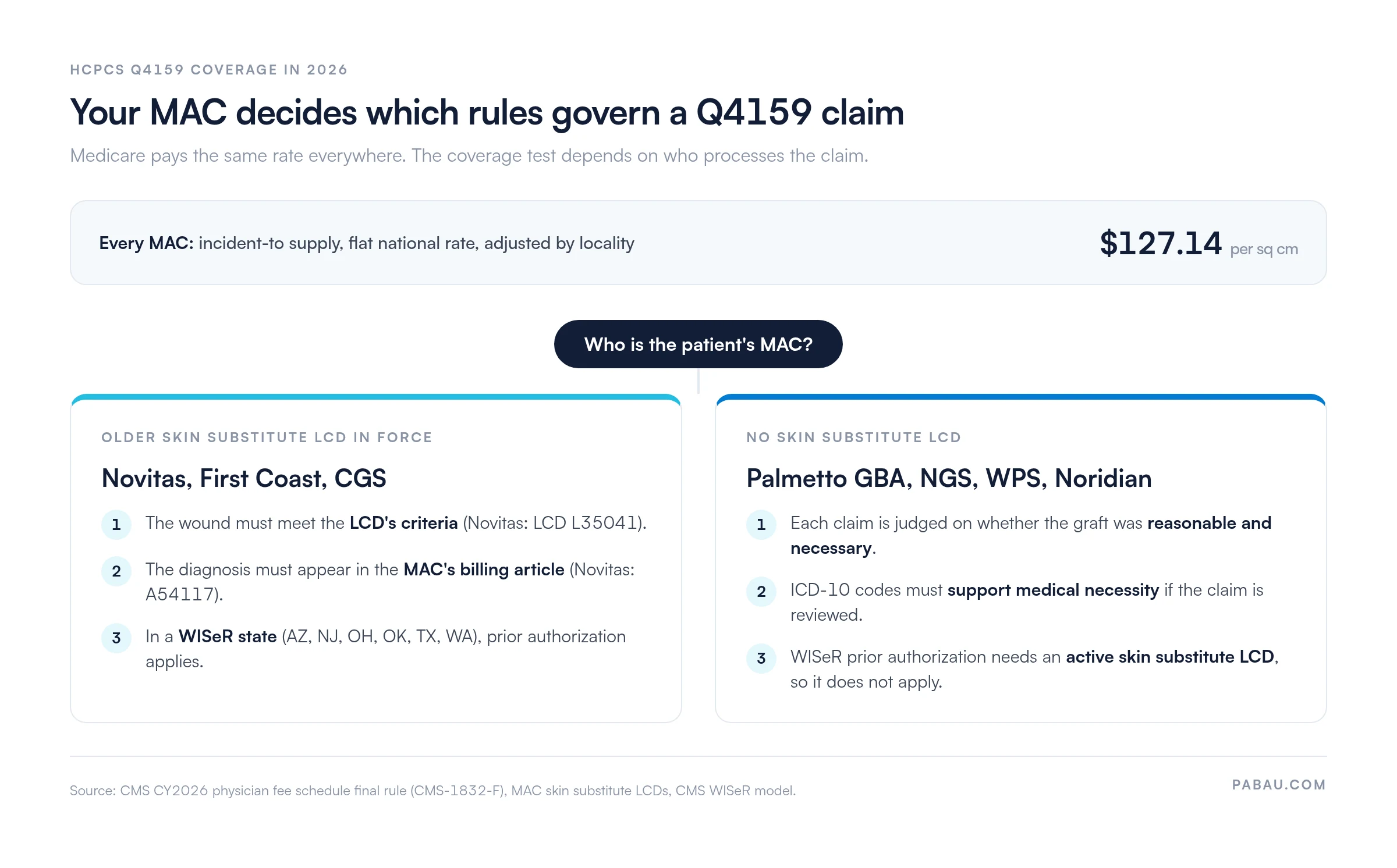
Novitas applies LCD L35041 with billing article A54117, titled “Billing and Coding: Application of Bioengineered Skin Substitutes to Lower Extremity Chronic Non-Healing Wounds.” Practices treating lower-limb wounds should confirm the wound meets their MAC’s criteria before applying Affinity.
Wounds most often billed with Q4159 include:
Acute surgical wounds, burns, and pressure injuries are generally not covered unless the MAC’s policy and the clinical record support an exception. Submitting Q4159 for an excluded wound type is a common denial trigger. An appeal rarely succeeds without clinical documentation created before the application.
Every unit of Q4159 on the claim represents one square centimeter of Affinity applied to the wound. Measure the wound’s length and width in centimeters, choose the graft size that covers it, and bill the square centimeters of graft applied. A 4 cm by 3 cm wound covered with a 12 sq cm graft is billed as 12 units.
Record the wound measurement, the graft size, and a photograph where possible in the procedure note. The units on the claim must match the graft size in that note. Pulling those details from the encounter record into claims management software removes the manual re-entry step where most unit errors start.
The practice buys Affinity from Organogenesis or an authorized distributor, applies it during the encounter, and bills Q4159 alongside the application CPT code. Physician offices bill on the CMS-1500, and hospital outpatient departments bill on the UB-04. Record the product lot number in the procedure note, since a MAC reviewer can request it in an additional documentation request.
Valid places of service depend on your MAC’s policy. Place of service 11 (physician office) and 22 (outpatient hospital) are the usual settings, and the 2026 flat rate applies in both. A place-of-service mismatch triggers an automatic claim edit that does not always come with a clear remittance explanation. Pull the place-of-service field from the encounter record rather than typing it on each claim.
From January 1, 2026, Medicare pays Q4159 at a flat national rate of $127.14 per square centimeter. CMS’s CY2026 physician fee schedule final rule (CMS-1832-F) and the parallel OPPS final rule reclassified skin substitutes as incident-to supplies. That change covers products in all three FDA pathways, including 361 HCT/P tissues such as Affinity.
CMS first finalized the rate at $127.28 and then corrected it to $127.14. The rate is set for the full calendar year rather than updated quarterly. The physician fee schedule adjusts it by locality through the geographic practice cost index, and the OPPS adjusts it by the hospital wage index.
To look up your locality’s adjusted Q4159 rate, use the CMS Physician Fee Schedule look-up tool and search by HCPCS code. The table below shows how the payment basis changed. The worked figure uses the national rate before any locality adjustment.
The application procedure (CPT 15271-15278) is still billed and paid separately from the graft. Because every qualifying skin substitute now earns the same rate, the practice’s margin on Affinity depends on its purchase price. Compare that price with your locality-adjusted rate before you reorder stock.
The 2026 skin substitute rate is fixed for the calendar year, so the rate check is now annual rather than quarterly. Look up your locality’s adjusted Q4159 rate each January, and read the physician fee schedule final rule each November for the next year’s figure. If the new rate falls below what you pay per square centimeter for Affinity, renegotiate with your distributor before the next order.
A Q4159 claim no longer needs an acquisition invoice for pricing, because the flat 2026 rate replaced invoice-based payment. Palmetto GBA’s “Affinity: HCPCS Code Q4159 Requires Invoice” notice dates from November 2021 and covered 2021 dates of service only. Palmetto’s current JM invoice code list, published September 23, 2026, does not include Q4159.
Keep the purchase paperwork anyway. A MAC reviewer, a Recovery Audit Contractor, or a commercial payer can still ask you to prove which product you applied and how much. Store these details with the encounter record:
Commercial and Medicare Advantage plans set their own pricing, and some still ask for an invoice. Check each plan’s contract before assuming the Medicare rule applies. Storing the invoice against the patient encounter, rather than in a separate purchasing file, means it is ready when any payer asks.
Every Q4159 claim must carry ICD-10-CM codes that support a chronic wound covered by your MAC’s policy. Where Novitas, First Coast, or CGS is the MAC, the diagnosis must appear in that MAC’s billing article, such as A54117 for Novitas. Elsewhere, the codes must support medical necessity on review. Coders often trigger denials by using a broad parent code where the policy lists a more specific one.
Check the ICD-10 pairings against your MAC’s policy in the Medicare Coverage Database for the date of service. The CDC/NCHS ICD-10-CM web tool shows current descriptors with full hierarchy navigation. A pairing check built into the coding workflow catches mismatches before the claim leaves the practice.
A Q4159 claim holds up on review only when the medical record supported it before the application. The checklist below covers what a MAC medical reviewer expects to see in the file.
The table below maps frequent Q4159 denial reasons to their root causes and the action that prevents each one.
When a claim is denied, look up the remittance advice reason code in our guide to denial codes in medical billing. Some denials need only a corrected claim, while others need a formal appeal. Medicare accepts a redetermination request within 120 days of the initial determination. A claim that goes out complete the first time avoids that rework.
Each skin substitute Q-code is product-specific, so Q4159 cannot stand in for another product’s code, and the reverse is also true. Since 2026 most of these codes pay the same flat rate, which removes any payment reason to pick one code over another. Billing the wrong code is still an improper claim. The comparison below covers codes often confused with Q4159.
Two further product-specific codes draw the same mix-ups. Q4117 covers Hyalomatrix, a hyaluronic acid-based product rather than an amniotic membrane allograft. Q4133 covers Grafix Prime and three related placental tissue grafts, so it never substitutes for Affinity.
The CMS HCPCS code set overview publishes the current skin substitute Q-codes each quarter. When a product label or invoice names a product other than Affinity, Q4159 cannot be used, however similar the composition. Celularity’s Biovance, another amniotic membrane allograft, is billed per square centimeter under Q4154.
Before submitting any skin substitute claim, match the product name on the invoice to the HCPCS code’s official descriptor. Print the product-to-code crosswalk from the Organogenesis coding guide and tape it to the wound-care supply cabinet. When staff pull a different product from stock, the wrong code cannot be assigned by mistake.
Traditional Medicare does not usually require prior authorization for Q4159, and most claims are reviewed after payment against the MAC’s policy. The exception is CMS’s WISeR model, which began in January 2026 in Arizona, New Jersey, Ohio, Oklahoma, Texas, and Washington. In those states, skin substitutes need prior authorization only where an active skin substitute LCD applies.
Medicare Advantage plans set their own rules, and many require prior authorization before any skin substitute application. Commercial payers and Medicaid programs vary by state and plan. Before the first application with any payer other than traditional Medicare:
Record each payer’s authorization status in the patient record, so requirements don’t get mixed up across a wound-care patient panel. Adding an authorization checkpoint to patient intake flags missing approvals before the application date.
Most Q4159 errors happen when wound details move by hand from the procedure note to the claim. A coder retypes the graft size, looks up the lot number in a separate file, and checks claim status in another portal.
Pabau keeps the wound measurement, the graft details, and the signed order in the patient record. Its claims management pulls those record details into a pre-filled claim, then submits and tracks it through Claim.MD. Supplier invoices and wound photographs can be stored against the same encounter.
The outcome is a Q4159 claim built from the note rather than from memory. When a payer asks for records, the practice answers from one file instead of three.

Pabau pulls wound measurements and graft details from the patient record into a pre-filled claim, then submits and tracks it. Supplier invoices stay attached to the encounter, so every Q4159 claim leaves the practice complete.

The 2026 flat rate changed Q4159 from a pricing puzzle into a documentation job. Medicare now pays the same $127.14 per square centimeter, adjusted for locality, whatever the practice paid for the graft. The remaining risk sits in the chart: units that match the graft size, a wound history that proves chronicity, and diagnosis codes your MAC accepts.
Start with the coverage map, since your MAC decides which policy governs the claim. Then compare the adjusted rate with your Affinity purchase price before the next order.
Pabau pre-fills each claim from the patient record, submits and tracks it, and keeps supplier invoices with the encounter. Book a demo to see how Pabau keeps wound-care claims complete from note to payment.

Want to understand how skin substitute claims fit into your broader billing workflow? Our medical billing fundamentals guide explains the end-to-end claim lifecycle for physician-administered products.
Getting denials with explanation codes you do not recognize? Our denial codes reference maps the most common CARC and RARC codes to root causes and appeal strategies.
Need to understand the claim lifecycle for products billed under the buy-and-bill model? Our superbill guide covers how to structure the claim form for physician-administered biologics.
Billing the application procedure that goes with the graft? Our CPT 15271 guide covers the first 25 sq cm of skin substitute application on the trunk, arms, or legs.
Comparing Affinity with a living cell skin substitute? Our HCPCS Code Q4101 guide explains how Apligraf is coded and billed per square centimeter.
HCPCS code Q4159 is the temporary Level II code for Affinity, a human amniotic membrane allograft made by Organogenesis. It is used on chronic lower-extremity wounds such as diabetic foot ulcers and venous leg ulcers. It is billed per square centimeter of graft applied, and coverage follows the patient’s MAC policy.
Q4159 is billed per square centimeter of Affinity applied, not per application. Measure the wound, choose a graft that covers it, and bill the graft’s square centimeters. A 4 cm by 3 cm wound covered with a 12 sq cm graft is billed as 12 units.
No, not for Medicare dates of service from January 1, 2026. Medicare now pays Q4159 at a flat rate of $127.14 per square centimeter, so an invoice no longer sets the price. Palmetto GBA’s current invoice code list does not include Q4159. Keep the invoice in the record for audits and for commercial payers that still ask for one.
The accepted codes depend on the wound type. For diabetic foot ulcers, use E11.621 or E10.621 with an L97.4- or L97.5- code for site and severity. For venous leg ulcers, use an I83.0- or I83.2- code with an L97.- severity code. Verify pairings against your MAC’s policy, such as Novitas’s billing article A54117, for the date of service.



