HCPCS code K0822: Group 2 power wheelchair billing guide
HCPCS code K0822 is the group 2 standard power wheelchair code HCPCS code K0822 ...

Last Updated: Nov 2, 2026
HCPCS code L1815 is a deleted Level II code for a prefabricated elastic knee orthosis with condylar pads.
It was deleted from the HCPCS code set for 2010 (last valid date of service December 31, 2009). A claim that still carries it fails as an invalid code.
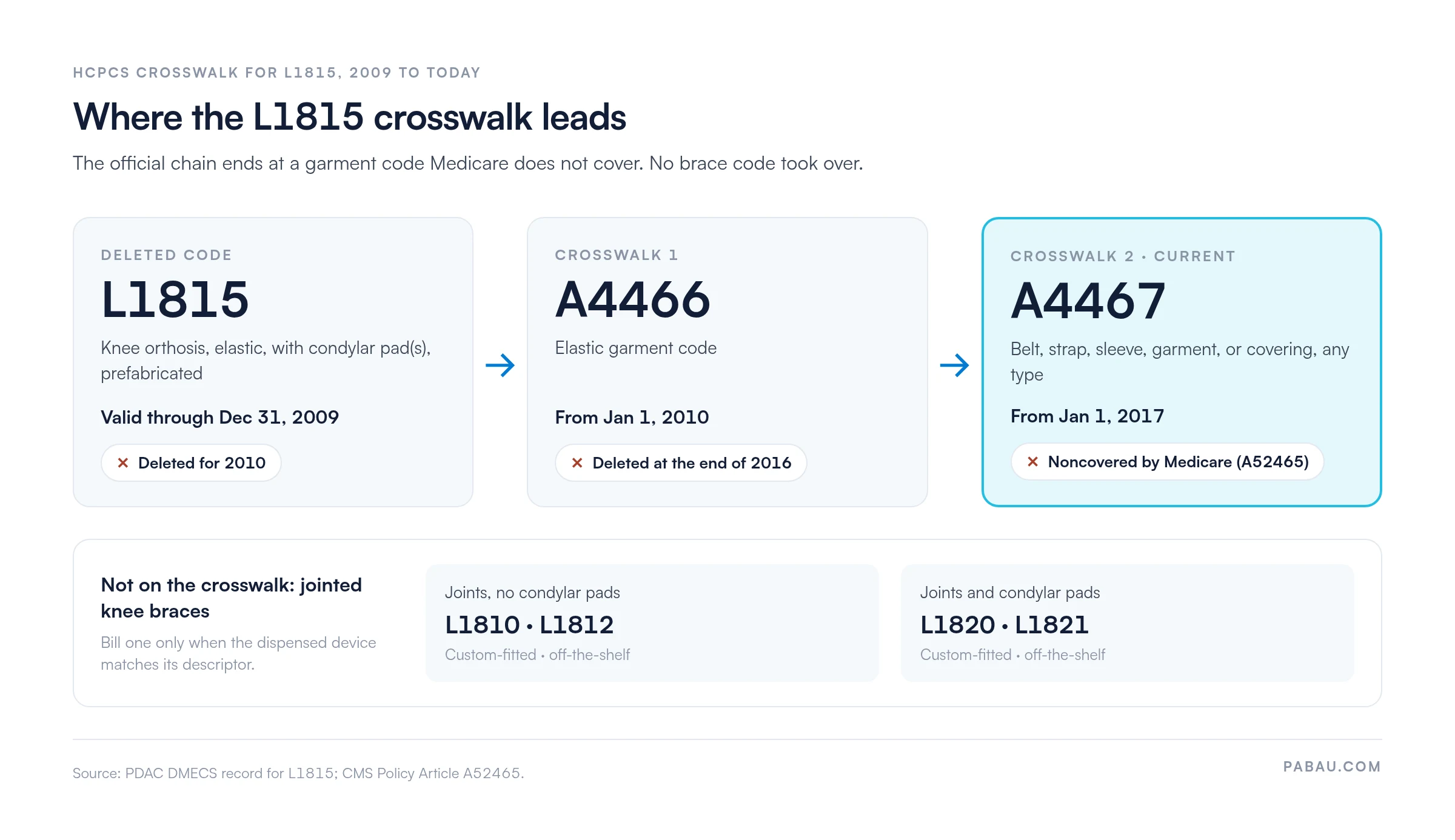
No brace code took over from L1815. Its official crosswalk points to A4466, an elastic garment code that A4467 replaced in 2017. Medicare denies A4467 as noncovered. A jointed brace bills as L1810, L1812, L1820 or L1821 only when the device you dispense matches that code’s descriptor.

HCPCS code L1815 was deleted from the HCPCS code set for 2010 (last valid date of service December 31, 2009).
L1815 described a prefabricated elastic knee orthosis with condylar pads and no joints.
Its only official crosswalk is to A4466, which was itself replaced by A4467 in 2017.
Policy Article A52465 says Medicare denies A4467 as noncovered, because an elastic garment does not meet the definition of a brace.
L1810, L1812, L1820, L1821 and L1830 describe other devices, so bill one only when the dispensed device matches its descriptor.
LCD L33318 and Policy Article A52465 set the coverage and modifier rules for those knee brace codes.
Removing L1815 from price lists and billing templates stops the deleted code from reaching the next claim.
L1815 was a code in the L section of HCPCS Level II. That section covers orthotic and prosthetic procedures. The PDAC DMECS record for L1815 holds its full descriptor. It reads “Knee orthosis, elastic or other elastic type material with condylar pad(s), prefabricated, includes fitting and adjustment.” The descriptor names no joints, which sets it apart from the jointed codes L1810 to L1821.
The same record shows that L1815 was deleted from the HCPCS code set for 2010 (last valid date of service December 31, 2009). It lists one crosswalk, from L1815 to A4466, effective January 1, 2010. A4466 was then deleted at the end of 2016 and crosswalked to A4467, “Belt, strap, sleeve, garment, or covering, any type.” The diagram traces that chain and the jointed codes that sit outside it.
The code is also absent from the CMS October 2026 alpha-numeric HCPCS file, available through the CMS quarterly HCPCS update page. That file lists the active knee orthosis codes from L1810 through L1860.
A deleted code is different from a non-covered code. A non-covered code is still valid but fails the payer’s coverage rules. A deleted code is no longer in the code set at all, so the claim fails before anyone looks at medical necessity.
The previous member of this family, L1800, was retired in the same 2010 update. Both codes cause the same problems when they survive in a billing system:
Pick the code from the device in hand, not from the old code on the template. L1815 has no one-to-one replacement, so each code below fits only a device that matches its descriptor. Billing a jointed code for a sleeve without joints is incorrect coding and an upcoding risk.
Policy Article A52465 groups the jointed elastic knee orthoses into two pairs. Each pair describes one product and differs only by the fitting performed at delivery.
Source: CMS October 2026 alpha-numeric HCPCS file and PDAC DMECS. The long descriptors for L1810 and L1820 spell out what the custom fitting involves. The prefabricated item is “trimmed, bent, molded, assembled, or otherwise customized to fit a specific patient by an individual with expertise.”
The jointed elastic orthosis without condylar pads has two billing pages of its own. L1810 covers the custom-fitted version, and L1812 covers the off-the-shelf one.
LCD L33318 (Knee Orthoses) governs Medicare coverage for the jointed knee orthosis codes and the L1830 immobilizer. The DME MACs CGS and Noridian apply it, and its latest revision took effect for services on or after January 25, 2026.
Under the LCD, L1810, L1812, L1820 and L1821 “are covered for ambulatory beneficiaries who have weakness or deformity of the knee and require stabilization.” The L1830 immobilizer is covered for a beneficiary “who has had a recent injury to or a surgical procedure on the knee(s).”
An elastic sleeve gets no route to payment from either document. A52465 says elastic or fabric support garments do not meet the statutory definition of a brace. It adds that “Code A4467 is denied as noncovered (no Medicare benefit).” A commercial payer may set its own policy, so check it before you dispense.
Policy Article A52465 sets the claim-line modifiers for the knee brace codes:
A52465 also treats additions L2390, L2750, L2780 and L4002 as replacement components. They are not separately payable at initial issue of a base orthosis, and A52465 lists them for L1810 and L1812.
Read the current versions of LCD L33318 and Policy Article A52465 on the CMS Medicare Coverage Database before you rebill. Both documents are revised over time, and the modifier and coverage wording above reflects the January 2026 revisions.
LCD L33318 lists four requirements a supplier must meet to justify payment for DMEPOS items. Policy Article A55426 sets the standard documentation rules for every claim submitted to the DME MACs.
Keep the file per CMS and MAC requirements, and verify the retention period with your MAC. Before you dispense, run insurance eligibility verification and check whether the payer requires prior authorization for the item.
A rejected L1815 claim points to a code that still lives somewhere in your system. Fix the claim and the source together:
The CMS DMEPOS fee schedule sets the Medicare allowable for L1810, L1812, L1820, L1821 and L1830. Amounts differ by state and change with each update, so look them up for your locality. A deleted code such as L1815 has no current fee schedule amount, and A4467 is noncovered.
Commercial payers set their own rates by contract. If an L1815 claim was denied or rejected, track the resubmission through your denial management workflow until it is paid.
When a deleted code such as L1815 still reaches a claim, the cause is often an old price list or claim template. Correcting one claim does not stop the next if that entry stays in place.
Pabau keeps patient records, invoices and claims in one practice management system, with claims management software built in for insurance billing. When CMS retires a code, your billing team updates it in one place.
That matters for orthotics billing, where the code depends on the device and its fitting. Your team can check the record and the claim side by side before it goes out.

Pabau’s claims management software supports insurance billing, with patient records and invoices in one system for your billing team.

An L1815 rejection means your code tables are out of date, and the next claim built from them will fail the same way. The deleted code has no path to payment, so the useful work is choosing the current code that matches the device.
Start with the device. A jointless elastic sleeve with condylar pads, the item L1815 described, now codes as A4467, which Medicare does not cover. A jointed brace with condylar pads points to L1820 or L1821, and one without them to L1810 or L1812. The fitting at delivery then decides between the custom-fitted and off-the-shelf code.
Once the code is right, a brace claim lives or dies on the LCD L33318 criteria and the A52465 modifiers. Book a demo to see how Pabau keeps your orthotics billing and patient records in one place.

Need a denial management framework? Denial management in healthcare walks through structured workflows for tracking, appealing, and preventing DMEPOS and physician-fee-schedule denials.
Want to understand clean-claim standards? Clean claim submission covers the elements a claim must contain to pass payer edits on first submission, including modifier and diagnosis requirements.
Looking for broader billing compliance guidance? Medical billing compliance outlines the CMS documentation and audit-readiness standards that apply across DMEPOS and professional fee billing.
Billing a canvas knee immobilizer? HCPCS code L1830 covers the prefabricated, off-the-shelf canvas longitudinal knee immobilizer and how to bill it.
Tracing the L1815 crosswalk? HCPCS code A4466 explains the elastic garment code L1815 was crosswalked to from 2010 until its deletion at the end of 2016.
No. HCPCS code L1815 was deleted from the HCPCS code set for 2010 (last valid date of service December 31, 2009). A claim that carries it fails as an invalid code, so bill the current code that matches the device.
No brace code replaced it directly. The 2010 crosswalk sends L1815 to A4466, which A4467 replaced in 2017. Bill L1810, L1812, L1820 or L1821 only when the dispensed device has joints and matches that descriptor.
No. Policy Article A52465 says elastic support garments do not meet the statutory definition of a brace. Medicare denies A4467 as noncovered, with no Medicare benefit.
Both are off-the-shelf elastic knee orthoses with joints. L1821 adds medial and lateral condylar pads, with or without patellar control. Without those pads, the device belongs under L1812.
Bill L1810 when an individual with expertise trims, bends, molds, assembles or otherwise customizes the device for the patient. Policy Article A52465 requires the off-the-shelf code, L1812, when minimal self-adjustment is the only fitting at delivery.
LCD L33318, Knee Orthoses, covers L1810, L1812, L1820 and L1821. Its companion Policy Article A52465 sets the coding rules and the KX, GA, GZ and RT/LT modifier requirements.
No. Medicare returns a claim with an invalid code as unprocessable, so there is no appeal to file. Correct the code and resubmit the claim with the required modifiers.
Yes. L1800, “Knee orthosis, elastic with stays, prefabricated, includes fitting and adjustment,” was deleted in the same 2010 update. Like L1815, it crosswalks to A4466.