

HCPCS code E0198: Water pressure pad billing guide
HCPCS code E0198 is a water pad for a standard mattress HCPCS code E0198 is the ...

Last Updated: Oct 13, 2026
L1830 is the HCPCS Level II code for knee orthosis, immobilizer, canvas longitudinal, prefabricated, off-the-shelf.
Canvas longitudinal construction is what separates L1830 from the rest of the knee orthosis family. Longitudinal refers to rigid or semi-rigid stays that run vertically along the sides of the brace.
Those stays give mediolateral support without custom fabrication. Because the device is off-the-shelf, a supplier can dispense it with only minimal self-adjustment by the patient.
Let Pabau's smart automation suggest the right codes, reduce claim denials, and keep your practice compliant—effortlessly.
Automate repetitive tasks and focus on what matters most—your patients.
Reduce coding errors and ensure compliance with the latest regulations.
Clean claims, fewer denials, and faster reimbursements.
Powerful insights and reporting to help your practice thrive.
HIPAA compliant SOC 2 certified GDPR-compliant Trusted by 4,000+ clinics worldwide

HCPCS Code L1830 covers a knee orthosis immobilizer of canvas longitudinal construction, prefabricated and off-the-shelf.
Medicare pays L1830 from the DMEPOS fee schedule, and purchase with modifier NU is far more common than rental.
Most denials trace to a missing modifier, a diagnosis code that fails LCD A52465, or no proof of delivery on file.
The knee orthosis L-codes split on fitting status, so L1832 needs a fitter with expertise while L1833 is off-the-shelf.
Practice management software like Pabau tracks modifier requirements and attaches documentation before a DME claim leaves the practice.
Medicare reimburses L1830 through the DMEPOS fee schedule, which CMS updates annually. Allowable amounts vary by region under locality-adjusted pricing, so a single national figure will not match what you are paid.
Verify current dollar amounts against the CMS DMEPOS fee schedule before you submit. Rates change each January 1 and carry a geographic adjustment tied to the DME MAC jurisdiction serving the patient’s state. Two suppliers in different jurisdictions can be paid different amounts for the same brace.
Coverage for L1830 is not automatic. Medicare requires documented medical necessity consistent with LCD Policy Article A52465 (Knee Orthoses). Both the clinical and the administrative criteria in that policy have to be satisfied before the claim will pay.
The following clinical scenarios generally support medical necessity for a canvas longitudinal knee immobilizer:
Because L1830 is an off-the-shelf code, the supplier must confirm that the device needs only minimal self-adjustment to fit.
A custom-fitted orthosis is a different animal, since it requires direct patient contact by a qualified practitioner to shape or fit the device. Billing a custom-fitted brace under an off-the-shelf code is a compliance risk under Medicare’s DMEPOS Quality Standards.
A custom-fabricated brace goes further still, since it is built from the patient’s own measurements. That is the point where a code such as L1840 applies.
Incomplete documentation is the leading cause of denials across the knee orthosis codes. A payable L1830 claim usually needs all five of these on file:
Record the physician order date, the diagnosis that supports the order, and the delivery date in one place. Payer audits cross-check all three against each other.
The diagnosis code has to reflect the condition documented in the record, or coverage fails on review. The codes below are commonly accepted as supporting medical necessity for a knee immobilizer.
This list is not exhaustive, and it must align with payer policy and with the patient’s documented clinical picture.
Match the ICD-10 code to the laterality documented in the record. Submitting a bilateral diagnosis code for a unilateral device is a common audit flag.
Modifier selection is the most audit-sensitive part of billing L1830. Each modifier signals a specific clinical or transactional circumstance to the payer. The AAPC HCPCS code lookup is a useful cross-check alongside payer-specific policy.
NU is the right modifier for most L1830 scenarios. The rental modifiers KH, KI and KJ apply only where the supplier and beneficiary have agreed to a rental arrangement. That is atypical for a canvas knee immobilizer.
A DME claim submitted with no modifier draws an automatic rejection from most Medicare Administrative Contractors (MACs).
Make the modifier a required field in your billing template for every off-the-shelf orthotic code. A missing modifier on an L1830 submission is the fastest route to an avoidable denial. Build a submission checklist that prompts for the modifier before the claim can leave the queue.
Billing L1830 correctly means lining up clinical documentation and supplier records before the claim reaches the payer. Confirm eligibility first, because a coverage problem found after dispensing is expensive to unwind.
Run every field against a clean claim checklist before submission. An incomplete DME claim form draws an automatic rejection rather than a formal denial, and a rejection cannot be appealed. You have to correct the form and resubmit it, which puts the payment weeks further out.
Most code reference pages stop at the descriptor. The failure patterns below are what actually send L1830 claims back, and every fix for them sits upstream of submission.
Track the denial reason codes that come back on your L1830 claims. A code that keeps repeating points to a process problem rather than a one-off coding mistake.
Picking the wrong code from the knee orthosis family causes both denials and compliance exposure. The deciding feature is rarely the material. It is the fitting status written into the descriptor, and two pairs of these codes get mixed up constantly.
Read the family as one picture and the pattern becomes obvious. The chart below sets each code’s fitting status side by side.
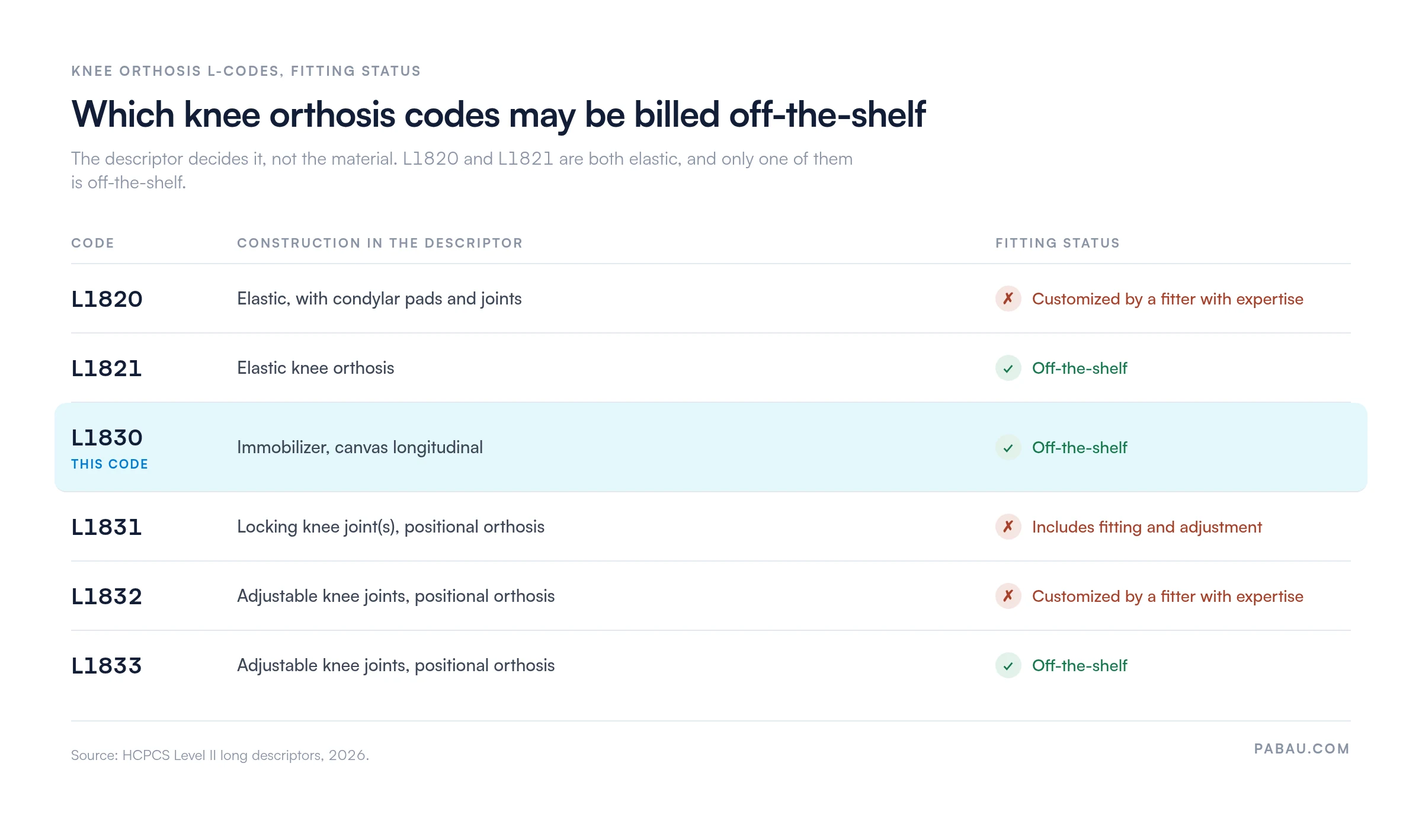
Two swaps account for most of the coding errors here. L1820 is elastic and has to be customized by an individual with expertise, while L1821 is the off-the-shelf elastic code.
L1833 is the off-the-shelf adjustable-joint code, and L1832 is the one that needs a fitter. Match the code to the device in hand, verified against the manufacturer’s product description.
The same split continues past the codes in this table. L1847 and L1848 both describe a double upright brace with inflatable air chambers, and only L1848 is off-the-shelf.
Keep a one-page sheet at the dispensing counter listing L1820 through L1833 with construction and fitting status side by side. When staff ask which code a brace falls under, they can check material, joint type and fitting status against the sheet instead of guessing.
Most suppliers keep the evidence for an L1830 claim in three places. The physician order arrives by fax and the fitting note sits in the chart. The signed proof of delivery lives in a folder somebody has to find when the audit letter turns up.
Practice management software like Pabau keeps the order, the clinical note, the fitting record and the delivery signature on one patient timeline.
Our claims management software holds a DME line back when the modifier field is empty, so the claim is corrected before a MAC rejects it. It also records which staff member captured the delivery signature and when.
The result is less rework in the denial queue, and an audit response that takes minutes rather than a day of file hunting. Every subscription includes the full billing toolset, so nothing here sits behind a higher tier.

Pabau’s claims management software helps DME suppliers and orthotists track documentation requirements, apply the right modifiers, and submit cleaner claims for codes like HCPCS L1830. See how it fits the way your team bills today.

L1830 is a simple code with an unforgiving paper trail. Three failures sink these claims: a missing modifier, a diagnosis that does not satisfy LCD A52465, and no proof of delivery on file.
Fix all three at the dispensing counter rather than in the appeals queue. Block submission until the modifier, the order and the signed delivery record are all present. That single rule protects more DME revenue than any coding reference. Book a demo to see how Pabau builds that check into the claim before your team sends it.

Want to see where a denied DME claim hits your collections? Revenue cycle management fundamentals covers how denials feed back into your overall collection rate and what to track.
Need the documentation standards that survive a DMEPOS audit? DME billing compliance guidance walks through the records that prevent the most common audit findings.
Not sure how to work a denied claim back to payment? Healthcare denial management strategies explains how to work denials systematically and recover the revenue faster.
HCPCS Code L1830 is a HCPCS Level II code for a knee orthosis (KO), immobilizer, canvas longitudinal, prefabricated, off-the-shelf device. It covers canvas braces with longitudinal stays that a supplier can dispense without custom fabrication or a professional fitting. The code is billed to Medicare and to commercial payers as a DMEPOS item.
NU, for a new equipment purchase, is the most common modifier on an L1830 claim. RR applies to a monthly rental and UE applies to used equipment, reimbursed at 75% of the purchase rate. The rental sequence modifiers KH, KI and KJ apply where a rental arrangement is in place. An L1830 claim submitted with no modifier will be rejected automatically by most Medicare Administrative Contractors.
Yes, Medicare Part B covers L1830 where medical necessity is documented under LCD Policy Article A52465 (Knee Orthoses). Coverage requires a physician order, a supporting diagnosis code, a signed proof of delivery, and confirmation that the device really is off-the-shelf. Coverage is not automatic, and the claim is denied if any of those elements is missing.
L1830 is a canvas longitudinal immobilizer supplied off-the-shelf. L1820 is an elastic knee orthosis with condylar pads and joints. Its descriptor requires the item to be customized to the patient by an individual with expertise. The off-the-shelf elastic version is a separate code, L1821. Billing the wrong code for the device dispensed is an error that can trigger a post-payment audit.
You need a physician order naming the orthosis and the supporting diagnosis, plus clinical notes confirming medical necessity. A signed proof of delivery from the beneficiary is also required. Add fitting notes confirming that the device needed only minimal adjustment, and a valid Medicare DMEPOS supplier number for the dispensing entity. Keep the records for at least seven years in case of a post-payment audit.
L1830 is a prefabricated, off-the-shelf code. The device is mass-produced and needs only minimal self-adjustment to fit, with no patient-contact fabrication by a qualified practitioner. Where a knee orthosis is genuinely custom fabricated, a custom-fabricated L-code such as L1834 applies instead. Billing L1830 for a custom-fabricated brace is a compliance error under Medicare’s DMEPOS Quality Standards.



