HCPCS Code G0163: Skilled nursing observation and assessment
What is HCPCS Code G0163? HCPCS Code G0163 is a deleted Level II code for skille...

Last Updated: Oct 15, 2026
L1812 is the HCPCS Level II code for knee orthosis, elastic with joints, prefabricated, off-the-shelf.
DME suppliers and orthotists use it to bill Medicare and commercial payers for a hinged knee brace dispensed with no customization at fitting. The sibling code L1810 covers the same physical device when a qualified fitter modifies it for one patient.
Coverage runs through Local Coverage Determination L33318 and Policy Article A52465. It also lists the documentation your file must hold before the device is delivered.
Let Pabau's smart automation suggest the right codes, reduce claim denials, and keep your practice compliant—effortlessly.
Automate repetitive tasks and focus on what matters most—your patients.
Reduce coding errors and ensure compliance with the latest regulations.
Clean claims, fewer denials, and faster reimbursements.
Powerful insights and reporting to help your practice thrive.
HIPAA compliant SOC 2 certified GDPR-compliant Trusted by 4,000+ clinics worldwide

HCPCS Code L1812 describes a knee orthosis that is elastic with joints, prefabricated, and off-the-shelf under Medicare’s DMEPOS rules.
L1810 covers the same hinged device when a qualified fitter customizes it, so the coding turns on the fitting service rather than the hardware.
Medicare coverage is governed by LCD L33318, and a signed detailed written order must be on file before delivery.
Modifier KX is required when all LCD coverage criteria are met, and modifier GA applies when an ABN is on file.
Claims management software like Pabau tracks the documentation each DMEPOS claim needs, so missing elements surface before submission.
HCPCS Code L1812 is the DMEPOS billing code for an elastic knee orthosis with hinges, prefabricated, and dispensed off the shelf. The official full descriptor reads: Knee orthosis (KO), elastic with joints, prefabricated, off-the-shelf.
HCPCS Level II codes are maintained by the Centers for Medicare and Medicaid Services (CMS). They identify products, supplies, and services that CPT does not cover. L1812 sits in the L-series orthotic range of HCPCS codes and is paid under the DMEPOS fee schedule.
Each element of the descriptor carries a specific billing meaning:
CMS treats the off-the-shelf element as a question of fitting effort, not device design. A brace that needs expert trimming, bending, or molding for one patient belongs to L1810 instead. That means the fourth element is settled at the fitting appointment, not in the product catalog.
L1810 and L1812 describe the same hinged elastic knee orthosis. What separates them is the fitting service performed before the patient walks out with it. Misassigning one for the other is a common audit trigger, because the claim has to match what your fitter actually did.
CMS names the customization explicitly in the L1810 descriptor. It covers a prefabricated elastic knee orthosis with joints that a fitter has trimmed, bent, molded, assembled, or otherwise customized to fit a specific patient. The descriptor adds that the work must be done by an individual with expertise.
Several code lookup sites describe L1810 as a sleeve or wrap with no hinges. That description is wrong, and coding from it produces a code-device mismatch an auditor will find. Both codes require joints. One question at the fitting decides which code you bill.
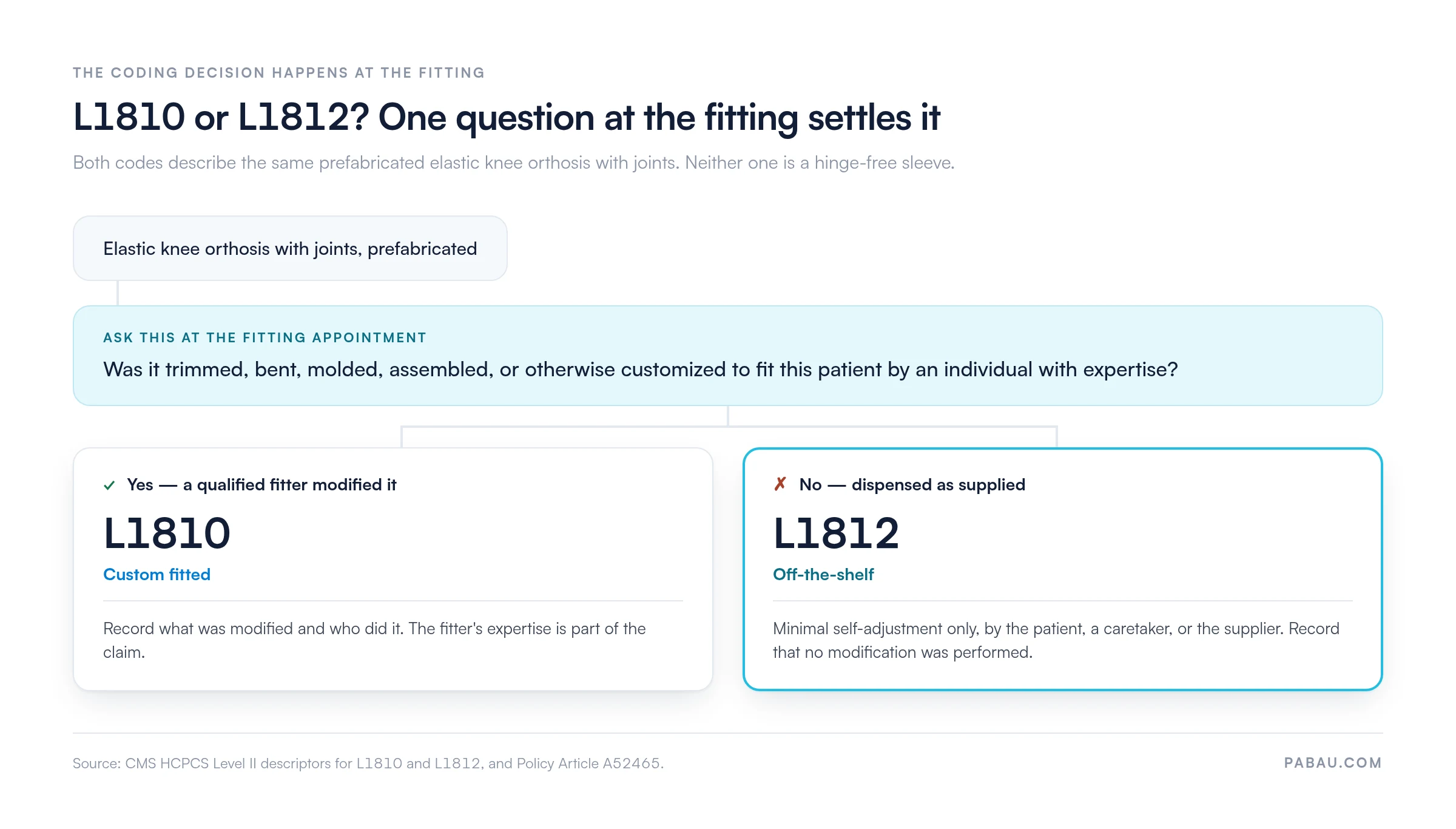
The table below lines the two codes up on the features that decide which one belongs on the claim.
Code from the fitting record, not from the purchase order. If your fitter trimmed or molded the brace for that patient, the claim belongs to L1810 even when the order said L1812. Write down what was done at the appointment while the patient is still in the room.
Medicare covers HCPCS Code L1812 when the record documents medical necessity and every criterion in Local Coverage Determination L33318 is met. LCD L33318 is the controlling CMS policy for knee orthoses. A supplier’s own attestation cannot stand in for it.
All of the following must be in place before delivery. A single missing element is sufficient grounds for denial or post-payment recovery.
Policy Article A52465 sits alongside LCD L33318 and sets the coding and supplier standards. Read together, the two CMS documents define the compliance framework for an L1812 claim.
Medicare requires at least one covered ICD-10-CM diagnosis on the claim to establish medical necessity. The diagnosis must come from the approved list in LCD L33318. The table below covers the diagnoses most commonly billed with this code. Covered code lists are updated annually, so check the CMS coverage database for the active year.
Laterality matters. ICD-10-CM requires right, left, or bilateral specificity for most knee codes. Submitting an unspecified code where a lateralized version exists risks a medical necessity denial. High-volume suppliers can cross-reference HCPCS codes against supported ICD-10 codes programmatically through the NLM Clinical Table Search.
Per Policy Article A52465, the documentation file for every L1812 claim must be complete before the device is dispensed. A chart amended after dispensing carries far less weight in a Recovery Auditor review. The following items belong in the patient’s file:
Suppliers running several DME orders at once do better with one checklist applied the same way every time. Check the file against A52465 before the claim goes out, rather than after a request for records arrives.
Run a pre-delivery checklist on every L1812 brace: DWO signed, face-to-face note filed, ICD-10 code lateralized, off-the-shelf status confirmed on the label. A five-minute check prevents a five-figure Recovery Auditor recoupment.
Modifiers tell Medicare the coverage status and condition of the device on an L1812 claim. Per Policy Article A52465, submitting without the required modifier triggers an automatic denial. Modifier KX carries the most weight. Appending it attests that every LCD criterion is met and documented.
Appending KX when the criteria are not actually met is a false attestation, with potential False Claims Act exposure. Where any element is in doubt, withhold KX, go back to the ordering physician, and consider an ABN before dispensing.
L1812 is paid under the DMEPOS fee schedule, not the Physician Fee Schedule. Allowed amounts vary by MAC jurisdiction and are republished every January. Third-party code listings often quote figures well above what CMS actually pays, so take the number from CMS rather than from a lookup site. Check the current allowance for your jurisdiction in the CMS DMEPOS fee schedule files before you plan revenue against it.
Several factors move what an L1812 claim is actually worth.
Commercial payer rates for L1812 are negotiated separately and may sit above or below Medicare. Read the contract language before assuming Medicare rates carry over to a commercial claim.
Recovery Auditors (RACs) and Supplemental Medical Review Contractors (SMRCs) look at knee orthosis claims often, because the documentation requirements are specific and frequently incomplete. The errors below account for most L1812 denials and post-payment recoupments.
Each of these errors shares one cause. The file gets assembled after the claim goes out instead of before it. Building it in the fitting room takes minutes. Rebuilding it for an auditor takes months.
Schedule a quarterly internal audit of a sample of L1812 claims. Pull 10 random claims from the prior 90 days, retrieve the documentation file for each, and verify every required element is present. Audit your own file before a Recovery Auditor does.
DMEPOS suppliers billing L1812 must meet the supplier standards in Policy Article A52465. Failing them can cost the supplier number itself, and with it the ability to bill Medicare at all.
A claims management software platform that keeps documentation next to the claim gives a supplier audit-ready records without a paper file room. DWOs, delivery receipts, and modifier selections live in one place, so a missing element surfaces before submission rather than after a records request.
Most DME suppliers keep the claim in one system and the documentation in another. The DWO scans sit on a shared drive, the delivery receipts in a folder by month, and the modifier decision only in the biller’s head. When a records request arrives, someone spends a day rebuilding a file that was complete on the day of delivery.
Practice management software like Pabau keeps both together. The order, the face-to-face note, the signed DWO, the delivery receipt, and the claim all attach to the same patient record. Your biller can see which A52465 elements an L1812 claim is still missing before it goes out.
Claim status comes back into that same record, so a denial lands next to the documentation that answers it. Appeals get written from the file rather than from memory, and the quarterly self-audit becomes a report instead of a filing project.

Pabau’s claims management tools keep the order, the signed DWO, the delivery receipt, and the claim in one patient record. Your team sees what a claim is missing before it goes out.

An L1812 claim is settled at the fitting appointment. If the brace went out as supplied, and the patient only adjusted the straps, L1812 is correct. If a fitter trimmed, bent, molded, or assembled it for that patient, the claim belongs to L1810.
The rest of the file supports that one decision. A signed DWO dated before delivery and a face-to-face note calling for hinges do most of the work. A lateralized diagnosis and an honestly applied KX finish the claim.
Build the file while the patient is still in the room and an audit turns into a retrieval task. Book a demo to see how Pabau keeps DMEPOS documentation and claim status in one record for your billing team.

Need to understand how denials move through the revenue cycle? Denial management in healthcare explains the end-to-end process for tracking, appealing, and preventing claim denials.
Looking for a clean-claim checklist before submission? Clean claim requirements covers every element a claim must contain to pass payer edits on first submission.
Want to tighten your billing compliance workflows? Medical billing compliance outlines the regulatory framework and internal controls that reduce audit exposure.
Tracking what DME claims actually pay? Revenue cycle management sets out how a claim moves from order to posted payment, and where the money stalls.
HCPCS Code L1812 is the DMEPOS billing code for a knee orthosis that is elastic with joints, prefabricated, and off-the-shelf. DME suppliers and orthotists use it to bill Medicare and commercial payers for a hinged knee brace dispensed without customization at fitting.
Both codes describe a prefabricated elastic knee orthosis with joints. L1810 applies when a qualified fitter trims, bends, molds, or assembles the brace for one patient. L1812 applies when the device is dispensed off the shelf with only minimal self-adjustment. The fitting service decides the code, and neither code covers a hinge-free sleeve.
Yes, Medicare covers L1812 when every criterion in LCD L33318 is met. That means a qualifying diagnosis, a signed detailed written order dated before delivery, and a documented face-to-face evaluation. The supplier must also hold an active DMEPOS number. Medicare then pays 80% of the approved amount after the Part B deductible.
Modifier KX is required on covered claims and certifies that all LCD L33318 coverage criteria are documented. Modifier GA is used when an Advance Beneficiary Notice is on file. Modifier GZ applies when coverage criteria are not met and no ABN was issued. Situational modifiers NU (new), RR (rental), and UE (used) indicate device condition.
Common qualifying diagnoses include M17.11 and M17.12 for primary knee osteoarthritis, and M23.611 and M23.612 for ligamentous disruption. M25.361 and M25.362 cover other knee instability, M25.661 covers knee stiffness, and Z96.651 covers a right knee replacement. The diagnosis must appear on the current covered list in LCD L33318, lateralized where a lateralized code exists.
DMEPOS competitive bidding may apply to knee orthoses in designated competitive bidding areas (CBAs). Reimbursement rates in CBAs differ from national fee schedule rates. Suppliers should verify the current competitive bidding program status for their MAC jurisdiction with CMS before assuming standard fee schedule rates apply.