HCPCS Code E0215: Electric heating pad (non-moist) billing guide
HCPCS Code E0215: Official description and device definition HCPCS Code E0215 is...

Last Updated: Nov 16, 2026
L1852 is the HCPCS Level II code for a prefabricated, off-the-shelf knee orthosis with double uprights along the thigh and calf. The brace has an adjustable flexion and extension joint and medial-lateral and rotation control, with or without varus/valgus adjustment.
Medicare covers it under LCD L33318 when the patient has objective knee instability, a recent knee injury or surgery, or qualifying tibiofemoral osteoarthritis. Since April 13, 2026, it also needs prior authorization nationwide.
Let Pabau's smart automation suggest the right codes, reduce claim denials, and keep your practice compliant—effortlessly.
Automate repetitive tasks and focus on what matters most—your patients.
Reduce coding errors and ensure compliance with the latest regulations.
Clean claims, fewer denials, and faster reimbursements.
Powerful insights and reporting to help your practice thrive.
HIPAA compliant SOC 2 certified GDPR-compliant Trusted by 4,000+ clinics worldwide

HCPCS Code L1852 covers a prefabricated, off-the-shelf knee orthosis with double uprights, an adjustable joint, and medial-lateral and rotation control.
Since January 25, 2026, LCD L33318 covers it for objective knee instability, a recent knee injury or surgery, or qualifying tibiofemoral osteoarthritis.
Medicare has required prior authorization for L1852 nationwide since April 13, 2026, on top of a face-to-face encounter and a written order before delivery.
Modifier KX goes on every covered claim, with RT, LT or RTLT to show which knee gets the brace.
Pabau’s claims management software tracks prior authorization codes on the patient’s case and submits claims through the Claim.MD clearinghouse.
HCPCS Code L1852 describes a prefabricated, off-the-shelf knee orthosis with double uprights along the thigh and calf. CMS’s entry for L1852 gives the full descriptor: an adjustable flexion and extension joint, medial-lateral and rotation control, and optional varus/valgus adjustment. The code sits in the HCPCS Level II L-code series, which the Centers for Medicare & Medicaid Services (CMS) maintains.
Three characteristics decide whether L1852 is the correct code. First, the brace is prefabricated, made in quantity rather than built to one patient’s measurements. Second, it is off-the-shelf, so it needs only minimal self-adjustment and no trimming, bending or molding by an expert. Third, it has two uprights, one on each side of the knee.
Medicare covers L1852 under the Part B durable medical equipment (DME) benefit when the patient meets Local Coverage Determination (LCD) L33318. That LCD is the DME MACs’ policy for knee orthoses. A revision effective January 25, 2026 rewrote the criteria for L1852 and its siblings L1843, L1845 and L1851.
The brace is covered when the record shows one of three conditions:
A claim that documents pain alone, without one of these three conditions, is denied as not reasonable and necessary. L1852 is also on the CMS list of items that need a face-to-face encounter and a written order before delivery.
The policy article that accompanies LCD L33318 lists the ICD-10-CM codes that support medical necessity for L1852. Knee osteoarthritis now has a coverage criterion of its own. The table below shows common pairings, and the policy article is the list to check, since it changes with each revision.
Pain codes used on their own get denied. Pair M25.561 or its left-knee counterpart with a structural diagnosis such as M17.0 or a ligament injury. Confirm covered diagnoses against the current policy article before billing.
L1852 belongs to a family of knee orthosis codes that share the same joint and control features. Two questions separate them: does the brace have one upright or two, and who shaped it to the patient? Selecting the wrong code gets the claim denied, so the delivery notes need to answer both. The grid below places all six codes on those two questions.
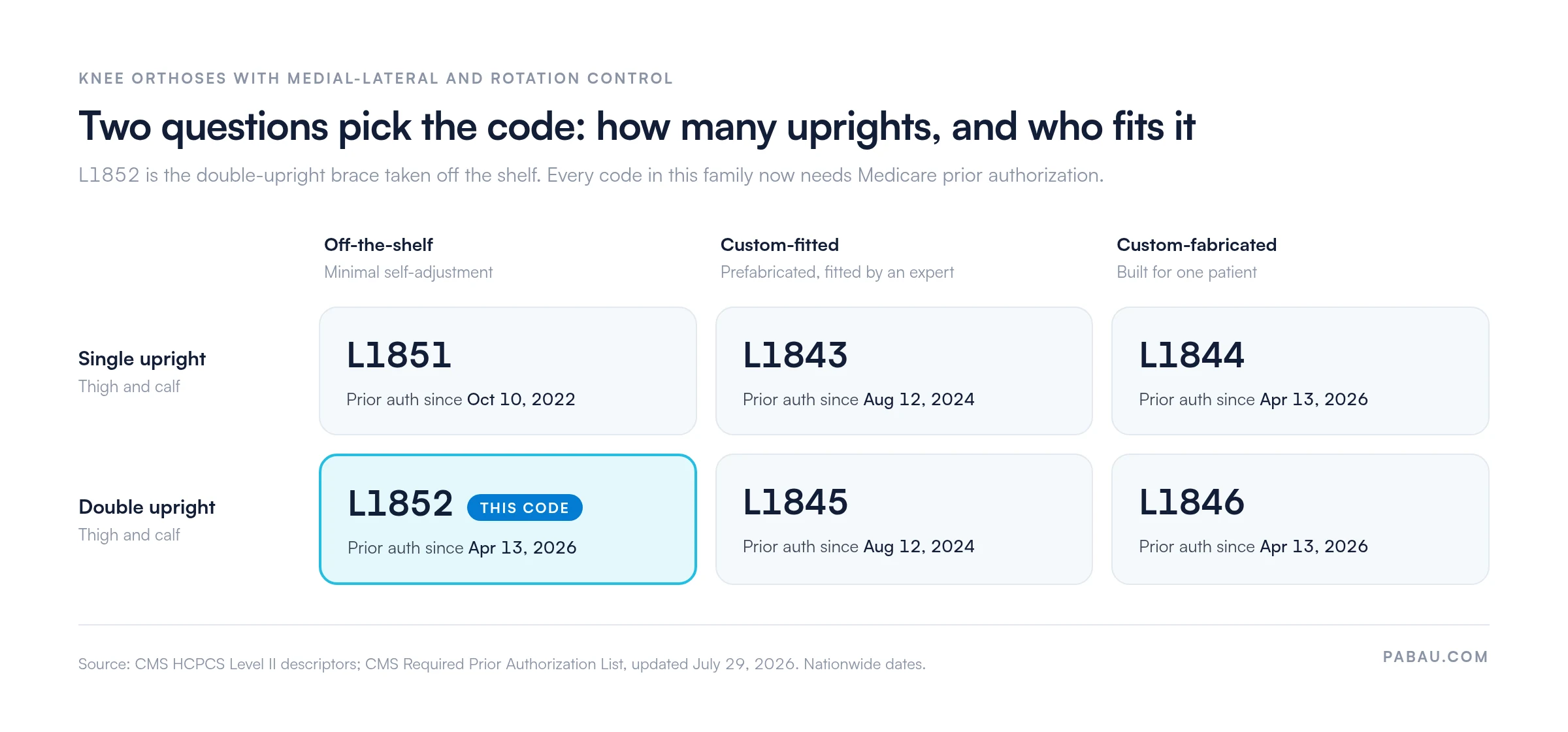
Critical distinction: L1852 versus L1845 turns on the fitting. If the supplier hands over a brace from stock that needs only minimal self-adjustment, L1852 is correct. If someone with orthotic expertise trims, bends, molds or assembles the brace to fit the patient, L1845 applies.
The other common mix-up is L1851, the single-upright version of the same off-the-shelf brace. The upright count is a product fact, not a fitting choice, so the PDAC listing for the model settles it.
Run a quarterly audit of your L1852 and L1845 claims. Every L1845 claim needs a fitting note from the person who customized the brace, describing what they changed. If that note does not exist, the brace went out off the shelf and L1852 is the code to bill.
Modifier selection is where many L1852 claims fail before anyone reads the documentation. Each modifier tells the payer one clinical or administrative fact. A missing or wrong modifier triggers a denial that the documentation cannot fix on the first pass.
Modifier KX must be appended to every covered L1852 claim. Without it, the DME MAC reads the claim as one where the supplier has not attested to LCD compliance. The claim is denied, and resubmitting with KX attached costs a billing cycle.
Medicare requires separate documentation of medical necessity for each knee when both get a brace. The order and the clinical notes must address each knee on its own, with its own exam findings and qualifying diagnosis.
Every element below must exist in the record before the brace is delivered. A compliant claim for HCPCS Code L1852 cannot be built afterward from incomplete notes.
The documentation package for a compliant L1852 claim has six parts:
Medicare has required prior authorization for L1852 nationwide since April 13, 2026, when CMS added it to the Required Prior Authorization List. The supplier sends the request to the DME MAC before delivery, because an affirmed decision is a condition of payment.
The same list has covered L1851 since 2022, and the custom-fitted L1843 and L1845 since August 12, 2024. Commercial payers set their own rules, so check each plan’s portal before dispensing.
The 2026 Medicare allowed amount for L1852 comes from the CMS DMEPOS fee schedule, which is updated every year and varies by state. Medicare Part B pays 80% of the allowed amount after the annual deductible. The remaining 20% coinsurance falls to the beneficiary or a secondary payer.
Use the CMS DMEPOS fee schedule files or the PGM Billing HCPCS lookup tool to find the current allowable for your state. The allowable in one state can differ noticeably from its neighbor’s.
Three factors affect the net reimbursement a supplier receives for L1852:
Reviewing the full revenue cycle for DME claims, from fee schedule checks to payment posting, helps practices catch shortfalls before they pile up.
Most L1852 denials fit into five categories. Each has a clear root cause and a prevention step that belongs in the pre-delivery workflow, not in the appeal.
The denial management workflow for DME claims differs from professional claims. A missing modifier can often be fixed on resubmission. A PDAC denial forces the supplier to substitute a listed product or bill a NOC code, which cuts reimbursement. Build the PDAC check into dispensing, not billing.
See the full list of medical billing denial codes for the adjustment reason and remark codes that appear on DMEPOS remittances.
PDAC (Pricing, Data Analysis and Coding) verification is a mandatory step. A brace marketed as a “functional knee orthosis” does not qualify for L1852 automatically. The PDAC contractor keeps a product listing that maps each manufacturer’s brace model to its HCPCS code. Billing L1852 for a product not listed for that code is an improper claim, even when the product is clinically appropriate.
The verification process works as follows:
Supplier eligibility is a separate requirement. Only suppliers with an active Medicare DMEPOS enrollment may bill Medicare for L1852. No competitive bidding contract is needed until a new bidding round starts, so enrollment is the check to run before accepting Medicare referrals.
Check the PDAC listing when a brace model enters your dispensing inventory, not at billing. Products are occasionally removed from the listing or reclassified, so a model verified last year may sit under a different code this year. Build a quarterly PDAC audit into your inventory cycle.
A supplier billing L1852 usually chases four documents from different places: the order, the face-to-face notes, the prior authorization decision and the delivery receipt. When one goes missing, the claim stalls or comes back denied.
In Pabau, the practice management platform we build, those records sit on the patient’s file. The prior authorization code and its dates are tracked on the case, and the team sees a warning when one is missing. Our claims management software then sends claims through the Claim.MD clearinghouse, with eligibility checks before submission.
Electronic remittance advice posts back against the same record. Your billing team sees a denial when the payer returns it, not at month-end reconciliation.

Pabau tracks prior authorization codes on the patient’s case and submits claims through the Claim.MD clearinghouse. See how it keeps orthotic billing records ready before a claim goes out.

Billing L1852 in 2026 starts before the brace leaves the shelf. The face-to-face visit, the written order and the prior authorization request all have to exist before delivery, and none of them can be added afterward.
Get the code right by asking two questions at dispensing: how many uprights, and did anyone customize the fit? Then make sure the notes name one of the three LCD criteria rather than pain alone. A claim built in that order goes out with its paperwork complete.
Book a demo to see how Pabau keeps the order, the authorization and the claim on one patient case.

Need a full reference on what qualifies as a clean claim? Clean claim requirements in medical billing explains the structural and documentation standards that prevent automatic rejections on first submission.
Confused about the ERA remittance codes on your L1852 denials? Electronic remittance advice explained breaks down adjustment reason codes and remark codes that appear on DMEPOS remittances.
Looking for broader DME billing compliance guidance? Medical billing compliance best practices covers payer audit triggers, documentation standards, and the compliance controls that protect DME suppliers.
Fitting the brace to the patient instead? HCPCS code L1843 covers the single-upright knee orthosis that an expert customizes to fit.
Building a knee brace from scratch? HCPCS code L1844 covers the custom-fabricated single-upright knee orthosis.
HCPCS Code L1852 covers a prefabricated, off-the-shelf knee orthosis with double uprights, an adjustable flexion and extension joint, and medial-lateral and rotation control. Medicare Part B covers it when the patient meets LCD L33318. That means objective knee instability, a recent knee injury or surgery, or qualifying tibiofemoral osteoarthritis.
Both are prefabricated, off-the-shelf knee orthoses with the same adjustable joint and medial-lateral and rotation control. L1851 has a single upright, while L1852 has two, one on each side of the knee. If an expert customizes the double-upright brace to fit, the code is L1845 instead.
Modifier KX is required on every covered L1852 claim to attest that the patient meets LCD L33318. Add RT or LT to show which knee gets the brace. For braces on both knees on the same date, bill one line with RTLT and 2 units. Add KX only if each knee meets the criteria.
Yes. CMS added L1852 to its Required Prior Authorization List nationwide on April 13, 2026. Submit the request with the written order and the face-to-face notes before delivery, then put the unique tracking number on the claim. Commercial payers set their own rules, so check each plan.
Every brace model billed under L1852 must appear on the PDAC product classification listing for that code. Billing L1852 for a non-listed product generates a CO-4 or CO-16 denial. Verify products at pdac.cms.gov before adding them to your dispensing inventory. If a product is not listed for L1852, bill the NOC code with a narrative description and the manufacturer invoice.
Yes, when each knee has its own documented medical necessity. Bill both braces on one claim line with the RTLT modifiers and 2 units of service. A single note that addresses both knees in general terms does not support a bilateral claim.