HCPCS code H0047 – Alcohol and drug abuse services
Code Definition
H0047 is the HCPCS Level II code for alcohol and/or other drug abuse services, not otherwise specified. It is a catch-all for substance use services that no more specific H code describes.
The descriptor sets no unit of service. Each state Medicaid program or managed care organization decides what H0047 covers, how a unit is counted, and what it pays. Medicare does not pay H0047 (coverage code I). Alcohol and/or drug assessment has its own code, H0001.
Related Information
Level
Level II
Category
H — Alcohol and drug abuse treatment services / rehabilitative services
Code range
H0001-H0050 Alcohol and other drug abuse services
Billable
No
Save time. Improve accuracy. Get paid faster.
Automate coding with Pabau
Let Pabau's smart automation suggest the right codes, reduce claim denials, and keep your practice compliant—effortlessly.
Automate repetitive tasks and focus on what matters most—your patients.
Improve accuracy
Reduce coding errors and ensure compliance with the latest regulations.
Get paid faster
Clean claims, fewer denials, and faster reimbursements.
Grow with confidence
Powerful insights and reporting to help your practice thrive.
HIPAA compliant•SOC 2 certified•GDPR-compliant•Trusted by 4,000+ clinics worldwide
Key takeaways
HCPCS Code H0047 is the not-otherwise-specified code for alcohol and/or other drug abuse services that no more specific H code describes.
The descriptor sets no unit of service, so each state Medicaid program or MCO defines the scope, the unit, and the rate.
Medicare does not pay H0047 (coverage code I), so state Medicaid programs and MCOs are the main payers.
Use H0001 for an alcohol and/or drug assessment, H0049 for screening, and H0048 for non-blood specimen collection.
Pabau, the practice management platform we build, keeps substance use notes, modifiers, and claim status in one patient record.
HCPCS Code H0047: Definition and official descriptor
HCPCS Code H0047 is the HCPCS Level II code for alcohol and/or other drug abuse services, not otherwise specified (NOS). It is a catch-all for substance use services that no more specific H code describes. The Centers for Medicare & Medicaid Services (CMS) maintains the HCPCS Level II code set, as set out in the CMS HCPCS overview.
The descriptor names no service and no unit. Each state Medicaid program or managed care organization (MCO) decides which services it reports under H0047, how a unit is counted, and what it pays. Medicare does not pay the code.
Field
Detail
Code
H0047
Official descriptor
Alcohol and/or other drug abuse services, not otherwise specified
Code type
HCPCS Level II (H-series)
Code status
Not otherwise specified (NOS) catch-all code, effective 2003
Unit of service
None in the descriptor. The state Medicaid program or MCO defines it.
Medicare
Coverage code I (not payable), pricing indicator 00
Primary payers
State Medicaid programs and MCOs
Maintaining body
CMS (HCPCS Level II code set)
What H0047 covers and what it excludes
H0047 has no national service definition. It covers whatever substance use service a state Medicaid program or MCO assigns to it, and nothing that a more specific code already describes. Your state’s provider manual or fee schedule is the only reliable source for its scope.
When payers use H0047
A state Medicaid program lists a named substance use service under H0047 in its fee schedule.
An MCO contract maps a program-specific service to H0047 for its members.
The service is a covered alcohol or drug service, but no specific HCPCS or CPT code describes it.
Services with their own codes (do not bill as H0047)
H0001 — alcohol and/or drug assessment, including intake and level-of-care evaluations
H0002 — behavioral health screening to determine eligibility for admission to a treatment program
H0048 — alcohol and/or other drug testing: collection and handling only, specimens other than blood
H0049 — alcohol and/or drug screening
Individual or group counseling sessions (typically billed under H0004, H0005, or applicable CPT codes)
H0047 vs. H0001, H0048 and H0049: Choosing the right code
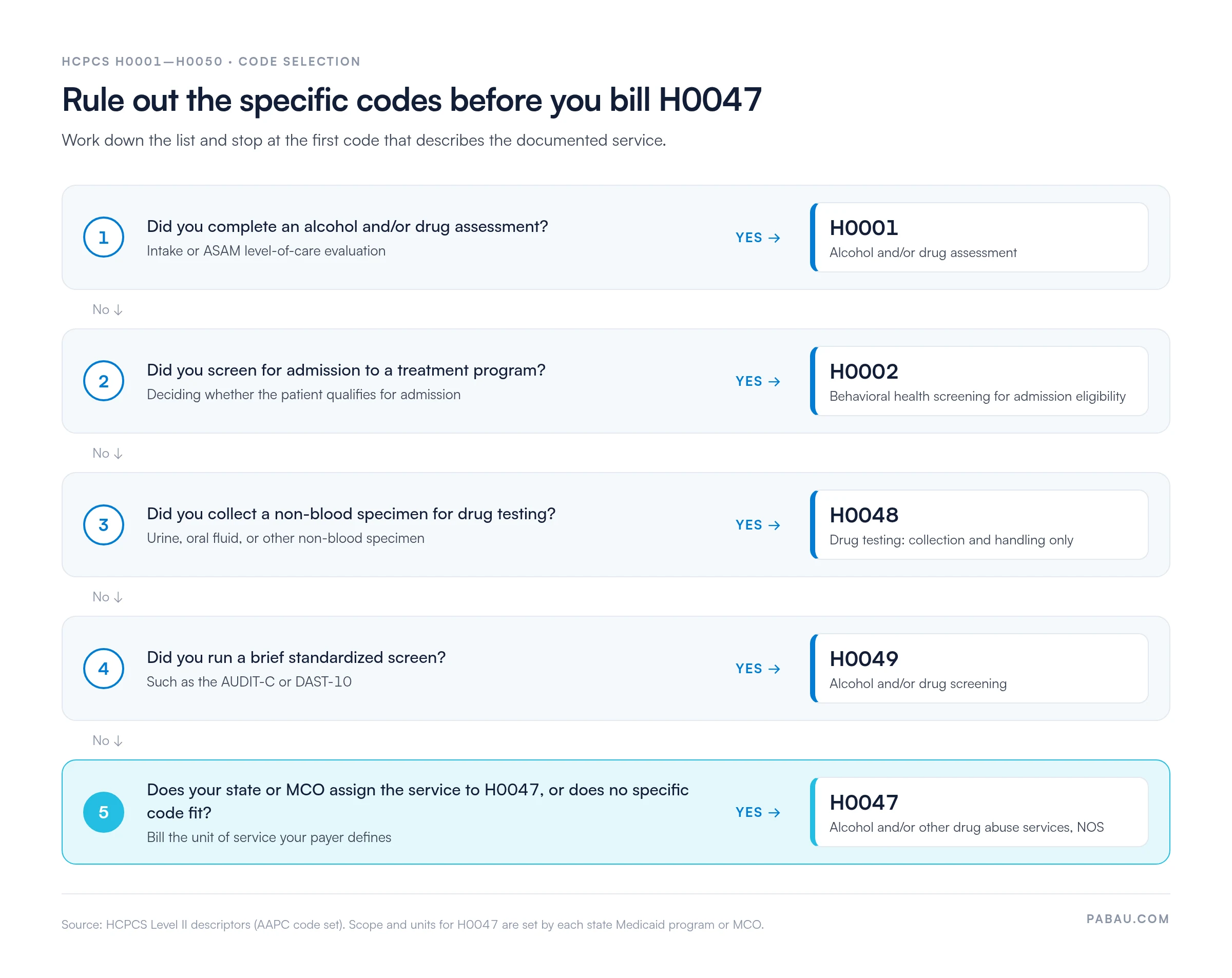
The adjacent H00xx codes describe different steps in substance use care, and only H0047 is unspecified. Payers expect the most specific code that fits. Reporting H0047 for an assessment that H0001 describes, or a screen that H0049 describes, invites a denial. The decision path below shows the order to check them in.
H0047 comes last because each earlier code names a specific service. Descriptors follow the HCPCS Level II code set as published by AAPC.
The table adds when to use each code. Descriptors follow the AAPC HCPCS code set.
Code
Official descriptor
Unit
Use when
H0001
Alcohol and/or drug assessment
Set by payer
You complete an alcohol and/or drug assessment, such as an intake or ASAM level-of-care evaluation
H0002
Behavioral health screening to determine eligibility for admission to treatment program
Set by payer
You screen a patient to decide whether they qualify for admission to a treatment program
H0047
Alcohol and/or other drug abuse services, not otherwise specified
None in descriptor; set by state or MCO
Your state assigns a substance use service to H0047, or no specific code describes it
H0048
Alcohol and/or other drug testing: collection and handling only, specimens other than blood
Set by payer
You collect and handle a urine, oral fluid, or other non-blood specimen for drug testing
H0049
Alcohol and/or drug screening
Set by payer
You run a brief standardized screen, such as the AUDIT-C or DAST-10
Payer coverage: Medicaid, Medicare, and commercial plans
H0047 is primarily a Medicaid code. Medicare lists it with coverage code I, which means it is not payable under Medicare, and pricing indicator 00. State Medicaid fee-for-service and managed care programs are the main payers. The table below summarizes coverage by payer type, with reference to the Medicare Informatics HCPCS tables.
Payer type
Coverage status
Notes
State Medicaid (FFS)
Covered where the state lists it
Check your state’s provider manual for the service definition, unit, and rate
Medicaid MCO
Plan-specific
MCO units, rates, and prior authorization rules may differ from fee-for-service
Medicare
Not payable (coverage code I)
Pricing indicator 00. Report the Medicare-recognized code for the service delivered.
Commercial insurance
Plan-specific; verify before billing
Many commercial plans do not accept H-series codes and expect CPT codes instead
TRICARE / CHAMPVA
Verify with plan
Coverage for H-series codes varies. Contact the plan’s behavioral health unit.
Prior authorization requirements for H0047
Prior authorization (PA) rules for H0047 are set by each state Medicaid program and MCO contract. Because the code has no national definition, check the specific payer policy for your state before every new service line. Billing without a required authorization is one of the most common reasons these claims are denied.
Identify the payer’s PA requirement. Search the state Medicaid provider portal or MCO provider manual for H0047 under the substance use or behavioral health section.
Confirm which service the payer maps to H0047. The authorization must name the same service that your clinical note will describe.
Gather clinical data before submitting the request. Most payers ask for a substance use diagnosis, a clinical summary, and the proposed service and frequency.
Submit the PA request through the payer’s channel. Some states use an electronic portal, while others require phone-based review or fax submission.
Document the authorization number. Record the PA number, the authorized units in the payer’s unit of measure, and the authorization period in the patient’s chart.
Bill within the authorized window. Dates of service must fall within the PA period. Claims outside it are typically denied with claim adjustment reason code (CARC) 197.
Documentation requirements for H0047 claims
Behavioral health practices billing H0047 need a clinical record behind every claim that can withstand a post-payment audit. Because the code is unspecified, the note has to show that the service matches the state’s own definition. At minimum, the record should contain the following.
Signed and dated service note with the actual date of service
A description of the service delivered that matches the payer’s definition of H0047
Start and stop times, or a count of encounters, wherever the payer uses time-based or encounter units
Primary substance use diagnosis (ICD-10-CM F10–F19 range) and the medical necessity for the service
ASAM Criteria level-of-care placement, where the state ties the service to a level of care
Rendering clinician’s credentials and NPI (confirm the clinician is credentialed with the payer)
Patient consent for treatment and release of information
Prior authorization number, if PA was required
Pro Tip
Keep a copy of your state’s H0047 service definition next to your note template. Before you submit, check a random sample of H0047 notes against that definition and the authorized units. Notes that say only ‘services provided’ without describing the service are a frequent finding in post-payment audits.
Modifier and place-of-service rules for H0047
Modifier and place-of-service (POS) rules for H0047 are payer-specific. Where a state requires them, missing or incorrect values can trigger automatic denials before the claim reaches a human reviewer.
Modifier
Description
When to use
HF
Substance abuse program
When the state requires a program identifier on substance use services
HH
Integrated mental health/substance abuse program
When the service is delivered within an integrated mental health and substance use program, per state policy
SA
Nurse practitioner rendering service in collaboration with a physician
When the payer requires it to identify a nurse practitioner as the rendering clinician
TF
Intermediate level of care
When the state ties the H0047 service to an intermediate level of care
U1-U9
Medicaid level of care 1-9, as defined by each state
When your state manual assigns a U modifier to a program or level of care
Common POS codes for substance use services include the following. Verify the accepted POS codes with each payer, as some state Medicaid programs restrict H0047 to specific facility types.
How to bill H0047: Units, frequency, and claim submission
Billing H0047 starts with the payer’s unit of service, because the code itself defines none. Some states count a day, others an hour, 15 minutes, or an encounter. Report units on the 837P electronic claim or paper CMS-1500 exactly as your payer defines them.
Confirm the unit of service in the state fee schedule or MCO contract, then enter units in that measure. Never assume a per diem unit.
Use the exact date of service in Box 24A (CMS-1500) or Loop 2400 DTP03 (837P). The date must match the signed service note.
Enter the rendering provider NPI in the appropriate field. Credentialing mismatches between the billing NPI and the rendering NPI are a frequent denial trigger.
Populate the diagnosis pointer to connect the primary ICD-10-CM code to the service line. Most state policies expect a substance use diagnosis in the F10–F19 range.
Append required modifiers in the modifier fields. Claims accept up to four modifier positions, so confirm the state-specific stacking order.
Submit within timely filing limits. Medicaid filing windows commonly run from 90 to 365 days after the date of service. Check your state’s specific window.
Pabau’s claims management software tracks HCPCS codes and modifier fields on each claim, and denials are worked from a single queue. A clean claim check before submission catches unit and modifier errors before the payer does.
Common reasons HCPCS Code H0047 claims are denied
H0047 claims are denied more often than claims for specific codes, because the payer has to match an unspecified code to its own service definition. Each denial carries a reason code on the remittance advice (ERA/835) that identifies the cause. Use the electronic remittance advice to triage the denial before correcting and resubmitting.
Denial reason
Common reason code
Corrective action
Missing or expired prior authorization
CO-197
Obtain retroactive authorization if the payer allows it, or appeal with clinical justification
A specific code fits the service (H0001, H0048, or H0049)
Varies by payer
Recode to the specific code that matches the documented service and resubmit
Units don’t match the payer’s unit of service
Varies by payer
Check the unit in the state fee schedule or MCO contract and correct the units field
Incorrect place-of-service code
CO-5
Verify accepted POS codes in the state Medicaid provider manual and correct the claim
Wrong or missing modifier
CO-4
Review the state-required modifier stack and resubmit with the correct modifiers
Rendering clinician not eligible or not credentialed
CO-B7, CO-185
Confirm the clinician is credentialed with the payer and the NPI matches enrollment records
H0047 billed with H0001 or H0049 on the same date
Varies by payer
Many payers do not allow both. Check payer policy and bill the code that matches the documented service.
Medical necessity not established
CO-50
Appeal with the full clinical note and evidence that the service meets the payer’s H0047 definition
Diagnosis not covered for the service
CO-167
Check the diagnosis against the payer’s covered list and correct the diagnosis pointer
How to appeal a denied H0047 claim
Most Medicaid programs allow one or more levels of appeal, and the window commonly runs 60–180 days from the denial date. Our denial management guide sets out the full framework.
Pull the ERA/835 remittance advice and record the exact CARC/RARC denial reason codes.
Gather supporting documentation: the signed service note, the payer’s H0047 service definition, authorization records, and clinician credential verification.
Draft an appeal letter that addresses the specific denial reason and shows how the documented service matches the payer’s own policy for H0047.
Submit the appeal through the payer’s designated channel (portal, fax, or mail) within the deadline, and keep confirmation of receipt.
Track the reconsideration in your billing system’s denial queue. Escalate to a second-level appeal or external review if the first-level appeal is upheld.
ICD-10-CM diagnosis codes commonly paired with H0047
Every H0047 claim requires at least one valid ICD-10-CM diagnosis code. The primary diagnosis usually reflects a substance use disorder in the F10–F19 range. Secondary codes for social determinants or co-occurring mental health conditions may also be listed. Use the PGM Billing HCPCS lookup to cross-reference code pairing requirements.
ICD-10-CM code
Description
Positioning note
F10.10
Alcohol abuse, uncomplicated
Primary (maps to DSM-5 mild alcohol use disorder)
F10.20
Alcohol dependence, uncomplicated
Primary (maps to DSM-5 moderate or severe alcohol use disorder)
F11.20
Opioid dependence, uncomplicated
Primary
F14.20
Cocaine dependence, uncomplicated
Primary
F19.20
Other psychoactive substance dependence, uncomplicated
Primary
Z59.x
Problems related to housing and economic circumstances
Secondary (social determinant)
Reimbursement rates and how they are determined
H0047 reimbursement is set by each state Medicaid agency or MCO, and no national Medicare fee schedule amount exists. Medicare assigns the code pricing indicator 00, and the CMS Physician Fee Schedule lookup returns no value for it.
Because each state defines its own unit, rates are not comparable from one state to the next. A daily rate in one state and a 15-minute rate in another describe different services. To find your rate, open your state Medicaid provider portal and locate the substance use or behavioral health fee schedule.
MCO rates are negotiated separately and may be higher or lower than the fee-for-service rate. Confirm rates and units with each MCO contract directly, as most states do not publish MCO reimbursement.
Compliance and audit considerations for H0047
Unspecified codes draw extra attention from state Medicaid auditors and the Office of Inspector General (OIG). Medical billing compliance programs for substance use providers should address the following risk areas.
Code selection: Bill H0047 only when the state assigns the service to it or no specific code exists. Using it in place of H0001, H0048, or H0049 is a common audit finding.
Medical necessity documentation: Every H0047 claim must be supported by a note that describes the service and why the patient needed it.
Clinician credential verification: The rendering clinician must be credentialed with the payer and hold the license the state requires. Credential rules vary by state.
Units and frequency limits: Bill units in the payer’s own measure, and stay within any limit per authorization period or per year. Exceeding the authorized units results in denial and may trigger a broader audit.
Same-day billing with related codes: Many payers do not allow H0047 with H0001 or H0049 on the same date for the same patient. Check payer policy, including any limits on same-day CPT counseling codes.
Record retention: HIPAA requires retaining compliance documentation for at least six years. Many state Medicaid programs set longer periods for clinical records. Set HIPAA-compliant record retention policies before the first audit request arrives.
Pro Tip
Schedule a quarterly review of your H0047 billing using the top five denial reason codes from your ERA reports as the audit criteria. Pull 10 random claims per denial type and trace each to the clinical note and authorization record. This pattern-based internal audit catches systemic errors before a Medicaid auditor does.
Related HCPCS codes
H0047 sits in the H0001–H0050 block of HCPCS Level II codes for alcohol and other drug abuse services. These neighboring codes describe specific services and take priority over H0047 when they fit.
H0001 — Alcohol and/or drug assessment
H0002 — Behavioral health screening to determine eligibility for admission to treatment program
H0004 — Behavioral health counseling and therapy, per 15 minutes
H0005 — Alcohol and/or drug services; group counseling by a clinician
H0048 — Alcohol and/or other drug testing: collection and handling only, specimens other than blood
H0049 — Alcohol and/or drug screening
H0050 — Alcohol and/or drug services, brief intervention, per 15 minutes
How Pabau supports H0047 documentation and claims
Many substance use programs keep the state’s service definitions in a binder and the clinical notes in a separate system. The claim is built later by someone who never saw the session. Wrong units and notes that don’t describe the service often start there.
In Pabau, the note and the claim sit in one patient record. A custom note template can prompt clinicians for the service, the time, and the diagnosis your state expects. The claim goes out from that same record, and staff can follow its status and work denials in Pabau.
The result is fewer H0047 claims sent with units or notes that don’t match the payer’s definition, and a complete record ready for an audit.
Streamline your behavioral health billing
Pabau keeps substance use notes, modifiers, and claim status in one patient record, so each H0047 claim matches your payer’s rules. See how it works for your team.
H0047 is an unspecified code, so the payer’s own policy is the definition you bill against. Treat it as the last option after H0001, H0048, and H0049. When you do use it, bill the units your state or MCO defines and describe the service in terms the payer recognizes.
Pabau keeps the note, the modifiers, and the claim status together, so your team can check those payer rules before the claim goes out. To see how it works for your substance use or behavioral health practice, book a demo.
Continue your research
Need to understand denial codes on your remittance advice?Denial codes in medical billing explains common CARC and RARC codes and how to respond to each.
Looking for guidance on behavioral health credentialing?How to get credentialed with insurance companies covers the credentialing process for behavioral health providers billing Medicaid and commercial plans.
Want to strengthen your overall revenue cycle?What is revenue cycle management walks through the end-to-end billing workflow from eligibility check to payment posting.
Screening for admission to a treatment program?HCPCS Code H0002 covers behavioral health screening to decide eligibility for admission.
Billing individual counseling sessions?HCPCS Code H0004 covers behavioral health counseling and therapy billed per 15 minutes.
Frequently asked questions
What is HCPCS Code H0047?
HCPCS Code H0047 is the Level II code for alcohol and/or other drug abuse services, not otherwise specified. Practices use it for substance use services that no more specific H code describes. Each state Medicaid program or MCO defines its scope and unit.
Is H0047 a per diem code?
No. The official H0047 descriptor has no unit of service, so it is not a national per diem code. Some state Medicaid programs or MCOs set a daily unit, while others use time-based or encounter units. Bill the unit in your payer’s fee schedule.
Is H0047 used for alcohol and drug assessments?
Not usually. Alcohol and/or drug assessment has its own code, H0001, and alcohol and/or drug screening is H0049. Use H0047 only when your state assigns a service to it or no specific code fits.
What is the difference between H0047 and H0049?
H0049 is alcohol and/or drug screening, while H0047 covers substance use services that no specific code describes. Many payers do not allow both on the same date for the same patient, so check payer policy.
Does Medicare pay for H0047?
No. Medicare lists H0047 with coverage code I, which means it is not payable under Medicare, and pricing indicator 00. For Medicare patients, report the code Medicare recognizes for the service delivered.
Is H0047 covered by Medicaid?
Many state Medicaid fee-for-service and managed care programs cover H0047, but each one sets its own service definition, units, prior authorization rules, and rates. Verify coverage in your state Medicaid provider manual before billing.
What modifiers are required when billing H0047?
Required modifiers vary by state Medicaid program. Common ones include HF (substance abuse program), HH (integrated mental health/substance abuse program), TF (intermediate level of care), and U1-U9 state-defined modifiers. Check your state’s provider manual for the required stack.
Does H0047 require prior authorization?
It depends on the payer. Many state Medicaid programs and MCOs require prior authorization for H0047 services. Claims billed without a required authorization are often denied with CARC 197.