HCPCS code S0139: Billing guide for Medicaid and commercial payers
HCPCS code S0139: Official descriptor and quick-reference details HCPCS code S01...

Last Updated: Nov 13, 2026
46924 is the CPT code for destruction of lesion(s), anus (eg, condyloma, papilloma, molluscum contagiosum, herpetic vesicle), extensive (eg, laser surgery, electrosurgery, cryosurgery, chemosurgery). It applies to extensive disease whatever the method, while 46900 through 46922 report simple destruction by one named method.
Where 46924 trips up billing teams is the word "extensive." It invites payer scrutiny, and denials are common when the operative note does not support the extent.
Let Pabau's smart automation suggest the right codes, reduce claim denials, and keep your practice compliant—effortlessly.
Automate repetitive tasks and focus on what matters most—your patients.
Reduce coding errors and ensure compliance with the latest regulations.
Clean claims, fewer denials, and faster reimbursements.
Powerful insights and reporting to help your practice thrive.
HIPAA compliant SOC 2 certified GDPR-compliant Trusted by 4,000+ clinics worldwide

CPT code 46924 reports extensive destruction of anal lesions by any method, and it is the only extensive code in the 46900-46924 series.
The five simple codes each name one method: 46900 chemical, 46910 electrodesiccation, 46916 cryosurgery, 46917 laser surgery and 46922 surgical excision.
Payers look for an operative note that supports an extensive field, with lesion count, distribution and the size of the treated area.
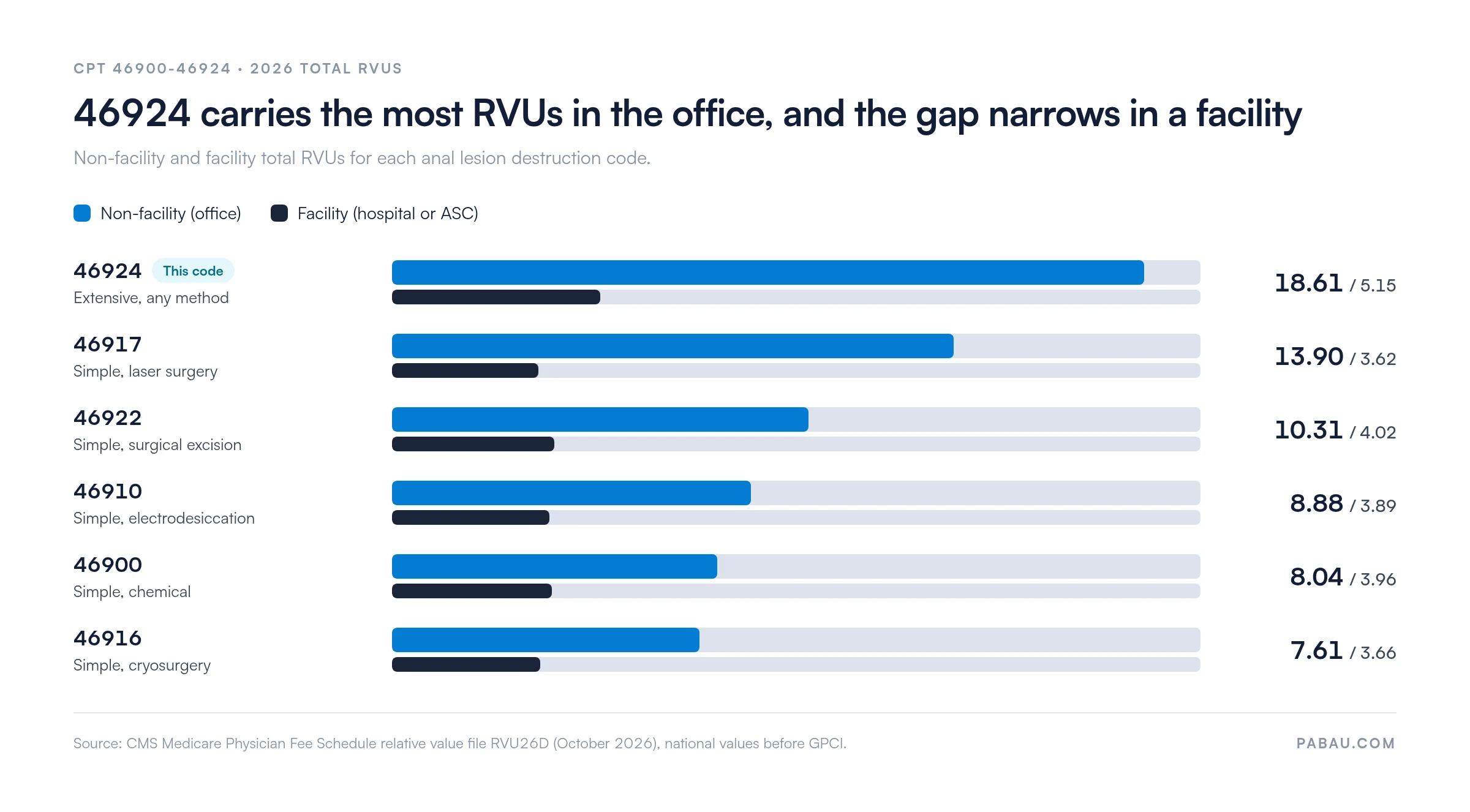
In the 2026 fee schedule, 46924 carries 18.61 total RVUs in the office and 5.15 in a facility, with a 10-day global period.
ICD-10-CM A63.0 (anogenital warts) is the usual supporting diagnosis, and a non-specific skin code invites medical necessity denials.
CPT code 46924 reports extensive destruction of one or more anal lesions, by any destruction method. CMS’s October 2026 relative value file lists it as an active, separately paid code with a 10-day global period. The American Medical Association publishes the full descriptor. It reads: Destruction of lesion(s), anus (eg, condyloma, papilloma, molluscum contagiosum, herpetic vesicle), extensive (eg, laser surgery, electrosurgery, cryosurgery, chemosurgery).
The code sits in the Surgery section of the CPT codebook, under Digestive system, Anus and Destruction. It is method-neutral. Electrosurgery, cryosurgery, laser surgery and chemical destruction all fall under 46924 when the extent of disease and treatment is extensive.
The key reference facts are summarized below. Verify the current-year descriptor and fee schedule in the CMS Physician Fee Schedule look-up tool before submitting claims. Annual updates can change modifier rules and payment amounts.
Several methods qualify under 46924 when the operative findings reach the extensive threshold. The descriptor is method-neutral, so the technique alone does not decide whether 46924 or a neighboring code applies. Extent does.
The anatomical scope covers the perianal skin and the anal canal. Lesions extending into the rectum may require a separate code for the rectal component. Document each anatomical zone treated to support medical necessity and avoid NCCI bundling conflicts.
CPT code 46924 represents extensive destruction, while CPT code 46922 represents simple destruction of anal lesions by surgical excision. The billing distinction matters, because 46922 carries 10.31 non-facility total RVUs in 2026 against 18.61 for 46924. Reviewers check both directions: 46924 billed without an extensive field documented, and 46922 billed when extensive destruction was performed.
Payers look for documentation that supports an extensive field: lesion count, distribution and the size of the area treated. The call rests on the physician’s judgment and the operative note. When in doubt, write a thorough note describing the full scope of disease and treatment rather than defaulting to the lower code.
CPT code 46924 is the extensive code in a six-code series covering anal lesion destruction. The five simple codes each name one method, while 46924 covers extensive destruction by any method. The table pairs each code with its 2026 total RVUs from the CMS fee schedule file.
When the method is laser and the extent is extensive, 46924 takes precedence over 46917. The extent descriptor outranks the method descriptor when the two codes would otherwise conflict.
Setting matters as much as the code. In the office, 46924 carries 18.61 total RVUs against 7.61 to 13.90 for the simple codes. In a hospital or ASC, the whole series sits between 3.62 and 5.15, because the facility carries the overhead.
Payers require a diagnosis code that establishes medical necessity before they will pay for CPT code 46924. The wrong diagnosis code is a frequent reason this procedure is denied.
A63.0 is the correct primary code for the large majority of 46924 claims. A non-specific skin code in place of A63.0, such as an L-code for unspecified dermatosis, tells the payer the diagnosis has not been established. That usually ends in a medical necessity denial.
The operative note is the single most important document for a successful CPT code 46924 claim. Payers scrutinize this code closely because “extensive” is a clinical judgment term. Every element below belongs in the note to withstand audit or appeal.
Pairing thorough operative notes with clean claim submission practices cuts the number of 46924 claims that come back for additional documentation. When the note already answers the payer’s questions, pre-payment review requests are easier to resolve without an appeal.
Run a quick self-audit before submitting 46924 claims. Does the operative note describe the extent, give a lesion count and distribution, and include a medical necessity sentence? If any element is missing, the note needs an addendum before the claim goes out.
CPT code 46924 carries the highest RVU weight in its series because it represents extensive destruction. The figures below come from the CMS 2026 Medicare Physician Fee Schedule relative value file, October update. Verify the current year in the CMS MPFS look-up tool before quoting rates to patients or coding teams.
The non-facility total is far higher than the facility total because the practice absorbs the overhead in the office. At the 2026 conversion factor of $33.4009, that works out to $621.59 in the office and $172.01 in a facility, before GPCI adjustment. Qualifying APM participants are paid at $33.5675, which gives $624.69 and $172.87.
A calculator such as the FastRVU look-up applies your locality’s geographic practice cost index (GPCI) to those national figures. Billing teams using Pabau, the practice management platform we build, can submit 46924 claims electronically, with eligibility checks available through the Claim.MD clearinghouse.
Medicare does not universally require prior authorization for CPT code 46924, but many commercial payers and Medicare Advantage plans do. Requirements vary by plan and change often. Never assume a prior-year authorization decision applies to the current benefit year.
When a commercial payer does require pre-authorization, the clinical criteria typically include one or more of the following:
Submit authorization requests with the operative plan, relevant history, and the specific CPT code 46924. Some payers offer a general “anal surgery” category in their authorization systems, which is too broad. Confirm medical billing compliance protocols with each payer individually. Medicare Administrative Contractor (MAC) policies and local coverage determinations (LCDs) can add criteria beyond the national Medicare guidance.
Several denial patterns repeat across colorectal and proctology practices billing CPT code 46924. Knowing them before submission is cheaper than fixing them after. The table below maps each denial type to its corrective action.
Structured denial management workflows catch many of these at the pre-claim stage. Build a 46924-specific pre-submission checklist into your billing process, so fewer claims reach the appeal stage at all. For tracking denial codes in medical billing systematically, a platform that surfaces CARC codes at the ERA level shortens the investigation cycle.
The National Correct Coding Initiative (NCCI) publishes quarterly tables of code pairs that are considered components of a more comprehensive procedure. For CPT code 46924, the most relevant bundling scenarios involve same-day E/M codes and diagnostic anoscopy, reported with 46600. Check the current procedure-to-procedure (PTP) tables on the CMS NCCI edits page before appealing any NCCI-related denial.
Key NCCI considerations for 46924:
Billing an evaluation and management (E/M) code on the same day as CPT code 46924 is appropriate only when the E/M was a separate service. That means a new problem was evaluated, a separate clinical decision was made, or the encounter involved work beyond the typical pre-operative assessment. Routine pre-operative assessment bundled into the surgical decision is not separately billable.
When a separate E/M is justified, two requirements apply:
A same-day E/M with 46924 needs two clearly separated documents. Write a procedure note for the destruction and a separate note for the E/M visit. When a reviewer cannot tell them apart, modifier 25 will not save the claim.
The operative note decides whether a 46924 claim holds up, and that stays with the surgeon. The billing team then confirms coverage, tracks any prior authorization, submits the claim and follows what comes back.
Pabau’s claims management software submits claims electronically and tracks them through remittance, so billing staff can see denials. The prior authorization code, dates and sessions sit on the patient’s case, with a warning when one is missing.
In the US, eligibility checks, CMS-1500 claims and ERA remittances all run through Claim.MD. A denied 46924 claim then comes back with its remittance reason, ready for the records request or appeal.

Pabau’s claims management software submits 46924 claims electronically and tracks them through remittance. Eligibility checks and prior authorization details sit on the same patient record.

Bill 46924 when the operative note describes an extensive field, and bill the simple code for the method used when it does not. The code is method-neutral, so the extent recorded in the note decides the claim.
The payment difference justifies the documentation effort. In the office, 46924 carries 18.61 total RVUs against 7.61 to 13.90 for the simple codes, and an unsupported note puts that difference at risk.
Pabau handles the administrative side, from claim submission and superbill documentation to ERA tracking. Book a demo to see how Pabau follows high-scrutiny surgical claims like 46924 through to payment.

Need a foundation in claim submission workflows? Medical billing fundamentals explains how claims move from charge capture to payment posting.
Submitting claims through Claim.MD? How Claim.MD clearinghouse works covers payer submission, eligibility, and ERA handling.
Tracking denials from remittance files? Electronic remittance advice explained covers how ERAs surface CARC denial codes so you can act before appeal deadlines.
Billing a diagnostic anoscopy on the same day? CPT code 46600 covers anoscopy billing, modifiers, and reimbursement.
CPT code 46924 is the billing code for extensive destruction of lesions of the anus, such as condylomata, papillomata, molluscum contagiosum and herpetic vesicles. It is the only extensive code in the 46900-46924 anal destruction series. It covers any destruction method, including electrosurgery, cryosurgery, laser and chemical destruction, when the extent of disease and treatment is extensive.
CPT 46922 covers simple destruction of anal lesions by surgical excision, while CPT code 46924 covers extensive destruction by any method. The distinction rests on the extent of disease and treatment, not the method used. For 46924, payers look for an operative note that supports an extensive field, with lesion count, distribution and size.
CPT code 46924 is method-neutral: electrosurgery, cryotherapy, laser ablation, and chemical destruction all qualify when the extent of treatment is extensive. The choice of technique does not determine code selection; the documented extent of the operative field does.
The work RVU (wRVU) for CPT code 46924 is 2.74 under the 2026 Medicare Physician Fee Schedule. This value is the same in facility and non-facility settings. The difference in total RVUs between settings comes from the practice expense component. Check the value each year when CMS publishes the final MPFS rule.