CCSD Code B2710: Radical mastectomy including block dissection
CCSD Code B2710: Definition and clinical scope CCSD Code B2710 is the UK private...

Last Updated: Nov 13, 2026
35820 is the CPT code for exploration for postoperative hemorrhage, thrombosis or infection; chest. It reports a return to surgery to reopen a chest wound and find and control bleeding, a clot or an infection after an earlier operation.
It is one of four site-specific codes in the 35800 series, alongside neck, abdomen and extremity. It carries a 90-day global period, so modifier 78 and the anatomic-site code are the main billing decisions.
Let Pabau's smart automation suggest the right codes, reduce claim denials, and keep your practice compliant—effortlessly.
Automate repetitive tasks and focus on what matters most—your patients.
Reduce coding errors and ensure compliance with the latest regulations.
Clean claims, fewer denials, and faster reimbursements.
Powerful insights and reporting to help your practice thrive.
HIPAA compliant SOC 2 certified GDPR-compliant Trusted by 4,000+ clinics worldwide

CPT Code 35820 reports exploration for postoperative hemorrhage, thrombosis or infection in the chest, not the neck, abdomen or an extremity.
The code carries a 90-day global period, and modifier 78 marks an unplanned return to the OR inside a prior procedure’s global window.
Under modifier 78, Medicare pays only the intraoperative portion that the CMS fee schedule file lists for 35820.
ICD-10-CM T81.0XXA, initial encounter, is the usual diagnosis code paired with 35820 for a postoperative bleed.
Practice software such as Pabau generates CMS-1500 claims from invoices and submits them electronically through Claim.MD.
CPT Code 35820 reports a return to surgery to explore a chest wound for postoperative hemorrhage, thrombosis or infection. Its official descriptor in the AMA’s CPT code set reads Exploration for postoperative hemorrhage, thrombosis or infection; chest. That anatomic qualifier, chest, separates it from the three other codes in the series.
The code captures reopening a chest surgical wound to find the source of bleeding, thrombosis or infection and control it. The CPT descriptor sets no site-of-service rule, but the procedure is typically performed in the operating room. Superficial wound care that never re-enters the chest does not describe this exploration.
CPT Code 35820 is billable when the surgeon reopens the chest wound, explores the operative field, and controls the source of hemorrhage, thrombosis or infection. The included services are wound re-entry, exploration of the repair site, control of the bleeding vessel or infectious focus, irrigation, and closure.
The exclusions are just as precise. Knowing what does not qualify prevents the unbundling errors that trigger NCCI edit denials.
Documentation turns a clinical event into a payable CPT Code 35820 claim. Payers audit two things. One is proof that the return to surgery was medically necessary. The other is proof that the exploration reached the chest rather than the skin.
The operative note must address each step below. A note that describes the clinical concern but omits the procedural findings is a frequent weakness on 35820 appeals.
The 35800 series contains four codes, each tied to one anatomic region. Submitting 35820 for an abdominal wound exploration is a miscoded claim that will deny or, on audit, count as false billing. Use the table below to confirm the correct code before every submission.
Gray area, the mediastinum: Coders sometimes debate how to report mediastinal re-exploration after cardiac or great-vessel surgery. Confirm the code against the current CPT book and the payer’s policy before you submit.
Site picks the code, and the original procedure’s global window decides the modifier. The diagram runs both checks in the order a coder makes them.
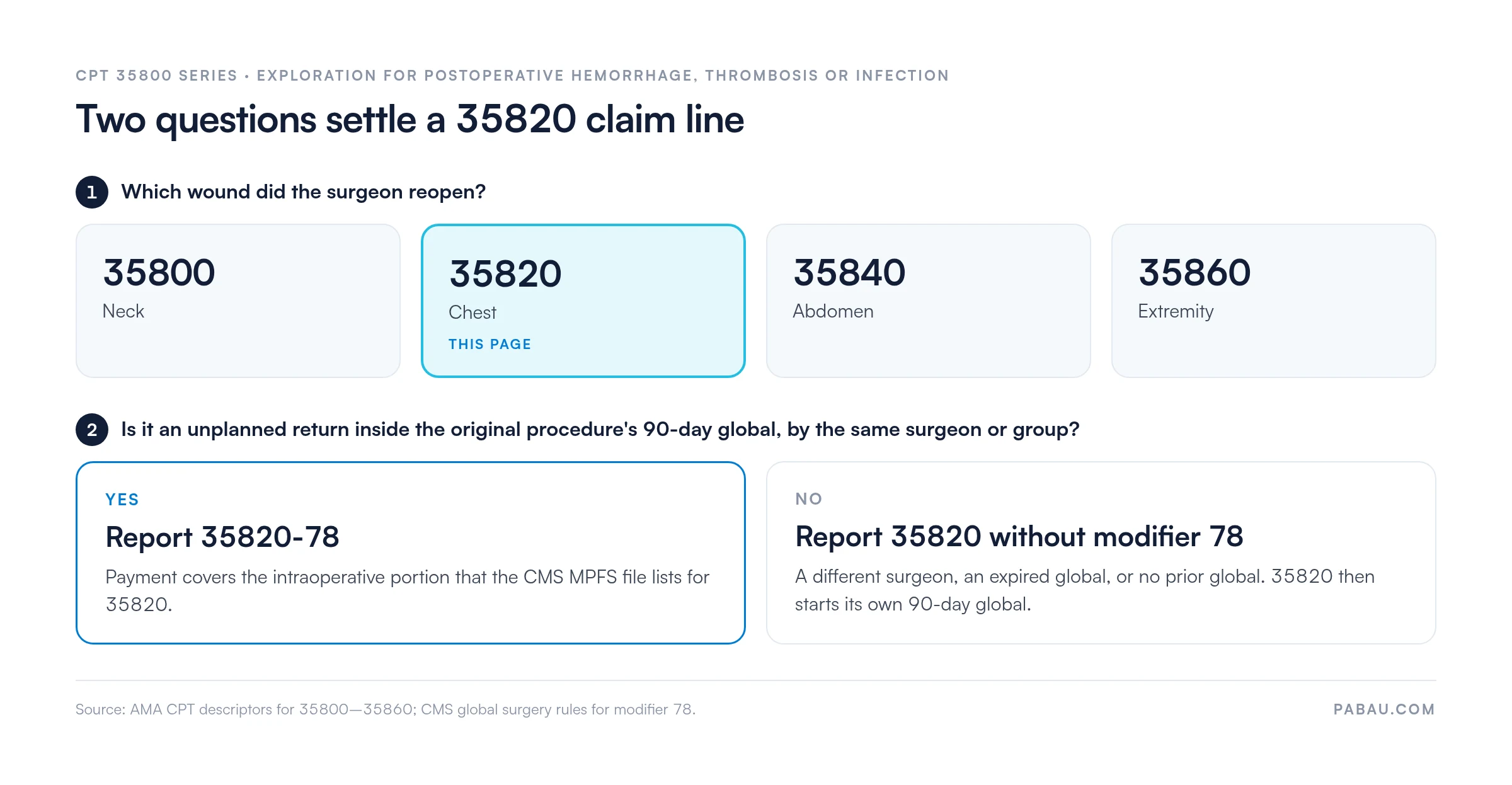
CPT Code 35820 carries a 90-day global surgery period (CMS indicator 090). A return to the OR after a procedure with its own global period falls inside that original global window. The exploration then cannot be billed as a standalone service without a modifier.
Modifier 78 reports an unplanned return to the operating or procedure room by the same physician for a related procedure during the postoperative period. It is the required modifier in this scenario. Medicare pays the intraoperative-portion percentage listed for 35820 in the CMS Medicare Physician Fee Schedule (MPFS) file. The original global period already pays for the pre-operative and post-operative services.
Every CPT 35820 claim must carry a diagnosis code that establishes medical necessity. The ICD-10-CM codes below are the ones commonly paired with this procedure. A wrong seventh character (A, D or S) on a T-code can trigger a denial, so follow the encounter guidance in the table.
Encounter flag rule: For the claim on the date of the OR return, use the “A” (initial encounter) flag on any T-code. Using “D” (subsequent encounter) on the operative claim date is a coding error, and the claim is likely to be denied or paid incorrectly. Reserve “D” for follow-up office visits after the exploration.
CPT Code 35820 reimbursement under Medicare is calculated from the CMS Medicare Physician Fee Schedule (MPFS). RVU values change every year with the MPFS final rule, so verify figures for the current calendar year before quoting a rate. The table below does not list RVU figures. Pull the work RVU and total facility RVU from the CMS file, then apply your locality’s Geographic Practice Cost Index (GPCI). The FastRVU lookup tool offers a quick cross-check.
The site-of-service distinction matters. CPT Code 35820 is almost always performed in a hospital operating room, so the facility total RVU applies. Submitting a non-facility claim for a hospital OR case overstates the site of service and flags for audit.
Run your 35820 RVU lookup against the MPFS file every January, because the conversion factor and RVU values change each calendar year. A rate built on the previous year’s file misstates reimbursement. Commercial contracts often index their rates to MPFS, so the error spreads across the payer mix.
Medicare and most commercial payers typically treat CPT Code 35820 as an emergent or urgent procedure. Prior authorization is therefore not required before the return to the OR. The key documentation obligations shift from pre-approval to post-service substantiation.
Understanding medical billing compliance requirements for surgical return procedures will help billing staff meet payer submission standards consistently. The core requirements across most payers are:
The denial management workflows for vascular wound exploration claims follow predictable patterns. Common causes of denial on 35820 claims fall into five groups, and each one is correctable before submission.
Reviewing medical billing denial codes alongside your 835 remittance data shows which of these causes appears most in your payer mix. That tells you where to focus pre-submission edits. Understanding broader revenue cycle management principles can also help billing managers build systematic denial-prevention processes that catch these errors before claims leave the practice.
This pre-submission checklist covers the documentation elements that distinguish payable 35820 claims from denied ones. Run through it before every submission, because each item it catches is one fewer appeal.
Claims management software takes over once these checks pass, generating the claim and sending it to the payer. Your coders still confirm the site code, modifier and encounter character, so each clean claim leaves the practice with those checks done. The AAPC Codify CPT lookup and the PGM Billing CPT search are also useful for quick code cross-checks during pre-submission review.
Once the coder settles the site code, the modifier and the diagnosis, the rest is claim assembly and submission. That step is where retyped fields and missed details creep into a 35820-78 line.
Pabau, the practice management platform we build, generates CMS-1500 claims from the invoice and submits them electronically through Claim.MD to thousands of US payers. Remittances come back as ERAs, so the billing team sees each payment or denial against its claim.
Where a payer asks for prior authorization, the auth code and dates are tracked on the case, with a warning when one is missing. The coding decisions in this guide stay with your coders, and Pabau carries their work to the payer as entered.
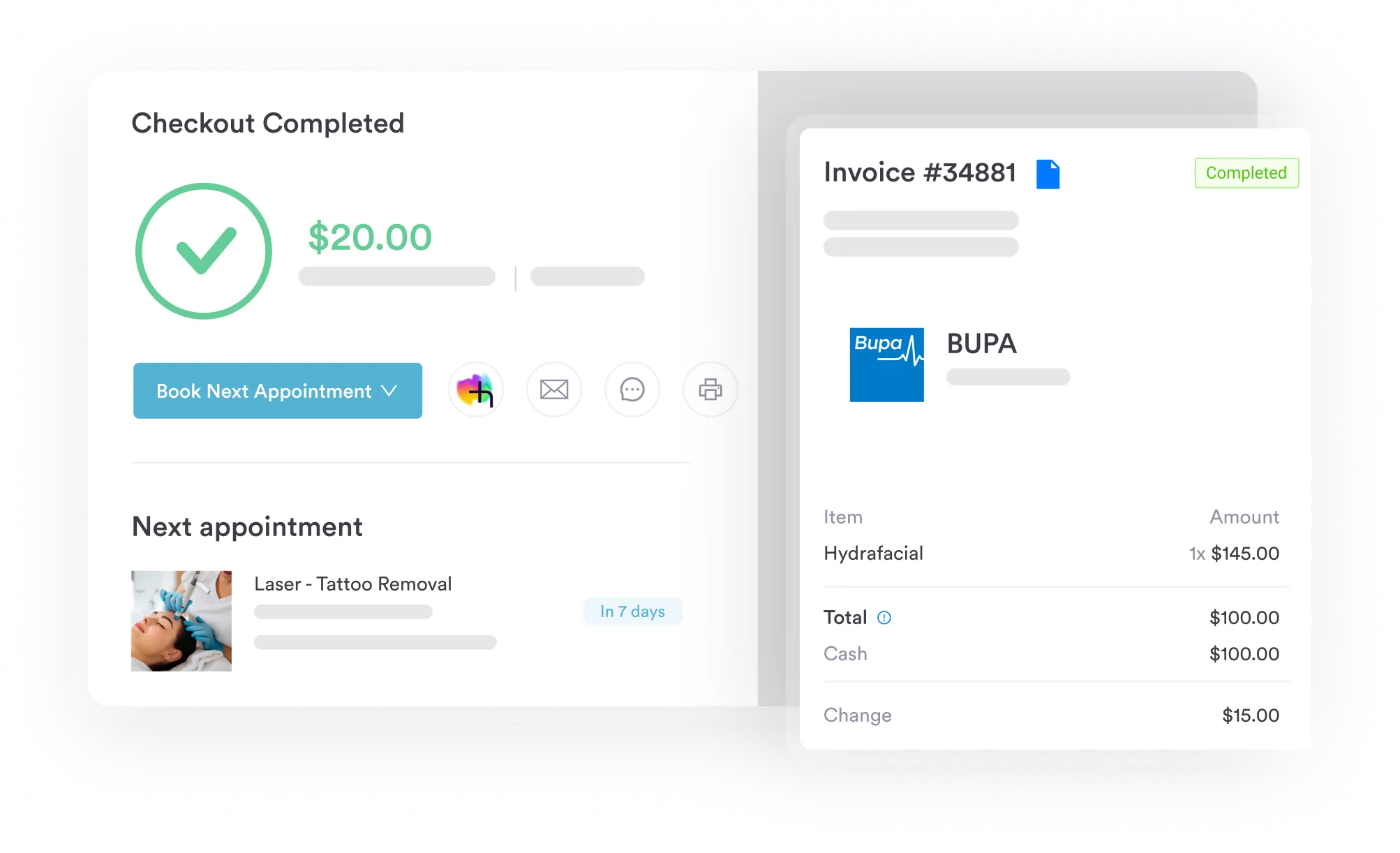

Pabau’s claims management generates CMS-1500 claims from invoices and submits them through Claim.MD, with remittances returned as ERAs. Your coders set the code and modifier once, and the claim carries them to the payer.

Settle three facts before you build a 35820 claim: the wound site, the global window, and the seventh character on the diagnosis. A wrong site code cannot be rescued by any modifier. A missed global window means the claim is likely to be denied or paid at the wrong amount.
So read the operative note first, not last. When it names the chest wound, the findings and the control method, the coding choices in this guide follow from it.
Book a demo to see how Pabau generates CMS-1500 claims and submits them through Claim.MD for surgical practices.

Need a foundation in medical billing workflows? Medical billing fundamentals explains the end-to-end claims lifecycle from charge capture through payment posting.
Struggling with 835 remittance matching? Electronic remittance advice workflows covers ERA file structure, CARC denial reasons, and automated posting best practices.
Building a denial prevention program? Claim.MD clearinghouse guide outlines how real-time eligibility checks and pre-submission edits reduce denial rates before claims reach payers.
CPT Code 35820 covers surgical exploration of a chest wound to find and control postoperative hemorrhage, thrombosis, or infection. The procedure is typically performed in the operating room, with wound re-entry, exploration, control of the bleeding or infectious source, and closure. It does not cover superficial bedside wound care or explorations outside the chest.
CPT Code 35820 applies when the wound being explored is in the chest. Use 35800 for neck wound explorations, 35840 for abdominal wound explorations, and 35860 for extremity wound explorations. The operative note must confirm the anatomic site before coding. Selecting the wrong code from the 35800 series is a common cause of denial on these claims.
Modifier 78 applies when the same surgeon performs CPT 35820 as an unplanned return to the OR during a prior procedure’s global period. It signals that the exploration is a related complication of the original surgery. Under modifier 78, Medicare pays the intraoperative-portion percentage listed for 35820 in the CMS MPFS file. The original global period already covers the pre-operative and post-operative components.
Yes, when the same surgeon performs it within 90 days of a procedure with a 90-day global indicator (CMS indicator 090). In that case CPT 35820 falls inside the original global period. Billed without modifier 78, the claim is likely to be denied or paid incorrectly.