CCSD Code H3334: Low anterior resection billing guide
CCSD Code H3334: Definition and clinical scope CCSD Code H3334 covers an open an...

Last Updated: Oct 16, 2026
95937 is the CPT code for neuromuscular junction testing (repetitive stimulation, paired stimuli), each nerve, any 1 method. It is reported once per nerve tested, and Medicare allows up to 4 units on one date of service.
Physicians order it to evaluate suspected myasthenia gravis, Lambert-Eaton syndrome, and other neuromuscular junction disorders. It is a standalone code, reported alongside nerve conduction studies 95907-95913 rather than bundled into them.
Let Pabau's smart automation suggest the right codes, reduce claim denials, and keep your practice compliant—effortlessly.
Automate repetitive tasks and focus on what matters most—your patients.
Reduce coding errors and ensure compliance with the latest regulations.
Clean claims, fewer denials, and faster reimbursements.
Powerful insights and reporting to help your practice thrive.
HIPAA compliant SOC 2 certified GDPR-compliant Trusted by 4,000+ clinics worldwide

CPT 95937 reports neuromuscular junction testing, such as repetitive stimulation or paired stimuli, and is billed once for each nerve tested.
Testing one nerve at several stimulation rates is still one unit, and Medicare’s MUE caps the code at 4 units per date of service.
95937 is a standalone code, so it is reported alongside nerve conduction studies 95907-95913 rather than bundled into them.
Each unit needs its own documented nerve, recording muscle, method, and CMAP result, backed by a signed physician interpretation.
CPT code 95937 reports neuromuscular junction testing (repetitive stimulation, paired stimuli), each nerve, any 1 method. The code sits in the American Medical Association CPT code set, among the Medicine section’s neurology and neuromuscular procedures.
The test checks how well signals cross from nerve to muscle. A peripheral nerve receives a train of impulses, or paired stimuli, while the compound muscle action potential (CMAP) is recorded from a muscle it supplies.
A progressive drop in CMAP amplitude across the train, called a decrement, points toward myasthenia gravis. A marked rise after brief exercise or fast stimulation points toward Lambert-Eaton syndrome.
Count units from the signed interpretation report, one per distinct nerve with its own recorded response. A nerve tested at 3 Hz at rest and again after exercise is a single unit of 95937.
Nerve conduction studies (95907-95913) and needle EMG are the codes most often reported with 95937, each under its own code. Conduction studies are coded by their total count, so a session with 11 or 12 studies is reported as 95912.
There is no limited or complete version of 95937, so code selection turns on counting rather than choosing between siblings. Check the current-year NCCI procedure-to-procedure table, via AAPC Codify or CMS, before adding modifier 59 or XS to any pair.
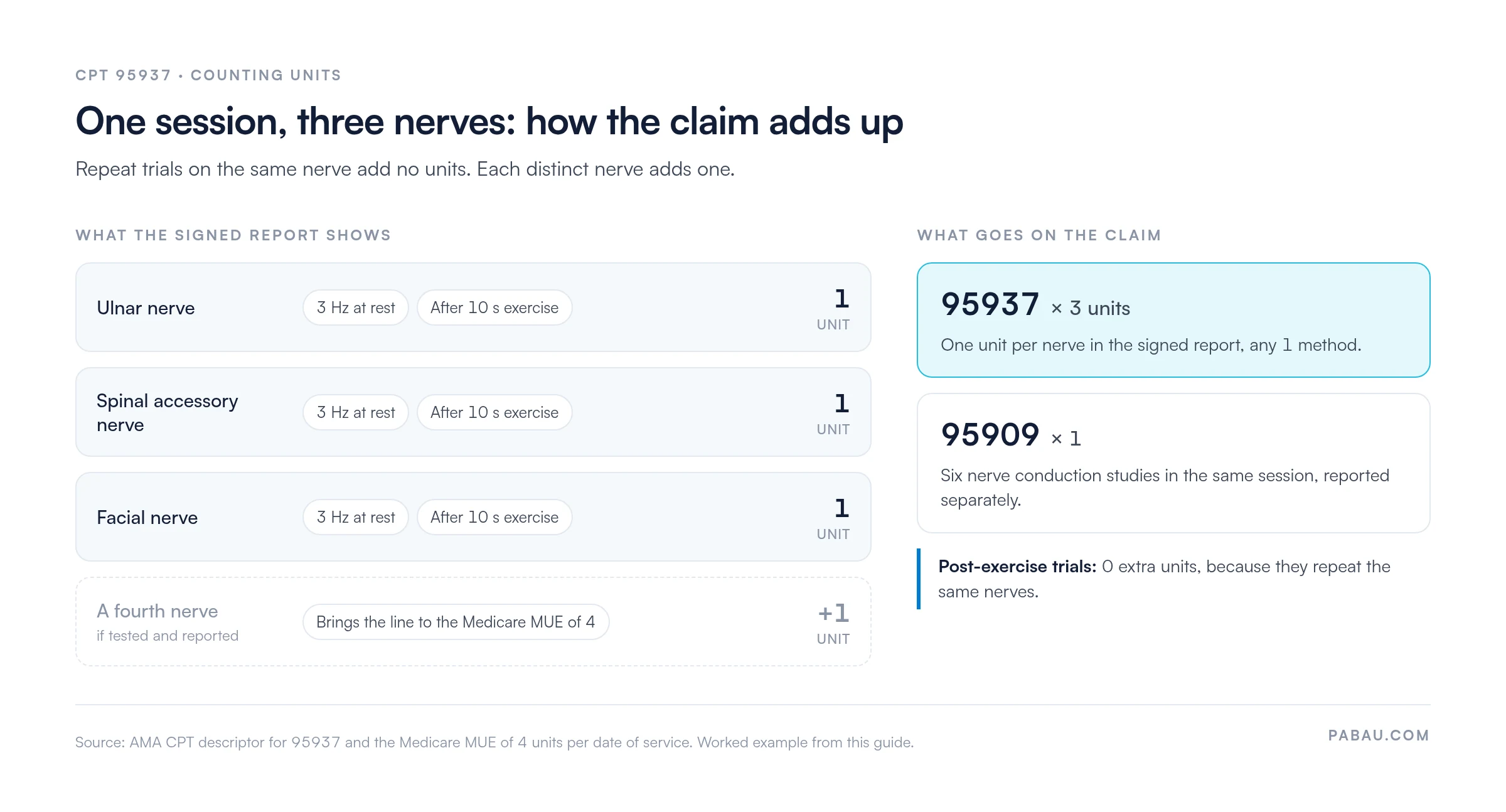
A patient with fatigable ptosis has repetitive stimulation of the ulnar, spinal accessory, and facial nerves. Each nerve is tested at 3 Hz at rest and again after 10 seconds of exercise.
The claim carries 95937 with 3 units, one per nerve. The post-exercise trials add no units, because they repeat the same nerves. If the session also includes six conduction studies, 95909 is reported for those as well. The breakdown below maps each nerve in the report to its line on the claim.
Myasthenia gravis, Lambert-Eaton syndrome, and other myoneural disorders are the core ICD-10 codes that support 95937. Each Medicare Administrative Contractor (MAC) sets its accepted list in a Local Coverage Determination (LCD), so check the one for your jurisdiction.
When the study rules out a junction disorder, code the presenting sign that prompted it, such as ptosis or muscle weakness. Confirm that sign appears on your MAC’s covered list in the CMS Medicare Coverage Database before the claim goes out.
Every unit of 95937 must trace back to one documented, distinct nerve. Maintaining medical billing compliance for this code means the record shows these elements for each nerve billed.
For submitting a clean claim, the units on the 95937 line should equal the number of nerves in the signed report. Matching the two before submission keeps the claim defensible on audit.
Modifier choice for CPT code 95937 depends on who owns the equipment and who interprets the study. Several nerves are billed as units on one line, not with a repeat-procedure modifier.
Bill the global code, with no modifier, when the practice owns the equipment and employs the interpreting physician. Never put 26 and TC on the same line from the same billing entity.
Medicare pays CPT code 95937 per unit under the Medicare Physician Fee Schedule (MPFS). The rate is the code’s relative value units (RVUs), adjusted for location, multiplied by the conversion factor.
For CY2026, CMS set two conversion factors: $33.5675 for qualifying APM participants and $33.4009 for other clinicians. Pull the current RVUs and your local rate from the CMS Physician Fee Schedule lookup tool before quoting a figure.
Pabau, the practice management and billing platform we build, sends 95937 claims in the 837P format through its Claim.MD integration. The electronic remittance advice then comes back to the same claim record.
Medicare fee-for-service does not require prior authorization for CPT code 95937. Medicare Advantage and commercial plans set their own rules, so treat this list as a starting point.
Most CPT code 95937 denials trace back to unit counts or diagnosis support. Structured denial management workflows help a billing team spot the pattern and fix it at the source. The adjustment reason code on the remittance shows which cause applied, and our guide to decoding denial codes explains each one.
Electrodiagnostic labs often record nerve-by-nerve results on technician worksheets, then re-key a unit count into a separate billing system. That hand-off is where units drift away from the report and NCS codes get left off.
In Pabau, a custom form can capture each nerve, its recording muscle, the method, and the CMAP result in one structured note. The physician signs the interpretation in the same patient record, so the billing team counts units from the signed report.
Pabau’s claims management software then submits the claim through Claim.MD and tracks it to payment. When an ERA returns a denial, its reason code sits beside the original claim, so the biller can see which line was denied.

Pabau keeps the signed electrodiagnostic report, the unit count, and the claim on one patient record. Claims go out through Claim.MD, and the ERA comes back to the same claim. See how it fits a neurology billing workflow.

Bill CPT 95937 by counting nerves, not stimulation trains, and report the session’s NCS and EMG codes alongside it. A practice that has treated 95937 as a complete study with bundled NCS has likely under-billed conduction studies and mis-counted units.
Pull a sample of recent junction studies and compare three numbers: nerves in the signed report, units on the claim, and NCS studies billed. Where they disagree, start with how the lab records its results. To see how Pabau keeps the report and the claim in step, book a demo with our team.

Counting nerve conduction studies for the same session? CPT code 95912 explains how NCS studies are counted across 95907-95913.
Adding needle EMG to the nerve conduction studies? CPT code 95886 covers the complete add-on study, reported per extremity with the NCS code.
Need to understand how clean claims reduce denial rates? Clean claim guidelines covers the elements every neurology claim needs before submission.
Want to see how electronic remittance advice works? Electronic remittance advice explained walks through ERA posting, CARC codes, and tracing denials to claim lines.
Preparing for a payer audit? Medical billing compliance guide covers audit preparation, documentation retention, and denial prevention for specialist practices.
CPT code 95937 covers neuromuscular junction testing, such as repetitive stimulation or paired stimuli, for each nerve tested by any 1 method. It is used to evaluate suspected myasthenia gravis, Lambert-Eaton syndrome, and other junction disorders.
Bill one unit for each distinct nerve tested. Testing one nerve at several stimulation rates, or before and after exercise, is still one unit. The Medicare MUE allows up to 4 units per date of service.
No. CPT 95937 is a standalone code with no add-on designation. It is often reported in the same session as nerve conduction studies 95907-95913 and needle EMG, each under its own code.
Yes. Nerve conduction studies 95907-95913 are reported in addition to 95937, not bundled into it. Needle EMG done with those studies is reported with add-on code 95885 or 95886. Check the current NCCI table before adding modifier 59 or XS.
Use modifier 26 when the physician only interprets, and TC when the equipment owner bills the technical part. GA shows a signed ABN is on file. GZ shows a denial is expected and no ABN was obtained.
Name each nerve and its recording muscle, the method and stimulation rate, and the CMAP results with the percentage change. A signed physician interpretation must list every nerve billed and link the findings to the diagnosis.
Both were H-reflex codes, and both were deleted in 2013. H-reflex studies are now counted within nerve conduction codes 95907-95913. Neither code was ever a limited version of 95937.