HCPCS Code G0163: Skilled nursing observation and assessment
What is HCPCS Code G0163? HCPCS Code G0163 is a deleted Level II code for skille...

Last Updated: Oct 15, 2026

CPT code 95886 is an add-on code for a complete needle EMG of one extremity, five or more muscles studied. Those muscles must span three or more nerves or four or more spinal levels.
Report 95886 only alongside a same-date nerve conduction study from 95907 to 95913. It never stands alone on a claim.
CPT codes 95860 to 95864 are still active. They apply when needle EMG runs without a nerve conduction study that day.
CPT 95886 carries 2.99 total RVUs, which is roughly $100 per unit at the 2026 national conversion factor. Verify your locality on the CMS lookup.
Practice management software like Pabau pre-fills the claim from the patient record, then tracks claim status and posts electronic remittances.
CPT code 95886 covers a complete needle EMG of one extremity, and it never stands alone on a claim. It is an add-on code, so the same claim has to carry a nerve conduction study performed that day. Without that primary line, 95886 rejects, however sound the clinical work was.
For a neurology or physiatry biller, that one rule decides whether about $100 a limb gets paid or reworked. Muscle counts, a supporting diagnosis, and a report that names both settle the rest.
The sections below follow the claim, from the descriptor thresholds to the denials worth heading off early.
CPT code 95886 is an add-on code for needle electromyography of a complete extremity. It applies when a practitioner studies five or more muscles in one limb. Those muscles have to be innervated by three or more nerves, or span four or more spinal levels.
That threshold separates a complete extremity study from a limited one. Getting it wrong is one of the most common reasons payers deny these claims.
According to the American Medical Association (AMA), the official CPT descriptor reads as follows.
Needle electromyography, each extremity, with related paraspinal areas, when performed, done with nerve conduction, amplitude and latency/velocity study;
complete, five or more muscles studied, innervated by three or more nerves or four or more spinal levels
(List separately in addition to code for primary procedure).
Two clauses in that descriptor decide whether the claim pays, and shortened versions often drop both. One is done with nerve conduction, amplitude and latency/velocity study. The other is the add-on instruction in brackets at the end.
Together they mean 95886 describes needle EMG performed as part of a wider electrodiagnostic study. It is never the whole procedure on its own.
Because it is an add-on code, and the descriptor says so outright. It ends with the instruction to list 95886 separately, in addition to the primary procedure code. A 95886 line with no primary on the same date will not pay.
The primary is a nerve conduction study performed in the same session. In practice that means one code from 95907 to 95913, chosen by how many studies were run.
Pick the primary by study count, not by habit. A session running 13 or more studies bills 95913, and 95886 sits beneath it on the same claim.
The AANEM Recommended Policy for Electrodiagnostic Medicine also names the codes 95886 must not appear with. Do not report it alongside 95860 to 95864, 95870, or 95905. Each of those describes needle or nerve conduction work that 95886 already covers.
When needle EMG is part of continuous monitoring in the operating room, the monitoring time bills on its own line. Each 15 minutes of that one-on-one attendance is reported under CPT code 95940.
This is where a lot of billing guidance goes wrong. Plenty of it still calls 95860 to 95864 retired codes, replaced by the 95885 to 95887 series.
The deletions people are remembering happened in 2013, and they hit the nerve conduction codes 95900, 95903, and 95904. Those three became the 95907 to 95913 range. The needle EMG codes were never withdrawn.
Clinicians order a complete extremity study when they need a full picture of neuromuscular function across a limb. A targeted study would leave too many muscles unexamined to map the distribution of pathology reliably.
Five clinical pictures account for most of these referrals:
Needle EMG records electrical activity in muscle, so small autonomic fibers sit outside what the study can assess. Where the sweat pathway is in question, sudomotor testing reports under CPT code 95923 instead.
Neurologists and physiatrists perform most of these studies. Who may bill one independently depends on state scope-of-practice rules, so check yours before adding the code to a new provider’s fee schedule.
A supporting ICD-10 diagnosis has to appear on the claim, or the line fails medical necessity. The crosswalk below lists diagnoses that Medicare contractors and major private payers commonly accept for needle EMG.
Coverage is set regionally, so read your own contractor’s current billing and coding article before you submit.
For Medicare beneficiaries, the governing document is the billing and coding article published by your own Medicare Administrative Contractor (MAC).
Those articles get revised and retired regularly, so confirm you are reading a current one. Commercial payers keep their own covered-diagnosis lists, and they do not always match the MAC’s.
Billing 95886 correctly starts with the add-on rule. After that it comes down to unit counts, provider eligibility, and how payers treat same-day studies.
These six rules cause most of the avoidable rework:
Unit counting by extremity is not confined to needle EMG. A formal range of motion measurement with a written report bills as 95851, again one unit per extremity or spine section. The hand is carved out to its own code, 95852.
Most 95886 rework traces back to a check a coder could have made in 30 seconds. Six quick confirmations cover it:
CPT 95887 covers needle EMG of non-extremity muscles, meaning cranial nerve supplied or axial muscles. It is an add-on to the same nerve conduction study primaries.
Sphincter work falls outside this family. EMG of the anal or urethral sphincter by a non-needle technique belongs to the urodynamic range, where it is reported with CPT 51784.
Report it with 95886 when both limb and non-limb muscles are studied in one session, and document the non-limb muscles separately.
National Correct Coding Initiative (NCCI) edits govern which code pairs may be reported together. Because 95886 is built to accompany a nerve conduction study, that pairing is expected rather than suspect.
The edits that catch practices out usually involve other same-day services. NCCI tables update quarterly, so check the current version on CMS.gov rather than a static reference.
Count units against limbs, not against muscles. Two extremities studied in one session means two units of 95886, each with its own named muscle list in the report. Billing a single unit for a bilateral study leaves half the work unpaid. Claiming two units off a one-limb report is an overpayment waiting for an audit. Where the second limb only justified a limited study, that line is 95885, not a second 95886.
Roughly $100 per unit in 2026, before any locality adjustment. Medicare prices CPT 95886 on the relative value units (RVUs) assigned under the Physician Fee Schedule (MPFS).
The code carries 2.99 total RVUs, and payment then shifts with the Geographic Practice Cost Index (GPCI) for each locality.
Work through a session to see how it lands. A patient has both legs studied completely, alongside 10 nerve conduction studies. The claim carries 95911 as the primary, plus two units of 95886.
Medicare prices the two add-on units at roughly $200 together, adds the primary line on its own RVUs, then applies your locality’s GPCI.
Check the CMS Physician Fee Schedule lookup tool before quoting a figure to a provider or a patient. National averages are useful for modeling, but nobody gets paid a national average.
The report has to prove two points. It has to show that the complete extremity threshold was met, and that the study was clinically indicated. Thin documentation is the main trigger for medical necessity denials on these claims.
Auditors and payer reviewers look for the following elements:
In practice, the difference shows up in one line. “Right tibialis anterior, medial gastrocnemius, vastus lateralis, extensor hallucis longus, and short head of biceps femoris examined” gives a reviewer five muscles to count.
“Multiple muscles of the right leg studied” gives them none, and it is the line that turns a paid claim into an appeal.
Practices that document ad hoc carry more audit risk than those working from a structured EMG report template. A good template prompts the clinician to confirm the muscle, nerve, and spinal level counts while the study is still in front of them.
A handful of patterns account for most 95886 rejections at neurology and physiatry practices, and each has a specific remediation path.
The most common one arrives as claim adjustment reason code 107, which reads “the related or qualifying claim/service was not identified on this claim”. In plain terms, the payer found your add-on and could not find its primary.
Track these by reason code rather than by claim. A biller working 95886 rejections one at a time will miss that the same documentation habit is producing rejections across the practice.
Reading denial codes against your 95886 history each quarter shows whether the root cause is documentation, coding, or payer policy.
Ask whether a nerve conduction study was performed the same day, and answer that first. With a same-day study, you report the needle EMG as 95885, 95886, or 95887.
Without one, you report it as 95860 to 95864. Muscle counts only matter once the family is settled.
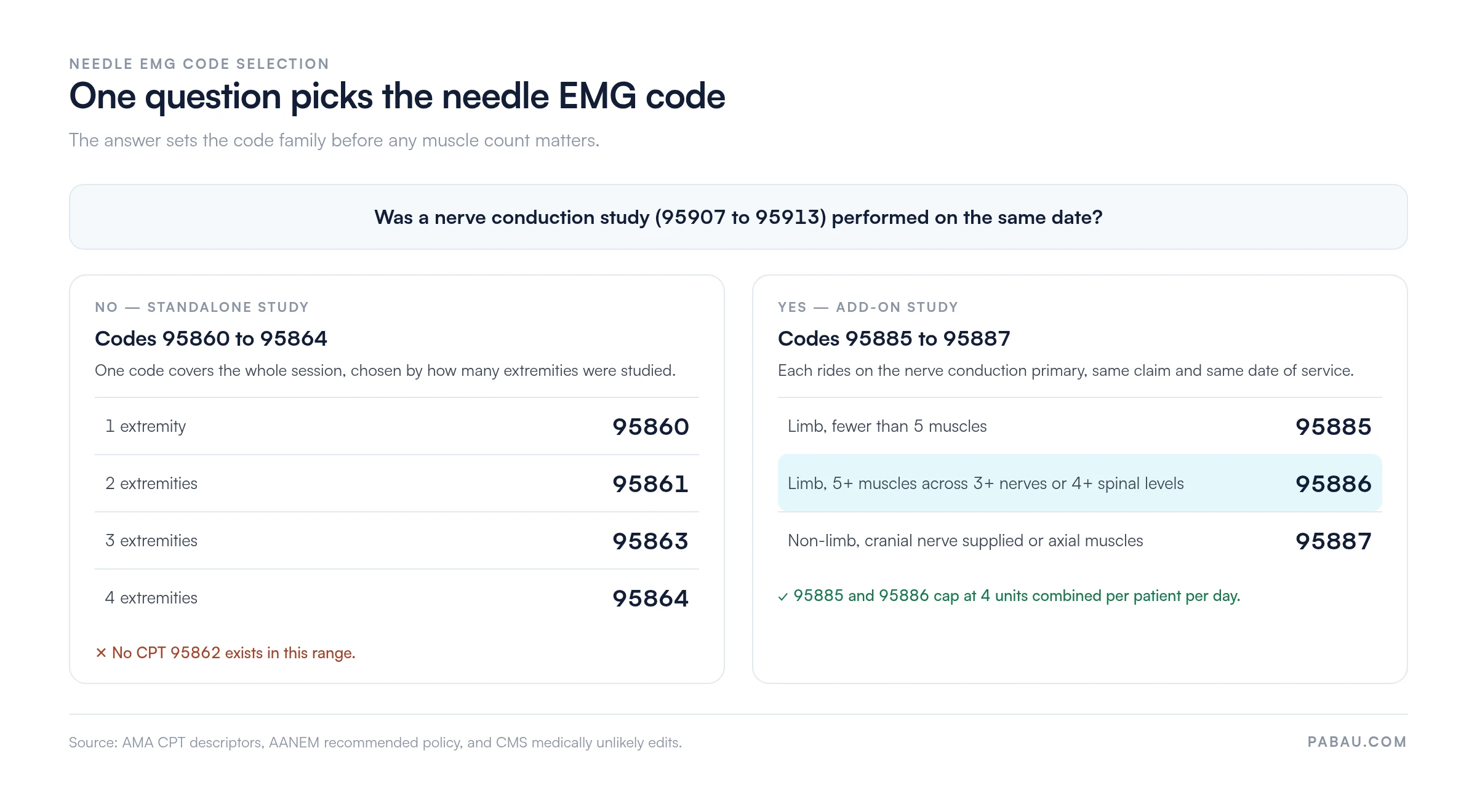
Inside the standalone family, the code follows the number of extremities. That gives 95860 for one, 95861 for two, 95863 for three, and 95864 for four. There is no 95862, so a claim carrying it comes straight back as an invalid code.
Inside the add-on family, the muscle count is what separates 95885 from 95886. Billing 95885 on a six-muscle study undervalues the work. Claiming 95886 on a three-muscle study is upcoding.
Practices that still see 95861 or 95863 denials usually have the two families mixed up. Those codes are current, but they are the wrong choice on a day when a nerve conduction study was also performed. Auditing the charge master for that pairing catches the problem quickly.
The documentation problems behind 95886 denials are rarely a failure of clinical work. They come from disconnected systems, where the procedure report and the claim live in separate platforms with no structured handoff between them.
Practice management software like Pabau builds the claim from the record that already exists. The CPT code attached to the service lands on the charge line, and ICD-10 slots are seeded from the recorded problem list.
Required claim fields have to be complete before the claim can be sent. Coders still make the coding call, but nobody re-keys a CMS-1500 from a report held somewhere else.
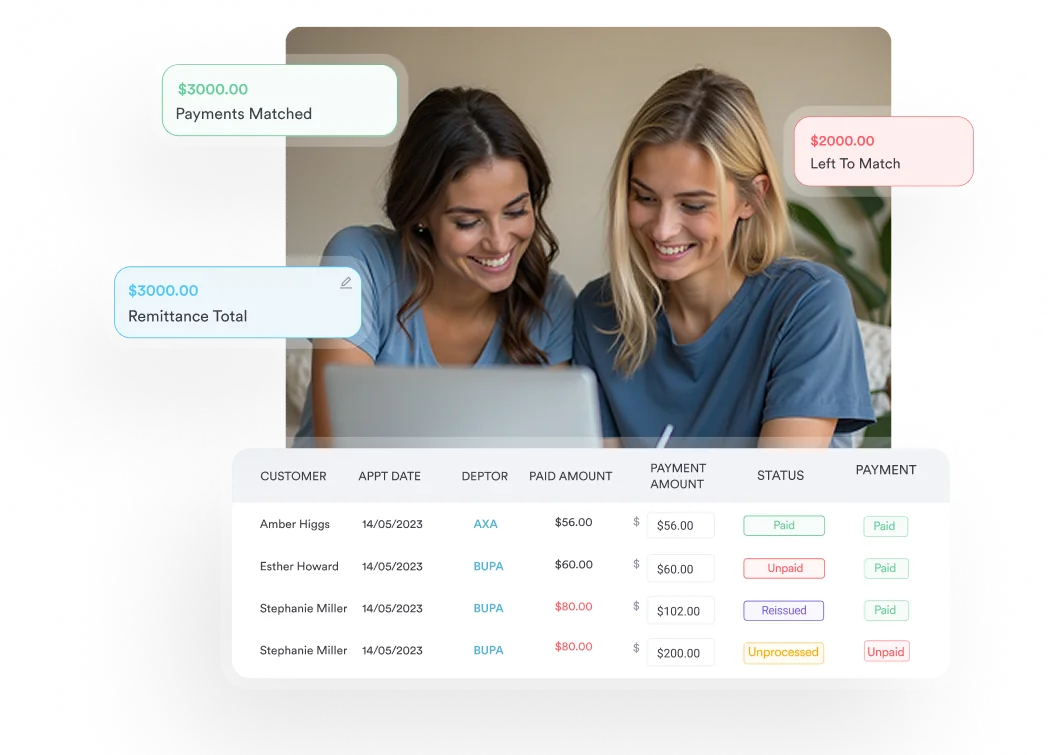
On the US pipeline, Pabau’s claims management software also runs eligibility checks and keeps a time-stamped status history for every claim. Electronic remittances post back against the invoice. A stack of unpaid EMG claims becomes a worklist your biller can work down, rather than a phone queue.

Pabau connects the procedure report to claim submission, so the codes on the claim come from the record the clinician already wrote. See how neurology and physiatry practices use it to cut 95886 rework.

CPT code 95886 pays when two conditions line up. The report has to carry the muscle, nerve, and spinal level counts that justify a complete extremity study. On the claim itself, a primary nerve conduction study code has to sit under the same date of service. Miss either one and the line rejects, however good the clinical work was.
So the fix sits upstream of the denial queue. Build the primary-code check and the muscle count into the moment the charge is created, and most of the rework never happens. That is a workflow decision rather than a coding one, which is why practices with the same coders get very different clean-claim rates.
Still assembling EMG charges by hand from a report held in another system? Book a demo and see how Pabau builds the claim, checks the required fields, and tracks it to payment.

Need to understand how clearinghouse submission works for electrodiagnostic claims? Pabau’s Claim.MD clearinghouse guide explains how 837P electronic claims reach thousands of US payers through the Claim.MD integration.
Want to catch coding errors before the payer does? Medical claims clearinghouse overview covers how clearinghouse validation flags problems ahead of payer submission.
Looking for a structured way to track denials across your CPT code mix? Denial management in healthcare sets out how to group denials by reason code and work them as a queue.
Yes, when different limbs were studied. One limb may need a limited study and the other a complete one. Report each on its own line, with its own documented muscle list. Medicare’s medically unlikely edit caps the two codes combined at four units per patient per day.
No. Add-on codes are exempt from modifier 51, so it never belongs on a 95886 line. The multiple-procedure reduction does not apply either, because add-on values already assume a primary service. Modifier 59 is a separate question, and only applies to a genuinely distinct same-day service.
Then 95886 does not apply to that visit. The add-on family needs a nerve conduction study on the same date of service. Report the needle EMG with 95860 to 95864 instead, chosen by the number of extremities studied that day.
Yes. Those needle EMG codes are current and payable when no nerve conduction study is performed that day. The codes deleted in 2013 were the nerve conduction codes 95900, 95903, and 95904. The needle EMG codes were never withdrawn.
No. One unit covers one complete extremity, however many muscles were sampled beyond the five-muscle minimum. A second unit needs a second limb, documented separately. Billing two units off a single-limb report is a unit-count error, and payers do check it.