



CCSD code G5100: Bypass of duodenum billing guide
CCSD code G5100 bills a bypass that leaves the duodenum in place CCSD code G5100...

Last Updated: Oct 16, 2026
CPT code 95910 is the billing code for nerve conduction studies covering 7 to 8 individual measurements in one session. Medicare’s 2026 national amount is about $184.71 when the practice performs and interprets the study in its own office. There is no facility rate for the global code. In a hospital outpatient department or an ASC, the physician bills 95910-26 at about $106.21.
The code sits in the neurology section of the AMA’s CPT code set, in the 95900-series reserved for nerve conduction tests. Each study counts as one motor or sensory nerve conduction measurement, not a limb and not an anatomical region. That definition drives the study count, and the study count drives code selection across the 95907-95913 range.

CPT code 95910 covers nerve conduction studies for 7 to 8 individual motor or sensory measurements in one session.
The NCS family runs from 95907 through 95913 by study count, and picking the wrong code is the top denial trigger.
Medicare’s 2026 national amount is about $184.71 for the global service performed in a physician office.
A hospital or ASC has no global rate for 95910, so the physician reports the professional component, 95910-26.
Practice management software like Pabau flags study-count mismatches before the claim leaves the practice.
CPT code 95910 describes nerve conduction studies; 7-8 studies. The AMA descriptor defines each study as one nerve conduction measurement across a single nerve segment. That measurement is either motor, including an F-wave, or sensory. Stimulating the same nerve at different sites counts as separate studies when each site yields independent data.
A 7-8 study panel usually turns up in a bilateral upper extremity evaluation, or in a unilateral carpal tunnel workup with a cervical screen. A bilateral median-ulnar screen with F-waves can reach 7 studies in one sitting, landing inside 95910’s range. Once a ninth measurement is recorded and interpreted, 95910 no longer applies. The correct code becomes 95911, which covers 9-10 studies.
The nerve conduction studies CPT codes run in a continuous range from 95907 through 95913, each defined solely by study count. Selecting the wrong code from this family is the most common claim denial in electrodiagnostic billing. The table below shows where CPT code 95910 sits within the full range.
These codes are mutually exclusive for a single session. Only one NCS code is reported per encounter, and the selection reflects the studies completed and interpreted, not the ones planned. Medicare Administrative Contractors (MACs) may cap study counts under their Local Coverage Determinations (LCDs). Check your own MAC before assuming that 7-8 studies will clear for medical necessity.
Counting upward from 95910, a session documenting 11 or 12 studies is reported under 95912. The step is two tiers, because 95911 covers the 9-10 range in between.
Elsewhere in the same neurology and neuromuscular section, the counting convention changes. A range of motion measurement billed under 95851 is reported once per extremity or trunk section, rather than once per session.
Nerve conduction studies are often performed in the same session as needle electromyography (EMG), and the two code families can generally be billed together. The NCS codes capture the conduction measurement work. Separate EMG codes capture the needle examination. CPT code 95910 can usually be reported alongside 95860, 95861 and 95886, provided both components were performed and documented.
Before billing any combination, check it against the National Correct Coding Initiative (NCCI) edit tables. Bundling errors between NCS and EMG codes account for a large share of electrodiagnostic denials. The table below lists the EMG codes most often reported with 95910.
When reporting CPT code 95910 with any EMG code, each service needs its own documentation. A single combined report covering both the NCS and the EMG findings is acceptable. It has to identify the result of every individual study, and the needle examination of every muscle tested.
Medical necessity for nerve conduction studies rests on the clinical indication. That indication reaches the payer as an ICD-10-CM diagnosis code linked to the claim line. Neurology and physical medicine practices ordering NCS share a fairly consistent set of covered diagnoses. The MAC’s own LCD defines the full list.
CMS coverage article A56619 is the national billing and coding article for NCS and EMG. It requires the ordering provider to document a clinical indication that electrodiagnostic testing can diagnose or characterize. Common ICD-10-CM codes supporting medical necessity include:
Category-level codes do not survive a claim scrubber. Carpal tunnel syndrome is the usual casualty: G56.0 is a category header, so the claim needs G56.00, G56.01 or G56.02 depending on laterality. The ICD-10-CM code library sets out the laterality and specificity rules code by code. This list is illustrative, so cross-reference the active LCD for your MAC jurisdiction before you bill.
Nerve conduction studies measure motor and sensory conduction, not sweat output. CPT code 95923 covers sudomotor testing, under separate Medicare LCDs A54954 and A57651.
Medicare reimbursement for CPT code 95910 is built on the Resource-Based Relative Value Scale (RBRVS). The figures below come from the CMS 2026 Physician Fee Schedule relative value file, April release. For location-specific amounts, run the code through the CMS Physician Fee Schedule lookup tool with the applicable MAC locality code.
95910 carries a PC/TC indicator of 1, which is where most published rate tables go wrong. CMS marks the facility column for the global code as not applicable. A physician working in a hospital outpatient department or an ASC does not bill a reduced global rate. They bill 95910-26, and the facility bills the technical side under its own payment system.
The split matters more than the headline number, because it decides which line a neurology practice can actually bill. The chart below shows how the global amount divides between the two components.
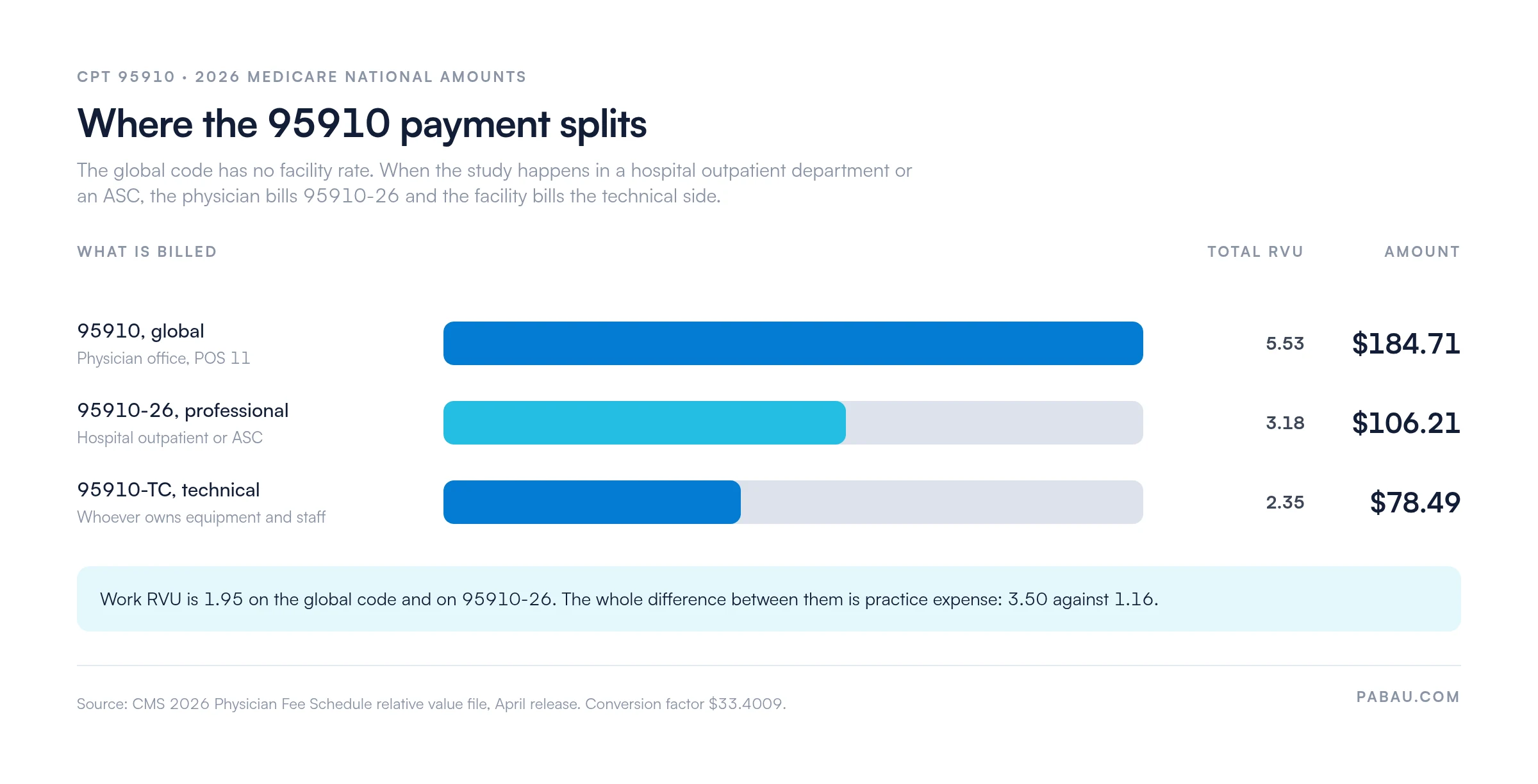
Geographic adjustments are applied through Geographic Practice Cost Indices (GPCIs) by MAC region. High-cost areas such as Manhattan and San Francisco push the office amount above the national average. Low-cost rural localities fall below it. The underlying values are published in the CMS relative value files, which CMS revises quarterly.
Practice management software like Pabau routes 95910 claims to thousands of US payers through its Claim.MD integration, with eligibility checks and automated ERA processing. Remittance data posts back against the claim line, so the time between the study and a posted payment shortens.
The RVU components for CPT code 95910 split across work, practice expense and malpractice. Work RVU is identical on the global code and on 95910-26, because the physician does the same interpretation either way. Practice expense is what moves, since the equipment and staffing costs sit with whoever owns them.
RVUs are multiplied by the Medicare conversion factor to reach a payment amount. CMS set two conversion factors for 2026: $33.5675 for qualifying APM participants and $33.4009 for everyone else. The amounts in this article use the $33.4009 figure, so a practice in an advanced APM will see each line come in slightly higher.
Run your 95910 claims through your MAC’s LCD cross-reference before billing. Some MACs cap the total NCS studies they will reimburse per encounter or per 12-month period, regardless of the number performed. Checking the LCD upfront prevents write-offs that stay invisible until the ERA arrives.
Documentation is the primary defense against denial and post-payment audit recovery for CPT code 95910. CMS coverage article A56619 specifies what has to appear in the medical record to support a nerve conduction studies claim. A missing element gives medical review somewhere to start.
A complete package for 95910 connects the ordering diagnosis to the individual study results, and then to the interpreting physician’s signed report. Each of the following must be present in the medical record:
A report that lists only summary findings will not satisfy Medicare. “Bilateral median and ulnar NCS performed, within normal limits” reads as one finding, not seven. Each measurement needs its own recorded values.
Several CPT modifiers apply to CPT code 95910, depending on the clinical scenario and the provider arrangement. The wrong modifier, or a missing required one, usually causes a rejection rather than a denial. The claim comes back unprocessed instead of being adjudicated and denied with a reason code.
When a physician performs and interprets the NCS in an office, no modifier is needed and the global rate applies. Split billing, where 26 and TC are reported by different entities, takes coordination to avoid duplicate payment flags. Append modifier 59 only when the second service is separately documented. It is not a blanket override for an NCCI edit.
Commercial payers often diverge from Medicare on coverage for nerve conduction studies. Anthem’s medical policy CG-MED-24 governs EMG and NCS coverage for its commercial lines. It typically requires prior authorization above a certain study count, or for specific indications. A neurology practice therefore needs payer-specific policy grids, not a single Medicare LCD.
Key commercial payer differences to track for CPT code 95910:
A reference grid for the commercial plans a neurology practice bills most often pays for itself quickly. One missed prior authorization turns a 95910 claim into a full denial and an appeal.
Electrodiagnostic billing carries one of the higher denial rates among outpatient specialty services, and most denials for CPT code 95910 are preventable. Pre-submission scrubbing catches these errors while the claim is still in the practice, rather than chasing them through appeals.
Effective denial management for NCS claims starts with pre-submission scrubbing across those six categories. Most billing platforms can be configured to flag study-count mismatches and missing diagnosis codes before claims go out. Sorting denials by category over a rolling 90-day window shows which error type is costing the practice the most.
Billing CPT code 95910 correctly means holding five things together: the study count, the diagnosis linkage, the modifier, the eligibility check, and the clearinghouse submission. A busy electrodiagnostic practice repeats that sequence dozens of times a day. Every repetition is another chance for a manual slip.
Pabau’s claims management software ships with a built-in CPT and ICD-10 catalog, so coders validate code combinations against NCCI edits before submission. Claims route straight to the clearinghouse in CMS-1500 and 837P formats. ERA data comes back automatically, so reconciliation happens without anyone downloading a remittance file by hand.
A single NCS session can produce several billable lines, one NCS code plus one or two EMG codes. Eligibility checks run at scheduling rather than at submission. Prior authorization requirements and frequency limits surface before the patient arrives, which is the only point at which the practice can still act on them.
Audit your 95910 claims quarterly by pulling the denied ones and sorting them by reason code. Study-count errors and medical necessity denials are the two categories most likely to show a systemic pattern. Those are fixable at the documentation or workflow level, rather than one appeal at a time.

Pabau’s claims management software includes built-in CPT and ICD-10 catalogs, automated eligibility checks, and direct clearinghouse submission. Neurology practices use it to catch study-count mismatches before claims leave the practice.

Two decisions carry most of the money on a 95910 claim. Count the studies as each one is documented, and report the professional component when the work happens in a hospital or an ASC. Both are settled before the claim is built, which is why appeals recover so little of what these errors cost.
The practices that stop losing revenue on electrodiagnostic claims scrub before submission instead of appealing afterward. Book a demo to see how Pabau validates 95910 study counts and modifiers before the claim leaves your practice.

Need to understand how claims reach payers? Medical claims clearinghouse guide explains how claims are validated, scrubbed, and transmitted from practice to payer.
Want to reduce your denial backlog? Insurance credentialing guide covers the payer enrollment steps that affect which codes and providers are reimbursable under each plan.
Looking for a complete billing compliance framework? Revenue cycle management explained walks through the full process from eligibility through payment posting for outpatient specialty practices.
CPT code 95910 is the nerve conduction studies billing code for 7 to 8 individual measurements performed and interpreted in one session. It belongs to the 95907-95913 NCS family, where each code is defined by study count. Only one code from that family is reported per encounter.
Medicare’s 2026 national amount is about $184.71 when the practice performs and interprets the study in its own office. The global code has no facility rate. In a hospital outpatient department or an ASC, the physician bills 95910-26 at about $106.21 and the facility bills the technical side. Amounts vary by MAC locality.
Yes. CPT 95910 can generally be reported alongside EMG codes such as 95860, 95861 and 95886. Both services have to be performed and documented in the same session. Each combination still has to be checked against the NCCI edit tables before submission. Bundling errors between NCS and EMG codes drive a large share of electrodiagnostic denials.
Common supporting codes include G56.00 for carpal tunnel syndrome of an unspecified upper limb and G62.9 for unspecified polyneuropathy. G54.4 covers lumbosacral root disorders, M54.16 covers lumbar radiculopathy, and E11.40 covers type 2 diabetes with neuropathy. Category-level codes such as G56.0 are not billable. The complete covered list comes from the applicable MAC’s LCD.



