CCSD Code H3334: Low anterior resection billing guide
CCSD Code H3334: Definition and clinical scope CCSD Code H3334 covers an open an...

Last Updated: Oct 16, 2026
94618 is the CPT code for pulmonary stress testing (e.g., 6-minute walk test), including measurement of heart rate, oximetry, and oxygen titration, when performed. It applies when the clinical question is whether a patient desaturates on exertion and how much oxygen they need.
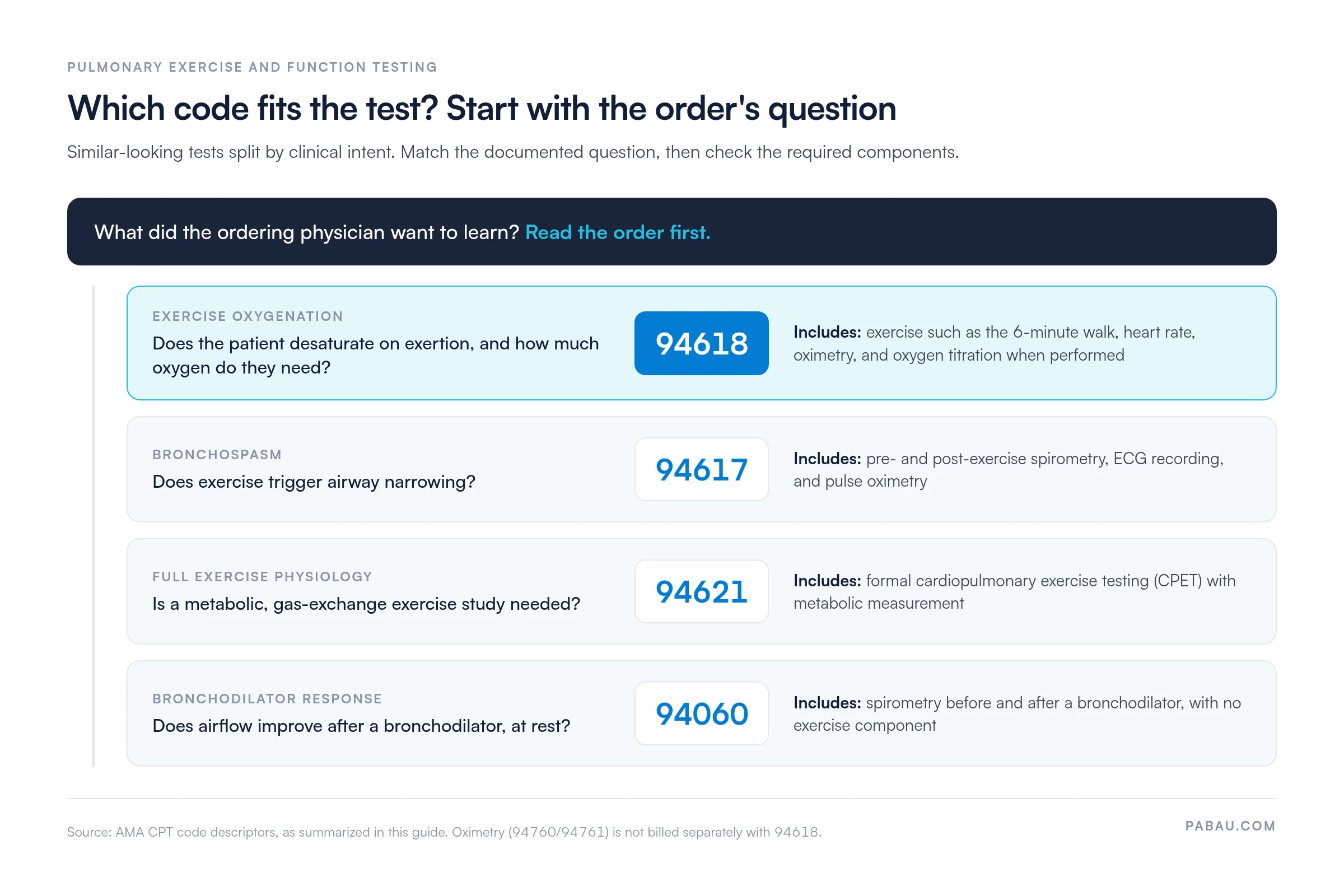
Coders often confuse 94618 with CPT 94617 because both tests involve exercise. 94618 requires oximetry, plus oxygen titration when performed, while 94617 requires spirometry before and after exercise with ECG recording.
Let Pabau's smart automation suggest the right codes, reduce claim denials, and keep your practice compliant—effortlessly.
Automate repetitive tasks and focus on what matters most—your patients.
Reduce coding errors and ensure compliance with the latest regulations.
Clean claims, fewer denials, and faster reimbursements.
Powerful insights and reporting to help your practice thrive.
HIPAA compliant SOC 2 certified GDPR-compliant Trusted by 4,000+ clinics worldwide

CPT code 94618 covers pulmonary stress testing, typically the six-minute walk test, with heart rate, oxygen saturation (SpO2), and oxygen titration when performed.
94617 tests for exercise-induced bronchospasm with spirometry and ECG recording, while 94618 measures how much oxygen a patient needs during exertion.
Common denial triggers include a non-covered ICD-10 diagnosis, missing pre- and post-test SpO2 and heart rate values, and billing 94617 when 94618 applies.
Medicare pays about $37 nationally in 2026 in both facility and non-facility settings, and 94618 takes no -26 or TC modifier.
Pabau, the practice software we build, routes claims to thousands of US payers through Claim.MD, so your team can submit and track every claim.
CPT code 94618 describes pulmonary stress testing that includes measurement of heart rate, oximetry, and oxygen titration when performed. The six-minute walk test is the most commonly used exercise protocol. The American Medical Association, which maintains the CPT code set, introduced 94618 and 94617 in 2018 to replace the deleted code 94620.
The complete official descriptor reads: “Pulmonary stress testing (e.g., 6-minute walk test), including measurement of heart rate, oximetry, and oxygen titration, when performed.” Every element of that descriptor carries a billing implication.
CPT 94618 covers the complete pulmonary stress test encounter, from the pre-test baseline through the walk to the post-exercise recovery check. In the six-minute walk test, the patient walks at a self-selected pace on a flat surface for six minutes. The supervising clinician monitors SpO2 and heart rate, adjusts supplemental oxygen if the patient desaturates, and records distance, symptoms, and Borg dyspnea scores.
94618 does not include formal cardiopulmonary exercise testing (CPET) with metabolic measurement, which is CPT 94621. It also excludes bronchodilation responsiveness spirometry (94060) and standalone pulse oximetry (CPT 94760/94761). Billing any of those alongside 94618 for the same session can trigger a bundling edit.
94618 and its nearest neighbors look alike on paper. CPT 94617 and 94618 sit in the same pulmonary stress testing family and share similar clinical contexts. What separates them is the clinical question the test answers. Diffusing capacity is a different case again: 94729 is an add-on code that never stands alone.
The 94617 vs 94618 call: If the ordering physician wanted to know whether exercise triggers bronchoconstriction, use 94617. If the goal was to find out whether the patient desaturates during exertion and how much supplemental oxygen they need, use 94618. Because both tests involve exercise, the pair is a frequent source of confusion, and the chart below maps the order’s question to the right code.
Payers compare the submitted diagnosis against their local coverage determination (LCD) or policy for respiratory care before paying for 94618. Confirm a covered ICD-10 code before the test is scheduled. Medicare contractors and most major commercial payers recognize a defined list of diagnoses as medically necessary indications for pulmonary stress testing.
This is not an exhaustive list. MAC-specific LCDs vary, and commercial payers maintain their own medical policy documents. Before billing 94618, confirm the submitted diagnosis appears on the applicable LCD. Some payers won’t accept a diagnosis of dyspnea alone (R06.09) as medical necessity unless an underlying cardiopulmonary condition is also listed.
Run an eligibility check before every 94618 encounter. Confirm the patient has an active covered diagnosis, and check whether the payer requires prior authorization for pulmonary function testing. Settling coverage before the test saves a retrospective prior auth request or a medical necessity appeal.
Incomplete documentation is a common reason 94618 claims deny. In Noridian jurisdictions JE and JF, billing and coding article A57224 sets the documentation floor for respiratory care billing. Other MACs publish their own respiratory care LCDs and articles. The chart note must contain all of the following to withstand a post-payment audit.
Good medical billing compliance practice means storing this documentation in a retrievable format. You should be able to produce it within the payer’s requested audit turnaround, typically 30 to 45 days.
Medicare pays 94618 under the Physician Fee Schedule at about $37 nationally in 2026, before geographic adjustment. The code carries 1.11 total RVUs in both facility and non-facility settings, which works out to about $37.07 at the $33.4009 conversion factor. The CMS Physician Fee Schedule lookup tool is the authoritative source for current-year rates, so verify before billing because rates update each January.
Geographic adjustment applies through the GPCI multiplier. A practice in San Francisco receives a different payment than one in rural Alabama for the same code. Use the FastRVU lookup tool to calculate locality-adjusted rates before setting patient cost estimates.
Medicaid coverage for 94618 varies by state. Covered codes, rates, and prior authorization thresholds differ from one state program to the next. Check the state Medicaid provider manual and fee schedule for the relevant state before billing a Medicaid beneficiary for this service.
Commercial payers typically align with Medicare coverage criteria but add their own layers. Many publish a pulmonary function testing medical policy that sets the criteria a patient must meet before the service is authorized. Blue Cross Blue Shield plans often require the ordering physician to document that the test informs a specific clinical decision rather than routine monitoring.
Prior authorization requirements also vary. Some payers require PA for any pulmonary function test, others only in outpatient facility settings, and others not at all in the non-facility setting.
Prior authorization for 94618 is payer-specific, so never assume it isn’t needed. Most payers apply similar clinical criteria:
Each of the six denial causes below can be caught before the claim leaves the practice. Effective denial management workflows start with knowing which edit is likely to fire.
Knowing the denial codes that come back on the remittance speeds up the appeal. CARC 4 means the procedure code is inconsistent with the modifier used, or a required modifier is missing. CARC 97 means the benefit is included in the payment for another service, which is typical when standalone oximetry is billed with 94618.
Clean claim submission for 94618 comes down to a few workflow habits that billing staff can build into every encounter.
Submitting a clean claim on the first pass avoids rework costs. The Medical Group Management Association puts the cost of reworking a denied claim at about $25.
Build a 94618 billing checklist into your respiratory care workflow. Confirm an LCD-covered diagnosis, verify any PA requirement, and document pre- and post-test SpO2 and heart rate. Record the distance walked and any oxygen adjustments, then get the physician’s signature before closing the note.
Many respiratory care teams record the walk test in one system and build the claim in another. Every retyped SpO2 value or code is a chance for the claim to go out incomplete or wrong.
Pabau keeps the test note, the diagnosis, and the claim against the same patient record. Its claims management software routes claims to thousands of US payers through the Claim.MD clearinghouse integration. Your team can submit and track every 94618 claim without switching systems.
The result is less retyping, fewer claims sent back for missing data, and one place to see where each claim stands.
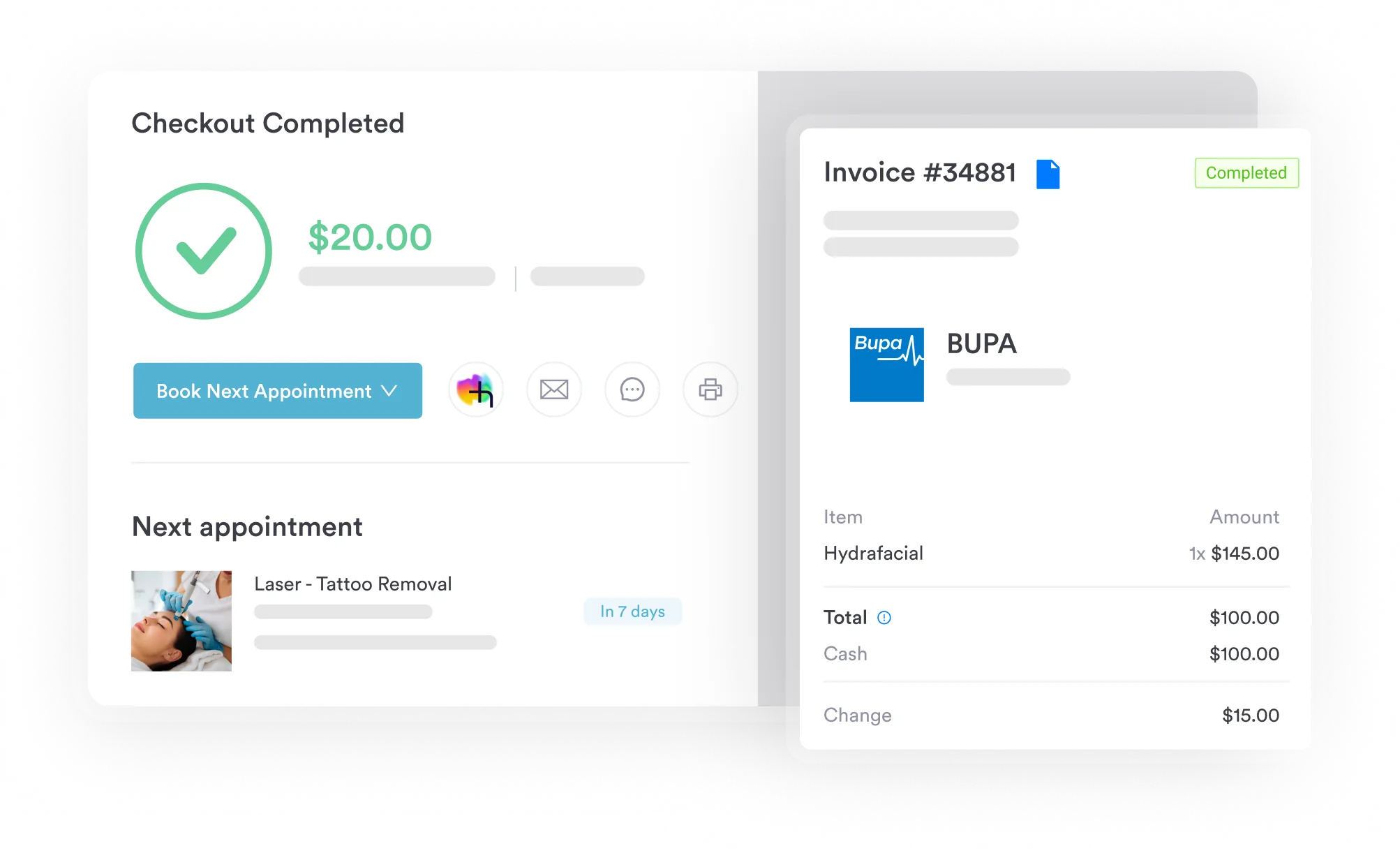

Pabau’s claims management tools help respiratory care teams submit claims through Claim.MD and track each one to payment. The walk-test note, diagnosis, and claim stay on the same patient record.

Code 94618 from the order, not from the procedure name. If the physician asked whether the patient desaturates and how much oxygen they need, the answer is 94618. The chart then has to prove it with pre- and post-test values.
Before you submit, check the diagnosis against your MAC’s respiratory care LCD, strip any standalone oximetry code, and leave modifier -26 off. Those checks take a minute per claim and stop the avoidable denials described above.
Pabau’s revenue cycle management tools keep that workflow in one system, from the walk-test note to the submitted claim. Book a demo to see how Pabau handles pulmonary function claims for respiratory care practices.

Need to understand how clearinghouse validation works before claims reach the payer? Medical claims clearinghouse guide explains the 837P submission path and where edits fire.
Want to reduce the time it takes to work denied 94618 claims? Electronic remittance advice (ERA) covers how 835 files carry CARC codes and how to action them faster.
Billing spirometry for the same patient? CPT code 94010 covers the spirometry descriptor, documentation, and reimbursement.
Ordering lung volumes as part of a full PFT workup? CPT code 94726 explains plethysmography billing and the add-on codes that pair with it.
Credentialing with a new payer before billing pulmonary codes? How to get credentialed with insurance companies walks through the provider enrollment process step by step.
CPT code 94618 covers pulmonary stress testing with heart rate monitoring, oxygen saturation measurement, and oxygen titration during exercise such as the six-minute walk test. The code bundles the exercise challenge, continuous oximetry, and any supplemental oxygen adjustments performed during the test into a single billable service.
CPT 94617 tests for exercise-induced bronchospasm and includes pre- and post-exercise spirometry, pulse oximetry, and ECG recording. CPT 94618 assesses exercise capacity and oxygen need, with SpO2 monitoring and oxygen titration during a walk test. In short, 94617 is a bronchoprovocation test and 94618 is an exercise oxygenation assessment.
Yes. Medicare covers CPT 94618 under the Physician Fee Schedule when the ICD-10 diagnosis meets the applicable MAC’s respiratory care criteria. Noridian jurisdictions JE and JF publish that guidance in article A57224, and other MACs have their own. Medicare pays about $37 (2026 national, before GPCI) in both facility and non-facility settings.
The chart note must include the ordering physician and clinical indication, pre- and post-test SpO2 and heart rate values, and the exercise protocol used. It also needs the distance walked, any oxygen adjustments made during the test, supervising clinician credentials, and a physician-signed final report.
Yes, a covered ICD-10 diagnosis is required for medical necessity. Commonly covered diagnoses include COPD (J44.9), interstitial lung disease (J84.x), pulmonary hypertension (I27.x), and chronic respiratory failure (J96.1x). The exact covered-diagnosis list depends on the applicable MAC LCD and the commercial payer’s medical policy.