



HCPCS code E0198: Water pressure pad billing guide
HCPCS code E0198 is a water pad for a standard mattress HCPCS code E0198 is the ...

Last Updated: Oct 13, 2026

CPT Code 94729 reports diffusing capacity (DLCO) testing and is an add-on code, never billable on its own.
Seven primary codes may carry it: 94010, 94060, 94070, 94375, 94726, 94727 and 94728.
The 2026 Medicare national unadjusted payment is roughly $63, the same in facility and non-facility settings.
Most denials trace to a diagnosis outside the payer’s covered list, or a missing signed physician interpretation.
Claims software like Pabau enforces the pairing rule at data entry, catching unpaired 94729 lines before submission.
CPT Code 94729 is the add-on code for diffusing capacity testing, better known as the DLCO test.
It reports how efficiently the lungs move carbon monoxide across the alveolar-capillary membrane. The code is never billable on its own. The AMA’s CPT code set lists it as “list separately in addition to code for primary procedure.” Every claim carrying 94729 therefore needs an approved primary pulmonary function test code on the same date of service.
Seven primary codes qualify: 94010, 94060, 94070, 94375, 94726, 94727 and 94728. Medicare’s 2026 national unadjusted payment for 94729 is about $63, and that figure is identical in office and hospital outpatient settings.
This guide covers the pairing rules and the ICD-10-CM codes that support medical necessity. It also sets out the 2026 reimbursement math, modifier conventions, and the documentation a payer audit asks for.
The AMA defines 94729 as: Diffusing capacity (eg, carbon monoxide, membrane) (List separately in addition to code for primary procedure). The plus sign in front of the code in the CPT book is the add-on marker.
The code sits in the CPT section for Pulmonary Diagnostic Testing and Therapies. Its job is to quantify gas transfer across the alveolar-capillary membrane, usually measured with carbon monoxide as the test gas. Membrane diffusing capacity (Dm) falls under the same descriptor, so a session that reports both measurements still bills one unit of 94729.
Diffusing capacity testing measures how well the lungs move gas across the alveolar-capillary membrane, the thin barrier between the air sacs and the bloodstream. Clinicians order it because spirometry alone cannot detect impaired gas exchange.
A patient can show normal airflow volumes and still have sharply reduced transfer efficiency. That pattern turns up in interstitial lung disease, pulmonary hypertension, and emphysema. Where nocturnal desaturation is suspected in the same patient, the overnight oximetry recording is a separate study billed under 94762.
The DLCO test has the patient inhale a small concentration of carbon monoxide, hold the breath for about 10 seconds, then exhale. The difference between inhaled and exhaled CO concentration reflects how much crossed the membrane. Results are expressed as ml/min/mmHg and compared against predicted values adjusted for age, sex, and height.
Physicians order DLCO testing in several clinical scenarios:
The American Thoracic Society (ATS) and European Respiratory Society (ERS) publish joint technical standards for DLCO measurement. Testing protocols should meet those standards, because payer audits scrutinize the test quality indicators printed on the report.
Seven primary pulmonary function test codes may carry 94729: 94010, 94060, 94070, 94375, 94726, 94727 and 94728. The CPT codebook’s parenthetical instruction under the code names all seven. A claim that lists 94729 without one of them on the same date of service denies automatically.
Older guidance limited 94729 to the lung-volume codes 94726, 94727 and 94728. Restricting the pairing to those three leaves legitimate spirometry-session claims unbilled. Spirometry is the most frequently performed of the qualifying primaries, and the full billing rules for 94010 sit on its own page.
Verify the pairing list every coding year. The AMA revises add-on parenthetical instructions annually, and a payer’s local coverage determination can narrow the list further. CMS Local Coverage Article A57225 (Billing and Coding: Respiratory Care) governs Medicare coverage of 94729.
Use the AAPC Codify CPT lookup to confirm current-year descriptions and parenthetical notes across the PFT family before you submit.
Medicare and most commercial payers want an ICD-10-CM diagnosis that justifies diffusing capacity testing. The diagnosis has to link to a clinical indication where a DLCO result changes what the clinician does next. Pairing 94729 with an unrelated or vague code is one of the most common causes of medical necessity denials.
Always use the most specific ICD-10-CM code the clinical documentation supports. Cross-check it against the covered-indication list in CMS Local Coverage Article A57225 before submitting. Private payers maintain their own medical necessity criteria, and those can be narrower than Medicare’s.
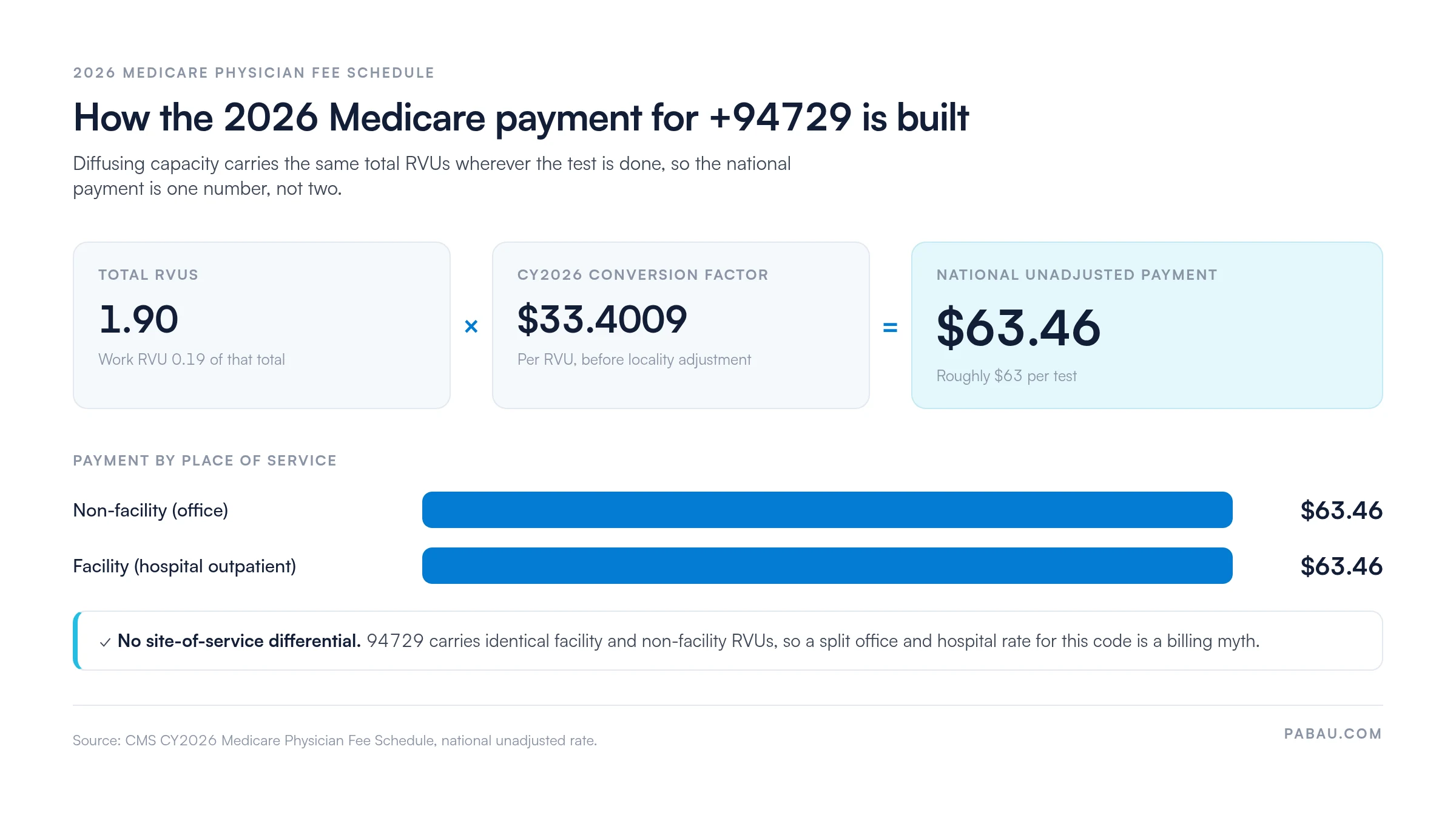
Medicare’s 2026 national unadjusted payment for CPT Code 94729 is about $63. The code carries 1.90 total RVUs, of which 0.19 is work RVU, and the CY2026 conversion factor is $33.4009. That arithmetic gives $63.46 before any locality adjustment.
Many fee guides still quote a split office and hospital rate for 94729. That split does not exist. The code carries identical facility and non-facility RVUs, so the same national rate applies wherever the test runs. Geographic practice cost indices are what move the figure, and the CMS Physician Fee Schedule lookup tool returns the rate for your locality.
Private payer rates vary far more widely. Some commercial plans follow the Medicare fee schedule with a multiplier, and others negotiate independently. Benchmark each contracted rate against the $63.46 national figure before you sign a renewal.
Check your MAC’s local coverage article before submitting. Some Medicare Administrative Contractors restrict 94729 coverage to specific diagnostic indications, or cap how often diffusing capacity testing may be repeated in a year. A medical necessity denial on 94729 is usually avoidable by reading MAC policy before the appointment rather than after the rejection.
Modifier conventions for add-on codes differ from standard procedure codes. Most modifiers do not apply to 94729 the way they apply to a primary code, and using one incorrectly triggers claim edits or delays.
When one entity performs the test and interprets it, the global service needs no modifier. Append 26 and TC only in split-billing arrangements. Confirm payer-specific modifier rules before submitting, because some commercial plans depart from Medicare conventions.
Documentation for 94729 has to establish three points. The test was medically necessary, it was performed correctly, and a qualified provider interpreted it. CMS Article A57225 sets the Medicare standard, and private payers usually mirror it.
Keep complete records in the patient chart for at least seven years, or longer where state law requires it. On appeal, a reviewer asks for the signed interpretation and the quality indicators printed on the report. A chart holding both turns a denied 94729 claim into a recoverable one.
94729 generates a predictable set of billing errors, and most of them are caught by a workflow check rather than by a coder’s memory.
When you work a 94729 denial, read the common denial codes first and identify the precise reason before drafting an appeal. Practices that log denial reasons by CPT code spot systemic coding or documentation problems early.
Run a monthly audit on every claim containing 94729. Pull each line where the code appeared without an approved primary on the same date of service. Even one instance a month adds up over a year. The pattern usually points to a single coder habit or claim template that one correction fixes for good.
A pulmonology practice running a full PFT schedule already knows the 94729 rules. Applying them to every claim on a busy day is where the revenue leaks. The check that pays for itself runs when a coder saves the encounter, weeks ahead of the month-end denial review.
Practice management software like Pabau applies add-on code logic during claim creation. Pabau’s claims software for pulmonologists flags any 94729 line with no approved primary PFT code on the same encounter. The correction happens inside the practice, instead of arriving back as a denial three weeks later.
The same workflow covers documentation. Once a PFT session is coded, the billing team is prompted to confirm the signed physician interpretation. That check happens before the claim queues for submission. Claims that pass through fewer edit cycles get paid faster and cost less admin time per encounter.

Pabau’s claims management software applies add-on code pairing rules during claim creation, prompts for the signed interpretation, and submits clean claims first time. See how it handles a pulmonology PFT schedule in a live demo.

The expensive 94729 mistakes are structural. Billing the code alone, pairing it with an uncovered diagnosis, and submitting without a signed interpretation are the three that recur. Each one is fixed by a claim-scrubber rule or a sign-off step at the point of coding.
Start with the pairing check, because it stops the largest share of denials for the least effort. Widen your approved-primary list to all seven codes while you are there, since the spirometry pairings are the easiest to overlook. Then review your ICD-10 list against your MAC’s coverage article once a year.
Book a demo to see how Pabau catches an unpaired 94729 line before the claim ever reaches your payer.

Need the billing rules for the primary code most often paired with 94729? CPT Code 94010 covers spirometry billing, documentation, and the pairings it supports.
Coding a COPD exacerbation alongside the DLCO test? ICD-10 Code J44.1 sets out the documentation that supports medical necessity for that diagnosis.
Want to know how claims move through the clearinghouse? Medical claims clearinghouse explained covers how electronic claims are validated, routed, and paid.
Want to reduce denial rates across your billing team? Denial management in healthcare outlines the strategies practices use to recover and prevent claim denials.
Looking for guidance on billing compliance for respiratory care? Medical billing compliance covers the documentation and coding standards that protect practices during payer audits.
CPT Code 94729 reports diffusing capacity testing (DLCO), the pulmonary function test that measures how efficiently the lungs move carbon monoxide across the alveolar-capillary membrane. It is an add-on code, so it is always billed alongside an approved primary PFT code. Physicians order DLCO testing to evaluate gas exchange impairment in COPD, interstitial lung disease, pulmonary fibrosis, and pulmonary hypertension.
Yes. The AMA designates 94729 as an add-on code. The plus sign (+94729) in the CPT codebook marks it, as does the parenthetical instruction “List separately in addition to code for primary procedure.” Billing 94729 without an approved primary PFT code on the same claim draws an automatic denial from Medicare and most commercial payers.
Seven primary codes qualify. They are 94010 (spirometry), 94060 (bronchodilation responsiveness), 94070 (bronchospasm provocation) and 94375 (respiratory flow volume loop). The lung-volume codes 94726 (plethysmography), 94727 (gas dilution or washout) and 94728 (impulse oscillometry) complete the list. Check the current-year parenthetical note under 94729 in the CPT codebook, and your payer’s local coverage article. Approved pairings can change with annual code updates.
The 2026 Medicare national unadjusted payment for CPT 94729 is approximately $63. The code carries 1.90 total RVUs, and the CY2026 conversion factor of $33.4009 gives $63.46. That rate is identical in facility and non-facility settings, because 94729 has no site-of-service differential. Only the geographic locality adjustment changes it, so check your own rate in the CMS Physician Fee Schedule lookup tool.
Eight ICD-10-CM codes commonly support medical necessity for 94729. They are J44.1 (COPD with acute exacerbation), J44.9 (COPD, unspecified), J84.10 (pulmonary fibrosis, unspecified) and J84.112 (idiopathic pulmonary fibrosis). The list also covers I27.0 (primary pulmonary hypertension) and J45.50 (severe persistent asthma, uncomplicated). J70.2 (acute drug-induced interstitial lung disorders) and R06.09 (other forms of dyspnea) complete it. Always use the most specific code the documentation supports, and verify it against CMS Local Coverage Article A57225.
Modifier 26 (professional component) applies when the interpreting physician bills separately from the facility billing the technical component. In global billing, where one entity performs and interprets the test, no modifier is needed. Modifier 59 is rarely required for add-on codes, and should be used only when a payer edit calls for it. Modifier GA applies when an Advance Beneficiary Notice has been signed before a potentially non-covered DLCO test.
You need a physician order carrying a documented clinical indication, plus a formal DLCO report with measured values and quality indicators. A dated, signed physician interpretation is also required. The record must show that diffusing capacity was measured during the same PFT session as the primary code. Retain the ICD-10-CM diagnosis that supports medical necessity, plus any Advance Beneficiary Notice signed where coverage was uncertain.
Yes. The CPT codebook’s parenthetical instruction under 94729 permits it to be reported with 94010, 94060, 94070 and 94375. Those sit alongside the lung-volume codes 94726, 94727 and 94728. Pairing 94729 with a spirometry session is a legitimate claim. Review the parenthetical notes each coding year to confirm the current approved list.



