



CCSD code G5100: Bypass of duodenum billing guide
CCSD code G5100 bills a bypass that leaves the duodenum in place CCSD code G5100...

Last Updated: Oct 16, 2026

CPT Code 94060 covers bronchodilation responsiveness spirometry, measured before and after a bronchodilator is administered.
NCCI treats CPT 94010 as a component of 94060, so the pair is not billed together for the same visit.
The pair carries modifier indicator 1, so modifier 59 fits only a truly separate, medically necessary spirometry session.
2026 Medicare non-facility payment runs roughly $35 to $55 by MAC jurisdiction. Verify the current figure in the CMS Physician Fee Schedule lookup.
Pabau captures structured spirometry data and submits claims through Claim.MD, then posts the ERA back against the original claim.
In short, CPT Code 94060 is the code you bill for bronchodilation responsiveness testing. It covers spirometry performed before a bronchodilator is given, then repeated once the drug takes effect. So, the comparison between those two efforts is what the code pays for.
This guide covers the official description, 2026 Medicare rates, documentation requirements, ICD-10 pairings, and modifiers. It also covers the denial patterns that cost respiratory and pulmonology practices the most. In fact, the most expensive of them is billing CPT 94010 alongside 94060 for the same encounter.
CPT Code 94060 describes bronchodilation responsiveness, spirometry as in 94010, with a bronchodilator given before and after. In other words, that official AMA CPT code set description sets out what the code requires. So, it is a complete spirometry session, measured before a bronchodilator is given and again after it takes effect.
Clinically, the procedure evaluates reversibility of airflow blockage. First, a patient performs a baseline spirometry effort. A short-acting bronchodilator (most commonly albuterol) is then given via inhaler or nebulizer. After an appropriate wait period, typically 15-20 minutes, a second spirometry effort is obtained. Finally, the pre- and post-bronchodilator FEV1 and FVC values are compared to quantify the degree of reversibility.
94060 belongs to the broader family of pulmonary function test (PFT) CPT codes. Notably, its defining feature is the bronchodilator challenge: no other spirometry CPT code combines baseline and post-bronchodilator measurement into one code you bill together.
This is where most billing errors originate. CPT 94010 covers basic spirometry, with no bronchodilator given. When a provider performs bronchodilation responsiveness testing, 94060 is the correct code. So, billing both on the same visit is an NCCI bundling violation.
The logic behind the NCCI edit is straightforward. 94060 already includes the spirometry component that 94010 represents, so billing 94010 separately breaks the bundling rule. The National Correct Coding Initiative assigns this pair a modifier indicator of 1, which means a modifier can bypass the edit in narrow cases. However, per AAPC guidance on NCCI indicators, modifier 59 applies only where the spirometry was a truly separate, medically necessary visit. So, appending it to a single pre- and post-bronchodilator session is not one of those cases.
In the end, which of the two codes applies comes down to one documented fact.
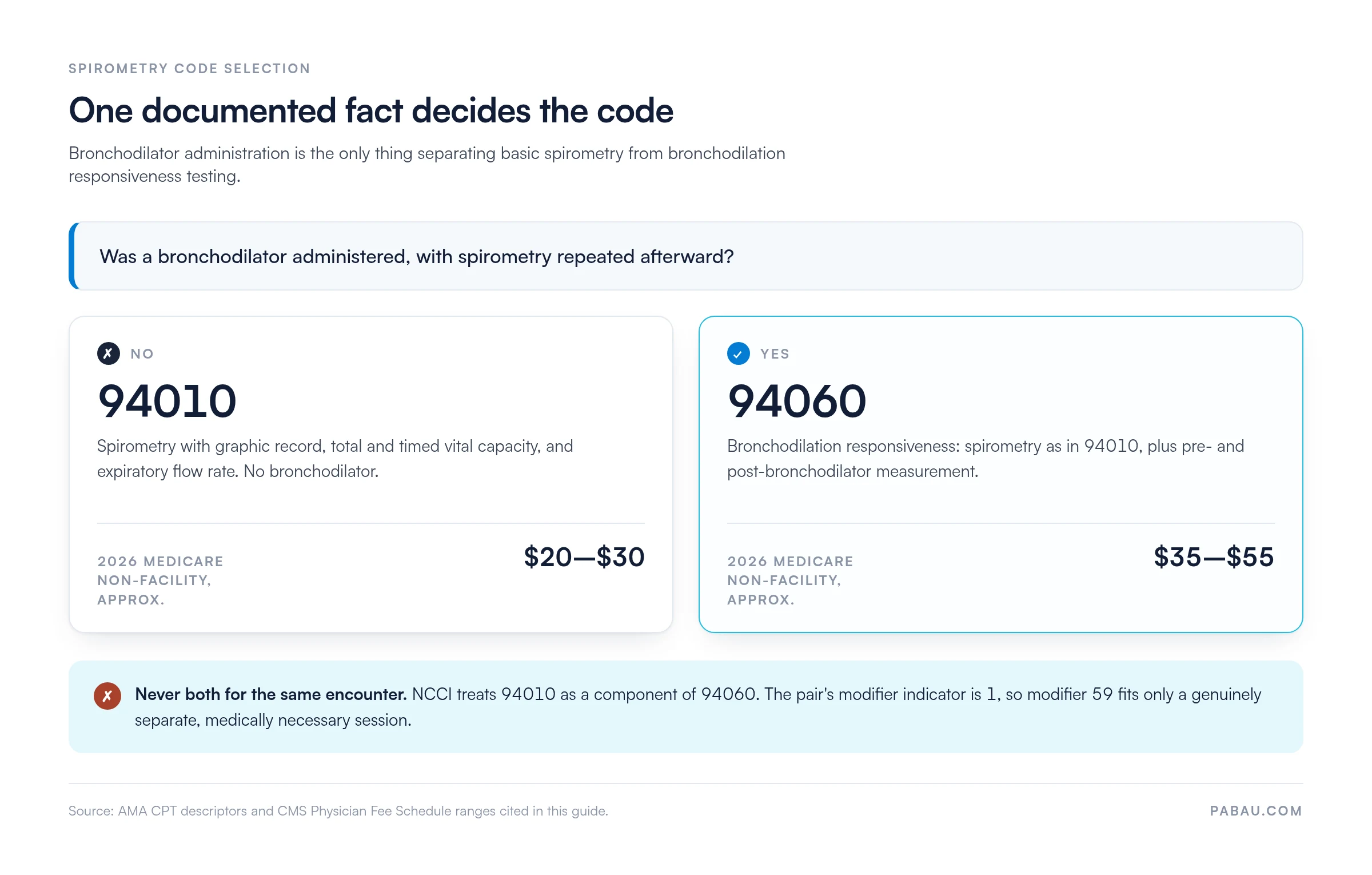
A provider may decide mid-visit to give a bronchodilator during routine spirometry. So, document that decision in the clinical note and bill only 94060. Instead, do not submit 94010 for the initial effort and 94060 for the post-bronchodilator effort. That is the NCCI violation behind most 94060 denials.
Medicare payment for CPT Code 94060 varies by place of service and geographic locality. According to the CMS Physician Fee Schedule lookup tool, 2026 non-facility rates for 94060 range about $35 to $55 by Medicare Administrative Contractor (MAC) jurisdiction. So, facility rates are lower because the practice expense component is attributed to the facility rather than the provider.
These figures are a guide only. Actual payment depends on the geographic practice cost index (GPCI) for your MAC jurisdiction. So, verify current rates in the CMS Physician Fee Schedule search tool before you submit claims or set a fee schedule.
Practices that submit online through practice management software like Pabau route 94060 claims via Claim.MD, its US clearinghouse partner. As a result, that connection supports real-time coverage checks and ERA remittance for thousands of commercial payers.
Missing documentation is the second most common denial reason for 94060 claims, behind only the 94010 bundling violation. Namely, CMS respiratory care billing article A57225 sets out what must be present in the medical record for this code to be covered under Medicare.
Capturing all six elements before the claim leaves the practice is the most effective way to prevent denials caused by missing records. For example, structured note templates configured for 94060 record bronchodilator type, dose, and pre/post values in discrete fields. In contrast, free-text notes bury those details, and that is where auditors find gaps. So, a checklist built into the note-taking workflow keeps each element in place before submission.
Coverage checks before the encounter matter here too. For instance, some payers apply Local Coverage Determination (LCD) restrictions that require pre-authorization for spirometry in specific patient populations. So, confirming coverage ahead of time prevents denials that have no connection to the coding itself.
The ICD-10-CM diagnosis code paired with 94060 must establish medical necessity. Payers review the diagnosis code to confirm the bronchodilation responsiveness test was clinically indicated. Below are the most frequently paired codes, confirmed by the AAPC CPT code reference and CMS respiratory care LCD documentation.
Use the most specific ICD-10-CM code available. For example, submitting J44.1 when the recorded diagnosis is mild intermittent asthma (J45.20) creates a medical-necessity mismatch that can trigger a post-payment audit. So, the diagnosis code in the record must match what is on the claim. Where the recorded diagnosis sits outside the table above, check the ICD-10-CM code reference for a more precise option first.
CPT Code 94060 sits within a family of pulmonary function testing codes. Knowing the full PFT CPT code set helps practices select the right code for each visit and avoid under-coding or over-coding. So, see the CMS annual CPT/HCPCS code list for current coverage status for each code.
94640 requires careful judgment alongside 94060. The bronchodilator given as part of the reversibility test already sits inside 94060. As a result, billing that same delivery separately as a 94640 nebulizer treatment invites payer scrutiny over whether it was a distinct treatment session. So, document the clinical rationale in the chart note if both codes are submitted.
Teaching the patient to use the inhaler or nebulizer is a separate service, reported with 94664. Its note must describe what was demonstrated and how the patient’s technique was assessed.
Two modifiers apply regularly to CPT Code 94060. First, which one you need depends on where the test is performed. Second, it also depends on how billing splits between the technical and professional components.
A pulmonologist with an in-office pulmonary function lab bills 94060 without a modifier: the global service includes both the technical performance and the physician’s review of the results. In contrast, the same pulmonologist reading spirometry performed at a hospital outpatient respiratory lab bills 94060-26 for the professional component only. The hospital separately bills 94060-TC. So, verify modifier acceptance with each payer before submitting: not all commercial payers follow the same rules as Medicare for modifier 26/TC split billing.
These are the denial patterns that appear most often across respiratory and pulmonology billing teams. Each one is a workflow problem rather than a one-off mistake, so each one has a fix that holds.
Tracking denials through the ERA is the fastest way to spot which reason code drives your rate. The CARC on the remittance names the cause: CARC 97 is a bundling edit, CARC 50 is a medical necessity issue, CARC 16 (often 163 or 164) flags missing records, and CARC 4 flags a modifier problem, not missing documentation as it’s often assumed.
A monthly denial report usually splits into two causes: coders billing 94010 when 94060 applies, or providers skipping the interpretation. Both are fixable at the source. A clearinghouse that runs bundling edits on the 837 file can catch the 94010/94060 pair before the payer ever sees it.
None of the denial reasons above are inevitable. Each one is avoidable at the workflow level. In fact, practice management software built for clinical billing helps in three specific places.
Structured documentation capture: When a provider selects 94060 in the billing workflow, a structured template prompts for each required element. That covers pre-bronchodilator values, bronchodilator name, dose and route, post-bronchodilator values, and the provider interpretation. In contrast, a free-text note leaves the provider to recall all six fields on every encounter.
Validated claim submission: Pabau pulls data already on the patient record into a pre-filled claim. It then checks required fields and authorization details before the claim goes out. Claims route online to Claim.MD, with real-time coverage checks against the payer. Pabau’s claims software for pulmonology does not pick the code for you, so the 94010 question is still settled in the note.
Electronic remittance processing: When a 94060 claim is denied, the ERA carries the CARC that explains why. Pabau posts that remittance back against the original claim on its own. A coder can then read the reason code, correct the claim, and resubmit without hunting through paper EOBs. As a result, the difference between that and manual posting shows up in days of accounts receivable.

Pabau captures structured spirometry data in the patient record, then submits and tracks the claim through Claim.MD. See how respiratory and pulmonology practices use it to get 94060 claims paid on the first submission.

Two decisions carry most of the money on a 94060 claim. The first is choosing 94060 over 94010 the moment a bronchodilator is given and re-measured. The second is putting all six required details in the record before the encounter closes.
Get those two right and the code becomes routine. So, a practice still losing revenue here should start with the note template rather than the claim form. That is usually where the missing element starts. To see how Pabau captures spirometry data and submits the claim, book a demo.

Want to see how clearinghouse billing works end to end? Medical claims clearinghouse guide walks through how claims move from practice to payer and where denials happen.
Getting denied for missing modifiers on split-billing claims? Medical billing workflows overview covers where modifier application fits into the wider claim submission process.
Need to cut denial rates across your full CPT code set? Denial codes in medical billing explains how to read CARC and RARC codes from your ERA and act on them faster.
Not sure how to read the remittance that comes back? Electronic remittance advice explained shows how to match an ERA to the original claim and work the denial.
Building the paperwork behind the claim? Superbill guide sets out what a complete charge document holds before it reaches the biller.
CPT Code 94060 is the billing code for bronchodilation responsiveness spirometry. It covers the spirometry described in CPT 94010, plus giving a bronchodilator. A second spirometry effort then measures the patient’s reversibility of airflow blockage. So, the code is used mainly in asthma and COPD evaluation.
Yes, Medicare covers CPT 94060 when medical necessity is established and records meet the requirements set out in CMS LCD A57225. Coverage may be subject to local coverage determinations that vary by MAC jurisdiction. So, verify your specific MAC’s LCD before billing.
Bundling 94010 with 94060 on the same visit is the most common. Missing pre- or post-bronchodilator records come next, followed by absent bronchodilator details. A missing provider interpretation and an incorrect place of service code round out the list. So, each maps to a specific CARC on the ERA remittance.
Bronchodilation responsiveness testing measures how much a patient’s airflow improves after receiving a bronchodilator. A baseline spirometry effort establishes the pre-bronchodilator values; after the bronchodilator is given (typically albuterol, 15-20 minutes before), a second spirometry effort captures the post-bronchodilator values. So, a significant improvement in FEV1 suggests reversible airflow blockage, supporting an asthma diagnosis.



