



CCSD code G5100: Bypass of duodenum billing guide
CCSD code G5100 bills a bypass that leaves the duodenum in place CCSD code G5100...

Last Updated: Oct 16, 2026

CPT code 93229 is the technical component of external mobile cardiovascular telemetry. It covers connection, patient instruction, attended surveillance, and data transmission for up to 30 days.
The monitoring service, IDTF, or hospital outpatient department that runs the surveillance center bills 93229. The interpreting physician bills CPT 93228, the professional component.
Do not append modifier -26 or -TC to either code. CMS billing and coding article A57476 rules both modifiers out for codes 93224 through 93229.
Report the date of service as the day the monitor was placed. One unit covers the whole episode of up to 30 consecutive days.
Practice management software like Pabau holds the signed order, the monitoring dates, and the diagnosis codes on one record. The claim then carries what an audit asks for.
CPT code 93229 is the technical component of mobile cardiovascular telemetry, and it holds almost all the payment. The monitoring vendor bills it, not the physician who reads the tracings. That physician bills CPT 93228 instead. Reverse the pair and you are short by roughly $990 per patient.
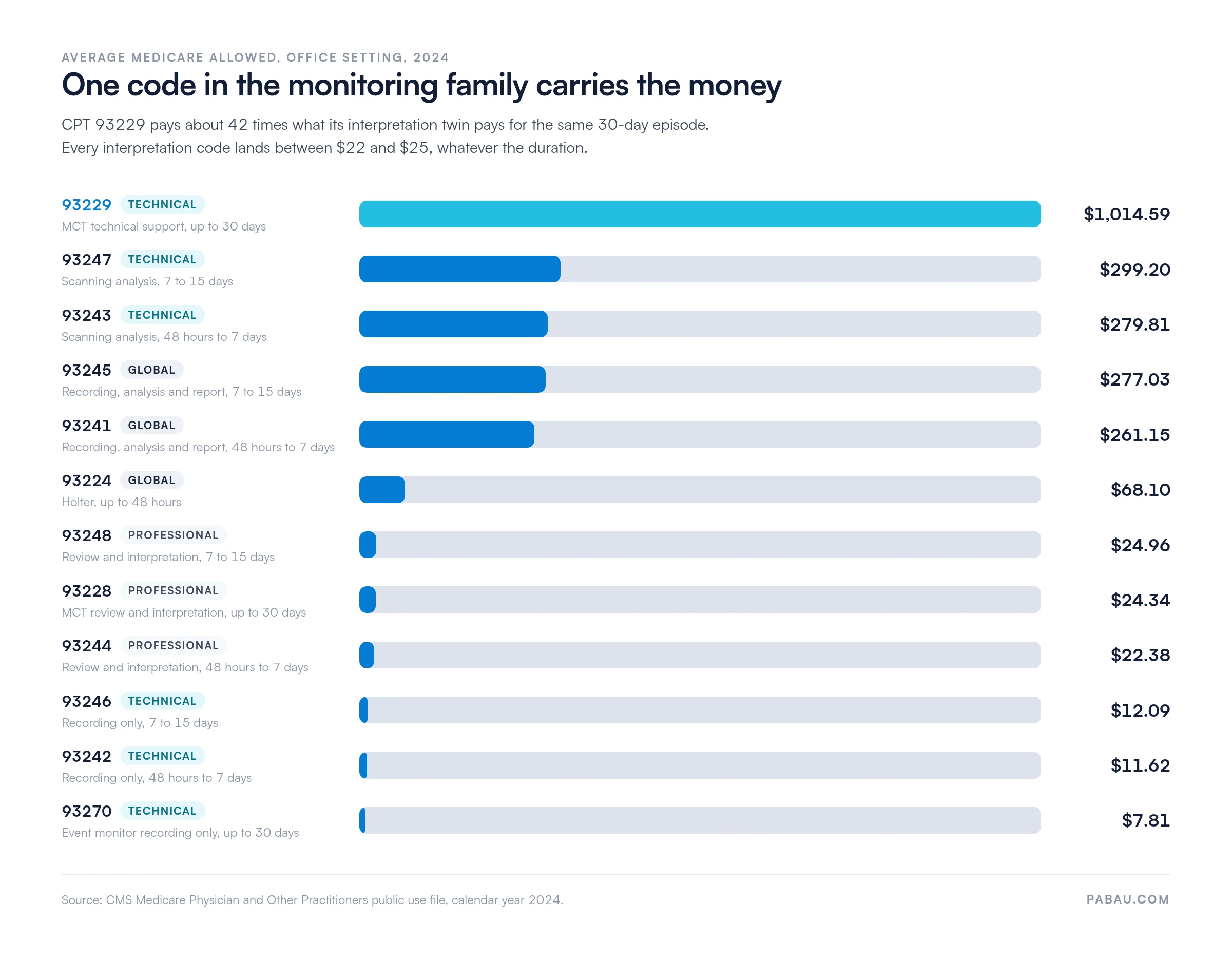
Medicare allowed an average of $1,014.59 on an office 93229 claim in 2024, against $24.34 for 93228. Two more rules decide whether the claim pays.
Neither code takes a -26 or a -TC modifier, and the date of service is the placement date. Coverage, documentation, and the diagnosis settle the rest.
CPT code 93229 pays for the equipment, the staff, and the surveillance side of mobile cardiovascular telemetry. It buys no physician time at all.
The clause after the semicolon in the descriptor is what separates it from its professional-component twin, and the American Medical Association (AMA) maintains that wording.
The descriptor is one long sentence, so it helps to read it in parts. The wording before the semicolon describes the service itself. The clause after it names the component, and that clause is what separates 93229 from 93228.
The underlying service goes by several names, which is one reason the codes get mixed up. The AMA descriptor calls it external mobile cardiovascular telemetry, and coders shorten that to MCT.
Device makers market the same service as mobile cardiac outpatient telemetry, or MCOT. All three names point at one service.
What sets it apart from a Holter or a patch monitor is the attended surveillance center. The device streams ECG data continuously to staff who watch it live and respond to events. A Holter stores its recording instead, and analysis waits until the patient returns the device.
CPT 93229 is the technical component and CPT 93228 is the professional component. The monitoring service that ships the device, teaches the patient to wear it, and staffs the surveillance center bills 93229.
The physician who reviews the tracings and signs the interpretive report bills CPT 93228. Neither one is a global code, so neither covers the other half.
A worked example makes the split concrete. A cardiologist orders 30 days of telemetry. A third-party vendor ships the patch, walks the patient through it, and staffs the surveillance center for the month.
The vendor bills 93229 under its own enrollment. The cardiologist reads the transmissions, signs the report, and bills 93228 on a separate claim. Two entities, two claims, one episode.
The money is what makes the split worth getting right. Both figures in the table come from the CMS Medicare Physician and Other Practitioners public use file for calendar year 2024.
Volume makes the stakes clearer still. Providers reported 389,272 office-setting 93229 services and 252,426 office-setting 93228 services in 2024. A monitoring service that submits 93228 by mistake collects around $990 less than the service it delivered.
Do not append modifier -TC or modifier -26 to CPT code 93229. CMS says so directly in billing and coding article A57476, which accompanies the electrocardiographic monitoring LCD. That article states that the -TC and -26 modifiers are not used with codes 93224 through 93229.
These codes are already split at the code level. A component modifier on top would describe a component of a component.
Plenty of published telemetry guidance gets this wrong. Some billing teams carry a “93228-TC plus 93229-26” convention across from a radiology or echocardiography workflow, where component modifiers do belong.
That rule does not reach this family, and the same convention usually reverses the two codes as well.
Remote cardiac device monitoring follows the same rule. CPT code 93296 is the technical component, so the physician analysis is billed under 93294 or 93295 instead of a modifier.
Place of service still matters, even with the modifier question settled. Report the setting where the monitoring service operates, not the patient’s home and not the ordering physician’s office. The interpreting physician reports their own place of service on the 93228 claim.
The entity that owns the equipment and staffs the attended surveillance bills CPT 93229. A physician who only reads the tracings never bills it, whatever their specialty.
Four arrangements cover almost every claim:
One arrangement to avoid: submitting 93228 and 93229 under a single tax ID when two separate entities performed the work. That looks like duplicate billing on a payer’s edit, and it is hard to unwind after payment.
A 93229 claim starts on day one of the episode, and it goes out once. The decisions that create denials mostly happen before the device even ships. Here is the sequence a clean episode follows.
Two steps carry most of the denials, and neither is about coding skill. Step two is a data-entry decision, and step five tests paperwork you either captured at intake or did not. The coverage policy behind step five is worth reading in full.
Medicare Part B covers CPT code 93229 when the monitoring is medically necessary and the record supports it.
The governing policy is LCD L34636, Electrocardiographic (EKG or ECG) Monitoring (Holter or Real-Time Monitoring), issued by Wisconsin Physicians Service. Article A57476 carries its billing and coding rules.
For monitoring across a 30-day window, the LCD recognizes indications such as:
Two questions come up on almost every audit call, so here are both answers up front.
One caution before you rely on any of this. Other MACs publish their own electrocardiographic monitoring policies, and the covered indications are not identical. Look up the LCD and billing article for your own jurisdiction before you submit.
Medicare allowed an average of $1,014.59 per office-setting 93229 claim in 2024 and paid an average of $800.93. CPT 93229 carries no physician work value at all.
Its payment is built from practice expense and malpractice value, which is why it pays like a monitoring service rather than an interpretation.
Your own rate will differ from the national average. Geographic practice cost indices adjust every locality up or down, and MAC pricing decisions move the technical code far more than the professional one.
Confirm the current figure through the CMS Physician Fee Schedule search tool before you quote a number to a patient or a payer.
Hospital outpatient departments are priced separately. There, 93229 falls under ambulatory payment classification 5721 in the OPPS, and the payment sits well below the office-setting fee schedule amount.
Check the current OPPS addendum for the rate that applies to your facility.
Commercial rates are contracted rather than published. Several payers also handle telemetry under a separate cardiac event detection policy, so read the contract before you assume the Medicare shape applies.
Reconcile your 93229 claims against device placement dates every month. The most common technical-component denial is a second claim inside an episode that already had one. A monthly match of claim dates against placement dates catches the duplicate while you can still correct and resubmit.
Technical-component claims fail post-payment review on records, not on code choice. Article A57476 and LCD L34636 put the retention duty on the IDTF or supplier that bills the code.
So the monitoring entity has to hold the paperwork, even though the physician wrote the order.
Where the order, the episode dates, and the diagnosis live on one patient record, the claim can be built straight from it. Nobody has to assemble the episode by hand.
That is the difference between passing a review and reconstructing an episode from three systems.
The monitoring entity reports the diagnosis the ordering physician documented, so the code on the 93229 claim should match the order. The codes below appear most often on telemetry claims.
Acceptance still varies by MAC and by commercial payer policy.
Treat this table as a starting reference rather than a covered-diagnosis list. Each code carries its own descriptor and exclusions, which our ICD-10-CM code reference sets out in full. Then crosswalk the diagnosis against your own MAC’s billing article before you submit.
CPT 93229 sits inside a family where nearly every duration tier splits into a global code and its component parts. Reading the clause after the semicolon is the only reliable way to tell them apart.
Two patterns fall out of those figures, and the chart below makes both visible. Interpretation codes pay roughly $22 to $25 across every duration tier. Technical codes swing from $7.81 to $1,014.59, depending on what the entity supplies.
The same logic explains the line between 93229 and the extended patch codes. Telemetry streams to staff who watch it live, while a patch monitor stores its recording for analysis after the device comes back.
A global code also never pays the sum of its parts, so billing 93245 alongside 93247 for one episode is unbundling.
The same split runs through the 48-hour Holter tier. 93225 covers recording only, billed by whoever supplies and connects the monitor, while 93224 covers all three parts. Scanning analysis with a report falls to 93226, and the physician who reviews and interprets the recording bills 93227.
Telemetry billing produces a short, repeatable list of mistakes, and each one has a specific fix.
Six questions catch almost all of the errors above, and they take about a minute per episode.
Six yeses and the claim is ready. Any no, and you have found the denial before the payer did.
Practices billing telemetry usually run one episode across three places. The order sits in the chart, and the monitoring dates sit with the device vendor.
Whoever builds the claim types it up from whatever made it into a message. By the time a payer asks for the record, someone is rebuilding it.
Practice management software like Pabau keeps the episode on one patient record instead. You can build a clinical note template for the order and the monitoring window.
The indication, the placement date, the requested duration, and the ordering physician then land in fields rather than free text. That record is what an appeal or a post-payment review asks for.
The claim then goes out from the same record. Every Pabau subscription includes claims software for practices, which routes the claim through Claim.MD.
That US clearinghouse connects to more than 4,000 payers. It supports CMS-1500 and 837P formats, real-time eligibility checks, and ERA and 835 remittance matching. So you can see what each payer allowed on a 93229 line without opening a paper EOB.

Pabau keeps the signed order, the monitoring dates, and the diagnosis on one patient record, then submits the claim through the Claim.MD clearinghouse. See how it works for your practice.

Four decisions carry a 93229 claim. The entity that supplies the device and staffs the surveillance bills it. The physician who reads the tracings bills 93228 instead. Neither line takes a component modifier, and the date of service is the placement date.
Get those four right and the rest of a telemetry claim is routine. Get the pair backwards and you are either short by around $990 or holding an overpayment, and the second one is worse. So build the habit of checking before submission, and you will rarely need the appeal.
That check is much easier when the order, the episode dates, and the diagnosis already sit on one record. Book a demo to see how Pabau builds a telemetry claim from the patient record your team is already keeping.

Need a framework for reducing claim denials across all CPT codes? Denial management in healthcare covers the most effective strategies for identifying, appealing, and preventing claim rejections.
Want to understand how the clearinghouse fits into your billing workflow? Medical claims clearinghouse explained breaks down how electronic claim routing works between practices and payers.
Looking for a primer on the full billing cycle for cardiology and other specialties? What is revenue cycle management covers the end-to-end workflow from patient intake through payment posting.
New to the mechanics of a medical claim? What is medical billing walks through how a service becomes a claim, and what each party contributes on the way.
Worried an audit would find something? Medical billing compliance sets out the checks that keep documentation and coding defensible across payers.
Yes. The descriptor says up to 30 days, so a shorter episode is still one unit. Document why monitoring ended early, and keep the placement date as the date of service.
Monitoring beyond 30 days is a new episode, and it needs a fresh order. Report that episode separately, with its own placement date. Never add units to the first claim.
Original Medicare does not require prior authorization for 93229. Many commercial plans and Medicare Advantage plans do require it for cardiac monitoring, so check benefits before the device ships.
Yes. The descriptor names a physician or other qualified health care professional, so an NP or PA can order it within their state scope. Keep the signed order on file either way.
Standard Part B cost sharing applies. Once the deductible is met, the patient owes 20 percent of the allowed amount. That coinsurance accounts for most of the difference between $1,014.59 allowed and $800.93 paid.
No. Remote patient monitoring codes cover physiologic data collection and management time for ongoing care. CPT 93229 is a diagnostic ECG test with attended surveillance, ordered for a set episode.
An IDTF or a physician office reports it on the CMS-1500, or its 837P electronic equivalent. A hospital outpatient department bills institutionally, and the payment runs through the OPPS.



