



CCSD code G5100: Bypass of duodenum billing guide
CCSD code G5100 bills a bypass that leaves the duodenum in place CCSD code G5100...

Last Updated: Oct 16, 2026

CPT code 93228 is the professional component of mobile cardiovascular telemetry. It pays the physician who reviews the monitoring data and signs the report.
CPT code 93229 is the technical component. The monitoring service bills it for the device, patient hookup, attended surveillance, and daily data transmission.
Neither code takes modifier -26 or -TC. CMS billing article A57476 tells providers not to append those modifiers to codes 93224 through 93229.
Reversing the pair is costly. Medicare allowed an average of $1,014.59 per 93229 claim in 2024, against $24.34 per 93228 claim.
Practice management software like Pabau links the signed interpretation report to the claim, so the correct component code reaches the payer.
CPT code 93228 is the professional component of mobile cardiovascular telemetry (MCT). It pays the physician who reviews the monitoring data and signs the interpretive report. The device, the patient hookup, the attended surveillance center, and the daily data transmission all sit under CPT 93229, the technical component. Coders reverse this pair often enough that it is worth settling first.
The two codes share an identical descriptor preamble and differ only in the clause after the semicolon. That single clause decides who bills, what gets paid, and which record has to be in the chart. The table below sets out where 93228 sits.
CPT 93228 is the professional component and CPT 93229 is the technical component. The physician who reads the tracings and signs the report bills 93228. The monitoring service that ships the device, teaches the patient to wear it, and staffs the surveillance center bills 93229.
Neither code is a global code, and neither one covers the other half of the service.
The size of the payment difference is why this matters more than a typical component split. In calendar year 2024, Medicare allowed an average of $1,014.59 per office-setting 93229 claim. The average for an office-setting 93228 claim was $24.34.
Both figures come from the CMS Medicare Physician & Other Practitioners public use file. A monitoring service that submits 93228 by mistake collects around $990 less per patient than the service it delivered.
The volume behind those averages is substantial. Providers reported 389,272 office-setting 93229 services and 252,426 office-setting 93228 services in 2024. At that scale, a coding convention that reverses the pair does not stay a small problem for long.
Do not append modifier -26 or modifier -TC to CPT code 93228. CMS says so directly in billing and coding article A57476, which covers electrocardiographic monitoring. That article states that the -TC and -26 modifiers are not used with codes 93224 through 93229.
Those codes are already split at the code level, so a component modifier would describe a component of a component.
This is where a lot of published MCT guidance goes wrong. Practices that copy a “93228-TC plus 93229-26” convention from a radiology or echocardiography workflow are applying a rule that does not reach this family. Practice management software like Pabau validates codes at submission, so a stray component modifier gets caught before the payer sees it.
Place of service still matters for 93228 even though the modifier question is settled. Report the setting where the physician performed the interpretation, not the patient’s home and not the monitoring center. The monitoring service reports its own place of service on the 93229 claim. The AAPC Codify CPT lookup carries payer-specific notes worth checking alongside your MAC’s billing article.
Mobile cardiovascular telemetry is ambulatory cardiac monitoring with a wearable sensor. The sensor records ECG data and transmits it in real time to a remotely attended surveillance center. Automatic triggers and patient-initiated event capture work alongside live technician oversight. That combination suits infrequent or unpredictable arrhythmias better than a passive recorder does.
Medicare covers MCT when the service is medically necessary and the claim meets the Local Coverage Determination requirements for the applicable MAC. Coverage is not automatic for any cardiac symptom. CMS’s Physician Fee Schedule lookup tool confirms that 93228 is an assigned, payable code under Medicare Part B.
CPT 93228 is a physician work code, so it pays like an interpretation rather than like a monitoring service. The figures below come from the CMS Medicare Physician & Other Practitioners public use file for calendar year 2024, the most recent release. They are national averages of what Medicare allowed, not fee schedule maximums.
Your own rate will differ from the national average. Geographic practice cost indices adjust every locality up or down, and MAC pricing decisions move the technical code more than the professional one. Confirm the current figure through the CMS Physician Fee Schedule search tool before you quote a number to a patient or a payer.
Verify your fee schedule quarterly rather than once each January. CMS issues mid-year corrections, and MACs update their coverage articles on their own schedule. A quarterly check against the current file catches those shifts while you can still rebill, instead of after the timely filing window closes.
The leading cause of 93228 denials is missing documentation rather than the wrong code. MACs running post-payment review on MCT claims cite incomplete records more than any other finding. Compliance starts with knowing what the chart has to hold before the claim goes out.
The diagnosis on the 93228 claim has to justify a 30-day attended monitoring episode. The codes below appear most often on MCT claims, but each MAC publishes its own payable list. Check that list before you rely on any of them. Our ICD-10-CM code reference covers these diagnosis codes in more detail.
CPT 93228 sits inside a family where almost every duration tier is split into a global code and its component parts. Reading the clause after the semicolon is the only reliable way to tell them apart. The AMA CPT code set overview describes how the classification is organized.
Two patterns fall out of that table, and the chart below sorts the family so both are visible at once. The interpretation codes across every tier pay roughly $22 to $25. The technical codes swing from $7.81 to $1,014.59, depending on what the entity supplies.
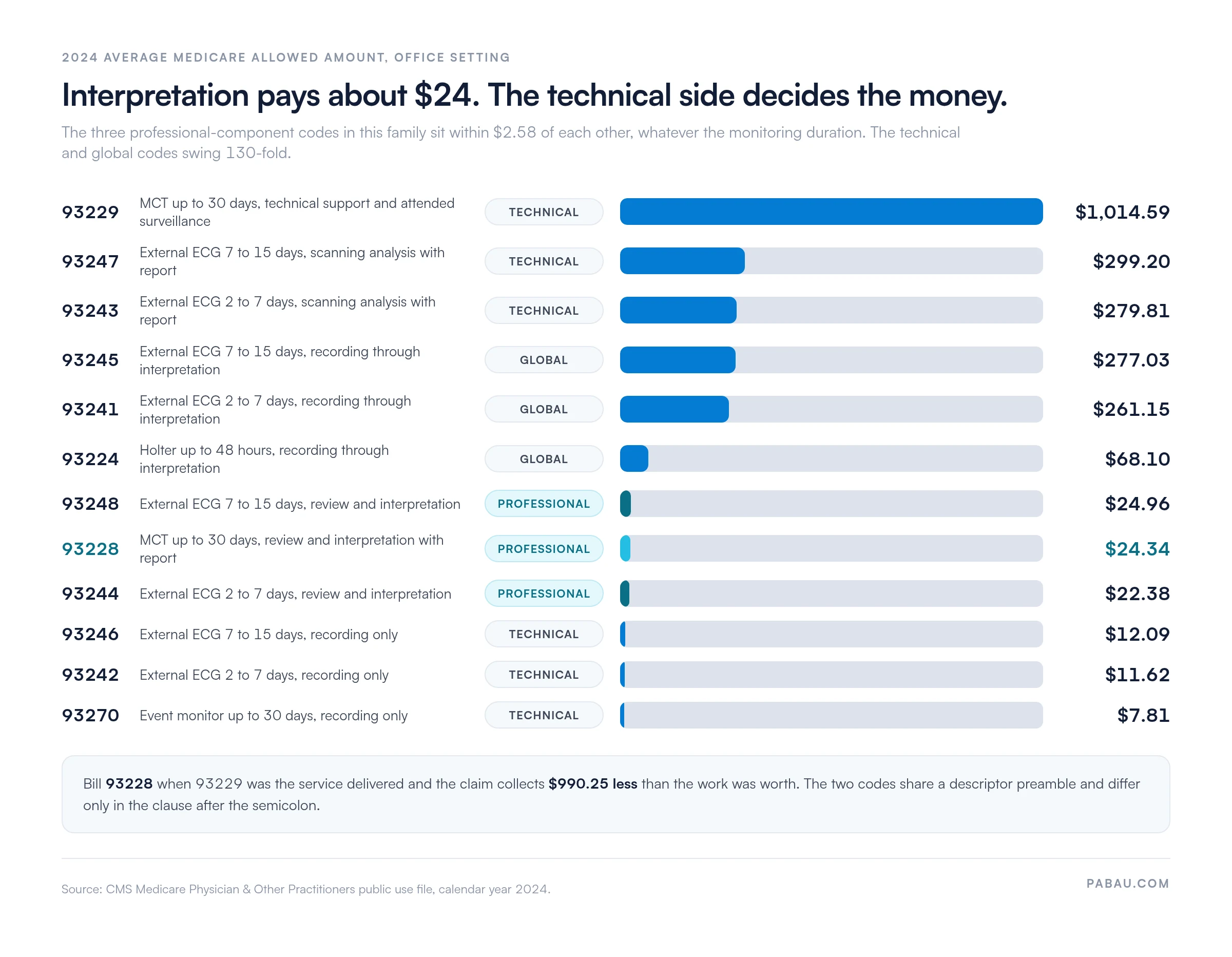
A global code also never pays the sum of its parts. Billing 93245 and 93247 for the same episode is an unbundling error, not a rounding difference.
The 48-hour Holter tier splits along the same lines. Global code 93224 covers the full study, while 93225 covers the recording alone and 93226 the scanning analysis. The physician who reads that study and signs the report bills 93227, the same professional role 93228 plays for MCT.
Practices offering several monitoring modalities should write down a code-selection rule. Record which device was ordered, why it was chosen over the alternatives, and the expected duration. That note is what stops a claim crossing from the Holter family into MCT when a patient switches devices mid-episode.
Implanted devices sit outside this external family. Remote interrogation of an implantable cardiovascular monitor is reported under CPT code 93297, on a monitoring period of up to 30 days. An implanted defibrillator takes a different code, 93295, which covers the physician analysis and report across a period of up to 90 days.
Cardiology audits surface the same handful of 93228 errors again and again. Most are caught by a pre-submission checklist. Proactive denial management workflows catch them before the claim leaves. When rejections do come back, cross-reference your remittances against the CARC reason codes you see most on MCT claims.
Build a pre-dispatch checklist for MCT orders. Before the device ships, confirm that the order is signed and dated. Check that eligibility shows MCT coverage under the governing LCD. Confirm prior authorization if the payer wants it. Then add one more line. Name which entity will bill 93228 and which will bill 93229, because settling that at order entry is what stops the component swap.
The distance between a correctly ordered MCT service and a paid 93228 claim is usually a workflow problem. When the order, the monitoring dates, and the interpretive report live in three systems, the biller assembles the claim from memory.
That is where the component code gets picked wrong. Capturing each element at the point of care removes the guesswork.
Pabau’s claims management software submits 93228 claims electronically through Claim.MD in the 837P format, reaching 4,000+ US payers. Real-time eligibility verification runs before the monitoring episode starts. You learn whether the plan covers MCT under the governing LCD before the device is dispatched.
Electronic remittance advice comes back into the same workflow, carrying the denial reason codes straight to the billing team. Nobody has to reconcile paper explanations of benefits to find out why a claim stalled. For a cardiology practice running several monitoring modalities, that shortens the loop between a rejection and a corrected resubmission.
Structured clinical note templates carry the rest of the weight. You can configure a template that prompts for the order language, the clinical indication, the monitoring dates, and the signed interpretive report. The record a MAC asks for on audit then gets built as the episode runs.
Because the claim draws from that same encounter record, the code and place of service come from one source rather than from a re-keyed summary.

Pabau connects clinical documentation, scheduling, and claims submission in one platform. Templates prompt for the exact records a MAC audits on an MCT claim. The Claim.MD integration then validates codes on the way out to 4,000+ US payers.

CPT code 93228 belongs to the physician who reads the monitoring data and signs the report. CPT code 93229 belongs to the service that supplies the device and staffs the surveillance center. Neither one takes a -26 or -TC modifier, because each already describes a single component. Fix those two points and most MCT denials stop arriving.
What remains is a documentation problem, and it responds to workflow. Capture the signed order, the monitoring dates, and the interpretive report as the episode runs, then let the claim draw from that record. To see how that works in a cardiology or multi-specialty practice, book a demo with the Pabau team.

Confused about how clearinghouse claims routing works? Medical claims clearinghouse explains the electronic submission pipeline from 837P file to ERA, including how payer rejections are handled.
Need to understand ERA processing for MCT remittances? Electronic remittance advice covers how ERA files carry CARC denial codes and how to action them without manual EOB reconciliation.
Building your revenue cycle from the ground up? Superbill guide walks through how a superbill captures CPT and ICD-10 codes at the point of service, feeding directly into the claim submission workflow.
CPT code 93228 reports the professional component of mobile cardiovascular telemetry. The interpreting physician bills it for reviewing up to 30 days of transmitted ECG data, responding to reported events, and issuing a signed report. The device, the patient hookup, and the attended surveillance center are billed separately under CPT 93229.
CPT 93228 is the professional component and CPT 93229 is the technical component. The physician who reviews the data and signs the report bills 93228. The monitoring service that supplies the device, instructs the patient, and runs attended surveillance bills 93229. Both descriptors share the same preamble and differ only in the clause after the semicolon.
The physician bills it. CPT 93228 pays for review and interpretation with a report by a physician or other qualified health care professional. The monitoring company bills CPT 93229 instead, which covers technical support, patient instruction, attended surveillance, and daily data transmission.
Not -26 and not -TC. CMS billing and coding article A57476 instructs providers not to use those modifiers with codes 93224 through 93229. Each code already describes a single component. Modifier -59 may apply where an NCCI edit pairs 93228 with a genuinely distinct same-day service, but only with documentation supporting the distinction.
In calendar year 2024, Medicare allowed an average of $24.34 per office-setting 93228 claim and paid an average of $18.98, according to CMS utilization data. The technical companion code 93229 allowed an average of $1,014.59 in the same setting. Your locality’s rate will differ, so check the CMS Physician Fee Schedule.
Yes, when the service meets the Local Coverage Determination requirements for the applicable MAC. Coverage generally requires a documented clinical indication and a signed physician order predating the monitoring period. You also need evidence that shorter monitoring was attempted or was clinically inappropriate. Criteria vary by MAC, so verify with your own contractor before billing.
You need a signed physician order predating the monitoring start, a note explaining medical necessity, records of the monitoring dates, and the signed interpretive report. The report is the billable work for this code. Missing any of these is the most common cause of post-payment denials on MCT claims.
CPT 93228 covers interpretation of MCT monitoring, which runs up to 30 days with real-time attended surveillance. Codes 93241 through 93248 cover long-term Holter recording of 48 hours to 15 days with no attended surveillance center. Holter is usually ordered first, and MCT follows when passive recording did not capture the arrhythmia.



