HCPCS Code V2208: Spherocylinder bifocal lens billing guide
HCPCS Code V2208: Definition and code attributes HCPCS Code V2208 is a Level II ...

Last Updated: Oct 7, 2026
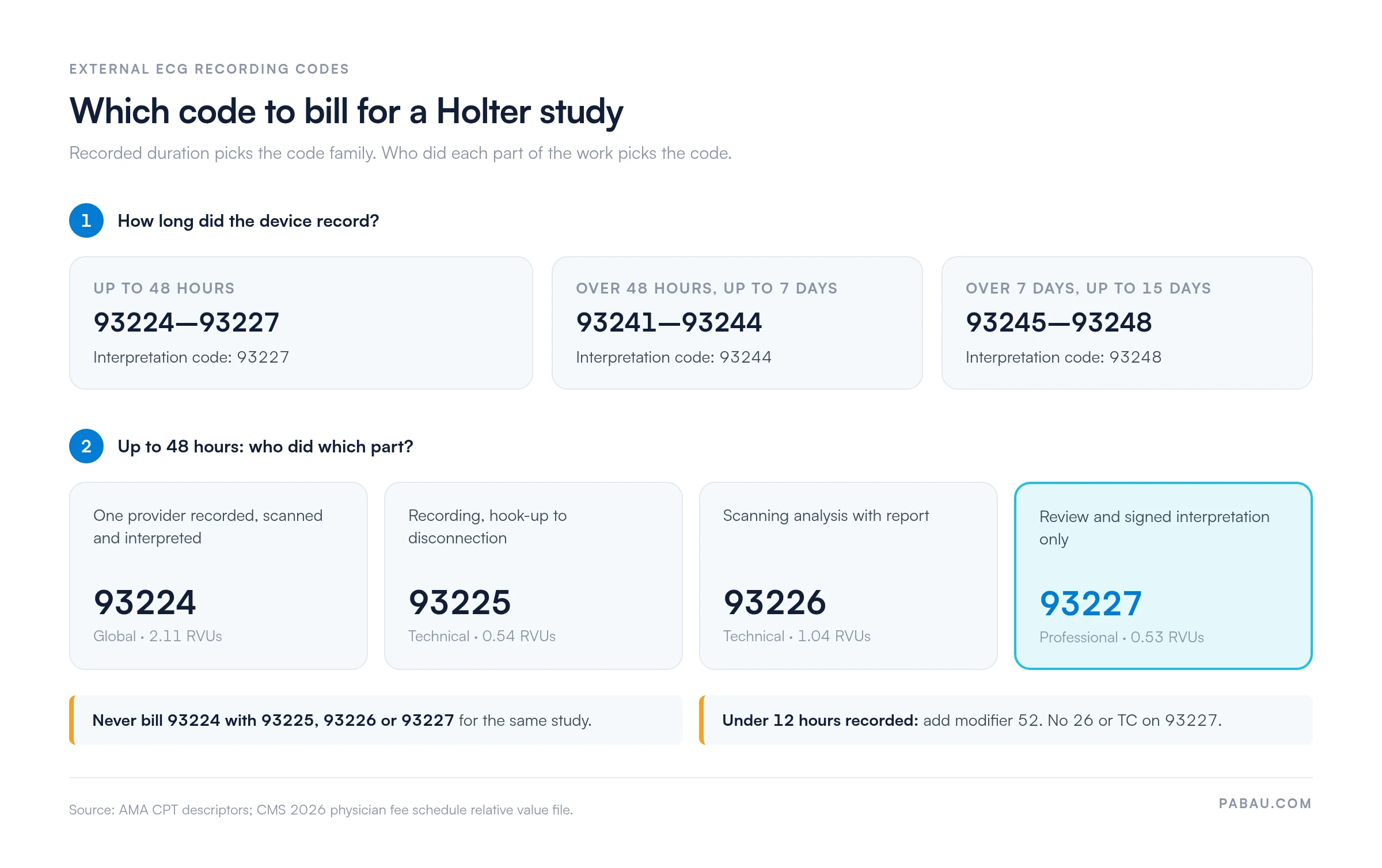
93227 is the CPT code for the physician review and interpretation of a Holter monitor study lasting up to 48 hours. It covers the professional component only, which means reading the stored rhythm data and scanning report, then signing the interpretation.
Recording is billed as 93225 and scanning analysis as 93226. When one provider performs all three parts, bill the global code 93224 instead, never alongside 93227.
Let Pabau's smart automation suggest the right codes, reduce claim denials, and keep your practice compliant—effortlessly.
Automate repetitive tasks and focus on what matters most—your patients.
Reduce coding errors and ensure compliance with the latest regulations.
Clean claims, fewer denials, and faster reimbursements.
Powerful insights and reporting to help your practice thrive.
HIPAA compliant SOC 2 certified GDPR-compliant Trusted by 4,000+ clinics worldwide

CPT code 93227 covers only the professional component of a Holter study up to 48 hours, which is the physician’s review and interpretation.
Recording is billed as 93225 and scanning analysis as 93226, while 93224 is the global code for one provider doing all three parts.
Never bill 93224 alongside 93225, 93226 or 93227 for the same study, because the global code already includes each component.
Modifiers 26 and TC do not apply to 93227, since CMS lists it as a professional-component-only code with PC/TC indicator 2.
In 2026, 93227 carries 0.53 total RVUs, which works out to $17.70 nationally at the non-QP conversion factor before locality adjustment.
CPT code 93227 reports the physician review and interpretation of a Holter monitor study lasting up to 48 hours. The AMA descriptor opens with the shared family text: external electrocardiographic recording up to 48 hours by continuous rhythm recording and storage. The 93227 portion adds review and interpretation by a physician or other qualified health care professional.
In short, 93227 pays for the read. The monitor hook-up is billed as 93225 and the scanning report as 93226, each by whoever performs it.
Because 93227 is interpretation only, the claim stands or falls on the signed interpretation report. Without one, the service was not performed, whatever the device data shows.
The 93224-93227 codes all describe the same service: external ECG recording for up to 48 hours. They differ only in which part of that service each code reports. Duration does not separate them.
A study under 12 hours of continuous recording still uses these codes, with modifier 52 for reduced services. A study longer than 48 hours moves to the 93241-93248 family covered below. PC/TC indicators come from the CMS physician fee schedule relative value files.
Bill 93227 when your physician interprets the study and someone else handles some or all of the technical work. When one provider performs every part, bill 93224 instead.
The bundling conflict to watch is 93224 billed with any of its components. The NCCI edits treat 93225, 93226 and 93227 as parts of 93224, so pairing them for one study is unbundling. Billing 93225, 93226 and 93227 together is fine when no one bills 93224.
The three component codes add up to the global code in 2026. 93225 (0.54), 93226 (1.04) and 93227 (0.53) total 2.11 RVUs, the same as 93224. Splitting the study across providers only changes who gets paid. Medicare’s total for the study stays at 2.11 RVUs.
Most 93227 claims need no modifier at all. The code already defines the professional component, so the usual component modifiers have no job to do.
The same logic covers the rest of the family. 93225 and 93226 are technical-only codes, and 93224 is a global test-only code, so none of them takes 26 or TC either.
The 93241-93248 codes took effect on January 1, 2021, for external ECG recording longer than 48 hours. They added coverage for longer studies and did not replace 93227. A study of 48 hours or less still bills under 93224-93227.
Each extended set mirrors the Holter structure. It has a global code, two technical codes and one review and interpretation code. Choose the family by the recorded duration, then choose the component by who did the work.
Mobile cardiovascular telemetry (MCT) is a different service from Holter monitoring, so it has its own codes. 93228 is the review and interpretation component, and 93229 is the technical component.
For one monitoring period, report Holter or MCT, not both. If the device transmitted events to an attended center, the MCT codes apply. If it stored the rhythm for later scanning, use the Holter family.
A 93227 claim rests on the interpreting physician’s work, so the record has to show that work clearly. Payers look for these elements.
Pairing CPT code 93227 with an unsupported diagnosis is a common denial cause. The codes below are frequent Holter indications, though coverage details vary by payer and local coverage policy. Report R55 for syncope only when the workup has not documented a more definitive cause.
Medicare pays 93227 at 0.53 total RVUs in 2026: 0.38 work, 0.14 practice expense and 0.01 malpractice. The facility and non-facility values match, so place of service does not change the 93227 payment.
These figures are national amounts, calculated as total RVUs multiplied by the 2026 conversion factor. CMS set two factors for 2026: $33.5675 for qualifying APM participants (QPs) and $33.4009 for other clinicians. Your local payment then shifts with the geographic practice cost indices for your locality.
RVUs come from the CMS 2026 relative value file (October release). Check the CMS Physician Fee Schedule lookup tool for your locality, and expect commercial rates to follow each contract.
Original Medicare does not require prior authorization for Holter monitoring. Medicare Advantage and commercial plans set their own rules, and some require authorization for ambulatory ECG studies.
Confirm the requirement before the monitor goes on, because retroactive authorization is rarely guaranteed. Strong insurance eligibility verification at booking catches most of these cases.
Most 93227 denials trace back to a handful of root causes. Effective denial management starts with naming the cause, because each one needs a different fix.
A clean claim workflow that checks these points before submission prevents most of these denials. When a denial does come back, its claim adjustment reason code names the cause, and reading denial codes points you to the fix.
Most 93227 errors start in setup, before anyone codes a single study. A superbill that defaults to 93224, or a charge screen that appends 26 to every diagnostic test, repeats the same mistake on each claim.
Pabau, the practice management and billing platform we build, keeps insurer details on the patient record. With Pabau’s claims management software, each invoice becomes a pre-filled claim without re-keying. Pabau checks that details such as membership numbers and authorization codes are present before you send.
In the US, Pabau submits claims through Claim.MD, its clearinghouse partner, to thousands of payers. You can check eligibility in real time before hook-up, track each claim and post ERA remittances in one place. Coverage problems surface while they are still easy to fix.
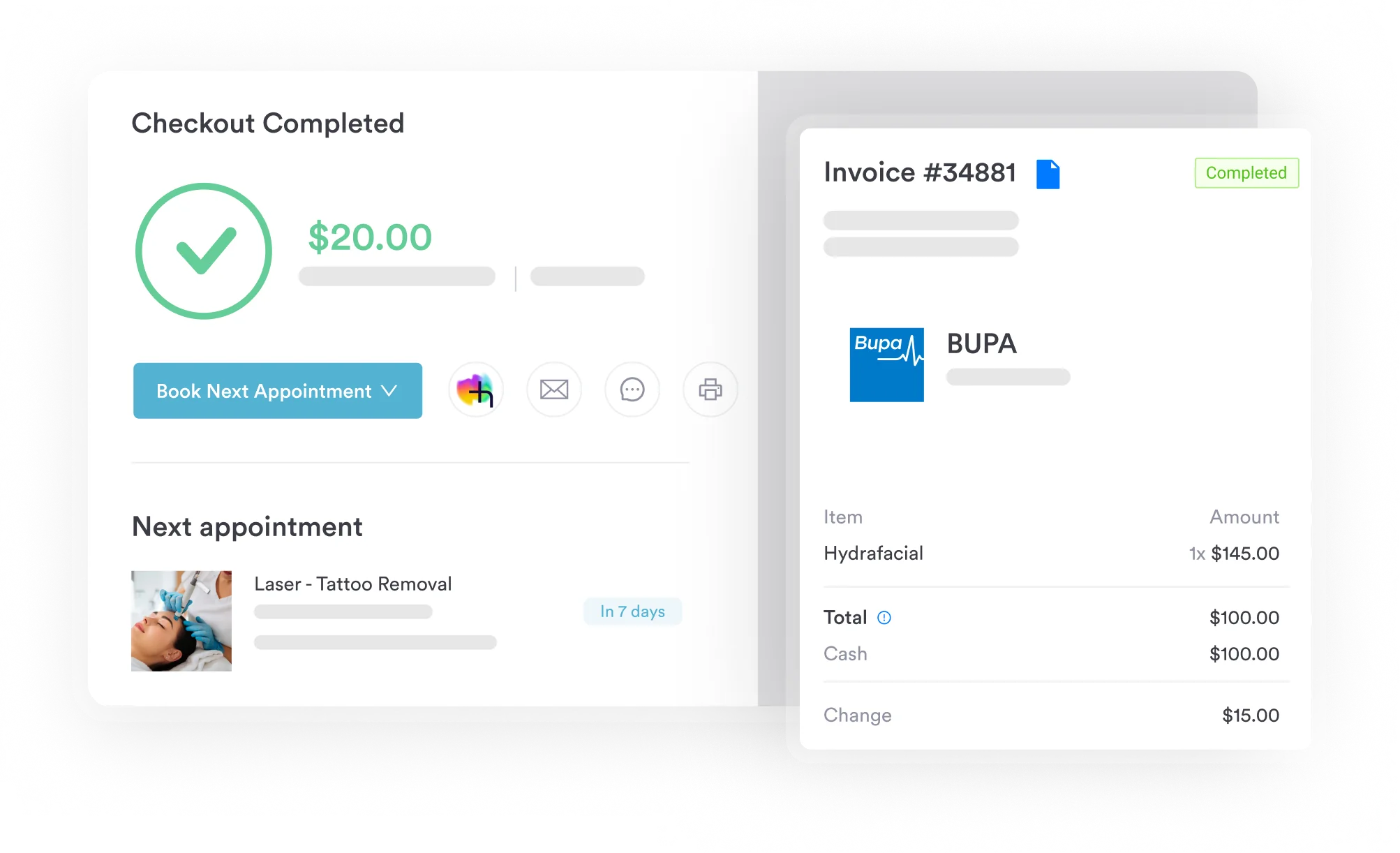

Pabau pre-fills insurance claims from the patient record and checks for missing details before you send. You can then track every 93227 claim through to ERA posting.

93227 is the physician’s line on a Holter claim. Ask who hooked up the monitor, who scanned the data and who signed the read, and the code choice follows.
If your practice does all three, 93224 pays the same total in one line and avoids split-billing errors. If you only interpret, 93227 with no modifier is correct, and the signed report is your evidence.
Getting this right protects a small payment on every study, which adds up across a cardiology schedule. Book a demo to see how Pabau keeps Holter claims accurate from the first submission.

Need a reference for electronic claims submission standards? 837 file format and medical billing covers how the 837P transaction set structures claim data for clearinghouse submission, including modifier fields and ICD-10 linkage.
Concerned about billing compliance for cardiac monitoring? Medical billing compliance fundamentals covers the documentation and audit-trail requirements that apply to diagnostic procedure billing.
Want to understand the clearinghouse role in claim adjudication? Medical claims clearinghouse guide explains how clearinghouses validate and route claims, and where eligibility checks fit before submission.
Is the device transmitting events in real time? CPT code 93229 covers the technical component of mobile cardiovascular telemetry, the counterpart to interpretation code 93228.
Billing a resting ECG rather than an ambulatory study? CPT code 93000 covers the routine 12-lead ECG with interpretation and report.
CPT code 93227 covers the review and interpretation of an external ECG recording up to 48 hours. A physician or other qualified health care professional performs it. It is the professional component only. Recording is billed as 93225 and scanning analysis as 93226.
CPT 93225 is the recording component of a Holter study, including connection and disconnection. CPT 93227 is the physician review and interpretation. They are different parts of the same service, so different providers can bill each one.
No. Codes 93241-93248 took effect on January 1, 2021, for recordings longer than 48 hours. 93227 remains the interpretation code for studies of 48 hours or less.
No. CPT 93224 is the global code and already includes the review and interpretation that 93227 describes. Billing both for the same study is unbundling and will be denied. Bill 93224 alone, or bill the components separately.
CPT 93227 is the interpretation of a Holter recording up to 48 hours. CPT 93228 is the review and interpretation of mobile cardiovascular telemetry, transmitted to an attended surveillance center for up to 30 days. Report one or the other for a monitoring period.