HCPCS code J3471: Hyaluronidase ovine injection billing guide
HCPCS code J3471: Descriptor, code type, and quick-reference data HCPCS code J34...

Last Updated: Oct 14, 2026
93295 is the CPT code for remote interrogation of a single, dual, or multiple lead implantable defibrillator system, up to 90 days. It covers interim analysis, review(s) and report(s) by a physician or other qualified health care professional.
Coders often confuse it with CPT 93294, which covers pacemakers and leadless pacemakers. Confirming that the device defibrillates before coding prevents the most avoidable 93295 denial, and the technical work bills separately under 93296.
Let Pabau's smart automation suggest the right codes, reduce claim denials, and keep your practice compliant—effortlessly.
Automate repetitive tasks and focus on what matters most—your patients.
Reduce coding errors and ensure compliance with the latest regulations.
Clean claims, fewer denials, and faster reimbursements.
Powerful insights and reporting to help your practice thrive.
HIPAA compliant SOC 2 certified GDPR-compliant Trusted by 4,000+ clinics worldwide

CPT Code 93295 covers remote interrogation of single, dual, or multiple lead ICD systems, while pacemakers and leadless pacemakers bill under 93294.
One unit covers a service period of up to 90 days per patient per device, so billing a second unit early triggers a frequency denial.
93295 is the physician review and report, and 93296 is the technical data transmission that the practice may bill alongside it.
Medicare’s 2025 national payment for 93295 is about $35, the same in facility and non-facility settings.
Pabau, our practice management software, sends 93295 and 93296 claims to payers electronically through its Claim.MD integration.
CPT Code 93295 is the code for remote interrogation of a single, dual, or multiple lead implantable defibrillator system, up to 90 days. It covers interim analysis, review(s) and report(s) by a physician or other qualified health care professional. The American Medical Association (AMA) maintains the CPT code set and places 93295 in the remote cardiac device family with 93294, 93296, and 93298.
The phrase “up to 90 days” defines the service period, not a session. One unit of 93295 covers every remote transmission reviewed within a 90-day window for one patient with one ICD system. That boundary drives scheduling and billing for any cardiology or electrophysiology practice running a remote device clinic.
The code applies to three ICD lead configurations.
A pacemaker-only device, with no defibrillation capability, is never billed under CPT Code 93295. Use 93294 for those devices, including leadless pacemakers.
The remote interrogation under CPT Code 93295 covers a defined set of components. Billing outside those components, or billing for services explicitly excluded, triggers denial or audit.
The clinical workflow for CPT Code 93295 involves the patient, the device manufacturer’s home monitoring system, and the practice’s device clinic. Each step generates documentation that supports a payable claim.
Documentation minimum: The report must be signed by the reviewing physician or QHP and include the date of review. It must also document arrhythmia episode analysis, lead integrity findings, battery status, or parameter review.
A note that only says “transmission reviewed, no changes” carries no clinical findings. It is insufficient for billing and a common audit target.
CPT 93295 covers ICD remote interrogation, and CPT 93294 covers pacemaker remote interrogation. Billing the code for the wrong device type is one of the most frequent denial triggers in this family. The table below shows the key differences.
Practical tip: When a patient has a CRT-D device (cardiac resynchronization therapy with defibrillation), the correct code is 93295, not 93294. CRT-D devices deliver defibrillation therapy and qualify as ICD systems under the CPT definition. The device type settles the code before anything else, as the decision chart below shows.
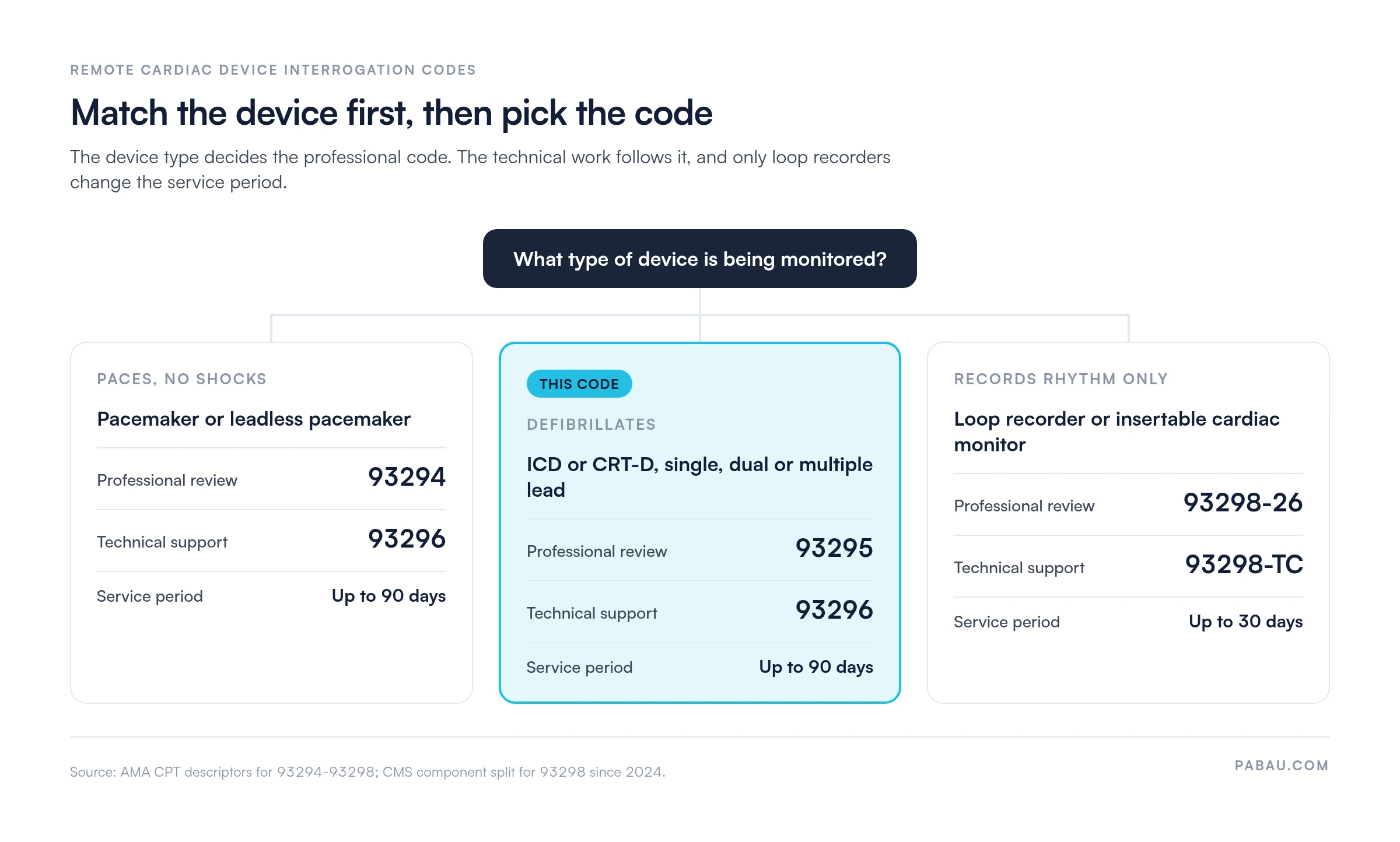
CPT Code 93295 is the professional component of remote ICD interrogation. CPT 93296 is the technical component, covering the receipt and processing of the transmitted data. In many practices, two separate entities perform these two functions.
When a single practice performs both components, as is common in independent cardiology offices, both codes go on the same claim. When a hospital or health system provides the technical infrastructure, the facility bills 93296 and the physician group bills 93295.
Billing only 93295 when your practice also runs the technical component leaves revenue unbilled. Billing both codes when you don’t control the technical component is an overbilling error.
Before submitting claims for both 93295 and 93296 on the same date of service, confirm in writing which entity owns the home monitoring infrastructure. Check this against your payer contract, not just your internal assumption. Payer audits frequently target practices that bill both components without a documented technical setup.
The 93294-93298 remote interrogation family splits by device type and by component. Knowing the whole family helps coders avoid cross-code confusion and spot unbundling errors before they reach the payer.
Note on 93298: Unlike the rest of the family, the loop recorder code 93298 bills in 30-day service periods rather than 90-day cycles. Since 2024 it also carries its own technical component, so loop recorder checks never go through 93296. The AAPC Codify CPT lookup lists descriptors and cross-references for the full family.
Medicare pays for CPT Code 93295 under the Medicare Physician Fee Schedule (MPFS). The Centers for Medicare and Medicaid Services (CMS) updates it each calendar year. The figures below are 2025 national amounts. Check current payment with the CMS Physician Fee Schedule search tool before quoting rates to patients or practice leadership.
Because 93295 pays only for the physician’s review and report, the practice expense RVU barely moves between settings. Equipment and staff costs sit in 93296 instead. For RVU detail, the FastRVU RVU lookup tool pulls directly from CMS data files.
When electronic remittance advice arrives after adjudication, check the allowed amount against your payer contract, not just the Medicare rate. Commercial payers may pay above or below Medicare, depending on the contracted fee schedule. Prior authorization rules for 93295 vary by payer and plan, so confirm them before the first claim under a new plan.
Billing CPT Code 93295 correctly turns on five rules: the 90-day service period, place of service, the diagnosis pointer, same-day office visits, and prior authorization. A clearinghouse that checks these rules before claims reach the payer cuts preventable denials.
Knowing how a medical claims clearinghouse works shows billing teams where 93295 claims get validated, scrubbed, and sent to payers. Its edit checks catch frequency violations, POS mismatches, and missing diagnosis codes before the claim leaves the practice. For medical billing compliance around remote monitoring documentation, the CMS Medicare Claims Processing Manual (Chapter 12) is the authoritative reference.
Claim denials for CPT Code 93295 cluster around a small number of root causes. Most are preventable with front-end claim edits and documentation standards. The denial codes that accompany these rejections often tell coders enough to correct and resubmit without a full appeal.
Build a 90-day service period tracker in your practice management system, indexed by patient MRN and device implant date. Flag accounts 85 days after the last billing date for the next transmission review cycle. This prevents both premature billing and missed revenue from expired periods that go unbilled.
Every CPT Code 93295 claim requires an ICD-10-CM diagnosis code that establishes medical necessity. The most commonly used code is Z45.02. Use the CrossCoder CPT-to-ICD crosswalk tool to check current code pairings against your MAC’s LCD before submitting.
Check the complete list of covered diagnosis codes against your Medicare Administrative Contractor (MAC) local coverage determination. LCDs vary by jurisdiction. A code that a national reference lists as acceptable may not be covered under your MAC’s LCD for remote ICD monitoring.
Most device clinics track 90-day periods in a spreadsheet and key 93295 claims into a payer portal by hand. A missed period end or a pacemaker coded as an ICD only surfaces when the denial comes back weeks later.
Pabau’s claims management software turns the invoice for each remote check into an electronic claim through its Claim.MD integration. Eligibility is checked in real time before the claim goes out, and ERAs post back to the same dashboard.
Your billing team sees which 93295 and 93296 claims are paid, pending, or denied without logging into a second system. That leaves more time for the reviews that drive the next 90-day cycle.

Pabau’s Claim.MD integration submits 93295 and 93296 claims electronically, checks eligibility in real time, and posts ERAs back to your claims dashboard.

Most 93295 denials trace back to two facts settled before the claim is built. One is the patient’s device type, and the other is when the last 90-day period started. Put both checks at the point of coding, and the rest of the 93294-93298 remote interrogation family gets easier to bill correctly too.
The trade-off is upfront effort. A device register and a period tracker take time to set up, but they cost far less than reworking denied claims every quarter.
Book a demo to see how Pabau submits and tracks remote ICD monitoring claims, so your device clinic gets paid for every review.

Need to understand what happens after a claim is denied? Denial management in healthcare explains the full rework and appeal workflow for billing teams.
Submitting claims electronically for the first time? How 837 electronic claim files work covers the EDI format used to transmit CPT codes to payers and clearinghouses.
Need a clean record of each billed service? What a superbill includes walks through the documentation elements that support a clean claim from submission to payment.
Billing an implantable cardiovascular monitor instead? CPT code 93297 covers the 30-day remote review for physiologic monitor systems.
CPT Code 93295 bills the physician or QHP review of remote ICD transmissions over a service period of up to 90 days. The review covers stored arrhythmia episodes, lead integrity, battery status, and programmed parameters, plus a written report. It applies to single, dual, and multiple lead ICD systems, while pacemakers use CPT 93294.
CPT 93295 covers remote interrogation of implantable cardioverter-defibrillators (ICDs), which deliver defibrillation therapy. CPT 93294 covers pacemakers and leadless pacemakers, which do not. Billing 93295 for a pacemaker is a frequent denial trigger in this code family and may prompt an audit.
CPT Code 93295 may be billed once per 90-day service period per patient per ICD device. The window does not reset at the start of each calendar year. It begins with the first transmission review and expires 90 days later. Billing a second unit before the period expires triggers a frequency denial.
Yes. Medicare covers CPT Code 93295 under the Medicare Physician Fee Schedule (MPFS) when an ICD-10-CM code such as Z45.02 documents medical necessity. The 2025 national payment is about $35 in both facility and non-facility settings. Coverage details follow the applicable MAC local coverage determination (LCD).
The claim needs a signed, dated report from a physician or qualified health care professional. The report documents at least one clinical finding, such as arrhythmia episode analysis, lead integrity, battery status, or parameter review. Keep evidence that the transmission was received, such as a manufacturer portal confirmation. A report stating only “transmission reviewed, no changes” is insufficient for billing.
Six causes come up repeatedly. They are the wrong device type, an exceeded 90-day frequency, a missing physician signature, and an incorrect diagnosis pointer such as Z45.09 instead of Z45.02. Missing proof of transmission receipt and unbundling errors between 93295 and 93296 complete the list.