

CPT Code 52352: Ureteroscopic stone removal billing guide
CPT Code 52352: Official descriptor and procedure overview CPT Code 52352 descri...

Last Updated: Oct 30, 2026
92065 is the CPT code for orthoptic training performed by a physician or other qualified health care professional. It covers in-office exercises that correct binocular vision disorders such as strabismus and convergence insufficiency. When a technician or vision therapist delivers the training under supervision, the session is billed as 92066 instead.
The code sits in the Ophthalmology range (92002-92499) of the CPT Medicine section. Optometrists and ophthalmologists can bill it, subject to state scope-of-practice rules. Medicare coverage is limited, and most commercial plans require prior authorization.
Let Pabau's smart automation suggest the right codes, reduce claim denials, and keep your practice compliant—effortlessly.
Automate repetitive tasks and focus on what matters most—your patients.
Reduce coding errors and ensure compliance with the latest regulations.
Clean claims, fewer denials, and faster reimbursements.
Powerful insights and reporting to help your practice thrive.
HIPAA compliant SOC 2 certified GDPR-compliant Trusted by 4,000+ clinics worldwide

CPT code 92065 covers orthoptic training performed by a physician or other qualified health care professional, not eye exams or refractive error correction.
Orthoptic training delivered by a technician or vision therapist under supervision is billed as 92066, not 92065.
Valid ICD-10 pairings include H50.xx (strabismus) and H51.11 (convergence insufficiency), and an invalid diagnosis code is a leading denial trigger.
Medicare coverage is restricted for most orthoptic training indications, while commercial payers apply session limits and often require prior authorization.
Pabau’s claims management software tracks authorization status, monitors ERA responses, and flags 92065 denials before they age into write-offs.
CPT code 92065 is the billable procedure code for orthoptic training performed by a physician or other qualified health care professional (QHP). The training is a program of exercises that corrects defects in binocular vision function. It targets the neuromuscular control of eye alignment and vergence, not visual acuity or refractive errors.
Clinically, orthoptic training is a structured sequence of exercises that the physician or QHP runs in the office. Each session addresses a specific deficit, such as convergence amplitude, fusional vergence, or oculomotor control. The provider documents the exercises performed, the patient’s response, and measurable changes in binocular function.
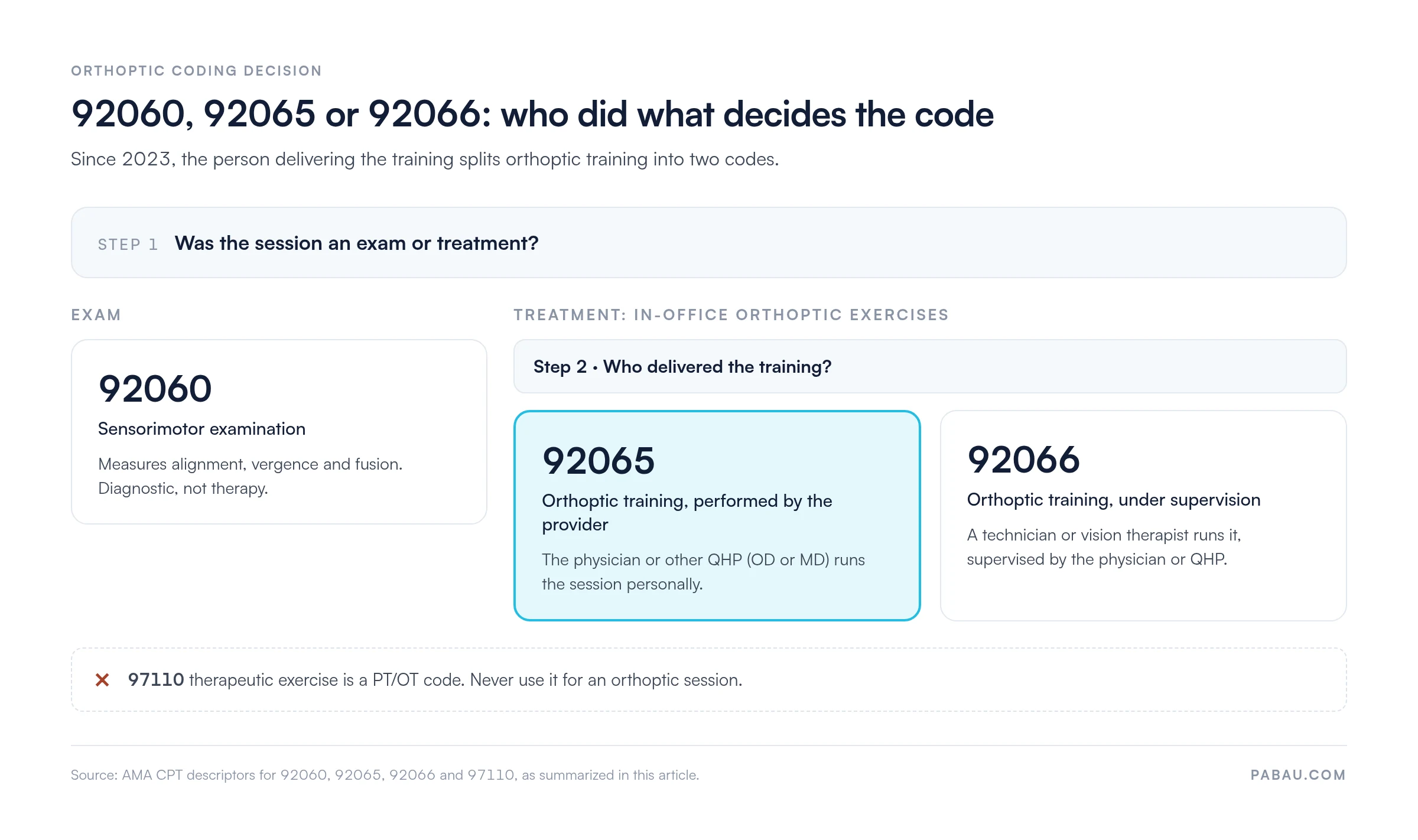
Since 2023, CPT splits orthoptic training by who delivers it. Supervised training delivered by staff, such as a technician or vision therapist, is billed as 92066, not 92065.
Clear boundaries around 92065 prevent both undercoding and upcoding. The code covers the in-office exercise component of a vision therapy program, delivered by the physician or QHP. It does not cover the evaluation that precedes it or the lens prescription that may accompany it.
Included: Vergence exercises, ocular pursuit training, stereopsis development, antisuppression techniques, prism adaptation training, and accommodative-vergence therapy, performed in the office by the physician or QHP.
Excluded: Sensorimotor examination (CPT 92060), contact lens fitting, refraction, any evaluation and management (E&M) service, and home vision therapy programs. Computer-based training performed without provider supervision is excluded as well. Training delivered by a technician or vision therapist under supervision is excluded too, because it is billed as 92066.
Billing 92065 on the same claim as a sensorimotor exam (92060) without a modifier is a common bundling error.
Four codes generate the most confusion alongside 92065. The diagram below shows how the type of visit and the person delivering it decide the code.
The table adds the key distinction for each code and whether same-day billing with 92065 is permitted.
Same-day billing of 92065 with 92060 is the question coders ask most often. The National Correct Coding Initiative (NCCI) may bundle a diagnostic exam with a same-day therapeutic service when they share the same diagnosis.
If both are genuinely separate and distinctly documented, modifier 59 (or XU) may apply. Verify the current NCCI edit table before appending it, because incorrect modifier use is an OIG audit risk.
Check the AAPC’s CPT code lookup for current CCI edit pairs before billing 92065 alongside any same-day evaluation code. The edit table updates quarterly, and a modifier that was valid last year may no longer be accepted.
The diagnosis code on a 92065 claim must reflect the binocular vision disorder being treated. Payers cross-reference the ICD-10 code against their medical policy for orthoptic training, and a mismatch triggers an automatic medical necessity denial.
Avoid H52.xx (refractive errors) as the primary diagnosis for 92065 claims. Refractive correction is explicitly excluded from the orthoptic training descriptor. A payer that sees H52 paired with 92065 will deny on medical necessity grounds without further review.
Payers auditing 92065 claims look for the same core elements across every session note. Missing any one of these triggers a medical necessity denial or a request for records that delays payment by 30-90 days.
Good medical billing documentation for orthoptic training records more than what happened in the room. It builds a longitudinal picture of treatment necessity across the episode of care.
Medicare’s coverage position on orthoptic training is restrictive. Most binocular vision therapy services, including many sessions billed under 92065, are classified as non-covered by Medicare Part B for the majority of beneficiaries. Coverage, where it exists, flows from a Local Coverage Determination (LCD) issued by the Medicare Administrative Contractor (MAC) for the provider’s jurisdiction.
Noridian Healthcare Solutions, the MAC for Jurisdictions E and F, publishes optometry and ophthalmology billing guidance. It addresses when orthoptic services may meet Medicare’s “medically necessary” threshold. Before billing Medicare for CPT code 92065, verify the active LCD at the provider’s MAC rather than relying on national policy alone.
Medicare Advantage (Part C) plans may have coverage rules that differ from traditional Medicare. Confirm those rules plan by plan.
Commercial payers treat CPT code 92065 with more flexibility than Medicare, but that flexibility comes with preconditions. United Healthcare, Excellus BCBS, and OSU Health Plan each publish formal medical policies governing vision therapy and orthoptic training. These policies define covered diagnoses, session limits, and prior authorization requirements.
UHC’s provider policy for vision therapy covers orthoptic training when convergence insufficiency (H51.11) or strabismus (H50.xx) is documented. Treatment must be supervised by a licensed provider. Excellus BCBS applies a similar framework with session limits that vary by plan year. Both payers require pre-authorization before services begin for most commercial lines of business.
The Medicare Physician Fee Schedule sets payment for CPT code 92065 based on its Relative Value Unit (RVU) assignment. Payment also depends on the geographic practice cost index (GPCI) for the provider’s locality. The facility or non-facility setting changes it too.
For current allowed amounts, use the CMS Physician Fee Schedule lookup tool and verify annually, since RVUs and conversion factors change each January.
Use the FastRVU lookup tool to calculate the 2026 allowed amount for 92065 by locality. For crosswalk data linking procedure codes to supported diagnoses, CrossCoder provides bidirectional CPT-to-ICD-10 mapping that helps verify medical necessity alignment before submission.
Frequency limits for CPT code 92065 are payer-set, not code-set. Medicare does not publish a universal per-day limit for the code, but CCI edits control what can be billed alongside it. Commercial payers impose their own session caps as part of their medical policies.
Billing 92065 more than once per day is rarely accepted. Most payers treat the code as representing one orthoptic training session per date of service, regardless of how many exercises were performed. Two sessions in a single day require an unusual clinical justification and detailed documentation of why separate sessions were medically necessary.
Most 92065 denials trace back to one of seven predictable reasons. Robust denial management workflows for orthoptic billing begin at eligibility verification, not at the remittance advice.
Tracking common denial codes in medical billing by payer and reason code turns reactive appeals into proactive process fixes. When the same denial reason appears three or more times from the same payer, the problem is in the workflow, not the individual claim.
Billing 92065 successfully requires a clean process from benefit verification through ERA reconciliation. Each step below corresponds to a point where claims commonly break down.
Build a 92065-specific superbill template that auto-populates the authorization number, the treating provider’s credentials, and the session’s measurable outcomes. A standardized template cuts documentation time per session. It also reduces audit risk, because every required element is present before the claim is generated.
Orthoptic billing often runs across three places: authorization numbers in a spreadsheet, session notes in the EHR, and denial reasons in a payer portal. A lapsed authorization or a staff-delivered session coded as 92065 slips through between them.
In Pabau’s claims management software, each claim is raised from the patient’s invoice, and the prior authorization code follows the appointment onto it. Claim validation catches missing or invalid details before you submit, and eligibility runs through Claim.MD before the visit.
When the ERA comes back, Pabau matches each payment to its claim and flags denied claims for rework. Your biller sees a rejected 92065 claim with its reason the day it lands, so the fix happens inside the appeal window.

Pabau’s claims management software tracks prior authorization status, monitors ERA responses, and surfaces CPT 92065 denials before they age into write-offs. See how it works for optometry and ophthalmology practices.

Paid 92065 claims share three traits. The physician or QHP delivered the session, the diagnosis is a binocular vision code the payer recognizes, and the authorization predates session one.
Start with the 92065 and 92066 split, because it’s the newest rule and the easiest to get wrong in a busy practice. Audit last quarter’s orthoptic claims for who ran each session, then fix the superbill so the code follows the provider.
The trade-off is a little more detail in every session note, which costs far less than a payment recouped after an audit. Book a demo to see how Pabau keeps authorizations, session notes and 92065 claims together for your optometry or ophthalmology practice.

Need to understand how clearinghouse billing works end to end? Medical claims clearinghouse guide explains how 837P claims are scrubbed, submitted, and reconciled across payer networks.
Want to reduce the time spent on claim resubmissions? Superbill documentation guide covers how to structure encounter documentation so claims pass on first submission.
Billing across multiple locations or provider types? Revenue cycle management overview outlines the end-to-end billing workflow from eligibility check to payment posting.
Pairing 92065 with a gaze palsy diagnosis? ICD-10 code H51.0 covers the palsy (spasm) of conjugate gaze code that supports orthoptic training claims.
Running a visual field test on a therapy day? CPT code 92083 explains how the visual field examination is billed alongside other eye services.
CPT code 92065 is the AMA procedure code for orthoptic training performed by a physician or other qualified health care professional. It covers in-office exercises that correct binocular vision disorders such as strabismus and convergence insufficiency. Training delivered by staff under supervision is billed as 92066.
Medicare Part B generally does not cover orthoptic training for most binocular vision indications. Coverage exceptions exist only where a Local Coverage Determination (LCD) from the provider’s Medicare Administrative Contractor creates a specific covered indication. Verify the active LCD for your MAC jurisdiction before billing, and issue an Advance Beneficiary Notice (ABN) when coverage is uncertain.
The most widely accepted ICD-10 codes paired with 92065 are H51.11 (convergence insufficiency) and the H50.xx strabismus range. H51.0 (palsy of conjugate gaze) and H51.8 (other specified disorders of binocular movement) are also accepted where clinical documentation supports them. Avoid H52.xx refractive error codes, which are not valid pairings for orthoptic training.
CPT 92065 is billed once per date of service in most circumstances. The code is not time-based and does not use units to indicate session length. Billing it more than once per day requires unusual clinical justification and is rarely accepted without explicit payer policy support.
Yes, for most commercial plans. UHC, Excellus BCBS, OSU Health Plan, and similar insurers require prior authorization before orthoptic training sessions begin. Retroactive authorization is rarely approved. Verify authorization requirements with each payer at the start of each plan year, as policies change at contract renewal.
CPT 92060 is a sensorimotor examination, a diagnostic evaluation of alignment, vergence, and fusion function. CPT 92065 is the therapeutic service that follows, with the physician or QHP personally running exercises to correct the deficit found in the exam. Billing both on the same date requires modifier 59 and clear documentation that the services were separate and distinct.
The most common denial reasons for CPT code 92065 are missing prior authorization and an invalid ICD-10 pairing, such as a refractive error code. Incomplete session documentation and an exceeded annual session limit follow close behind. Check the remittance advice reason code first, because it points to the specific problem on each claim.



