HCPCS code J3471: Hyaluronidase ovine injection billing guide
HCPCS code J3471: Descriptor, code type, and quick-reference data HCPCS code J34...

Last Updated: Oct 14, 2026
92060 is the CPT code for a sensorimotor examination with multiple measurements of ocular deviation, with interpretation and report. The AMA descriptor names restrictive or paretic muscle with diplopia as its example indication, and marks the code a separate procedure.
Most rejections trace to three documentation problems. The chart shows a single measurement of deviation rather than several. No recorded indication ties the exam to a strabismus or binocular vision diagnosis. Or the code is billed beside a same-day comprehensive eye exam, with no modifier.
Let Pabau's smart automation suggest the right codes, reduce claim denials, and keep your practice compliant—effortlessly.
Automate repetitive tasks and focus on what matters most—your patients.
Reduce coding errors and ensure compliance with the latest regulations.
Clean claims, fewer denials, and faster reimbursements.
Powerful insights and reporting to help your practice thrive.
HIPAA compliant SOC 2 certified GDPR-compliant Trusted by 4,000+ clinics worldwide

CPT code 92060 covers a sensorimotor examination with multiple measurements of ocular deviation, plus a written interpretation and report.
The AMA marks 92060 a separate procedure, so it is not reported alongside a service that already includes it.
Medicare’s CY2026 national non-facility rate works out at roughly $57, before any locality adjustment.
Modifier -25 goes on the E&M code when 92060 is billed the same day, never on 92060 itself.
Practice management software like Pabau flags bundling conflicts and missing modifiers before the claim leaves the practice.
CPT code 92060 is the AMA’s code for a sensorimotor examination with multiple measurements of ocular deviation, with interpretation and report.
The descriptor names restrictive or paretic muscle with diplopia as its example indication. It also marks the service a separate procedure. The code sits in the Ophthalmology Services and Procedures range, 92002-92499, of the AMA CPT code set. Within that range it falls under Special Ophthalmological Services and Procedures, 92015-92287.
The load-bearing word in the descriptor is “multiple.” A single recorded value does not satisfy the code. Payers expect several measurements documented across the diagnostic positions of gaze that the suspected muscle problem calls for. The descriptor names no technique and no testing distance, so the chart has to show the measurements themselves.
“Separate procedure” carries a rule of its own. Where the exam forms part of a larger ophthalmological service performed at the same session, it is not reported separately. Bill it when it stands alone, or when it is clearly distinct from the other service performed that day.
A 92060 claim rests on what the note shows. Recording the conclusion is not enough. The chart has to carry the measurements themselves, the positions they were taken in, and the physician’s reading of them.
A frequent overcoding error is billing 92060 after a single cover test with no measured deviation. The descriptor asks for multiple measurements, so one finding recorded as “exotropia noted at distance” will not carry the claim.
Both ophthalmologists and optometrists can bill CPT code 92060, subject to state scope-of-practice laws and payer credentialing. The performing provider has to be enrolled with the payer for this service type before the claim goes out.
The non-facility rate applies when the exam is performed in an office or outpatient practice. The facility rate applies in an ambulatory surgery center or a hospital outpatient department. Most 92060 claims are paid at the non-facility rate.
The CY2026 Medicare Physician Fee Schedule assigns work, practice expense, and malpractice RVUs to CPT code 92060. At the national non-facility rate those components come to roughly $57 before any locality adjustment. Check the figure for your own area with the CMS Physician Fee Schedule lookup tool before you set a fee schedule.
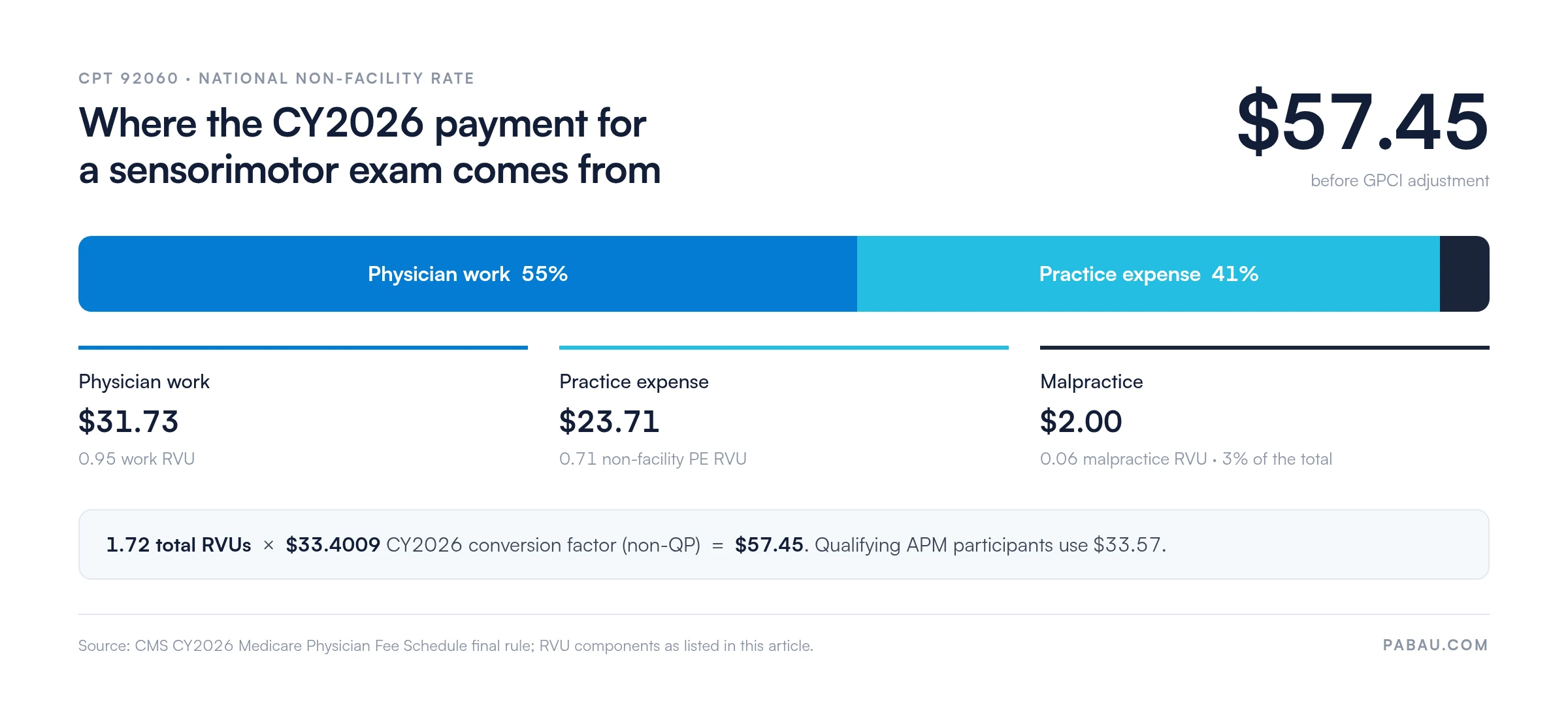
Practice expense makes up most of the remainder, and malpractice barely registers. The table below lists each component and the arithmetic behind the national figure.
Commercial payer rates for 92060 typically run from 100% to 130% of Medicare, depending on the contracted fee schedule. Some payers fold the exam into a global ophthalmological service when it is billed the same day as a comprehensive exam. Read your contract language before you assume both lines will pay.
Enter 92060 in the CMS MPFS lookup tool with your state and carrier to get the locality-adjusted rate. High-cost metropolitan areas pay above the national figure, and rural localities pay below it. Run the lookup at the start of each calendar year, before you set your patient fee schedule.
92060 needs no modifier on its own. The moment it shares a date of service with another billed service, the modifier decides whether the second line pays. Two of them do the work here, and the rest are traps.
Documentation for CPT code 92060 has to show medical necessity and capture every element the descriptor names. Payers audit the code because the descriptor is specific and the notes behind it often are not.
A note reading “strabismus measured, exotropia at distance” will not support the code on audit. Auditors look for several recorded values and a physician’s reading of them, not one impression.
Medical necessity for CPT code 92060 rests on the linked diagnosis code. An unspecified ICD-10 code is one of the fastest routes to a medical necessity denial. The diagnosis has to state why a sensorimotor exam was needed, not simply describe the patient’s eye condition.
Diagnoses that commonly fail review on their own include H52.xx, disorders of refraction, and the unspecified vision codes in H54.xx. An unspecified strabismus code such as H50.9 often fails for the same reason. Pair the exam with a refraction disorder only where a strabismus or binocular vision problem also exists.
Several codes around 92060 overlap in function but differ in what they include. Picking the wrong one either underpays the practice or creates audit exposure. The table compares the five that get substituted most often.
The hardest call is between 92060 and 92065. Structured orthoptic training, such as convergence exercises or prism adaptation, is 92065. Measuring deviation to guide a treatment decision is 92060. Reporting the training code for a diagnostic evaluation underpays the practice every time.
The National Correct Coding Initiative maintains code-pair edits that decide which codes can be billed together. For 92060 the question is whether another ophthalmological service on the same claim triggers a column 1 / column 2 edit.
Clearinghouses scrub for these edits before a claim reaches the payer. Catching a bad pair at that stage costs far less than appealing the denial afterwards.
Never use a modifier to override an NCCI edit carrying indicator 0. That is unbundling, and it creates audit exposure whatever the clinical justification behind it.
Coverage for 92060 differs widely between payers. Medicare covers the exam where it is medically necessary. Several commercial and Medicaid managed care plans add frequency limits or prior authorization for particular indications. Practice management software like Pabau supports cleaner claims management by surfacing payer-specific rules before submission.

Before billing 92060 for a Medicaid managed care patient, check whether the plan runs ophthalmology benefits in-house or delegates them to a vision carve-out. Carve-outs often have their own billing address, authorization process, and fee schedule. Sending the claim to the wrong entity is a common cause of a zero-pay on this code.
Most 92060 denials fall into five patterns. Your remittance advice names the reason for each one, and the denial codes to track tell you which pattern is costing the practice most. Close that one first.
Pull a month of 92060 remittances and tally them against these five rows. The tally shows where process effort belongs, rather than fixing whichever denial arrived most recently.
Most ophthalmology practices catch a 92060 problem after the remittance arrives. Someone reads the denial, pulls the chart, checks which line the modifier went on, and refiles. That loop runs for weeks, and the same defect reappears on the next claim.
Pabau checks the claim before it leaves the practice. The scrubber reads the code pair against current NCCI edits and checks that the modifier sits on the correct line. It also confirms the linked diagnosis supports a sensorimotor exam. A claim that fails any of those checks is held for correction rather than submitted.
Claims then go out through the Claim.MD clearinghouse integration, so eligibility and payer rules are checked against live data. Remittances post back automatically and the denial reason lands on the claim record. Your billers see the pattern across every 92060 claim, instead of one denial at a time.

Pabau’s claims management software flags modifier conflicts, NCCI bundling issues, and missing documentation before your ophthalmology claims leave the practice. See how it fits your billing workflow.

92060 pays a modest amount and carries an outsized administrative cost when it is coded loosely. The descriptor asks for multiple measurements and a written interpretation, and it marks the service a separate procedure. Those three phrases decide almost every claim.
Pick one of them and audit last month’s charts against it. Practices that fix the documentation upstream stop appealing the same denial every quarter, and the exam becomes worth performing rather than a break-even line. Book a demo to see how Pabau scrubs ophthalmology claims before they reach the payer.

Need a clearinghouse that catches 92060 bundling errors before submission? How medical claims clearinghouses work explains the scrubbing process and what to look for in an integration.
Want to understand how denial codes map to root causes? Medical billing fundamentals covers the claim lifecycle from charge capture through remittance posting.
Billing other ophthalmology services alongside this one? Revenue cycle management for specialty practices covers the workflow steps that reduce denial rates across complex code sets.
CPT code 92060 covers a sensorimotor examination with multiple measurements of ocular deviation, plus a written interpretation and report. The AMA descriptor gives restrictive or paretic muscle with diplopia as its example indication, and marks the service a separate procedure. It is used to assess strabismus, diplopia, and other ocular motility disorders.
The CY2026 Medicare national non-facility payment for 92060 works out at roughly $57. That figure is 1.72 total RVUs multiplied by the $33.40 conversion factor for non-qualifying participants. Qualifying APM participants use $33.57 instead. Locality GPCI adjustment moves the number in either direction, so check the CMS MPFS lookup tool for your own area.
Yes, Medicare covers CPT code 92060 where it is medically necessary and supported by an ICD-10 diagnosis. Strabismus codes (H49.xx, H50.xx), amblyopia (H53.0x) and diplopia (H53.2) all qualify. No National Coverage Determination limits frequency, but Local Coverage Determinations from your MAC may apply. Refraction-only diagnoses in H52.xx typically do not establish medical necessity.
It depends on whether the sensorimotor exam was distinct from the comprehensive eye exam. NCCI edits may bundle 92060 with 92004 or 92014 on the same date. Where the edit carries modifier indicator 1, adding -59 or XS with documentation of the separate service can allow both codes to pay. Where it carries indicator 0, both codes cannot be billed for the same date of service.
Five patterns account for most 92060 denials. The modifier -25 is missing from a same-day E&M line, or the linked ICD-10 diagnosis is too non-specific to establish medical necessity. NCCI bundles the code with a comprehensive eye exam and no valid modifier was applied. The chart records one measurement of deviation where the descriptor asks for several. Or the billing provider was working outside their state scope of practice. Correcting the documentation before refiling resolves most of these.
CPT 92060 is a diagnostic evaluation. The provider measures ocular deviation to assess the problem and guide a treatment decision. CPT 92065 is therapeutic, covering orthoptic or pleoptic training delivered to improve binocular function. Both can be billed on the same day where the evaluation preceded and informed the training session. Each service has to be documented separately, and the NCCI modifier indicator has to permit it.