HCPCS Code Q4175: Billing, coverage, and documentation guide
HCPCS code Q4175: Code description and product identity HCPCS Code Q4175 is the ...

Last Updated: Nov 20, 2026
67312 is the CPT code for strabismus surgery, recession or resection procedure; two horizontal muscles. It covers recession, resection or one of each on the medial and lateral rectus of the same eye.
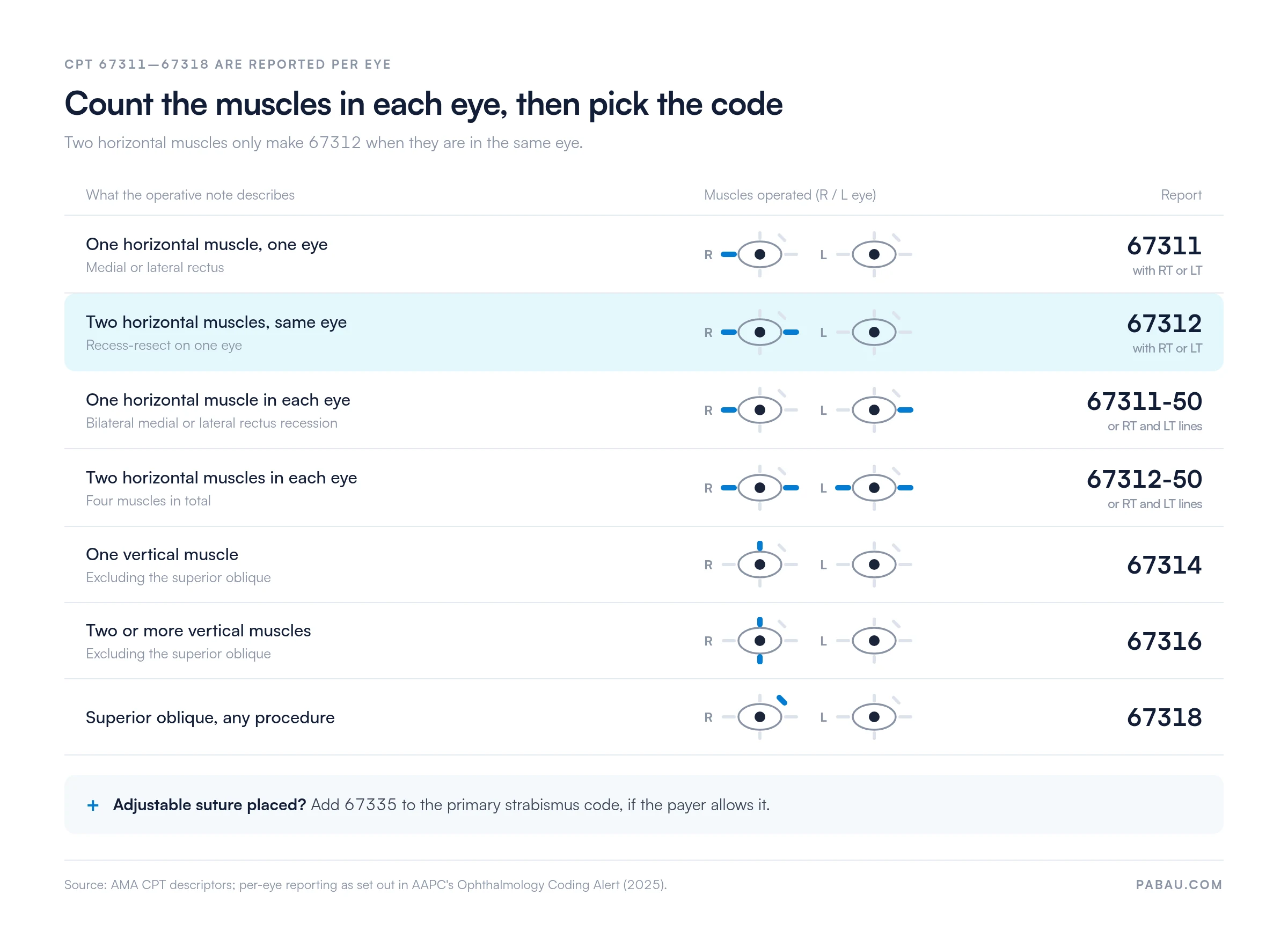
The strabismus codes are reported per eye. Surgery on one horizontal muscle is CPT 67311, and one horizontal muscle in each eye is 67311 with modifier -50 rather than 67312.
Let Pabau's smart automation suggest the right codes, reduce claim denials, and keep your practice compliant—effortlessly.
Automate repetitive tasks and focus on what matters most—your patients.
Reduce coding errors and ensure compliance with the latest regulations.
Clean claims, fewer denials, and faster reimbursements.
Powerful insights and reporting to help your practice thrive.
HIPAA compliant SOC 2 certified GDPR-compliant Trusted by 4,000+ clinics worldwide

CPT code 67312 covers recession or resection of two horizontal muscles, the medial and lateral rectus, in the same eye.
The strabismus codes are reported per eye, so one horizontal muscle in each eye is 67311 with modifier -50, not 67312.
The operative note must name each muscle, its eye and the technique used on it to support the two-muscle code.
Medicare takes modifier -50 on one line for bilateral surgery, while some commercial payers want separate -RT and -LT lines.
Pabau’s claims management software submits strabismus claims through the Claim.MD clearinghouse and tracks prior authorization on the patient’s case.
CPT code 67312 is the code for strabismus surgery, recession or resection procedure; two horizontal muscles. AAPC’s ophthalmology coding guidance confirms that codes 67311-67318 are unilateral, so the two muscles must be in the same eye.
The AMA’s CPT code set places 67312 in the Extraocular Muscles subsection (67311-67399). It covers any mix of weakening and strengthening on the medial and lateral rectus of that eye.
Three operative approaches fall under this descriptor. A recession moves a muscle’s insertion back on the globe, which reduces its pull. A resection shortens the muscle to increase its pull.
A recess-resect procedure recesses one horizontal muscle and resects the other in the same eye. Two recessions or two resections on one eye qualify too, as long as the note documents both muscles.
The sole distinction between 67311 and 67312 is how many horizontal muscles were operated on in one eye. Bill 67311 when the surgeon operates on one horizontal muscle.
Bill CPT code 67312 when the medial and lateral rectus of the same eye are both operated on. Because the codes are reported per eye, one horizontal muscle in each eye is 67311 with modifier -50, not 67312.
Downcoding to 67311 when two muscles were operated on leaves revenue on the table. Upcoding to 67312 when only one muscle was addressed exposes the practice to audit and recoupment. The operative note is the arbiter. It must name each muscle, state the technique applied to each, and confirm two horizontal muscles were treated.
The chart below sets out the same rule eye by eye, so a coder can match the operative note to a single row.
Strabismus surgery corrects ocular misalignment by altering the mechanical force of the extraocular muscles. Two primary techniques determine how the operative note is written and how CPT code 67312 is supported.
A recession weakens the muscle. The surgeon detaches the muscle from the globe and reattaches it at a point posterior to the original insertion, reducing its effective pull.
A resection strengthens the muscle by excising a measured segment and reattaching the shortened muscle at or near the original insertion. Either technique, or one of each on the two horizontal muscles of the same eye, satisfies the descriptor for 67312.
When the surgeon uses an adjustable suture, CPT 67335 may be reported as an add-on code alongside CPT code 67312. The technique allows postoperative fine-tuning of muscle position while the patient is awake.
Not all payers accept 67335 as separately billable. Some commercial plans bundle it into the primary surgical code. Verify current National Correct Coding Initiative (NCCI) edits and your payer’s specific policy before submitting both codes on the same claim.
Modifier selection is a common source of claim denials for CPT code 67312. The correct modifier depends on the payer, the operative scenario, and whether both eyes are involved.
Bilateral surgery on two horizontal muscles per eye, four muscles in total, is reported as 67312 with modifier -50. One horizontal muscle per eye stays on 67311-50. Record the muscle count for each eye in the operative note before the claim goes out.
Every CPT code 67312 claim requires a paired ICD-10-CM diagnosis code that establishes medical necessity for horizontal muscle surgery. The diagnosis laterality must match the procedure laterality.
A claim coded for right-eye surgery with a left-eye diagnosis will deny on a laterality mismatch even when the operative work is documented correctly.
When the record documents strabismus without naming its type, H50.9 is the unspecified code. A surgical claim is easier to support with the specific esotropia or exotropia code, so query the surgeon before falling back on it.
Medicare payment for CPT code 67312 is calculated from the Medicare Physician Fee Schedule (MPFS). The Centers for Medicare and Medicaid Services (CMS) updates it every year.
The CMS Physician Fee Schedule look-up tool provides the current national payment rates and RVU components. Use it to get the exact facility and non-facility rates for your geographic practice cost index (GPCI) locality. A static figure published elsewhere will not match your area.
The 2026 total RVUs for 67312 combine three parts. The work RVU reflects surgeon effort, and the malpractice RVU covers liability cost. The practice expense (PE) RVU differs between the office and a facility such as an ambulatory surgery center or hospital.
The global surgery period for 67312 is 90 days under CMS guidelines. Pre- and post-operative care in that window is bundled into the base payment. Verify the current global period designation via the FastRVU 2026 RVU lookup tool, which sources directly from CMS data.
Ophthalmology practices billing in an ambulatory surgery center (ASC) receive the facility rate for the professional component. The ASC facility fee is billed separately by the facility under its own claim.
Confirm the billing entity and place-of-service code before submitting, to avoid a POS mismatch denial. POS 24 is an ASC, and POS 22 is an on-campus hospital outpatient department.
Run a CMS Physician Fee Schedule lookup for your specific MAC locality before quoting a reimbursement figure to a patient or billing team. GPCI adjustments mean your local allowed amount can differ noticeably from the national rate. The CMS look-up tool at cms.gov takes under two minutes and returns the current-year rate for your ZIP code.
Prior authorization for CPT code 67312 is not universal. Requirements vary by payer class, plan, and state. Getting the authorization wrong delays the procedure and risks a non-covered-service denial after surgery is complete.
Confirm insurance eligibility verification and obtain the PA reference number before the operative date. Document the PA number in the claim and retain the approval letter in the patient file.
A claim submitted after the PA expiry date will deny regardless of clinical justification. Integrating your authorization tracking into your practice management system removes the manual follow-up step.
Denials for CPT code 67312 cluster around a handful of root causes. Each is preventable with the right documentation and a pre-submission claim check.
Structured denial management workflows track denial codes by CPT and payer. They show an ophthalmology practice whether laterality mismatches or modifier errors drive most of its rework. Building a 30-day denial report filtered to the 673xx code family reveals patterns quickly.
The operative report is the primary audit defense for CPT code 67312. It must contain each of the following elements before the claim is submitted.
Confirm ophthalmology billing compliance by cross-checking the operative report against the claim before submission. A pre-submission audit of muscle count, laterality match and modifier selection takes a few minutes. It catches the most frequent denial categories for strabismus surgery.
Give your surgical coordinator a strabismus billing checklist to complete before each claim is released. It confirms four points: (1) muscle count per eye, (2) ICD-10 laterality matches the modifier, (3) PA number recorded, (4) place of service verified. The four checks take a few minutes and catch the usual denial triggers before submission.
CPT code 67312 sits within a family of codes covering strabismus correction by muscle type, count and technique. Picking the right one prevents the downcoding and upcoding errors that audits flag.
Many patients try non-surgical treatment first, and orthoptic training is reported with 92065. The rest of the code set is in our CPT reference for coders.
Strabismus claims usually go wrong at the hand-off between the operative note and the claim form. A muscle count or a laterality modifier gets re-keyed by hand, and the error surfaces weeks later as a denial.
In Pabau, claims management for practices sits in the same system as the patient record. The billing team codes from the operative note itself, then submits CMS-1500 (837P) claims through the Claim.MD clearinghouse. Eligibility checks run before the operative date.
Prior authorization codes, dates and approved sessions are tracked on the patient’s case, with a warning when one is missing. Electronic remittance advice posts back against the same record. A laterality denial then reaches the billing team while the case is still fresh.

Pabau keeps the operative note, prior authorization and claim in one patient record, and submits claims through the Claim.MD clearinghouse. See how it handles 673xx surgery billing.

The coding call on a strabismus case comes down to one question. How many horizontal muscles were operated on in each eye? Two in one eye is 67312, while one in each eye is 67311 with modifier -50.
So read the operative note eye by eye before a code goes on the claim. A note that names each muscle, its technique and its side makes the code obvious and keeps an audit short. Book a demo to see how Pabau keeps the operative note, prior authorization and claim together for eye surgery billing.

Submitting strabismus claims electronically? How Claim.MD works as a clearinghouse explains how real-time eligibility checks and 837P submission reduce claim errors before they reach the payer.
Want to understand the full revenue cycle behind surgical claims? What is revenue cycle management walks through each stage from eligibility verification to payment posting.
CPT code 67312 is the billing code for strabismus surgery on two horizontal muscles, the medial and lateral rectus, of the same eye. It covers recession, resection or one of each to correct misalignment from conditions such as esotropia or exotropia.
CPT 67311 covers surgery on one horizontal muscle, and CPT code 67312 covers two horizontal muscles in the same eye. The operative note must name both muscles and their techniques to support 67312. Billing 67312 when only one muscle was operated on is upcoding and an audit risk.
CPT code 67312 is reported per eye. One horizontal muscle in each eye is 67311 with modifier -50, not 67312. When both horizontal muscles are operated on in both eyes, report 67312 with modifier -50. Use -RT and -LT lines instead if the payer asks for them.
The most common are -50 for a bilateral procedure and -RT or -LT for laterality, which some commercial payers want instead of -50. Global-period modifiers also apply: -78 for an unplanned return to the OR, -79 for an unrelated procedure and -58 for a planned staged procedure.
Medicare reimbursement for CPT code 67312 comes from the annual Medicare Physician Fee Schedule and varies by geographic practice cost index (GPCI) locality. Use the CMS Physician Fee Schedule look-up tool to get the current facility and non-facility rates for your location. National averages can differ noticeably from local allowed amounts.
Prior authorization requirements for CPT code 67312 vary by payer. Medicare does not routinely require prior authorization. Many commercial insurers and state Medicaid programs do, and they usually ask for orthoptic exam findings, prism measurements and the conservative treatment tried first.