



CCSD code G5100: Bypass of duodenum billing guide
CCSD code G5100 bills a bypass that leaves the duodenum in place CCSD code G5100...

Last Updated: Oct 16, 2026

CPT code 92083 is the extended visual field examination, covering quantitative automated threshold perimetry or Goldmann fields with at least 3 isopters plotted.
The official descriptor names Humphrey full-threshold programs 30-2, 24-2 and 30/60-2, so a full-threshold 24-2 field belongs on 92083.
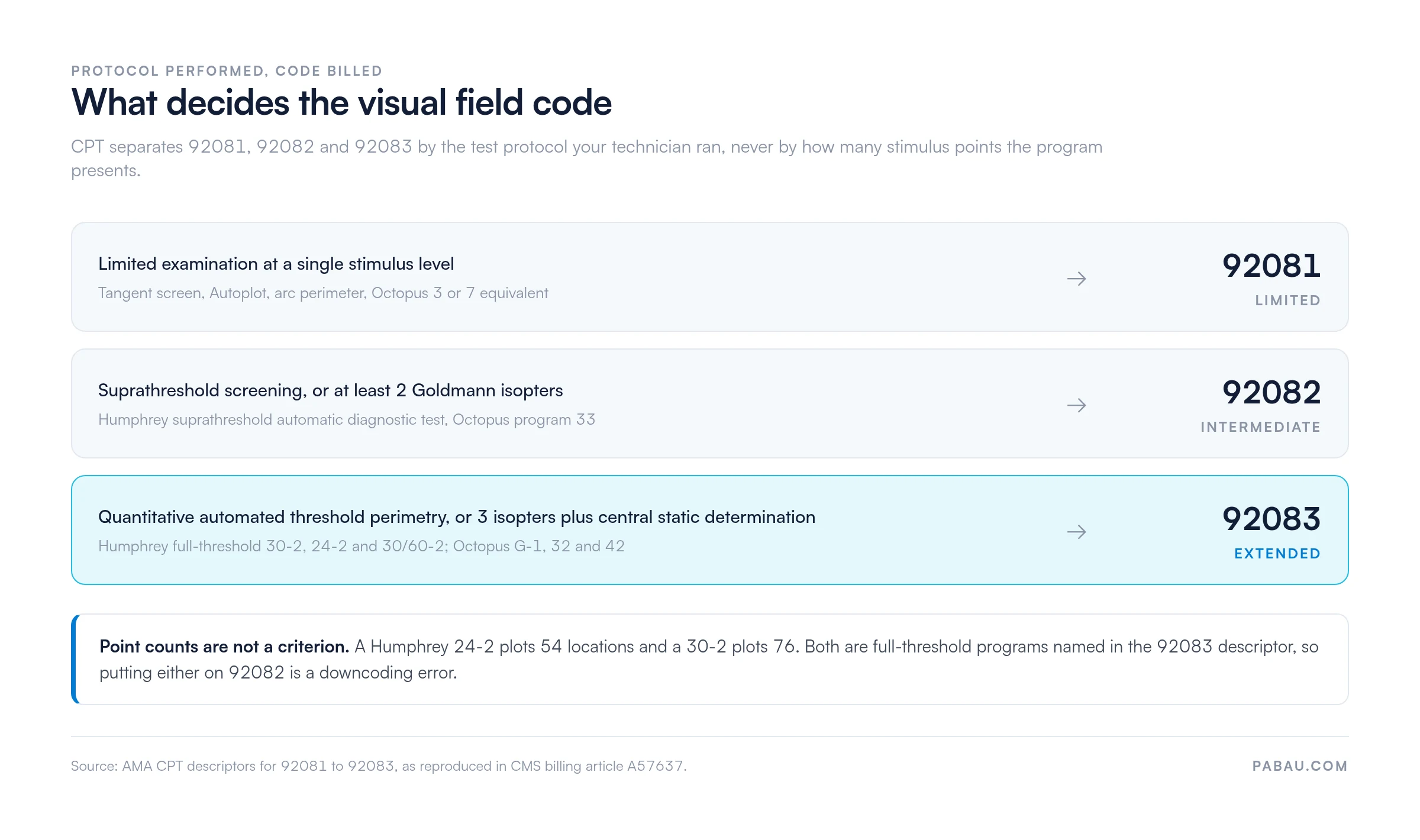
Code choice across 92081, 92082 and 92083 turns on the test protocol performed, never on how many stimulus points the program presents.
One unit of 92083 covers one eye or both, so the laterality modifiers -50, -RT and -LT do not belong on the claim line.
Pabau’s claims management software pairs clinical documentation with claim submission, which cuts manual transcription errors on 92083 claims.
The American Medical Association (AMA) defines CPT code 92083 as a visual field examination, unilateral or bilateral, with interpretation and report, extended examination. Practices usually call it the comprehensive or threshold field.
The descriptor names what qualifies. One route is quantitative automated threshold perimetry. The other is Goldmann fields with at least 3 isopters plotted, plus static determination inside the central 30 degrees.
The descriptor then names specific programs, including Octopus G-1, 32 and 42, and Humphrey full-threshold 30-2, 24-2 and 30/60-2. So the code turns on the method and the program run, not on how many points the program plots.
Confrontation fields and single-stimulus-level screening never reach this level, however long the visit takes. One unit of 92083 covers the exam whether the technician tested one eye or both.
The exam still has to produce a printed or stored result, a written interpretation, and a dated signature. Record the perimeter by name and model, and record the program alongside it. That one line in the chart is what lets a coder confirm the level later.
The 92081-92083 family describes three levels of visual field examination. CPT separates them by methodology and by named test protocol, not by a stimulus-point count. Match the program your technician ran to the descriptor that names it, and the code follows.
Billing a level the exam did not meet invites an audit, and billing below it gives away reimbursement you earned.
Point counts cause most of the confusion here. A Humphrey 24-2 plots 54 locations and a 30-2 plots 76, and neither number decides the code. Both are full-threshold programs written into the 92083 descriptor, which CMS billing article A57637 reproduces.
Putting a full-threshold 24-2 on 92082 is a downcoding error, not a safe one. The map below traces each protocol to the code it belongs on.
One rule trips practices up when two levels happen in one visit. If a screening field prompts you to run a threshold field the same day, bill only the higher-valued test. Report 92083 on its own, never 92082 and 92083 together.
Medicare covers CPT code 92083 when it is medically necessary for the diagnosis or management of a covered condition. Billing without a supporting ICD-10 diagnosis that meets payer criteria is one of the fastest routes to denial. Checking the payer’s coverage policy before the exam prevents the rework downstream.
CMS billing article A57637 lists the primary indications. Accepted clinical scenarios include:
Frequency matters too. Medicare and most commercial payers do not cover visual field testing performed more often than twice per year per eye without documented clinical justification. Some payers require prior authorization for repeat testing. Check individual payer policies before scheduling a third annual exam.
Missing documentation is the single largest driver of 92083 denials. CMS billing article A57637 specifies what the medical record must contain. A visual field printout alone is not enough. Compliance for this code means the chart entry carries every element below before the claim is submitted.
Treat the paperwork for every visual field visit as if it will be audited. The interpretive note should reference what changed since the last test. It should also say what the defect pattern suggests clinically, and how that shapes the management plan. “Results reviewed” does not meet the standard.
The supporting ICD-10-CM diagnosis code must establish medical necessity for the exam. Payers cross-reference the diagnosis on the claim against their covered-condition list before approving reimbursement. These are the codes most often paired with 92083 in ophthalmology billing:
Common pairing is not the same as coverage. Hereditary retinal dystrophy (H35.50) and neuromyelitis optica (G36.0) do not appear on the A57637 covered-diagnosis list. Check that list, or your own payer’s policy, before you bill either one.
ICD-10-CM codes update annually each October. Verify every diagnosis against the current ICD-10-CM code set before you submit claims. A code that was valid last year may have been retired or made more specific.
CPT code 92083 is reimbursed under the CMS Medicare Physician Fee Schedule (MPFS). Payment rates change annually and vary by geographic locality. The figures below reflect the current national average. Always confirm your own locality’s rate through the CMS MPFS Look-Up Tool before billing.
Billing for visual field testing often involves a split. Where one entity owns the perimeter and another physician interprets the study, -TC and -26 divide the payment between them. Clarify who owns the equipment before you set the billing default.
Always pull the current-year fee schedule rate directly from the CMS MPFS Look-Up Tool for your geographic locality before estimating reimbursement. National averages can differ from your own locality’s rate by 15-30% depending on the GPCI adjustment.
Modifier selection on CPT code 92083 is narrower than most billers expect. Laterality is already inside the code, so the modifiers that matter here either split the technical and professional components or flag a non-covered service. Claim-scrubbing tools flag modifier conflicts before the claim reaches the payer, which catches these errors early.
Bill one unit of 92083 per session, whether the technician tested one eye or both. The relative value units already assume a bilateral study, so appending -50 buys no extra payment and can stall the line. Two units, or separate -LT and -RT lines, will not pay as a bilateral claim either.
Where only one eye could be tested, check what your Medicare Administrative Contractor (MAC) wants. Some accept RT or LT informationally, with no change in payment. Others point to -52 when the study was genuinely reduced. The -TC and -26 split is unaffected by any of this.
The National Correct Coding Initiative (NCCI) defines which code pairs cannot be billed together on the same date of service without a modifier override. NCCI edits for CPT code 92083 are updated quarterly, so verify the current table before you bill a new code combination.
Corneal topography, 92025, does not bundle with 92083, because it maps corneal structure while the visual field test measures function. Each service needs its own documented indication on the claim.
Sensorimotor testing is not part of the 92081 to 92083 family. CPT code 92060 measures ocular deviation, carries a separate procedure designation, and does not cover visual field testing performed on its own.
The NCCI Policy Manual for Medicare Services (published by CMS) is the authoritative source for bundling rules. Review the ophthalmology chapter specifically, as it contains procedure-pair tables not visible in basic code lookup tools.
Claim denials for visual field examination billing cluster around a handful of predictable issues. Fixing them starts with knowing which cause is most common in your own practice. Tracking denials by reason code is the fastest way to find the root cause and fix it upstream.
Submitting a clean claim for 92083 comes down to timing. Run the documentation and coding checks before the claim reaches the payer, not after it bounces. Proactive scrubbing beats retrospective rework on both time and recovered reimbursement.
Build a 92083 documentation checklist into your EHR template. It needs six fields. Record the perimeter name and model, the program run, the result attached, a substantive interpretation note, the diagnosis, and the provider signature. A five-second check before closing the chart clears the most common denial causes.
Most 92083 errors start in the handover between the chart and the claim. When the visual field result lives in one system and the billing workflow lives in another, details drop out in transit.
Practice management software like Pabau removes that handover. Its claims management software reads the clinical record directly. Billing staff see the documentation status before the claim goes out, not after the denial lands.

The practical effect is timing. An integrated EHR and billing setup flags incomplete 92083 documentation as the chart closes, instead of leaving it for a payer audit weeks later. Denial tracking built into the platform then surfaces patterns across the practice. You can see whether denials cluster around one provider, one technician, or one test protocol.
That visibility turns denial guidance into workable data. Pabau’s Claim.MD clearinghouse integration reaches thousands of US payers for electronic claim submission and electronic remittance advice. So one workflow carries a 92083 claim from eligibility check through to payment posting.

Pabau connects clinical documentation with claim submission so your ophthalmic billing team stops hunting for missing chart elements at the end of each day. Build the documentation checklist into the workflow, not the rework queue.

CPT code 92083 denials are almost always preventable. The code requirements are clear, the documentation checklist is finite, and CMS publishes the modifier rules. The practices that avoid rework build 92083 compliance into the clinical workflow instead of auditing claims after the fact.
The trade-off worth remembering is where the time goes. Five seconds of checking at the point of care costs far less than a 30-day appeal cycle. So pick one of the six documentation fields your chart template is missing, and add it this week.
Book a demo to see how Pabau makes the 92083 documentation checklist a step your ophthalmology team cannot skip.

Need to understand how clearinghouse submissions work? 837 file format guide explains how electronic claim files are structured for payer submission.
Getting claims rejected before they reach adjudication? Insurance credentialing guide covers how provider enrollment affects claim acceptance rates with individual payers.
Costing out a clearinghouse? Claim.MD pricing overview breaks down clearinghouse cost structures for ophthalmology practices choosing a billing tool.
CPT code 92083 is used for an extended visual field examination. It covers quantitative automated threshold perimetry, or a Goldmann study with at least 3 isopters plotted. The descriptor names Humphrey full-threshold programs 30-2, 24-2 and 30/60-2. It is most often billed for glaucoma monitoring, glaucoma suspect evaluation, optic nerve disorders and neuro-ophthalmological field mapping.
CPT separates the three codes by test methodology, not by how many stimulus points the program presents. 92081 covers a limited exam such as a tangent screen or single-stimulus-level test. 92082 covers an intermediate exam such as 2 Goldmann isopters or suprathreshold screening. 92083 covers an extended exam using threshold perimetry, or at least 3 isopters with central static determination. A full-threshold Humphrey 24-2 is therefore 92083, and billing it as 92082 is a downcoding error.
Medicare’s 2026 national average non-facility rate for CPT 92083 is approximately $60-$64. The amount you are paid varies by geographic locality through the GPCI adjustment. Verify the current rate for your own location in the CMS Physician Fee Schedule Look-Up Tool at cms.gov before you estimate practice revenue.
Laterality modifiers do not belong on CPT 92083. The descriptor already covers a unilateral or bilateral exam, so one unit pays at one rate and -50, -RT and -LT add nothing. The modifiers that do apply are -TC and -26 in split-billing arrangements. Modifier -59 applies where 92083 is a genuinely distinct service on the same date as another procedure. Some MAC guidance accepts RT or LT informationally on a single-eye study, or -52 for a reduced service.
The most frequently paired ICD-10-CM codes are H40.10×0 (open-angle glaucoma) and H40.00 (preglaucoma or glaucoma suspect). Optic nerve pairings include H47.10 (unspecified optic nerve disorder) and H47.39 (other disorders of optic disc). H35.50 (hereditary retinal dystrophy) and G36.0 (neuromyelitis optica) are also billed with 92083, but neither appears on the A57637 covered-diagnosis list. Check your payer’s policy for those two, and verify every code against the current ICD-10-CM code set, which updates each October.
NCCI edits prohibit billing CPT 92083 with 92081 or 92082 on the same date of service. Only one level of visual field examination is payable per session. Certain E/M codes may also bundle with 92083, depending on the current quarterly NCCI table. Modifier -59 can override some edits when the services are genuinely distinct, but it needs supporting documentation. Verify the current NCCI table through CMS before billing a new code combination.
The most common denial reason for CPT 92083 is documentation. A missing interpretive note or an unsigned result will each stop the claim. Close behind are a non-covered ICD-10 diagnosis, frequency limit violations, and NCCI conflicts without a valid modifier. Billing 92083 for a screening field that only met the 92082 descriptor also draws a denial. Most of these are preventable with a pre-submission checklist and an automated claim scrub.



